
Quiz
Previous year Quizz 2
Create a free account to finish this quiz
Save your progress and see your final score.
Already have an account? Sign in
Questions in this quiz (18)
1Smell disorders are frequently caused by ...
- ANeurodegenerative diseases
- BSkull fractures
- CSide effects of drugs
- DDiabetes mellitus Type I
- EKallmann Syndrome
2The dorsolateral prefrontal cortex
- Ais involved in triggering of reflexive saccades
- Binhibits unwanted reflexive saccades
- Cis the source of a cortico-cerebellar projection modulating the vestibulo-ocular reflex
- Dis rarely affected in neurodegenerative disorders
- Eis intact when antisaccades are directed towards the target
3Dorsal Horn Lamina II neurons
- Aare all GABAergic
- Breceive primary afferent input from NGF responsive sensory neurons
- Cprocess proprioceptive information
- Dprocess exclusively thermal information from the periphery
- Eare mostly projection neurons
4One of these statements is WRONG: Sensory neurons that respond to noxious heat...
- Aalso respond well to the chili pepper compound capsaicin
- Bcan sometimes also respond to noxious cold
- Crespond to no other type of stimuli
- Dalmost always respond to noxious mechanical stimuli
- Eare never polymodal
5The figure below shows the basal aspect of the human brain. Which of the following statements is false?
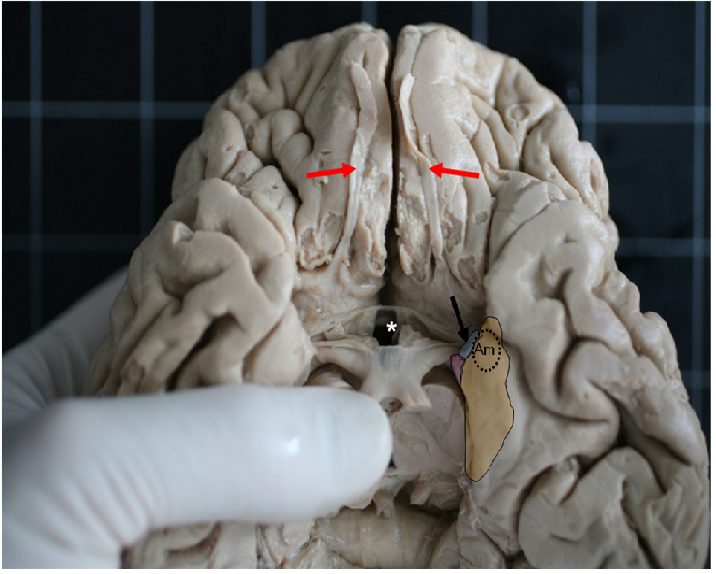
- AThe structure labeled with red arrows contains migrating cells of the rostral migratory stream
- BThe structure labeled with red arrows contains axons of mitral cells
- CThe structure labeled as “Am” is part of the temporal lobe and target of mitral cell axons
- DThe asterisk (*) shows the third ventricle
- EThe black arrow points at the anterior part of the insular cortex
6What afferent fiber type conveys first pinch sensation?
- AGroup Ia spindle afferents
- BThinly myelinated Aδ-fibers
- CLarge myelinated AB−fibers
- DSympathetic efferent fibers
- EMerkel disk afferent fibers
7Inhibition of reflexive saccades is not:
- Acontrolled by the dorsolateral prefrontal cortex
- Bdependent on omnipause neurons in the brainstem
- Cvisible at the patient’s bedside
- Dinvestigated by antisaccade testing
- Edependent on Brodmann’s area 46
8Irrepressible bursts of involuntary saccades ("ocular flutter / opsoclonus")
- Aindicate dysfunction of the prepontine paramedian reticular formation
- Boccur with lesions affecting the oculomotor nuclei
- Cindicate dysfunction of omnipause neurons in the nucleus raphe interpositus
- Doccur with lesions affecting Brodmann's area 46 in the prefrontal cortex
- Eare a sign of frontal eye field dysfunction
9Which of the following is wrong? Saccade velocity…
- AMay be reduced by centrally acting drugs
- BDepends on activity of premotor burst neurons in the brainstem reticular formation
- CIs reduced in neurodegenerative disorders affecting the brainstem reticular formation
- DIs normal in Parkinson’s disease
- EIs always accompanied by disorders of saccade accuracy
10Sensory neurons in the Dorsal root ganglia have myelinated and unmyelinated axons. Which class off fiber convey vibrotactile sensation?
- AUnmyelinated C-fibers
- Bγ−motor fibers
- CThinly myelinated Aδ-fibers
- DLarge myelinated A-fibers
- ESympathetic efferent fibers
11Impaired fixation suppression of the vestibulo-ocular reflex is a sign of
- ADiseases affecting the cerebellar hemispheres
- BDisturbed vergence
- CDiseases affecting the cerebellar flocculus and/or dorsal vermis
- DLesions affecting the dorsolateral prefrontal cortex
- EParkinson’s disease
12Which of the following eye movements changes images of the environment on the fovea?
- AFixation
- BSaccades
- CVergence
- DVestibulo-ocular reflex
- ESmooth pursuit
13The following structure is not involved in brainstem control of saccades:
- ANucleus raphe interpositus
- BNucleus prepositus hypoglossi
- COculomotor nuclei
- DNucleus principalis nervi trigemini
- EPrepontine paramedian reticular formation
14Which of the following statements is correct?
- AOlfactory loss can be an early sign of Parkinson’s disease.
- BOlfactory loss is rarely seen in elderly people.
- COlfactory loss is commonly associated with brain lesion after stroke.
- DOlfactory loss is not associated with Huntington’s disease.
- EOlfactory loss can be an early sign of measles.
15The following sensations are mediated through oral stimuli. What sensations are mediated through neurons with cell bodies in trigeminal ganglion?
- Abitter through caffeine
- Bumami through glutamate
- Csour through vinegar
- Dhot through capsaicin
- Esweet through sucrose
16The most frequent causes of olfactory loss in adults are…
- Aenvironmental pollution.
- Bneurodegenerative diseases.
- Cdrug abuse.
- Dsinunasal diseases.
- Ehead trauma.
17Mature Nerve growth factor
- Ais an endogenous mediator of inflammatory pain in growing individuals
- Bcan activate p75 to produce hyperalgesia
- Cstimulates mast cell proliferation
- Dactivates the sortillin receptor
- Ecan kill adult sensory neurons
18The “neural integrator” in the brainstem and cerebellar flocculus
- AControls the vestibulo-ocular reflex
- BControls accuracy of saccades
- CTransforms a saccade velocity signal into a tonic signal for gaze holding in eccentric positions
- DDetermines saccade velocity by integrating activity of neurons in oculomotor nuclei
- EIs involved in generating vergence eye movements
Information
- Description
- Quiz on Previous year Quizz 2, created by Alba Del Rio Serrato on 02/12/2017.
- Author
- Alba Del Rio Serrato
- Language
- English
- Views
- 22
- Tags
- Rating
- No ratings yet Rate this quiz