
Test
Willingham's Learning Theory
Este test tiene tipos de pregunta que se abren en el reproductor de siempre.
Preguntas del test (10)
1Willingham disagreed with [blank_start]Piaget[blank_end] about learning and development, believing development to have more factors; to be more variable.
He also disagreed with the "[blank_start]Visual, Auditory, Kinesthetic[blank_end]" Theory of Learning.- APiaget
- BBloom
- CDweck
- DPeterson
- EVisual, Auditory, Kinesthetic
- FMultiple Intelligences
- GTaxonomy
- HMindset
- IVygotsky
2Willingham combined a number of other theories into his theory.
These included:
[blank_start]Bloom's Taxonomy[blank_end] (Shown in the diagram)
The [blank_start]Multi-Store Model[blank_end] of Memory
The [blank_start]Multiple Intelligences[blank_end] Theory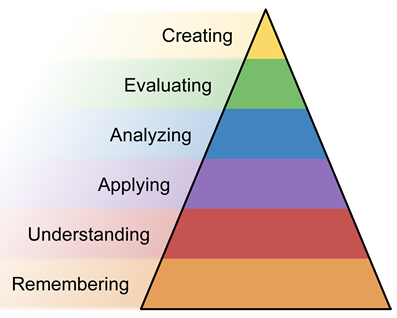
- ABloom's Taxonomy
- BMulti-Store Model
- CTORM
- DMultiple Intelligences
- EPiagetian
- FVisual, Auditory, Kinesthetic
- GNeeds
3The first major principle that Willingham believed is that Cognitive Development builds on Prior Knowledge.
Therefore, no new idea can be fully learned without prior knowledge.- AVerdadero
- BFalso
4The second major principle Willingham believed was that development occurs in distinctive stages.
- AVerdadero
- BFalso
5What did Willingham believe about Practise? (Tick all that apply)
- APractice and effort are very important
- BPractice and effort are not very important
- CPractice shouldn't be too easy or too hard
- DPractice should lead to "Overlearning"
- E"Overlearning" is harmful
- FPractice frees up space in the working memory store
- GPractice frees up space in the Long-Term memory store
6[blank_start]Ericsson et al.[blank_end] (1993) supports Willingham's theory.
This study showed that the [blank_start]best violinists practise the most[blank_end], however this study was not very [blank_start]objective[blank_end].- AEricsson et al.
- BPiaget and Inhelder
- CGunderson
- DMurdoch
- Ebest violinists practise the most
- Fbest footballers practise the most
- Gmost intelligent people revise a lot
- Hbest footballers practise less over time
- Iobjective
- Jethical
- Ksubjective
- Landrocentric
7[blank_start]Gilbert[blank_end] (1957) supports Willingham's theory.
This experiment showed that [blank_start]overlearning[blank_end] leads to better memory retention.- AGilbert
- BBouchard and McGue
- CYuille and Cutshall
- DLoftus and Palmer
- Eoverlearning
- Fexercise
- Greading
- Hwriting
- Ispeaking
8However, studies like [blank_start]Bouchard and McGue[blank_end] (1981) suggest development, especially cognitive development, is more down to [blank_start]genetics than environment[blank_end], countering Willingham's theory.
- ABouchard and McGue
- BLoft and Parmley
- CMcGregor
- DVaygotsky
- Egenetics than environment
- Fenvironment than genetics
- Gdiet than exercise
- Hparenting than school
9Willingham disagreed fundamentally with Carol Dweck's mindset theory.
- AVerdadero
- BFalso
10Willingham disagreed fundamentally with Vygotsky and the idea of social (co-learning).
- AVerdadero
- BFalso
Información
- Descripción
- GCSE (Topic 1: Development) Psychology Test sobre Willingham's Learning Theory, creado por Ablazej P el 07/03/2018.
- Autor
- Ablazej P
- Idioma
- English
- Visitas
- 8
- Etiquetas
- Valoración
- Aún sin valoraciones Valora este test