
Test
RNA Structure
Este test tiene tipos de pregunta que se abren en el reproductor de siempre.
Preguntas del test (7)
1RNA differs from DNA in three main aspects:
1) [blank_start]ribose[blank_end] instead of 2'-[blank_start]deoxyribose[blank_end]
2) RNA contains [blank_start]U[blank_end] rather than [blank_start]T[blank_end]
3) RNA is usually [blank_start]single[blank_end]-stranded- Aribose
- Bdeoxyribose
- CU
- DT
- Esingle
2Label the following image.
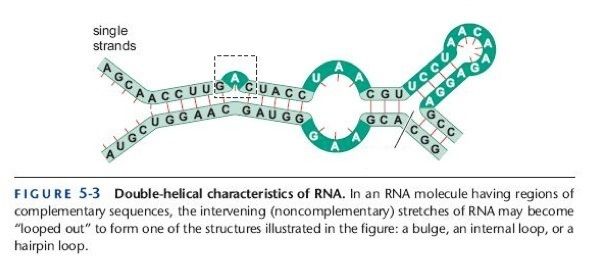
- Abulge
- Binternal loop
- Cjunctionn
- Dhairpin
3[blank_start]Tetraloop[blank_end]: UUCG has unusual base stacking, U interacts with ribose and increases stability
[blank_start]Pseudoknot[blank_end]: Base pairing with distant regions can yield this twisting structure. The figure below illustrates how the pseudoknot structure is formed by base pairing with 5' upstream nucleotides.- ATetraloop
- BPseudoknot
4Uracil allows for base pairing that cannot happen in DNA:
[blank_start]G[blank_end]:[blank_start]U[blank_end] pairing
[blank_start]U[blank_end]:[blank_start]A[blank_end]:[blank_start]U[blank_end] triple- AG
- BU
- CU
- DA
- EU
5Due to unconventional base pairing, base triples and base-backbone interactions, RNA can form [blank_start]tertiary[blank_end] structures. Proteins may also assist in forming these tertiary structures, e.g. ribosomes. These structures are also capable of changing conformation and this increases their biological significance.
- Atertiary
6Traditionally, RNA structure was predicted using NMR and X-ray crystallography. Both of these methods are challenging and expensive. Recently, a method called 'mutate and map' has been developed to determine RNA structure. In this method, the RNA is first mutated by introducing a nucleotide substitution and then the mutant is chemically modified. Chemical modification is done by a method referred to as SHAPE ([blank_start]Selective[blank_end] 2'-Hydroxyl [blank_start]Acylation[blank_end] analyzed by [blank_start]Primer[blank_end] [blank_start]Extension[blank_end]). SHAPE tags the unpaired nucleotides at their 2'-OH and the position of the upaired nucleotide is then determined by primer extension.
- ASelective
- BAcylation
- CPrimer
- DExtension
7[blank_start]RNAse P[blank_end] has a protein component and an RNA component (M1 RNA). RNA appears to have the active site, while the protein component stabilizes RNA or helps in some other fashion. With [blank_start]self[blank_end]-[blank_start]splicing[blank_end] introns (a class of introns), the intron is both the enzyme and substrate. The introns require a guanosine cofactor and are inhibited by 3’-deoxyguanosine. An internal guide sequence binds to the 5’ end of the splice site. The hammerhead ribozyme is a [blank_start]metalloenzyme[blank_end] that interacts with Mg++. RNA cleavage reactions are catalyzed. See the ribozyme animation in Unit 2 for more detail.
- ARNAse P
- Bself
- Csplicing
- Dmetalloenzyme
Información
- Descripción
- (Unit 2) Molecular Biology Test sobre RNA Structure, creado por Brooks Johnson el 03/06/2020.
- Autor
- Brooks Johnson
- Idioma
- English
- Visitas
- 1
- Etiquetas
- Valoración
- Aún sin valoraciones Valora este test