
Test
Grade 10 Coordinated Science Quiz
Este test tiene tipos de pregunta que se abren en el reproductor de siempre.
Preguntas del test (27)
1In which order does the signal for the reflex arc travel?
- ARELAY NEURONE to SPINAL CORD to SENSORY NEURONE
- BSENSORY NEURONE to SPINAL CORD to MOTOR NEURONE
- CSPINAL CORD to SENSORY NEURONE to STIMULUS
- DSTIMULUS to MOTOR NEURONE to SPINAL CORD
2In the lighting circuit in a house, how are lamps usually connected, and what is one reason for this?
- APARALLEL - to allow every lamp to have the full voltage supply
- BPARALLEL - to share out the voltage equally between the lamps
- CSERIES - to allow every lamp to have the full voltage supply
- DSERIES - to share out the voltage equally between the lamps
3When the voltage of the supply is reduced, the voltage across the resistor decreases
- AVerdadero
- BFalso
4What factors can effect the resistance of a piece of wire?
- Atemperature of the wire
- Bmaterial of the wire
- Cthickness of the wire
- Dlength of the wire
- Ewhere the wire is located
5When the eye is focusing on a nearby object:-
Structure 6 ([blank_start]the suspensory ligaments[blank_end]) will [blank_start]relax[blank_end], allowing for more light to [blank_start]be refracted[blank_end] into the eye. Then structure 8 ([blank_start]The cilliary muscles[blank_end]) [blank_start]contract[blank_end]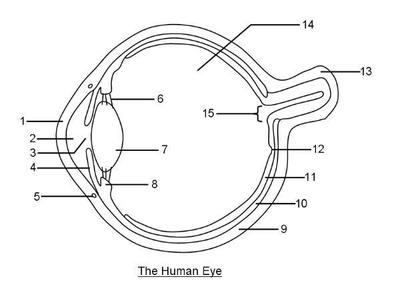
- Athe suspensory ligaments
- Bthe optic nerve
- Cthe retina
- Dthe iris
- Ethe cilliary muscles
- Frelax
- Gbe refracted
- Hnot be enetered
- Ienter
- JThe cilliary muscles
- Kthe pupil
- Lthe cornea
- Mthe lens
- Ncontract
6The change in blood glucose concentration can be detected by organ A. If it releases hormone B into the blood, hormone B will convert glucose to glycogen and the concentration of glucose in the blood will decrease. If it releases hormone C into the blood, hormone C will stimulate organ D to convert glycogen to glucose and the blood glucose concentration will increase.
NAME ORGAN A AND HORMONES B AND C- AOrgan A - PANCREAS
Hormone B - GLYCOGEN
Hormone C - INSULIN - BOrgan A - PANCREAS
Hormone B - INSULIN
Hormone C - GLYCOGEN - COrgan A - LIVER
Hormone B - GLYCOGEN
Hormone C - INSULIN - DOrgan A - LIVER
Hormone B - INSULIN
Hormone C - GLYCOGEN
- AOrgan A - PANCREAS
7Why is glucose converted to glycogen rather than just kept as glucose in the cells
- Aglycogen takes up less space and can therefore be stored more easily
- Bglycogen is easier to digest and can therefore speed up digestion
- Cglycogen is insoluble and is therefore not in danger of osmosis
- Dglucose is bad for the human body and must therefore always be converted into glycogen
8LABEL THE NEURONES IN THE REFLEX ARC DIAGRAM
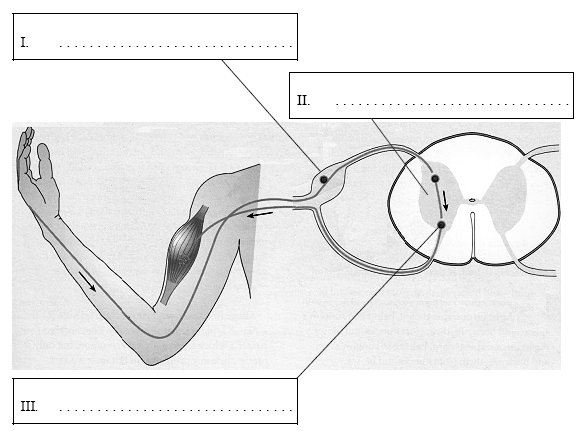
- Asensory neurone
- Brelay neurone
- Cmotor neurone
9What is the receptor of pressure and temperature detected in the environment?
- AToungue
- BSkin
- CEye
- DNose
- EEar
10LABEL THE EYE DIAGRAM
give answers without the (ex. tree - correct ex. the tree - incorrect)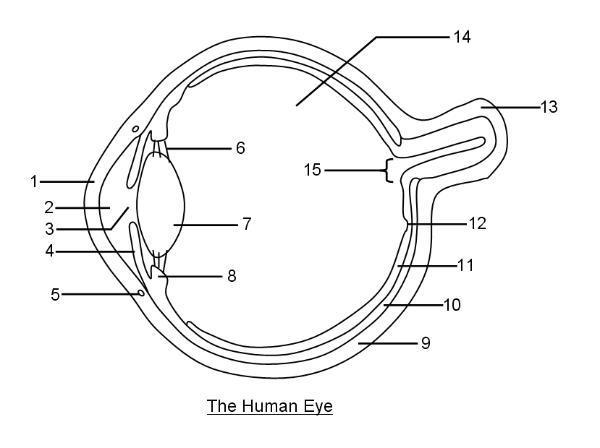
- Airis
- Blens
- Csuspensory ligaments
- Doptic nerve
- Eretina
- Fcornea
11In bright light the radial muscles of the iris [blank_start]____[blank_end] and the circular muscles of the iris [blank_start]_____[blank_end]
- Arelax
- Bcontract
12The suspensory ligaments...
- Acontrols the amount of light entering the eye
- Bpulls the lens for focusing
- Cholds the lens in place
13[blank_start]_________[blank_end]glands have a gland
- Aexocrine
14[blank_start]______[blank_end] glands are found at the base of the brain, produce hormones and are linked by hypothalamuses to the brain
- APituitary
15The pancreas is...
- Aendocrine
- Bexocrine
- Cboth endocrine and exocrine
- Dneither endocrine nor exocrine
16When adrenaline is secreted into the blood...
- APupils dilate
- Bheart race increases
- Cglycogen is released from the liver
- Dblood is directed to the gut and away from the liver
- Ebreathing becomes deeper
- Fbreathing becomes faster
- Ghairs stand on end
17The body must be kept at a constant temperature of [blank_start]___[blank_end] degrees celcius
- A37
18Name the respons(es) that the body has in reaction to a decrease in temperature
- Asweating
- Bvascodilation
- Cshivering
- Dvascoconstriction
19What happens when enzymes are in a too cold environment
- AThey denature
- BThey work to slow
- CThey freeze and die
- DThey escape to be in a warmer environment
20homeostasis is the maintenance of a constant internal environment
- AVerdadero
- BFalso
21The cilliary muscles..
- Apull the light in for focusing
- Bcontrol the amount of light entering the eye
- Chold the lens in place
22The cornea
- Ais a light sensitive layer, sends signals to the optic nerve
- Blets light into the eye and focuses
- Cfocuses light onto the retina
23The iris
- Acontrols the amount of light entering the eye
- Bis a light sensitive layer, sends signals to the optic nerve
- Cfocuses light onto the retina
24The optic nerve
- Asends signals to the brain
- Bpulls the lens for focusing
- Ccontrols the amount of light entering the eye
25The pupil...
- Alets light through to the lens
- Bcontrols the amount of light entering the eye
- Clets light into the eye and focuses
26The retina
- Alight sensitive layer, sends signals to the optic nerve
- Blets light into the eye and focuses
- Ccontrols the amount of light entering the eye
27which two parts of the eye work together to focus on objects
- Acornea and lens
- Bpupil and lens
- Cretina and lens
- Diris and lens
Información
- Descripción
- Hormones, Nervous System, Power and the eye on IGCSE level
- Autor
- Imani :D
- Idioma
- English
- Visitas
- 1.702
- Etiquetas
- Valoración
- 5,0 de 5 · 4 valoraciones Valora este test