
Test
Behavioural 1&2
Crea una cuenta gratis para terminar este test
Guarda tu progreso y consulta tu resultado final.
¿Ya tienes cuenta? Inicia sesión
Preguntas del test (40)
1You have been asked to assess and change a child’s disruptive behaviour *at school*. The teacher reports that he engages in the behaviour most during maths class. When is the best time to observe?
- ADuring maths lessons.
- BDuring all lessons.
- CAt home.
- DDuring school and at home.
2The research approach that looks at generating theories from carefully collected data is called...
- Abehaviour analysis.
- Bdeduction.
- Cinduction.
- Dthe scientific method.
3What can we say about this graph?
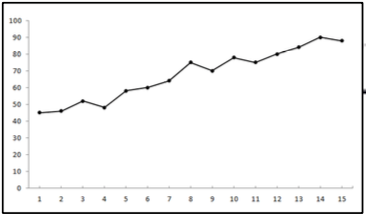
- AThe data show a decreasing trend.
- BThe data show an increasing trend.
- CThe data show positive behaviour change.
- DThe data show negative behaviour change.
4Which of the following is accurate from the perspective of behaviour analysis?
- APositive means additive and negative means subtractive.
- BPositive means good and negative means bad.
- CPositive means in the desired direction and negative means contrary to the desired direction.
- DPositive means reinforcing and negative means punishing.
5Behaviour analysts look for causes of psychological behaviour in the...
- Amind.
- Bbehaver’s repertoire.
- CDSM.
- Denvironment.
6The best reference for your scientific work is...
- AGoogle Scholar.
- BWikipedia.
- Cyour textbook.
- Da peer-reviewed journal.
7Behaviour can be defined as...
- Aanything a person does.
- Bthe interaction of an organism in an environment.
- Cthoughts and feelings.
- DA and B.
- Eall of the above.
8Which of the following is a principle?
- AShaping
- BReinforcement
- CChaining
- DDiscrimination Training
9Which of the following is incorrect in regards to behaviour?
- AThe horde behaved like hungry hyenas.
- BA combatant checked that the supplies were packed safely.
- CA Healer observed an infected person and took notes.
- DThe General gave an order.
10The use of visual analysis requires which of the following assumptions?
- AThat the data are accurate.
- BThat all variables (other than the independent variable) were held consistent across phases.
- CThat the baseline comes first followed by intervention.
- DA and B.
- EAll of the above.
11Visual analysis involves looking at the level, trend, and ______________ of the data.
- Agenerality
- Bvariability
- C mean
12A common assumption in social science is that variability is ____________ to the individual.
- Aintrinsic
- Buncontrollable
- C extrinsic
13_______________ are tentative statements for which further support is sought.
- Atheories
- Bhypotheses
- Chypothetico-deductions
14Behaviour analysis ______________ ‘off-the-shelf’ designs for particular research questions.
- Adoes not have
- Bdeductively use
- Cuses
15_____________ of behaviour describes a functional relation between behaviour and controlling variables.
- Atactic
- Btheory
- Cprinciple
16Inductive approaches involve __________________________________.
- A giving prominence to hypothesis testing
- Bgiving prominence to theory rather than data
- Cgiving prominence to data rather than theory
17Dissimilarity of scores in an experimental condition is called __________.
- Atrend
- Bvariability
- C stability
18When changes in behaviour result from the intervention are meaningful and useful, they are ____________________.
- Areliable and significant
- Bstatistically significant
- C clinically significant
19A / an __________________ is a brief but specific statement of what the researcher wants to learn from conducting the experiment.
- A induction
- Bhypothesis
- Cexperimental question
20Beginning with a measure of an individual’s behaviour against which an independent variable is measured is called _________________________.
- Aestablishing a baseline
- B developing an hypothesis
- C measuring trend
21In his book The Behavior of Organisms (1938) Skinner described a science called the ________________________ of behaviour.
- Aexperimental analysis
- Bapplied analysis
- Cbehavioural analysis
22________________ is antithetical to determinism, which specifies that behaviour is lawful.
- AEmpiricism
- BMentalism
- CAccidentalism
23Radical behaviourism does not ignore thoughts and feelings, but treats them like other operant behaviours and calls them _____________________.
- Aemotive behaviour
- B private events
- Cprivate occurrences
24_____________________ are circular arguments that do not help to explain behaviour.
- AParsimonious fictions
- BFictitious explanations
- C Explanatory fictions
25The principle that conclusions drawn from scientific manipulation are tentative is that of __________________.
- Aphilosophic doubt
- B scientific doubt
- Cempiricism
26A behaviour analyst may use _________________________________.
- Adiscrete trial teaching as the main approach
- Bdiscrete trial teaching, but only for children with autism
- C some discrete trial teaching
27_____________________ refers to a variety of techniques designed to reduce the stimulation directly produced by a response.
- APlanned ignoring
- BSensory extinction
- C Escape extinction
28Allen et al. (2013) found that the presence of manic episode in a woman with schizoaffective disorder and an intellectual disability made challenging behaviour sensitive to attention. This indicated that her challenging behaviour was likely maintained by ______________________.
- A negative reinforcement
- B positive punishment
- Cpositive reinforcement
29Escape extinction is __________________ for behaviours maintained by social attention.
- Airrelevant
- Brecommended
- C contraindicated
30Holtyn et al. (2014) used negative reinforcement to increase drug abstinence by introducing a _________________ contingent on an employee producing a urine sample showing drug use.
- Apay rise
- Bbase pay rest
- Ctoken economy
31The experimental analysis of behaviour as defined by Skinner, involves:
- AMentalisms
- BHypothetical constructs
- CA focus on the environment
- DB and C
32The smell of live flesh makes the Infecteds’ eyes dilate like a shark’s do. The smell of live flesh is a / an:
- AUnconditioned stimulus
- BConditioned stimulus
- CUnconditioned response
- DNeutral stimulus
33The Healers turn the lights to red when they enter the quarantine area where the Infected are being rehabilitated. When the lights go red, the Infecteds’ eyes dilate. The lights are now a / an:
- AUnconditioned stimulus
- BConditioned stimulus
- CUnconditioned response
- DNeutral stimulus
34The Infecteds’ eyes dilating can be an example of a / an:
- AUnconditioned response
- BConditioned response
- CNeutral response
- DA and B
35The dimension of applied behaviour analysis ‘generality’ refers to:
- ABehaviour change being meaningful
- BBehaviour change persisting across time
- CBehaviour change persisting across time and across settings
- DBehaviour change methods are described in detail
36We can train dogs to sniff out Infected that are hiding in wooded areas. If we say that the dogs do this because we reinforce their behaviour rather than because the dogs’ ids have an internal desire to hunt the Infected, we are being:
- Adeterministic
- Bphilosophically doubtful
- Cempirical
- Dparsimonious
37‘The Infected can hunt people because they are intelligent’ is:
- AAn explanatory fiction
- BA scientific manipulation
- CA pragmatism
- DA good description of behaviour
38How are reinforcement and bribery different?
- ABribery doesn’t work
- BReinforcement doesn’t work
- CBribery precedes behaviour and benefits the briber, reinforcement follows behaviour and is intended to benefit the learner
- DReinforcement follows behaviour and benefits the person reinforcing the behaviour, bribery precedes a behaviour and benefits the briber
39Removing reinforcement for a previously reinforced behaviour is:
- APunishment
- BIgnoring
- CExtinction but is never ignoring
- DExtinction and can be ignoring
40Motivating operations...
- APermanently change the value of a reinforcer and frequency of behaviours previously reinforced by that reinforcer
- BMomentarily change the value of a reinforcer and frequency of behaviours previously reinforced by that reinforcer
- Cdeprivation
- Dthe value of a punisher
Información
- Descripción
- Questions from Missions 1 and 2
- Autor
- Rachel Smith
- Idioma
- English
- Visitas
- 591
- Etiquetas
- Valoración
- 5,0 de 5 · 2 valoraciones Valora este test