
Test
AQA (9-1) Topic 8
Este test tiene tipos de pregunta que se abren en el reproductor de siempre.
Preguntas del test (8)
1Artificial colours can be detected and identified using:
- AFiltration
- BPaper chromatography
- CFlame tests
- DMass spectrometer
2Paper chromatography works because some of the coloured substances are better at dissolving in the liquid than they are at bonding with the paper, so they travel further [blank_start]up[blank_end] the paper.
- Aup
3There are four gases you need to know how to test. Select the correct gas, and fill the blanks for the tests below.
[blank_start]Hydrogen[blank_end] can be tested by placing [blank_start]a light splint[blank_end] over the end of a test tube, and hearing a 'squeaky pop'.
[blank_start]Oxygen[blank_end] can be tested by placing a [blank_start]glowing splint[blank_end] over the end of a test tube, and seeing it relight.
[blank_start]Carbon dioxide[blank_end] can be tested by bubbling the gas through limewater, and seeing it turn cloudy.
[blank_start]Chlorine[blank_end] can be tested for by holding [blank_start]damp blue[blank_end] litmus paper over the end of a test tube, and seeing it turn [blank_start]red, then white[blank_end].- AHydrogen
- BOxygen
- CCarbon dioxide
- DChlorine
- Ea lighted splint
- Fa glowing splint
- GOxygen
- HHydrogen
- ICarbon dioxide
- JChlorine
- Kglowing splint
- Llighted splint
- MCarbon dioxide
- NOxygen
- OHydrogen
- PChlorine
- QChlorine
- ROxygen
- SHydrogen
- TCarbon dioxide
- Udamp blue
- Vdry blue
- Wdamp red
- Xdry red
- Yred, then white
- Zblue, then white
4Paper chromatography consists of two stages:
the [blank_start]stationary[blank_end] phase (a.k.a. the phase that doesn't move - this is the [blank_start]paper[blank_end])
the [blank_start]mobile[blank_end] phase (a.k.a. the phase that moves - this is the [blank_start]solvent[blank_end])- Astationary
- Bpaper
- Csolvent
- Dmobile
5A formulation is a [blank_start]mixture[blank_end] that has been designed as a useful product.
- Amixture
- Bcompound
- Celement
6Pure substances will melt and boil [blank_start]at specific[blank_end] temperatures, so we can use the temperature that a substance melts/boils at to tell how [blank_start]pure[blank_end] it is. Impure substances will melt [blank_start]over a range of[blank_end] temperatures. If a substance is [blank_start]impure[blank_end] it will generally also have a [blank_start]lower[blank_end] melting point and a [blank_start]higher[blank_end] boiling point.
- Aat specific
- Bover a range of
- Cpure
- Dimpure
- Elower
- Fhigher
7A pure substance is either a single element, or compound, that is not mixed with any other substance.
- AVerdadero
- BFalso
8If the red spot moved 7 cm, and the solvent moved 9 cm, then what is the Rf value of the red spot? (give answer to 2 d.p.) [blank_start]0.78[blank_end]
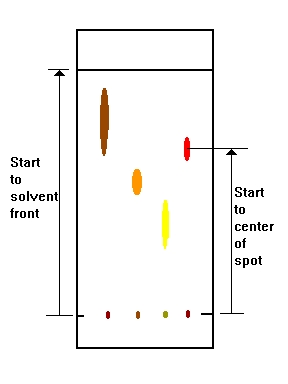
- A0.78
Información
- Descripción
- GCSE (AQA) Chemistry Test sobre AQA (9-1) Topic 8, creado por https:// revisechemistry.uk el 06/03/2018.
- Idioma
- English
- Visitas
- 4.339
- Etiquetas
- Valoración
- Aún sin valoraciones Valora este test