
Test
Biopsychology- Quiz (A2)
Este test tiene tipos de pregunta que se abren en el reproductor de siempre.
Preguntas del test (67)
1The Nervous Systems
[blank_start]Central Nervous System[blank_end]- made up of the brain and spinal cord. The spinal cord is responsible for reflex actions, while the brain is the centre of all conscious awareness. It has a very advanced cerebral cortex compared to animals.
[blank_start]Peripheral Nervous System[blank_end]- made up of millions of neurons that transmit messages to and from the CNS.
[blank_start]Autonomic Nervous System[blank_end]- a subsystem of the PNS, this nervous system controls bodily functions, like breathing and heart rate
[blank_start]Somatic Nervous System[blank_end]- a subsystem of the PNS, this nervous system controls voluntary movement.
[blank_start]Sympathetic Nervous System[blank_end]- a branch of the ANS which is involved in the fight or flight response, and makes the body physiologically aroused
[blank_start]Parasympathetic Nervous System[blank_end]- a branch of the ANS which is involved in the fight or flight response, and returns the body to its resting state.- ACentral Nervous System
- BPeripheral Nervous System
- CAutonomic Nervous System
- DSomatic Nervous System
- ESympathetic Nervous System
- FParasympathetic Nervous System
2What is a gland?
- AAn organ/biological structure that synthesises hormones
- BAn organ/biological structure that synthesises neurotransmitters
- CA chemical substance in the bloodstream that controls bodily functions
- DA section of the brain that deals with decision making and planning
3How does the endocrine system differ from the nervous systems?
- AIt is quicker but less powerful
- BIt is quicker and more powerful
- CIt is slower but less powerfull
- DIt is slower and more powerful
4Which gland is considered the 'master gland', as it controls all other glands?
- APineal gland
- BPituitary gland
- CThyroid gland
- DHypothalamus
5Label the process of the fight or flight response (starting at 1, ending at 5) with the correct letter.
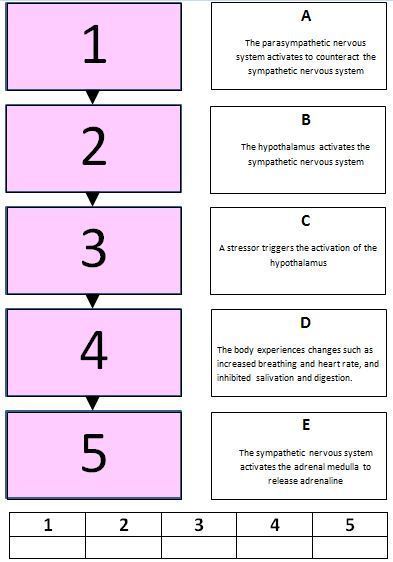
- AC
- BB
- CE
- DD
- EA
6Label the neuron below.
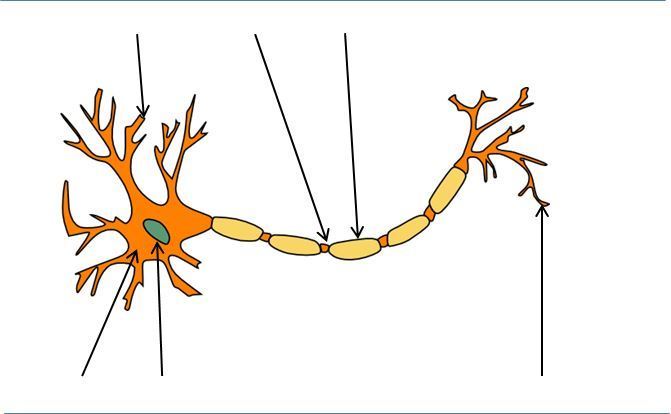
- AAxon terminals
- BAxon
- CMyelin sheath
- DNucleus
- ECell body
- FDendrites
7Sensory neurons: have [blank_start]long[blank_end] dendrites and [blank_start]short[blank_end] axons
Motor neurons: have [blank_start]short[blank_end] dendrites and [blank_start]long[blank_end] axons
Relay neurons: have [blank_start]short[blank_end] dendrites and [blank_start]short[blank_end] axons- Along
- Bshort
- Cshort
- Dlong
- Eshort
- Flong
- Glong
- Hshort
- Ishort
- Jlong
- Kshort
- Llong
8When in a resting state, the neuron is [blank_start]negatively[blank_end] charged. Upon activation by a stimulus, it temporarily becomes [blank_start]positively[blank_end] charged, creating an action potential.
- Anegatively
- Bpositively
- Cpositively
- Dnegatively
9Label the diagram of synaptic transmission.
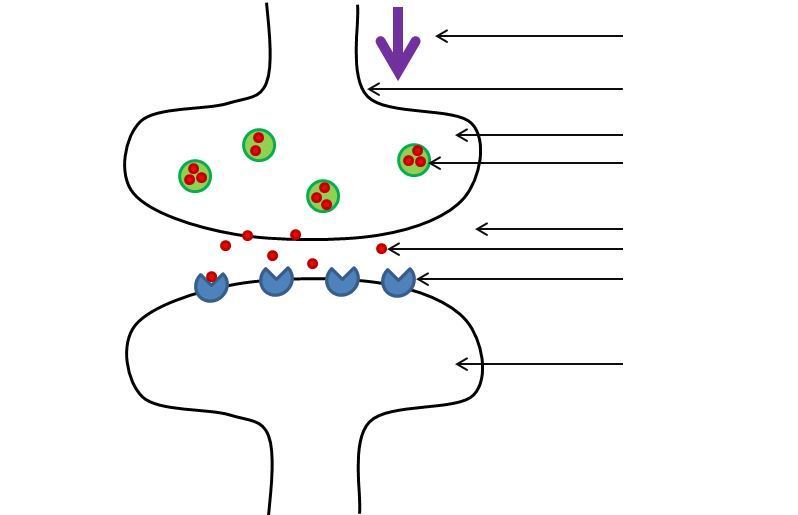
- AElectrical impulse
- BAxon
- CPre-synaptic neuron
- DVesicles
- ESynapse
- FNeurotransmitter
- GReceptor sites
- HPost-synaptic neuron
10Messages between neurons are transmitted [blank_start]chemically[blank_end] while messages within neurons are transmitted [blank_start]electrically[blank_end].
- Achemically
- Belectrically
11Which of the following is an excitatory neurotransmitter?
- ASerotonin
- BAdrenaline
- CGABA
- DGlycine
12Which of the following is an inhibitory neurotransmitter?
- ASerotonin
- BAdrenaline
- CGlutamate
- DHistamine
13What is the theory that opposes localisation of function?
- AHolism
- BHumanism
- CDeterminism
14Label the lobes and areas of the brain.
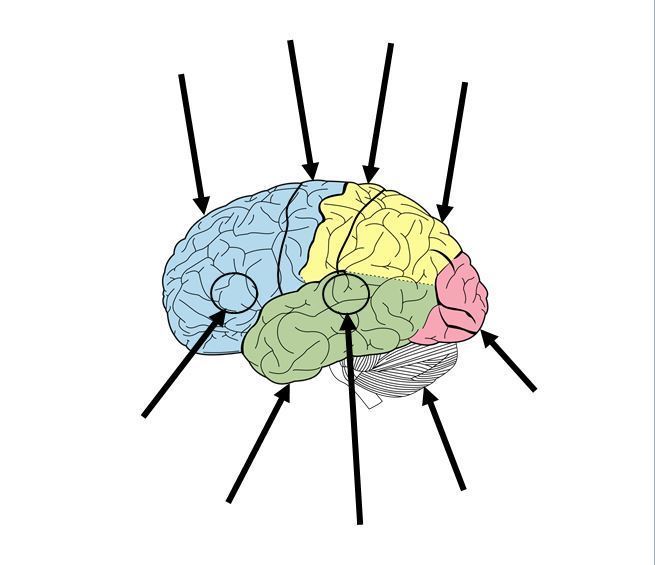
- AThe frontal lobe
- BBroca's area
- CThe temporal lobe
- DWernicke's area
- EThe occipital lobe
- FThe parietal lobe
- GThe somatosensory area
- HThe motor cortex
- IThe cerebellum
15The functions of the lobes/areas
[blank_start]Frontal lobe[blank_end]: controls planning and decision making. Damage leads to a lack of restraint and rash actions
[blank_start]Motor area[blank_end]: controls voluntary movement. Damage leads to loss of fine motor skills
[blank_start]Somatosensory area[blank_end]: receives sensory information from the skin. Damage leads to an inability to identify by touch
[blank_start]Occipital lobe[blank_end]: the visual area in which each eye sends information to the opposite side of the brain. Damage leads to blindness in the opposite eye
[blank_start]Temporal lobe[blank_end]: the auditory area in which speech-based information is analysed. It is also in charge of facial recognition. Damage leads to partial hearing loss
[blank_start]Wernicke's area[blank_end]: controls understanding speech. Damage leads to Wernicke's aphasia (fluent but nonsensical speech)
[blank_start]Broca's area[blank_end]: controls speech production. Damage leads to Broca's aphasia (non-fluent and labourious speech)- AFrontal lobe
- BMotor area
- CSomatosensory area
- DOccipital lobe
- ETemporal lobe
- FWernicke's area
- GBroca's area
16There are three types of evidence which support localisation of function:
Brain scan evidence: [blank_start]Peterson[blank_end] did brain scans and found Wernicke's area was active during listening tasks (understanding speech), while Broca's area was active for reading aloud tasks (speech production). [blank_start]Tulving[blank_end] found that episodic and semantic memories were stored on different sides of the pre-frontal lobe. This type of evidence is scientific and objective.
Neurosurgical evidence: [blank_start]Dougherty[blank_end] suggested that lesioning the cingulate gyrus helps treat OCD
Case study evidence: [blank_start]Phineas Gage[blank_end] had a pole through his head which damaged the frontal lobe, and he became rash and lacked restraint. This shows the function of the frontal lobe- APeterson
- BWernicke
- CTulving
- DBaddeley
- ETulving
- FPeterson
- GWernicke
- HBaddeley
- IDougherty
- JBaddeley
- KTulving
- LWernicke
- MPhineas Gage
- NClive Wearing
- OKF
- PLittle Albert
17There are two main disadvantages of the localisation of function theory:
[blank_start]Lashley[blank_end]'s research: he removed parts of the cortex in rats and found that it didn't matter which part was removed, the effect on learning was the same. This supports the holistic view.
[blank_start]Plasticity[blank_end]: when damaged, the brain can reorganise itself to recover the lost function. This suggests that all parts of the brain are involved in functions, thus supporting the holistic theory.- ALashley
- BTulving
- CPeterson
- DDougherty
- EPlasticity
- FBiological rhythms
- GSplit-brain research
18Plasticity
During infancy, a child undergoes [blank_start]rapid[blank_end] brain development- synaptic connections peak at [blank_start]15,000[blank_end] at [blank_start]2-3[blank_end] years old ([blank_start]Gopnick[blank_end])
As we age, rarely used connections are deleted while frequently used ones are strengthened. This is known as [blank_start]synaptic pruning[blank_end].- Arapid
- Bgradual
- Cminimal
- Dmoderate
- E15,000
- F1,000
- G1 million
- H1,500
- I2-3
- J10
- K6
- LGopnick
- MTulving
- NBaddeley
- OPeterson
- Psynaptic pruning
- Qsynaptic hedging
- RAxon sprouting
19Which researcher investigated plasticity with relation to taxi drivers having more grey matter in the posterior hippocampus (linked to spatial memory) than a control group?
- AMaguire
- BTulving
- CDraganski
- DDougherty
20Which researcher investigated plasticity with relation to medical students who had learning-induced changes in their posterior hippocampus and the parietal cortex 3 months after their exam?
- ADraganski
- BLashley
- CMaguire
- DTulving
21There are 3 structural changes that occur in the brain during functional recovery. Choose the 3 changes below.
- AAxon sprouting
- BDendrite sprouting
- CSynaptic pruning
- DReformation of blood vessels
- ERecruitment of homologous areas
- FRecruitment of heterologous areas
- GReduction of blood vessels
22What is meant by 'homologous areas' with regards to functional recovery?
- AAreas of the brain in the opposite hemisphere that are similar to those areas damaged
- BAreas of the brain in the same hemisphere that are similar to those areas damaged
- CAreas of the brain in the opposite hemisphere that are different to those areas damaged
- DAreas of the brain in the same hemisphere that are different to those areas damaged
23What is the practical application of research into plasticity (according to the AQA textbook)?
- AContribution to neuro-rehabilitation such as movement therapy and electrical stimulation to counter deficits in cognitive/motor functioning
- BTreating OCD via lesioning the cingulate gyrus, as the function will transfer to a homologous area..
- CTo act as a treatment for phantom limb syndrome
- DTo be used in care homes for elderly people who suffer from dementia as a way of countering the effects of the illness
24[blank_start]Hubel and Wiesel[blank_end] investigated functional recovery by sewing a [blank_start]kitten[blank_end]'s eye shut. They found that the area of the visual cortex without that eye continued to process information from the other eye.
- AHubel and Wiesel
- BDougherty
- CMaguire
- DDraganski
- Ekitten
- Fpuppy
- Grhesus monkey
- Htoddler
25What are two examples of negative plasticity?
- APhantom limb syndrome
- BPTSD
- CDementia
- DParalysis
26'Plasticity reduces with age before eventually stopping'
Is this statement true or false?- AVerdadero
- BFalso
27'The idea that the two hemispheres of the brain are functionally different and that certain mental processes are primarily processed by one side of the brain'
Which of the following does this describe?- APlasticity
- BHolism
- CLocalisation of function
- DHemispheric lateralisation
28The right hemisphere includes functions such as [blank_start]art awareness[blank_end], [blank_start]creativity[blank_end], [blank_start]holistic thoughts[blank_end], and [blank_start]left[blank_end] hand controls.
The left hemisphere includes functions such as [blank_start]analytic thought[blank_end], [blank_start]language[blank_end], [blank_start]science/maths[blank_end], and [blank_start]right[blank_end] hand controls.- Aart awareness
- Banalytic thought
- Ccreativity
- Dlangauge
- Eholistic thoughts
- Fscience/maths
- Gleft
- Hright
- Ianalytic thought
- Jart awareness
- Klanguage
- Lcreativity
- Mscience/maths
- Nholistic thoughts
- Oright
- Pleft
29Which researcher investigated split-brain research?
- ASperry
- BSiffre
- CTulving
- DDoughtery
- EDraganski
30What kind of operation had the participants of Sperry's split-brain study undergone?
- AA comissurotomy- removal of the corpus callosum
- BA pre-frontal lobotomy- cutting the connections to and from the prefrontal cortex
- CLesioning of the cingulate gyrus
31Which disorder did the participants in Sperry's split-brain research suffer from?
- AEpilepsy
- BDiabetes
- COCD
- DAmnesia
- EDementia
32What is the role of the corpus callosum with relation to split-brain research?
- AConnection between the two hemispheres
- BThe area of the brain associated with facial recognition
- CThe area of the brain associated with identification by touch
- DConnection between the suprachiasmatic nucleus and the two hemispheres
33In the diagram below, you will see examples of the split-brain research procedures. Considering the functions of the left hemisphere (right visual field) and right hemisphere (left visual field), label the procedures.
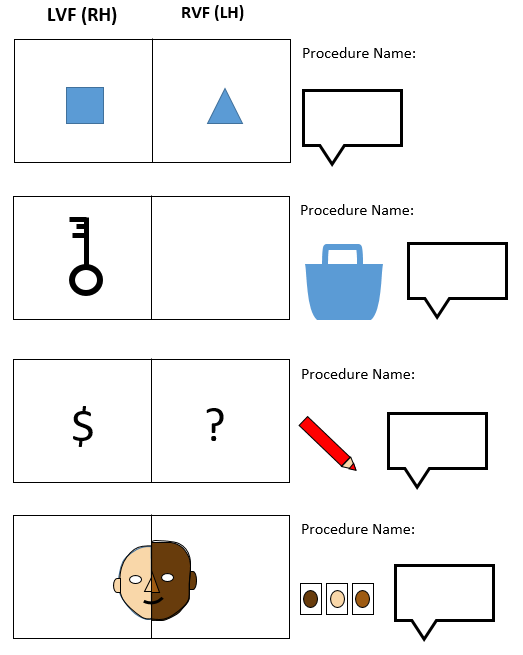
- ADescribe what you see
- BRecognition by touch
- CSimultaneous words
- DMatching faces
34Name two advantages of Sperry's split-brain research
- AGood supporting evidence- his research produced impressive and sizeable evidence for hemispheric lateralisation
- BGood supporting evidence- his research produced impressive and sizeable evidence for functional recovery
- CGood methodology- used specialised and standardised procedures
- DEasy to generalise- a large sample size with diverse sample characteristics makes the theories easy to generalise
- EComprehensive approach- it takes into account how the right hemisphere can still be associated with language, and therefore doesn't oversimplify
35Name two disadvantages of Sperry's split-brain research
- AInsufficient evidence- there is very little evidence to support Sperry's theory
- BPoor methodology- lack of standardisation and control, with researcher bias playing a significant role in the findings
- CDifficult to generalise due to the abnormal sample characteristics- epilepsy
- DGender bias- only studied women, and split brain research has showed notable differences in men in terms of hemispheric lateralisation
- EOversimplification- the right hemisphere does still play a role in language, not just the left hemisphere.
36In the spaces provided, label the scanning technique described.
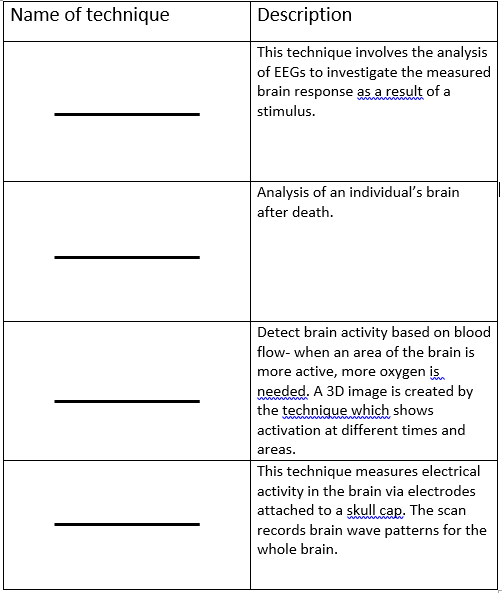
- AERPs
- BPost-mortem examinations
- CfMRIs
- DEEGs
37There are points to consider when evaluating scanning techniques. This includes:
[blank_start]Cost[blank_end]- is it a technique that is expensive?
[blank_start]Temporal resolution[blank_end]- is there a lag in the scanning, or is it instantaneous?
[blank_start]Spatial resolution[blank_end]- is the picture clear?
[blank_start]Ethical issues[blank_end]- people can't consent if they're dead
[blank_start]Risks[blank_end]- does the technique use radiation or invasive methods?
How much does it actually tell us?- fMRI is just blood flow, and post-mortems are affected by extraneous variables- ACost
- BTemporal resolution
- CSpatial resolution
- DEthical issues
- ERisks
- FTemporal resolution
- GSpatial resolution
- HEthical issues
- IRisks
- JCost
- KSpatial resolution
- LTemporal resolution
- MCost
- NEthical issues
- ORisks
- PEthical issues
- QRisks
- RTemporal resolution
- SSpatial resolution
- TCost
- URisks
- VTemporal resolution
- WSpatial resolution
- XEthical issues
- YCost
38Biological Rhythms
Circadian rhythms: [blank_start]every 24 hours[blank_end], such as the [blank_start]sleep/wake cycle[blank_end]
Ultradian rhythms: [blank_start]more than once every 24 hours[blank_end], such as the [blank_start]sleep cycle[blank_end]
Infradian rhythms: [blank_start]less than once every 24 hours[blank_end], such as the [blank_start]menstrual cycle[blank_end]
Circannual rhythms: a type of infradian rhythm that is [blank_start]once every year[blank_end], such as [blank_start]seasonal affective disorder[blank_end]- Aevery 24 hours
- Bmore than once every 24 hours
- Cless than once every 24 hours
- Donce every year
- Esleep cycle
- Fmenstrual cycle
- Gseasonal affective disorder
- Hsleep/wake cycle
39Siffre spent 2 months in a cave to investigate how the sleep/wake cycle was influenced by endogenous pacemakers. How did his sleep/wake cycle change?
- AChanged to a 25 hour sleep/wake cycle
- BChanged to a 29 hour sleep/wake cycle
- CChanged to a 18 hour sleep/wake cycle
- DThere was no change
40[blank_start]Aschoff and Wever[blank_end] had participants spend a month in [blank_start]a WW2 bunker[blank_end] with no exogenous zeitgebers. The majority had a 24-25 hour sleep/wake cycle.
[blank_start]Folkard[blank_end] had 12 volunteers live [blank_start]in a cave[blank_end] for 3 weeks with no light. Gradually, the clocks were sped up so a seemingly 24 hour day lasted only 22 hours. The majority maintained a 24-25 hour sleep/wake cycle.
These studies suggest [blank_start]exogenous zeitgebers[blank_end] have little influence on our biological rhythms.- AAschoff and Wever
- BFolkard
- Cin a cave
- Da WW2 bunker
- Eexogenous zeitgebers
- Fendogenous pacemakers
41The main endogenous pacemaker for the sleep/wake cycle is the [blank_start]suprachiasmatic nucleus[blank_end], and the exogenous zeitgeber is [blank_start]daylight[blank_end].
- Asuprachiasmatic nucleus
- Bhippocampus
- Cdaylight
- Dheat
- Edaylight
- Fheat
- Gweather
- Hsound
42One advantage of research into circadian rhythms is the practical application. This includes [blank_start]shift work[blank_end]- well-lit rooms and regular breaks. This improves production and decreases risk of harm.
[blank_start]Drug treatment[blank_end] can also be improved- drugs are taken [blank_start]at certain peak times[blank_end] to be most effective.- Ashift work
- Bvolnteering
- Cpart-time work
- Dfull-time work
- EDrug treatment
- FCognitive therapy
- GSocio-psychological therapies
- Hat certain peak times
- Iin the morning
- Jwhen needed
43Research into circadian rhytms (the sleep/wake cycle) used small samples and case studies. Why is this an issue?
- ADifficult to generalise
- BCulture bound
- CEthical issues- lack of informed consent
44Why could we say that there was poor control in studies into the sleep/wake cycle?
- AThey still used artificial light
- BWhen speeding up the clocks in Folkard's study, they used estimation rather than precision
- CThere were places where the participants could still see natural light
45How often does the menstrual cycle occur?
- A28 days
- BOnce a year
- COnce a day (if this happens to you, you might want to get it checked out...)
- D14 days
- EA week
46Which two hormones are involved in the menstrual cycle?
- AOestrogen
- BTestosterone
- CProgesterone
- DOxytocin
- EInsulin
47The menstrual cycle
1. High levels of [blank_start]oestrogen[blank_end] cause the ovary to develop an egg
2. The egg is released
3. After [blank_start]ovulation[blank_end], [blank_start]progesterone[blank_end] thickens the lining of the womb. If an egg isn't fertilised, the womb lining is shed and leaves the body ([blank_start]menstrual flow[blank_end])- Aoestrogen
- Bovulation
- Cmenstrual flow
- Dprogesterone
48Which researcher investigated the menstrual cycle?
- AMcClintock
- BFolkard
- CAschoff and Wever
- DSiffre
- ESperry
49McClintock studied women with irregular menstrual cycles. He took samples of pheromones from 9 women during their cycle, and wiped them on the upper lip of 20 other women. What percentage of the women experienced changes to their menstrual cycle which synced them to their pheromone donor?
- A68%
- B100%
- CNone
- D44%
- E12%
50What does McClintock's study of the menstrual cycle highlight the role of?
- AEndogenous pacemakers
- BExogenous zeitgebers
51When does Seasonal Affective Disorder affect sufferers of the disorder?
- AMornings
- BEvenings
- CWinter
- DSummer
- EAutumn
- FSpring
52Seasonal Affective Disorder
Lowered exposure to sunlight in the [blank_start]winter[blank_end] leads to larger quantities of [blank_start]melatonin[blank_end] being produced. As a result, less [blank_start]serotonin[blank_end] is produced, hence the lowered mood.- Awinter
- Bevening
- Csummer
- Dearly morning
- Emelatonin
- Fserotonin
53The sleep cycle is [blank_start]an ultradian[blank_end] rhythm; it involves 5 stages, and lasts [blank_start]90 minutes[blank_end].
Stage 1+2- light sleep, easy to wake. [blank_start]Alpha to theta waves[blank_end]
Stage 3+4- deep sleep, difficult to wake. [blank_start]Delta waves[blank_end]
Stage 5- REM sleep, the body is paralysed but the mind speeds up. [blank_start]Mixture of waves[blank_end]- Aan ultradian
- Ba circadian
- Can infradian
- D90 minutes
- Ea day
- Fan hour
- GAlpha to theta waves
- HDelta waves
- IMixture of waves
- JDelta waves
- KAlpha to theta waves
- LMixture of waves
- MMixture of waves
- NDelta waves
- OAlpha to theta waves
54Some psychologists suggest the menstrual synchrony has an evolutionary basis- menstruating together leads to falling pregnant around the same time, so the children could be cared for collectively. However, why may we actually question the validity of this statement?
- AThere isn't enough evidence about the menstrual cycle
- BThis would actually just create competition for the highest quality males in the group, so avoidance of synchrony would be better
- CThe males would fight over the females
55Factors such as diet, stress and exercise affect the menstrual cycle
- AVerdadero
- BFalso
56Dement and Kleitman carried out brain scans to study the sleep cycle. They would wake the participants up during different stages. At which stage would it be easiest to recall dreams?
- AStage 1
- BStage 5- REM sleep
- CStage 4
57What is the main advantage of research into SAD?
- AIt leads to the development of treatments like photo-therapy
- BIt means SAD can be predicted in future generations
- CIt means people can take time off work for the disorder without a diagnosis
58What the main endogenous pacemaker in humans?
- AThe suprachiasmatic nucleus
- BDaylight
- CThe liver
- DThe peripheral oscillator
59What does the suprachiasmatic nucleus (SCN) lie above in the hypothalamus?
- AThe optic chiasm
- BThe parahippocampal gyrus
- CWernicke's area
- DThe cerebellum
60DeCoursey destroyed the suprachiasmatic nucleus in 30 chipmunks. What effect did this have on their sleep/wake cycle?
- ANone- the cycle remained 24 hours
- BIt decreased to 16 hours
- CIt disappeared entirely, so they stayed awake and were killed by predators
- DIt increased until they essentially slept all day and night, so were killed by predators
61Ralph transplanted the SCN cells of hamsters with 20-hour sleep/wake cycles to hamsters with regular 24- hour sleep/wake cycles. What effect did this have on the normal hamsters?
- ATheir sleep/wake cycles changed to 20 hours
- BThere was no significant change in their sleep/wake cycle
- CTheir sleep/wake cycle disappeared entirely
- DThe sleep/wake cycle changed to 45 hours
62Which gland produces melatonin?
- AThe pineal gland
- BThe pituitary gland
- CThe thyroid gland
- DThe adrenal gland
63What is the name given to the other endogenous pacemakers found in the body other than the SCN, such as the liver and spleen?
- APeripheral oscillators
- BPeripheral circulators
- CPeripheral nervous system
64Campbell and Murphy conducted a study in which a light pad was shone on the backs' of participants' knees at regular intervals during sleep. What did they find?
- AThe menstrual cycle became more frequent
- BThe sleep/wake cycle deviated by 3 hours
- CThe sleep cycle became 70 minutes, rather than 90
65Other than light, what is another key exogenous zeitgeber?
- AThe suprachiasmatic nucleus
- BGenetic makeup
- CSocial cues
66What is one disadvantage of Campbell and Murphy's study into exogenous zeitgebers (shining light pads on the back of knees)?
- AMay have had partial exposure to light in their eyes
- BThe influence of demand characteristics was ignored
- CAll participants had had the backs of their knees checked for sensitivity beforehand, so may not be able to generalise to the wider population
67Why might we say that the influence of exogenous zeitgebers is overstated?
- AThe blind still have 24-hour sleep/wake cycles despite social cues, and people in the Arctic still have 24-hour sleep/wake cycles despite near-constant sunlight
- BEndogenous pacemakers and exogenous zeitgebers can't function simultaneously, and there is stronger evidence for endogenous pacemakers
- CThere is no human evidence for exogenous zeitgebers, only animal studies
Información
- Descripción
- AQA A Level Psychology: Biopsychology- This resource was created based on material in the textbook, and is only suitable for A Level students as it contains A Level content alongside the AS Level content.
- Autor
- Grace Fawcitt
- Idioma
- English
- Visitas
- 12.905
- Etiquetas
- Valoración
- 5,0 de 5 · 2 valoraciones Valora este test