
Test
Anatomical terminology - Axial Skeleton
Crea una cuenta gratis para terminar este test
Guarda tu progreso y consulta tu resultado final.
¿Ya tienes cuenta? Inicia sesión
Preguntas del test (78)
1The appendicular skeleton is
- Amainly a propulsive structure with some supportive role: the hind limbs support and the forelimbs propulse and steer.
- Bmainly a supportive structure with some propulsive role: the hind limbs support and steer and forelimbs propulse.
- Cmainly a supportive structure with some propulsive role: the hind limbs are propulsive and forelimbs support and steer.
- Dmainly a propulsive structure with some supportive role: the hind limbs are propulsive and forelimbs support and steer.
2What is a bone of the heterotopic skeleton
- Ahumerus
- Bskull
- Cos penis
- Dsternum
3Which bones are part of the axial skeleton?
- ASkull
- BScapula
- CSternum
- DSacrum
4What is another name for vertebrae C2?
- AAtlas
- BAxis
- CXiphoid
- DCranial 2
5The skeleton functions are to support, help with locomotion, protect the brain and the heart and lungs, and form red blood cells, it cannot store calcium and phosphorus.
- AVerdadero
- BFalso
6Palmar stands for:
- Acaudal aspect of the forelimb below the carpus and the surface of the fore paw that contacts the ground
- Bcaudal aspect of the hindlimb below the tarsus and the surface of the hind paw that contacts the ground
7What is an example of a fibrous joint?
- Askull sutures
- Bmandibular symphysis
- Cgrowth plate
- Dhip joint
8Cranial movement of the limb such as reaching out is called:
- Aprotraction
- Bretraction
9Moving limb away from the median plane or from the body trunk is called an:
- Aabduction
- Badduction
10Supination is defined as:
- ALateral rotation of appendage so that palmar/plantar surface of paw faces medially
- BLateral rotation of appendage so that palmar/plantar surface of paw faces the substrate
11The most proximal, dorsal, cranial or central attachment of a muscle is called its:
- Aorigin
- Binsertion
12A brachiocephalic dog has an elongated, narrow skull
- AVerdadero
- BFalso
13This is a dorsal view of the skull. What is the name of the bone colored in GREEN.
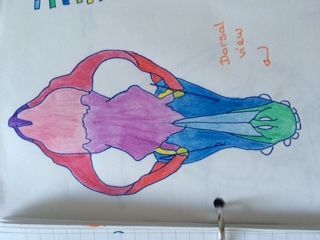
- Aincisive
- Bnasal
- Cmaxilla
- Dfrontal
14This is a dorsal view of the skull. What is the name of the bone colored in LIGHT PINK
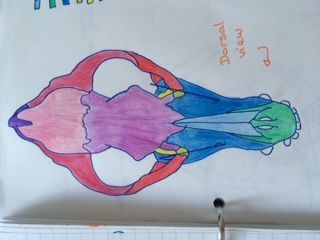
- Atemporal
- Bparietal
- Czygomatic
- Dfrontal
15This is a ventral view of the skull. what is the name of the bone colored in LIGHT ORANGE?
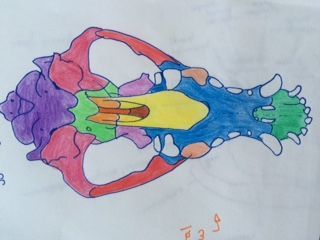
- Avomer
- Bpterygoid
- Cpalatine
- Dbasisphenoid
- Epresphenoid
16The skull articulates with the temporo-mandibular joint at the __________ of the ramus.
- Acoronoid process
- Bcondylar process
- Cangular process
- Dcoracoid process
17The vomer bone is rostral to the presphenoid bone
- AVerdadero
- BFalso
18The sagittal crest runs caudal to rostral, from the occipital bone to the temporal bone
- AVerdadero
- BFalso
19Choose the correct order rostral to caudal for these 3 landmarks of the skull
- Aoptic canal, orbital fissure, rostral alar foramen
- Borbital fissure, rostral alar foramen, optic canal
- Crostral alar foramen, optic canal, orbital fissure
20The mandibular foramen is the:
- Acaudal opening of the mandibular canal
- Brostral opening of the mandibular canal
21What landmark is number 20 pointing at?
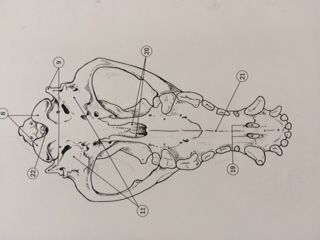
- Ahard palate
- Bvomer
- Cchoanae
- Dnasal aperture
22What is #12 pointing at?
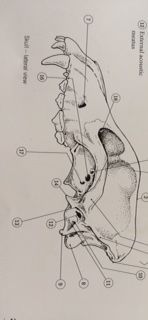
- Aretroarticular foramen
- Bexternal acoustic meatus
- Cstylomastoid process
- Dtympanic bulla
23What type of joint is the TMJ ? What movements does it allow?
- Acondylar cartilaginous joint, allows movement in one axial plane only.
- Bcoronoid synovial joint, allows rotational and lateral sliding with little movement in one axial plane.
- Ccondylar synovial joint, allows movement in one axial plane, little rotational and lateral sliding.
- Dcoronoid cartilaginous joint, allows movement in a hinge-like fashion
24How many teeth does a dog have in total?
- A42
- B30
- C40
- D32
- E46
25How many molars does a dog have on 1 upper hemi-mandibule?
- A2
- B3
- C4
- D1
26What is the dental formula of the dog?
- A2* I 3/3 C 1/1 P 3/2 M 1/1
- B2* I 3/3 C 1/1 P 3/2 M 2/2
- C2* I 3/3 C 1/1 P 4/4 M 3/2
- D2* I 3/3 C 1/1 P 4/4 M 2/3
- A2* I 3/3 C 1/1 P 3/2 M 1/1
27In normal dental occlusion, the upper incisors are 1________ the lower incisors, the lower canines sit between the 2_________ and the 3__________, the premolars interdigitate in a 4_________________, and the upper last premolar and molars rest 5_______ to the lower molars.
- A1 behind, 2 upper canine, 3 last upper incisor, 4 pinking shear, 5 lateral
- B1 ahead of, 2 upper canine, 3 first premolar, 4 pinking shear, 5 lateral
- C1 in line with, 2 upper canine, 3 first premolar, 4 pinking shear, 5 medial
- D1 ahead, 2 upper canine, 3 last upper incisor, 4 pinking shear, 5 lateral
28Select the odd one out
- Atympanic bulla
- Boccipital condyle
- Cchoanae
- Dparacondylar process
- Esagittal crest
29Mimetic muscles are innervated with what nerve?
- Afacial nerve
- Bcranial nerve V
- Ctrigeminal nerve
- Dmimetic nerve
30Which muscle(s) of the face help(s) raise the lips?
- Aorbicularis oris
- Blevator nasolabialis
- Ccaninus
- Dzygomaticus
- Eplatysma
31Which muscle(s) open(s) the mouth?
- Adigastricus
- Btemporalis
- Cmasseter
- Dpterygoid
32The ____________ runs from the occipital area of the skull to the ventral part of the body of the mandible
- Azygomaticus
- Bdigastricus
- Ctemporalis
- Dplatysma
33What is the bone labeled 3?
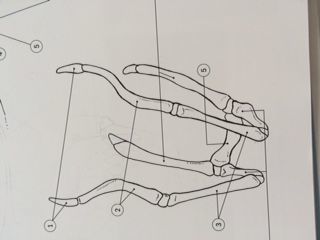
- AThyrohyoid
- BEpihyoid
- CStylohyoid
- DTympanohyoid
- ECeratohyoid
34Which muscle is split during a tracheostomy?
- Asternohyoideus
- Bmylohyoideus
- Cbrachiocephalicus
- Dgeniohyoideus
35What is the function of the styloglossus muscle?
- Aretract and depress the tongue
- Bretract and elevate the tongue
- Cprotrude and retract apex
36What is the function of the hyoglossus muscle?
- Aretract and depress
- Bretract and elevate
- Cprotrude tongue and retract apex
37The styloglossus, hyoglossus and genioglossus are examples of _________ muscles
- Aintrinsic
- Bextrinsic
38Which gland duct opens at the level of the upper fourth premolar tooth
- Aparotid
- Bzygomatic
- Csublingual
- Dmandibular
39The parotid gland is lateral to the mandibular gland on a ventral view.
- AVerdadero
- BFalso
40The mandibular lymph nodes are caudal to the retropharyngeal lymph nodes
- AVerdadero
- BFalso
41The trachea is dorsal to the oesophagus
- AVerdadero
- BFalso
42The epiglottis flips caudally to allow food to pass to the oesophagus
- AVerdadero
- BFalso
43In brachiocephalic breeds the __________________ can cause airway obstruction
- Aelongation of the soft palate
- Bshortening of the hard palate
- Csmaller oropharynx
- Doverprotruding epiglottis
44The whole swallowing process works due to a coordinated series of events which begins involuntarily but, upon food contact with the highly sensitive pharyngeal mucosa, continues voluntarily.
- AVerdadero
- BFalso
45Contraction of the cricopharyngeus muscle allows the bolus of food to enter the oesophagus
- AVerdadero
- BFalso
46Pharyngeal muscles are supplied by the:
- Avagus X and glossopharyngeal IX nerves
- Bglossopharyngeal IX nerve only
- Chypoglossal and vagus X nerves
- Dtrigeminal and glossopharyngeal IX nerves
47Which is NOT true concerning the gag reflex?
- Aprotective spasm mediated by the vagus X and the hypoglossal IX nerve
- Bactivated by oropharyngeal wall irritation during swallowing
- Cneuromuscular disease, anesthesia or altered consciousness can affect this reflex
- Dabsence of the reflex can suggest nerve damage
48The pharyngeal muscles comprise
- AConstrictors
- BExtenders
- CDilators
- DElongators
- EShorteners
49List the cartilage of the larynx from cranial to caudal
- AEpiglottis, Cricoid, Thyroid, Arytenoid
- BEpiglottis, Cricoid, Arytenoid, Thyroid
- CThyroid, Epiglottis, Arytenoid, Cricoid
- DEpiglottis, Thyroid, Arytenoid, Cricoid
50Select muscles of the larynx
- Acricothyroid
- Bthyrocricoid
- Carytenothyroideus dorsalis
- Dcricoarytenoideus dorsalis
- Ethyroarytenoideus
51The cricothyroid muscle is the only one innervated by the cranial laryngeal nerve
- AVerdadero
- BFalso
52The cricoarytenoideus dorsalis ________ the glottis while the cricoarytenoideus lateralis __________ it.
- Acloses, opens
- Bopens, closes
- Ctenses, relaxes
- Drelaxes, tenses
53The cricothyroid _____the vocal fold while the thyroarytenoideus ______it.
- Atenses, relaxes
- Bopens, closes
- Ccloses, opens
- Drelaxes, tenses
54Epaxial muscles lie dorsally while hypaxial muscles lie ventrally to the transverse process of the vertebral column.
- AVerdadero
- BFalso
55Epaxial muscles
- Asupport the spinal column
- Bflex the neck or tail
56Which epaxial muscle supporting the spinal column is the most medial
- Ailiocostalis
- Blongissimus
- Ctransversospinalis
- Dsclaneus
57Which muscle of the hypaxial group can be found in the neck area?
- Apsoas
- Bsclaneus
- Crectus capitis ventralis
- Dlongissimus
58In figure 3.6 (a) [on the left] What is the name of the structure colored in dark blue?
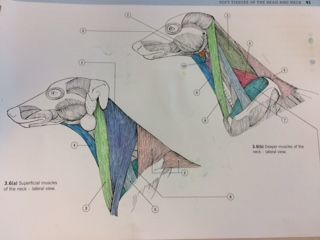
- Abrachiocephalicus
- Bsternocephalicus
- Ctrapezius
- Dsplenius
59Where does the brachiocephalicus muscle originate?
- Aclavicle
- Bcervical vertebrae
- Cmastoid process of the skull
- Dhumerus
60What is the average total number of bones in an adult male dog?
- A213
- B321
- C431
- D342
61How many pair of ribs does a dog have and how many pairs are considered "true ribs"?
- AThe dog has 13 pair of ribs, 9 are considered true.
- BThe dog has 14 pair of ribs, 10 are considered true.
- CThe dog has 13 pair of ribs, 8 are considered true.
- DThe dog has 11 pair of ribs, 8 are considered true.
62Another name for sternebrae 1 of the sternum is?
- Axiphoid
- Bbody
- Cmanubrium
- Datlas
63Name the rib features from dorsal to ventral
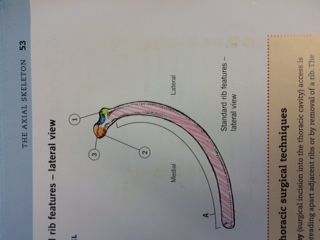
- Ahead, neck, tubercle, body
- Bbody, tubercle, neck, head
- Ctubercle, neck, head, body
- Dhead, body, tubercle, neck
64What is the vertebral formula for the dog?
- ACervical 7, Thoracic 11, Lumbar 7, Sacrum 3, Caudal 20-23
- BCervical 7, Thoracic 13, Lumbar 7, Sacrum 3, Caudal 20-23
- CCervical 7, Thoracic 12, Lumbar 7, Sacrum 3, Caudal 20-23
- DCervical 7, Thoracic 13, Lumbar 7, Sacrum 3, Caudal 21-23
65List some of the characteristics of the Atlas
- Alarge flat wings or transverse processes
- Blateral and transverse foramens
- Ctall spinous process
- Dfovea dentis and caudal articular fovea
- Eodontoid processes
66All vertebrae have a body, a vertebral arch and various processes: cranial and caudal articular processes, transverse, spinous, accessory or mammillary depending on the vertebrae concerned.
- AVerdadero
- BFalso
67Characteristics of the axis
- Atall spinous process dorsally
- Bcranial projections called dens
- Ctransverse processes pointing cranially
- Dtransverse foramen
- Eall the above
68C7 has a noticeably large transverse process
- AVerdadero
- BFalso
69C7 has a tall spinous process
- AVerdadero
- BFalso
70The first 9 thoracic vertebrae are similar while the last 4 begin to resemble lumbar vertebrae.
- AVerdadero
- BFalso
71Characteristics of the thoracic vertebrae
- Atall spinous process
- Bshort vertebral body
- Cmamillary process
- Dshort and sharp transverse process
- Eall the above
72T10 has a spinous process that is more or less perpendicular to the long axis of the bone, known as the anticlinal vertebra
- AVerdadero
- BFalso
73Characteristics of lumbar vertebra
- Atall spinous process
- Blarge transverse process point cranially
- Cshort bodies
- Dwide spinous process
- Enone of the above
74Select the vertebra that has a mamillary process
- Alumbar
- Bthoracic
- Ccervical
- Dcaudal
- Esacral
75Characteristics of caudal vertebra
- Ataper and get shorter caudally
- Bcylindrical
- C20-23 of them
- Dalso known as coccygeal
- Eall the above
76The vertebral column is said to be flexed when it is arched dorsally
- AVerdadero
- BFalso
77What is the structure colored in pink called?
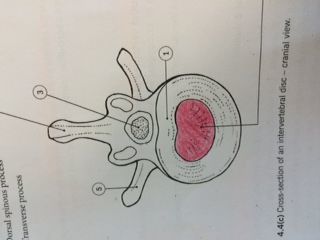
- Aannulus fibrosus
- Bnucleus pulposus
- Cnucleus fibrosus
- Dspinal cord
- Eannulus pulposus
78Between adjacent vertebrae there are discs of fibrocartilage. The center of the disc contains fibrous nucleus pulposus, surrounded by a lamellar structure of cartilaginous tissue, the annulus fibrosus. Theses discs have a shock-absorbing function.
- AVerdadero
- BFalso
Información
- Descripción
- Anatomical terminology, skull and mandible, soft tissue of the head, pharynx/larynx and neck, axial skeleton
- Autor
- celine_barbiersg
- Idioma
- English
- Visitas
- 841
- Etiquetas
- Valoración
- 2,0 de 5 · 2 valoraciones Valora este test