
Test
Linguistics Exam 1
Este test tiene tipos de pregunta que se abren en el reproductor de siempre.
Preguntas del test (41)
1[blank_start]Prescriptive[blank_end] grammar is [blank_start]rules[blank_end] of grammar brought about by grammarians to legislate what speakers' grammatical rules should be
- APrescriptive
- Brules
2[blank_start]Descriptive[blank_end] grammar is a linguist's description of the [blank_start]mental[blank_end] grammar, including units, structures, and rules. An explicit statement of what speakers know about their language.
- ADescriptive
- Bmental
3[blank_start]Phonology[blank_end] is the sound system of a language; [blank_start]inventory of sounds[blank_end] and rules for their combination and pronunciation.
- APhonology
- BMorphology
- CTaxonology
- Dinventory of sounds
- Einventory of vocabulary
- Finventory of pairing
4[blank_start]Morphology[blank_end] is the study of the structure of words; the component of the grammar that includes the rules of [blank_start]word formation[blank_end].
- AMorphology
- BPhonology
- CSyntaxology
- Dword formation
- Eword structuring
- Fword synching.
5[blank_start]Syntax[blank_end] is the rule of sentence formation; the component of the mental grammar that represents speaker's knowledge of the structure of [blank_start]phrases and sentences[blank_end].
- ASyntax
- BMorphology
- CSemantics
- Dphrases and sentences
- Ephrases and structures
- Fsentences and grammar
6[blank_start]Semantics[blank_end] is the study of linguistic meaning of morphemes, words, phrases and sentences.
- ASemantics
- BSyntax
- CMorphology
7[blank_start]Pragmatics[blank_end] is the study of how context and situation affect meaning.
- APragmatics
- BSyntax
- CPhonology
8[blank_start]Lexicon[blank_end] is the speaker's knowledge about morphemes and words; a [blank_start]speaker's mental dictionary[blank_end].
- ALexicon
- BSyntax
- CSemantics
- Dspeaker's mental dictionary
- Espeaker's mental rules
- Fspeaker's mental language
9[blank_start]Universal[blank_end] grammar as the basic [blank_start]blueprint[blank_end] that all languages follow; it is part of the biologically endowed human language faculty.
- AUniversal
- Bblueprint
10When we say in later chapters that a sentence is grammatical we mean that it conforms to the [blank_start]rules[blank_end] of the mental grammar (as described by the linguistic); when we say it is ungrammatical, we mean it [blank_start]deviates[blank_end] from the rules in some way.
- Arules
- Bidea
- Cdeviates
- Dagrees
11What is Sapir-Whorf hypothesis? (language and thought)
- Athe structure of a language determines a native speaker's perception and categorization of experience.
- Ban individual's thoughts and actions are determined by the language or languages that individual speaks.
- Cthe structure of a language determines a native speaker's language experience.
- Dan individual's mood are determined by the language or languages that individual speaks.
12What are the features of language that [blank_start]Hockett[blank_end] suggested?
- Discreetness; language has parts and units
- arbitrariness; sounds have no meaning inherently
- displacement; the ability to communicate actions and time/events/location that is not exactly at that moment or place
- duality of patterning; we can give sound meaning
-openness; the ability and flexibility to add new words, and no limit to what I can talk about; ex. abstract ideas
-cultural transmission; we acquire language based on our social environment- AHockett
13[blank_start]Broca area[blank_end] is located front part of the left hemisphere of the brain, damage to which causes [blank_start]agrammatism[blank_end]/ Broca's aphasia.
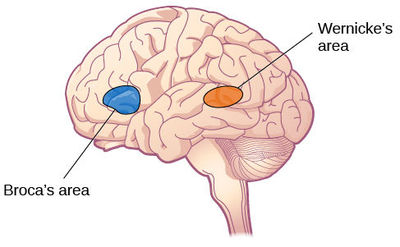
- ABroca area
- Bagrammatism
14[blank_start]Wernicke area[blank_end] is located [blank_start]back[blank_end] (posterior) part of the left brain that if damaged causes a specific type of aphasia.
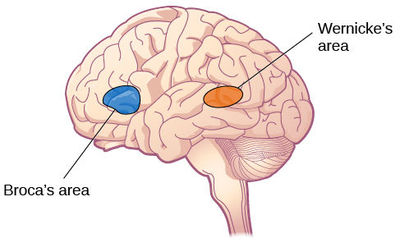
- AWernicke area
- Bback
15[blank_start]Corpus callosum[blank_end] are fibers connecting the right and left cerebral hemispheres.
- ACorpus callosum
16[blank_start]Lateralization[blank_end] of brain function. Term used to refer to cognitive functions localized ton one or other hemisphere of the brain.
How do we know the linguistics functions are generally lateralized?- ALateralization
17[blank_start]Broca[blank_end] aphasia: characterized by labored speech and certain kinds kinds of word-finding difficulties; affects person's ability to form sentences with the rules of [blank_start]syntax[blank_end].
- Asyntax
- BBroca
18[blank_start]Wernicke[blank_end] aphasics: they produce fluent speech with good information and their language is often [blank_start]semantically[blank_end] incoherent.
- AWernicke
- Bsemantically
19What do we know about language acquisition and the critical period based on children with atypical exposure to language when they were growing up?
Based on cases such as Genie, "the wild child", a girl who was rarely exposed to language and people in her first 13 years of her life shed light into the critical period/sensitive period: A period were is [blank_start]optimal[blank_end] to acquire language, as you age, your ability to acquire langue is more [blank_start]limited[blank_end], as seen in the case of Genie.
Are there any issues that have not been considered?
[blank_start]Trauma[blank_end] is mostly not accounted and its effect in the acquisition of language in a child.- Aoptimal
- Blimited
- CTrauma
20What Hockett features of language do honey bees demonstrate and what important aspects are they lacking?
-[blank_start]discreetness[blank_end]; able to talk about a location (distance and direction of food (richness) even though they are not there, by doing specific movement.
-lacking [blank_start]productivity[blank_end]; bees not able to communicate never-before-heard sentences and able to visualize/understand and coherently understand it.- Adiscreetness
- Bproductivity
21[blank_start]Content[blank_end] words: are the nouns, verbs, adjectives, and adverbs that constitute the major part of the vocabulary.
- AContent
22[blank_start]Function[blank_end] words: are words that do not always have a clear lexical meaning but has grammatical function.
- AFunction
23[blank_start]Free[blank_end] morphemes is a single morpheme that constitutes a word. example: dog
- AFree
- BBound
24[blank_start]Bound[blank_end] morphemes: is a morpheme that must be attached to other morphemes. Example: ---ly, ---ed, non---
- ABound
- BFree
25A [blank_start]root[blank_end] is the morpheme that remains when all affixes (infix, prefix, suffix) are stripped away; the simplest form of a complex word.
Example. The root in the word 'semantically' is 'semantic'- Aroot
- Bstem
- Caffix
26A [blank_start]stem[blank_end] is the base in which an affix (infix, prefix, suffix) is attached to create a more complex form that may be another stem or root.
Example. A stem in the word 'semantically' is ---ally- Astem
- Broot
- Caffix
27An [blank_start]affix[blank_end] is a bound morpheme attached to a stem or a root. Includes; prefix, suffix, infix, circumfix, stem, and root.
prefix: an affix attached in front of a morpheme or a stem
suffix: an affix attached at the end of a morpheme of a stem
infix: bound morpheme inserted in the middle of another morpheme
circumfix: bound morpheme, which occur in a word before and after the root.- Aaffix
- Broot
- Cstem
28It is [blank_start]derivational[blank_end] if it changes part of speech or if it changes the meaning of the word.
It is [blank_start]inflectional[blank_end] if it does not change part of speech and does not change the meaning of the word.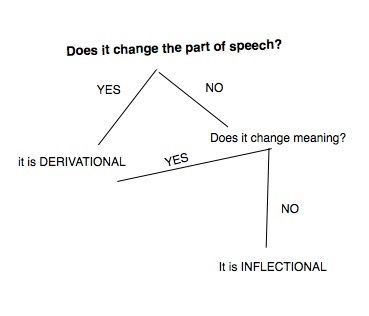
- Aderivational
- Binflectional
29[blank_start]Noun-verb[blank_end] pairs in ASL are signs that use the same handshape, location, and orientation, but have a different movement.
The verb of a noun verb pair generally has a single, continuous movement that is larger than the movement of the noun.
example: hand motion for the noun word 'airplane'. add forward movement for the hand motion for 'airplane' and it becomes the verb 'to fly'- ANoun-verb
30[blank_start]Sequential[blank_end] affixation in ASL, is a process in which sequential morpheme process occurs in order to give information about a word.
Example: Sign for 'TEACH' + Sign for 'ER' = TEACHER is an example of using a sequential morpheme process
On the other part, there is simultaneous affixation too but is mostly used in sign language rather than spoken language. And Sequential affixation is mostly seen in spoken language.- ASequential
31[blank_start]Aspectual morphology[blank_end] in ASL includes a sign motion plus repeated movement to adhere such characteristic.
Example. in the image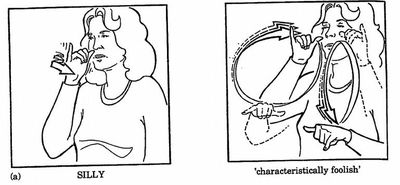
- AAspectual morphology
32Grammaticality and well-formedness
The following sentence is meaningless, yet grammatically acceptable:
Colorless green ideas sleep furiously.
Alternatively, a sentence that is not well-formed, but makes some sense is:
[blank_start]*[blank_end]Me Tarzan, you Jane.- A*
33Constituency tests
Sentence: The new Iphone is very expensive.
Stand Alone Test:
Q: What is expensive?
A: The new Iphone.
PASSED
Move as a Unit Test
Very expensive the new Iphone is.
New Iphone is very expensive the.
FAILED
Substitution Test
The new Iphone is very expensive. ----> The new it is very expensive.
FAILED (the new what?)- AVerdadero
- BFalso
34Difference between semantics and pragmatics
Semantics studies the [blank_start]linguistic meaning[blank_end] of a word while pragmatics sees how [blank_start]context[blank_end] and the situation affects the meaning of a word.- Alinguistic meaning
- Bcontext
35Plain verb vs Agreement verb
A plain verb is a normal verb in ASL. When using plain verbs the signer must [blank_start]designate[blank_end] the subject and the object. Examples of plain verbs in ASL are PLAY, RUN, JUMP, and SING.
Agreement verb verbs allow the signer to [blank_start]incorporate[blank_end] the subject and object into the verb in one fluid motion. Examples of inflecting verbs in ASL are GIVE, INFORM, TELL, PICK-ON, SEND, and PAY.- Adesignate
- Bincorporate
36Truth relations: Entailment, Tautology, and Contradiction
Entailment: the relationship between two sentences, where the truth of one necessitates the truth of the other.
Example: The officer warned the minors to not drink again.
Entailment: the minors drinked
Tautology: My brother is a male
True in all senses
Contradiction: My aunt is a man.
[blank_start]*[blank_end]- A*
37Deictics:
I saw her standing there.
---> the deictic in this sentence is 'there'
Yesterday, all my troubles seemed so far away.
---> the deictic in this sentence are 'yesterday', 'my', 'so far away'
[blank_start]*[blank_end]- A*
38Presuppositions
We went to the ballpark again.
Presupposition: The group of people (2 or more) have been to the park already before.
[blank_start]*[blank_end]- A*
39Implicatures
A: Smith doesn't have any girlfriends these days.
B: He's been driving over the West End a lot lately
The implicature in this example is that Smith has a girlfriend in the West End. Implicatures are deductions that are not made strictly on the basis of the content expressed in the discourse.
[blank_start]*[blank_end]- A*
40Grice's [blank_start]Maxims[blank_end]
Quality: do not lie
Relevance: be relevant
Manner: be clear, easy to understand, avoid ambiguity
Quantity: say neither more nor less than the discourse requires- AMaxims
41Syntax tree example on image
Start with [blank_start]S[blank_end]
then to NP and VP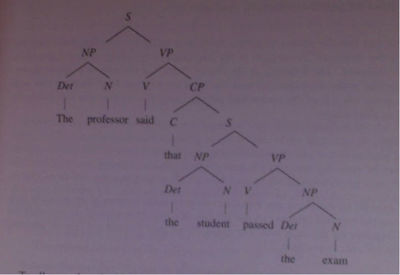
- AS
Información
- Descripción
- Semantics, morphology, syntax. Basics.
- Autor
- Bianca Tonche
- Idioma
- English
- Visitas
- 434
- Etiquetas
- Valoración
- Aún sin valoraciones Valora este test