
Test
PSC 1 - Chapter 3 Homework
Este test tiene tipos de pregunta que se abren en el reproductor de siempre.
Preguntas del test (13)
1Identify parts of neuron.
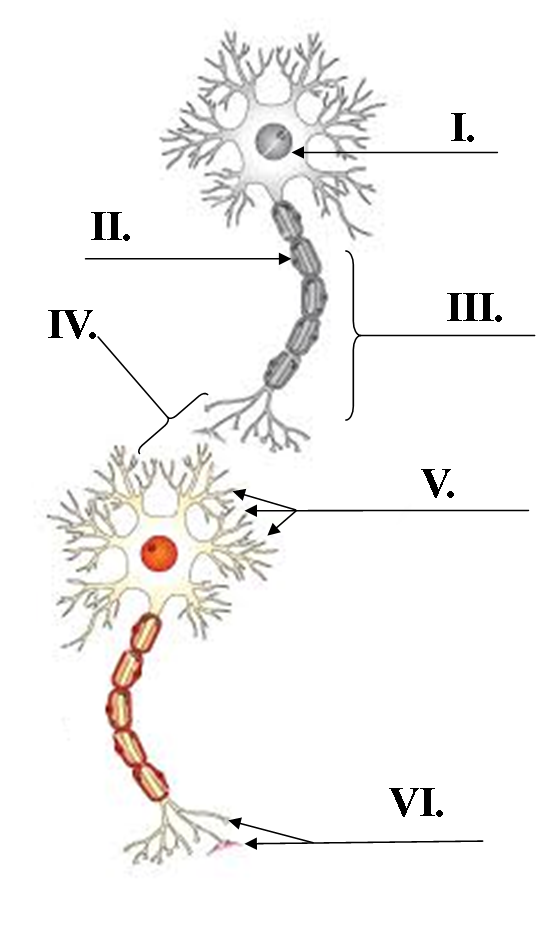
- ATerminal Buttons
- BDendrites
- CSynapse
- DAxon
- EMyelin Sheath
- FCell Body
2Chemical messenger manufactured in the synaptic vesicles of a neuron [blank_start]neurotransmitter[blank_end]
Neurotransmitter that usually communicates an inhibitory message is [blank_start]GABA[blank_end]
Neurotransmitter involved in the regulation of bodily movements, thought processes, and pleasurable or rewarding sensations is [blank_start]dopamine[blank_end]
Neural impulse or "firing" is [blank_start]action potential[blank_end]
Chemical message that travels through the bloodstream is [blank_start]hormone[blank_end]- Aneurotransmitter
- BGABA
- Caction potential
- Ddopamine
- Ehormone
- FGABA
- Gaction potential
- Hneurotransmitter
- Ihormone
- Jdopamine
- Kdopamine
- Laction potential
- Mneurotransmitter
- NGABA
- Ohormone
- Phormone
- Qaction potential
- Rneurotransmitter
- Sdopamine
- TGABA
- Uaction potential
- VGABA
- Wneurotransmitter
- Xdopamine
- Yhormone
3Label
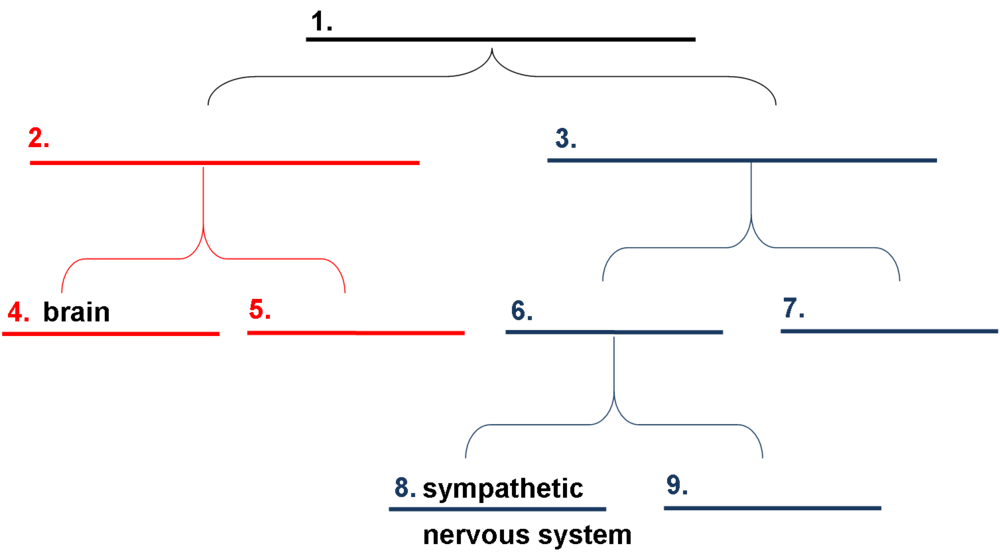
- Athe nervous system
- Bperipheral nervous system
- Cautonomic nervous sytem
- Dsomatic nervous system
- Eparasympathetic nervous system
- Fspinal chord
- Gcentral nervous system
4Complex, organized communication system of nerves and neurons is the [blank_start]nervous system[blank_end]
Includes all nerves lying outside the central nervous system is the [blank_start]peripheral nervous system[blank_end]
Consists of the brain and spinal cord is the [blank_start]central nervous system[blank_end]
Produces rapid physical changes to perceived threats and emergencies is the [blank_start]sympathetic nervous system[blank_end]
Communicates sensory and motor information is the [blank_start]somatic nervous system[blank_end]
Maintains normal bodily functions and conserves physical resources is the [blank_start]parasympathetic nervous system[blank_end]
Regulates involuntary functions such as heartbeat and respiration is the [blank_start]autonomic nervous system[blank_end]
Main organ of the nervous system, made up of billions of neurons is the [blank_start]brain[blank_end]
Handles both incoming and outcoming messages to and from the brain is the [blank_start]spinal chord[blank_end]- Aperipheral nervous system
- Bnervous system
- Ccentral nervous system
- Dsympathetic nervous system
- Esomatic nervous system
- Fparasympathetic nervous system
- Gautonomic nervous system
- Hbrain
- Ispinal chord
5Match the description to the appropriate region of the cerebral cortex
Pavia slips and falls in the bathroom and bangs her head on the tile floor. She begins to see “stars” and flashes of light, indicating some activation of brain cells in the [blank_start]___________.[blank_end]
Paul has auditory hallucinations where he thinks he hears the voices of demons, which involves activation of the [blank_start]________.[blank_end]
Leilani suffered a brain injury in a car accident which left her with temporary numbness on the left side of her body, which likely involves her [blank_start]______.[blank_end]
Albert was in an accident and is now unable to move his right hand, which likely suggests damage in the [blank_start]_____.[blank_end]
Shirley had a severe head injury and now she blurts out whatever she is thinking, regardless of the social setting; this could be linked to damage to her[blank_start]_____[blank_end]- Aoccipital lobe
- Btemporal lobe
- Cparietal lobe
- Dfrontal lobe
- Efrontal lobe
6Match the description to the brain region that is likely affected.
After Larry was hit in the head by a baseball, his movements became jerky and uncoordinated, and he could no longer type or play guitar. The baseball likely damaged his [blank_start]______[blank_end].
In the third round of a boxing match, Bruno caught a right hook that snapped his head back; when he hit the canvas, his breathing stop. He likely experienced damage to his [blank_start]_____[blank_end].
Ever since he was in a car accident 6 months ago, Lily watches the same video day after day and responds to it as if she has never seen it before. Her sensory functions are intact, but she does not seem to be able to form new memories because of damage to her [blank_start]______[blank_end].
Janna has lost her senses of taste, sight, hearing, and touch because of a brain tumor in her [blank_start]_____[blank_end].
When researchers electrically stimulated a brain region in a cat, its back arched, its fur bristled, and it showed all the characteristics of feline rage and anger. The part that was stimulated was the [blank_start]_____[blank_end].- Acerebellum
- Bbrain stem
- Chippocampus
- Dthalamus
- Eamygdala
7Dendrites in the postsynaptic neuron pick up [blank_start]___[blank_end] from the synapse. If more [blank_start]___[blank_end] than [blank_start]___[blank_end] signals are received, the postsynaptic neuron fires.
The [blank_start]___[blank_end] travels down the axon. If the axon is myelinated, the message travels more [blank_start]____[blank_end]
When the message reaches the end of the axon, neurotransmitters are released from [blank_start]___[blank_end] into the synapse. In the adjacent neurons, the process begins again.- Aneurotransmitters
- Bexcitatory
- Cinhibitory
- Daction potential
- Equickly
- Fterminal buttons
8Once an action potential reaches the end of the axon, how does the information usually get to the next neuron?
- AThe action potential jumps across the synaptic cleft to the next neuron in the form of an electrical impulse.
- BPotassium ions (K+) move back and forth between neurons to carry the information across.
- CVesicles in the terminal buttons of the axon release neurotransmitters which float across the synaptic cleft to the next neuron.
- DMyelin acts as a bridge to transport it across the synaptic cleft.
9When Liz is relaxing on the couch after lunch, her heart rate, blood pressure,breathing, and digestion all are functioning without any conscious effort on her part. This is because of a subdivision of the _______ called the ______ regulates these involuntary functions.
- Aperipheral nervous system; autonomic system
- Bperipheral nervous system; somatic system
- Ccentral nervous system; somatic system
- Dcentral nervous system; autonomic system
10Which of the following represents the correct sequence for secretion of hormones?
- Aorgans of the body, endocrine glands, pituitary gland, hypothalamus
- Bpituitary gland, organs of the body, hypothalamus, endocrine glands
- Chypothalamus, pituitary gland, endocrine glands, organs of the body
- Dendocrine glands, hypothalamus, organs of the body, pituitary gland
11The nervous system is to a _________________, as the endocrine system is to a ____
- Aslow acting & sustained duration; fast acting & brief duration
- Bfast acting & sustained duration; slow acting & brief duration
- Cslow acting & brief duration; fast acting & sustained duration
- Dfast acting & brief duration; slow acting & sustained duration
12In considering a human characteristic, we could say that the _____ provides the options and the _____ determines which option is taken.
- Achromosome; genome
- Bgenome; environment
- Cgene; genome
- Denvironment; genome
13"Heritability" refers to:
- Athe degree to which genes control a characteristic
- Bthe degree to which shared environments account for a shared characteristic among siblings
- Cthe degree to which an individual's characteristics come from their father and mother
- Dan estimate of how much of the variation in a characteristic is due to known genetic variation
Información
- Descripción
- 1 (Exam 1) Psychology 001 Test sobre PSC 1 - Chapter 3 Homework, creado por Olivia Tait el 15/10/2015.
- Autor
- Olivia Tait
- Idioma
- English
- Visitas
- 367
- Etiquetas
- Valoración
- Aún sin valoraciones Valora este test