
Test
Protein section 2
Este test tiene tipos de pregunta que se abren en el reproductor de siempre.
Preguntas del test (45)
1Amino acids are grouped according to their [blank_start]physico-chemical[blank_end] properties and this is reflected in the genetic code
- Aphysico-chemical
- Bbinding
- Cstructural
- Dbiological
2A single base change in the [blank_start]third[blank_end] position of the codon will often produce the same amino acid and in the [blank_start]second[blank_end] position often one with very similar physico-chemical properties.
- Athird
- Bfirst
- Csecond
- Dsecond
- Ethird
- Ffirst
3 The second base of the codon specifies whether an amino acid is...
- Apolar or hydrophobic
- Bbasic or acidic
- Cprimary or secondary
- Daromatic or non-aromatic
4Why are conservative substitutions good
- Abecause of them mutation events in the DNA sequence do not lead to a change in the function
- Bthey induce molecular evolution
- Cthey repair DNA
5How many levels of protein structure are there
- A3
- B2
- C1
- D4
- E5
6Match the level of the structure with the image
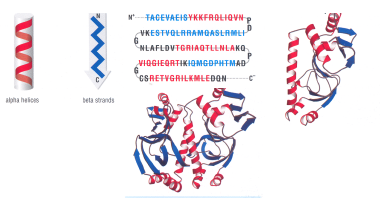
- ASecondary
- BPrimary
- CTertiary
- DQuaternary
7The amino acid sequence of the protein, dictated by the genetic code. This sequence contains all the information needed to specify:
- APrimary structure
- BSecondary structure
- CTertiary structure
- DQuaternary structure
8Regular repeating patterns of hydrogen-bonded backbone conformations such as alpha-helices and beta-sheets.
- APrimary structure
- BSecondary structure
- CTertiary structure
- DQuaternary structure
9The primary structure also dictates how these the structural elements pack together to form the overall shape of the protein in the form of folds. This is called the...
- ATertiary structure
- BQuaternary structure
- CFolding structure
10This represents the overall relative arrangement of two or more individual tertiary folded polypeptides.
- APrimary structure
- BSecondary structure
- CTertiary structure
- DQuaternary structure
11Reactivities of the elements involved in the primary structure
- AThe overall polypeptide chain
- BThe peptide bond
- CThe amino acid R groups of the primary structure
- DThe size of the amino acid sequence
12Resonance is the result of [blank_start]delocalisation[blank_end] of [blank_start]electrons[blank_end] over several [blank_start]atoms.[blank_end]
- Adelocalisation
- Bdeprotonation
- Cprotonation
- Delectrons
- Eside chains
- Fhydrogen atoms
- Gatoms
- Hmolecules
13Resonance decreases the polarity of the peptide bond and each has a dipole moment.
- AVerdadero
- BFalso
14 As we mentioned previously there is rotation allowed around [blank_start]N-Cα[blank_end] and [blank_start]Cα-C[blank_end] by angles phi and psi
Thus we have a polymer with rotatable covalent bonds which alternate with rigid planar ones
This [blank_start]restricts[blank_end] the number of [blank_start]conformations[blank_end] the polypeptide can adopt.- AN-Cα
- BN-Cb
- CCα-C
- DCb-C
- Erestricts
- Fincreases
- Gconformations
- Hbonds
15Apart from the properties of the peptide bond what other chemical reactivities does the polypeptide exhibit?
- AThe reactivity of the carbonyl oxygen and amide nitrogen of the peptide bond
- BThe various reactivities of the R groups attached to the α-carbon of the amino acids in the primary structure.
- CThe London dispersion interactions between the amino acids
- DHydrophobic effect
16[blank_start]Hydrophobic[blank_end] side chains engage in van der Waals interactions. They have a tendency to [blank_start]avoid[blank_end] contact with water and pack against each other. This is the basis for the [blank_start]hydrophobic[blank_end] effect.
Tendencies: [blank_start]Alanine[blank_end] and [blank_start]leucine[blank_end]- helix favouring residues, proline -helix breaking residue- AHydrophobic
- BHydrophilic
- Cavoid
- Dgo into
- Ehydrophobic
- Fhydrophilic
- GAlanine
- HMethionine
- ISerine
- Jleucine
- KAspargine
- LHistidine
17[blank_start]Hydrophilic[blank_end] side chains are able to make [blank_start]hydrogen[blank_end] bonds with each other, with the peptide bond, with polar organic molecules and with water. Also because some are [blank_start]charged[blank_end] and exhibit [blank_start]pKa’s[blank_end] they can change their charge depending on the [blank_start]pH[blank_end] or the microenvironment.
- AHydrophilic
- BHydrophobic
- Chydrogen
- Dcovalent
- Echarged
- Fneutral
- GpH
- HpKa
- IpKa’s
- JpH
18[blank_start]Amphipathic[blank_end] side chains have both polar and non-polar character and are ideal at interfaces and may be involved in both [blank_start]H-bonding[blank_end] and [blank_start]van der Waals interactions.[blank_end]
- AAmphipathic
- BAcidic
- CBasic
- DH-bonding
- ECovalent bonding
- Fvan der Waals interactions.
- Ghydrophobic interactions
19Hydrogen bonds are formed when a hydrogen atom has a significant partial negative charge by virtue of being bound to a more electronegative atom such as oxygen or nitrogen and is attracted to a near neighbour (less than 0.35nm) that has significant partial positive charge.
- AVerdadero
- BFalso
20The atom to which the hydrogen is attached is called the H-bond [blank_start]donor[blank_end]
- Adonor
- Bacceptor
21The charge state of the donor and acceptor changes the strength of the H-bond.
- AVerdadero
- BFalso
22To the right are some examples of H-bonding in proteins, the most important of which in the context of primary structure and its influence on the secondary structure of proteins is that between the amide [blank_start]donor[blank_end] and the carbonyl [blank_start]acceptor[blank_end] of the main chain peptide bond. The other shown are more important in tertiary structure.
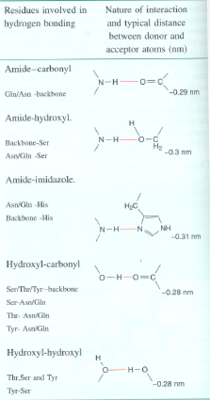
- Adonor
- Bacceptor
- Cacceptor
- Ddonor
23ALTHOUGH PROTEINS ARE LINEAR POLYMERS THE STRUCTURES OF MOST OF THEM ARE NOT THE RANDOM COILS SEEN IN SYNTHETIC NON-NATURAL POLYMERS.
- AVerdadero
- BFalso
24Most proteins are observed to be [blank_start]globular[blank_end] and have a [blank_start]tightly packed[blank_end] hydrophobic core which consists primarily of hydrophobic amino acids. One very striking feature of the folded polypeptide chain is that the chain of amino acids takes up conformations in which the torsion angles phi and psi of the backbone chain repeat in regular patterns.
- Aglobular
- Blinear
- Ctightly packed
- Dloose
25Types of secondary structure
- AHelices
- BBeta sheets
- CBeta turns
- DGlobulin
26The most common of these is alpha helix
- AHelices
- BBeta-sheets
- CBeta-turns
27Sometimes known as pleated sheets. These sheets can exist as parallel or anti-parallel.
- ABeta sheets
- BBeta turns
- CHelices
28here the chain is forced to turn sharply in a reverse direction, this small secondary structure element allows for the compact folding of proteins.
- AHelices
- BBeta sheets
- CBeta turns
29The network of regular [blank_start]secondary[blank_end] structures contributes very significantly to the [blank_start]stability[blank_end] of the overall folded protein providing extensive networks of [blank_start]hydrogen[blank_end] bonds in which many consecutive residues are involved. All of the [blank_start]hydrogen[blank_end] bonding capability in the secondary structure of a protein is contributed from the amide nitrogen and carbonyl oxygen of the main chain peptide bond as [blank_start]donor[blank_end] and [blank_start]acceptor[blank_end] respectively.
This hydrogen bonding provides much of the stabilising [blank_start]enthalpy[blank_end] which allows the polar backbone amide and carbonyl groups to exist in the very [blank_start]hydrophobic[blank_end] environment in the interior of a folded protein.- Asecondary
- Bprimary
- Cstability
- Dconformation
- Esize
- Fhydrogen
- Gcovalent
- Hhydrogen
- Icovalent
- Jdonor
- Kacceptor
- Lacceptor
- Mdonor
- Nenthalpy
- Oentropy
- Phydrophobic
- Qhydrophylic
30The carbonyl oxygen atom (n) of each residue accepts an H bond from the amide nitrogen four residues further along (n+5)
- AVerdadero
- BFalso
31All of the polar amide groups of this helix are hydrogen bonded to each other except the [blank_start]first[blank_end] amide hydrogen and the [blank_start]last[blank_end] carbonyl oxygen.
- Afirst
- Bsecond
- Cthird
- Dlast
- Efifth
- Ffourth
32The helix forms a [blank_start]cylindrical[blank_end] structure with the walls formed by the H bonded backbone with the side chains pointing [blank_start]outwards[blank_end].
- Acylindrical
- Btetrahedral
- Cspherical
- Doutwards
- Einwards
33What is amphipathic, in what type of secondary structure can it be seen
- Ahydrophobic nature on one side of the helix and hydrophilic on the other; helices
- Bhydrophobic nature on one side of the helix and hydrophilic on the other; beta turns
- Cacidic nature on one side of the helix and basic on the other; beta sheets
- Dacidic nature on one side of the helix and basic hydrophilic on the other; coils
34Steric factors favour the left handed helix.
- AVerdadero
- BFalso
35No theoretical limit to the length of helices, very long ones up to hundreds of Angstroms have been observed in keratin (Hair protein).
- AVerdadero
- BFalso
36formed between main chain amide hydrogen and carbonyl oxygen come from backbone groups distant from each other in the primary sequence.
- AHelices
- BBeta sheet
- CBeta turns
37The strands can run in the same direction and be parallel beta sheets or in opposite directions and be anti-parallel beta sheets. It is also possible to get mixed sheets with both parallel and anti-parallel strands together. What direction is more stable?
- Aanti-parallel
- Bparallel
38indicate the directionality of the sequence
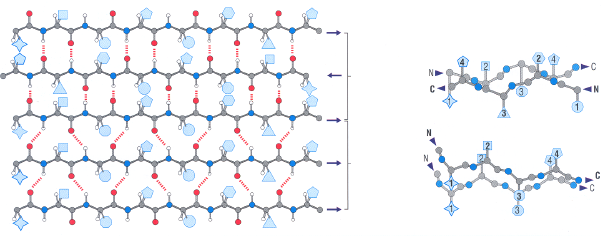
- AAntiparallel
- BParallel
- CParallel
- DAntiparallel
39 Nearly all polar amide groups are [blank_start]hydrogen[blank_end] bonded to one another in a sheet structure
The N-H and C=O groups on the outer sides of the sheets, the edge strands are not H bonded to other strand members.
These residues can H bond to [blank_start]water[blank_end], or may pack against polar side chains in perhaps a nearby [blank_start]helix[blank_end].
[blank_start]Parallel[blank_end] sheets are always buried.
Anti-parallel sheets are however frequently exposed to solvent and are probably [blank_start]more[blank_end] stable structures than parallel sheets.- Ahydrogen
- Bcovalently
- Cwater
- Dsubstrate
- Ehelix
- Fbeta sheet
- GParallel
- HAnti-parallel
- Imore
- Jless
40 parallel sheets are always separated by another structural element usually [blank_start]helices[blank_end].
beta sheet polypeptide chains are nearly fully extended (unlike helices) with distances between residues being up to [blank_start]3.3[blank_end]Angstroms.
beta strands always have a pronounced [blank_start]right[blank_end] handed twist due to steric factors arising from the [blank_start]L-amino[blank_end] acid configuration.
[blank_start]Valine[blank_end] and [blank_start]isoleucine[blank_end] are residues more commonly found in sheets.
Beta strands can be [blank_start]amphipathic[blank_end] due to the alternating consecutive side chain configuration. These strands are found on the [blank_start]surface[blank_end] of proteins.- Ahelices
- Bbeta turns
- C3.3
- D3.4
- E3.5
- Fright
- Gleft
- HL-amino
- ID-amino
- JValine
- KThreonine
- LCysteine
- Misoleucine
- NAlanine
- OGlycie
- Pamphipathic
- Qamphoteric
- Rsurface
- Sinside
41BETA SHEETS CANNOT FORM BARREL STRUCTURES
- AVerdadero
- BFalso
42What kind of protein is it?
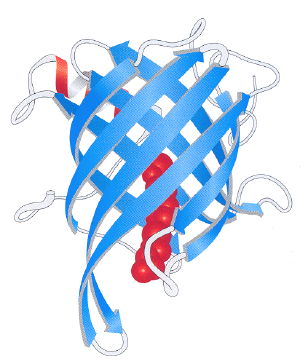
- ARetinol binding protein
- BRetinol inhibiting protein
- CCadherin binding protein
- DCadherin inhibiting protein
43Here we see retinol binding protein with a distinct [blank_start]beta barrel[blank_end] structure.
A large [blank_start]anti-parallel[blank_end] beta [blank_start]sheet[blank_end] curves all the way round with the last strand [blank_start]hydrogen[blank_end] bonded to the first thus forming a closed cylinder.
The interior of the cylinder is lined with [blank_start]hydrophobic[blank_end] residues and can accommodate retinol which is [blank_start]non-polar[blank_end].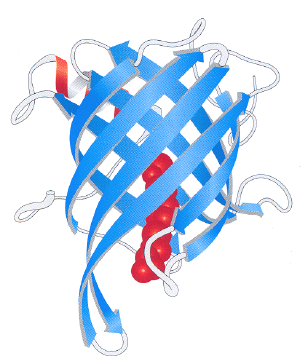
- Abeta barrel
- Balpha helix
- Canti-parallel
- Dparallel
- Esheet
- Fturns
- Ghydrogen
- Hnitrogen
- Ihydrophobic
- Jhydrophylic
- Knon-polar
- Lpolar
44The simplest secondary structural element is the beta turn and usually involves just [blank_start]four[blank_end] residues. It is very important in allowing compact folding of proteins and is often found connecting the strands of [blank_start]anti-parallel[blank_end] beta sheets.
The beat turn comprises a hydrogen bond from the carbonyl oxygen of one residue (n) to the amide N-H of residue [blank_start]n+3[blank_end]. This reverses the direction of the chain.
Beta turn are most commonly found on the [blank_start]surface[blank_end] of proteins in contact with the aqueous environment.
The tight geometry of the turn means that some amino acids such as [blank_start]glycine[blank_end] are found more commonly in turns than other bulkier groups.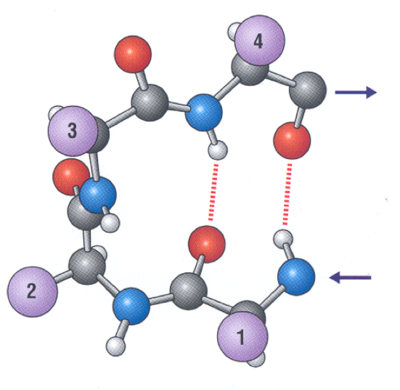
- Afour
- Bfive
- Canti-parallel
- Dparallel
- En+3
- Fn+4
- Gsurface
- Hinterior
- Iglycine
- Jphenylalanine
- Kglutamine
45What limits the number and positioning of secondary structural elements
- Asize of R group
- Bsteric constraints
- Cnature of R group
- DDirectionality
- EThe amount of peptide bonds
Información
- Descripción
- 1st year Biochemistry and molecular biology Test sobre Protein section 2, creado por MrSujg el 22/11/2015.
- Autor
- MrSujg
- Idioma
- English
- Visitas
- 215
- Etiquetas
- Valoración
- Aún sin valoraciones Valora este test