
Chemistry
Diapositivas del conjunto (7)
-
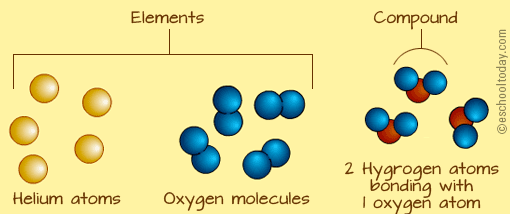
- Properties of a compound is different to the properties of the elements in which it is made.
- When the elements are joined, the atoms lose their individual properties and have different properties from the elements they are composed of.
- Pie de imagen: Showing that when 2 or more elements mix they chemically combine and their properties change.
-
- Compounds are given a certin chemical formula because they have fixed compositions,using Magnesium Oxide as an example.
- Example-ZnS-Its got this formula becasue its got Zinc atoms and Sulphur atoms chemically combined.
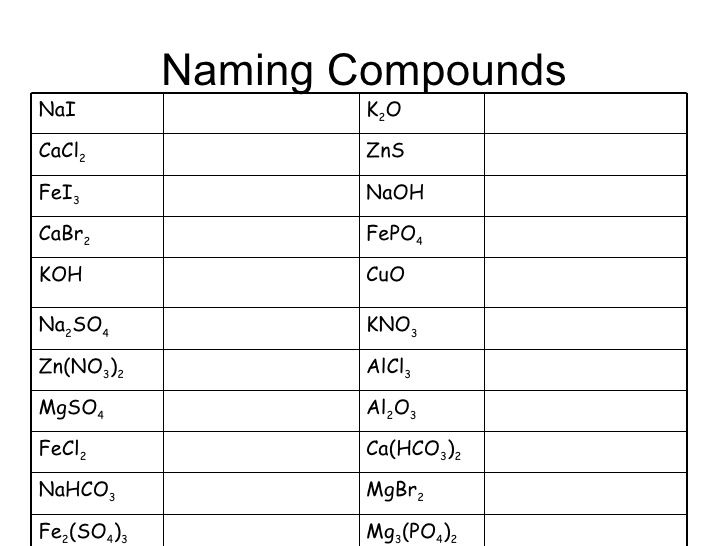
- Pie de imagen: Examples of compound formulae
-
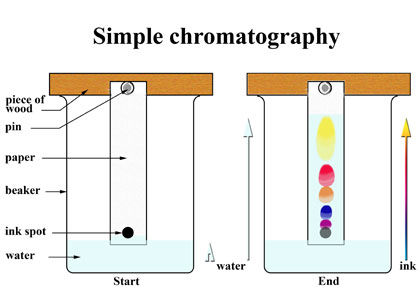
- Chromatography is a technique of separating two or more dissolved solids which are presents in a solution in very small quantities.
- Step 1:Get some Chromatography Paper small enough for it to fit into a beaker
- Step 2:Draw a PENCIL line across it(dont do it with an pen because the ink will flow up the paper with the ink.)
- Step 3:Put 2 spots of ink on the pencil line-one with pen and one with ink.
- Step 4:Get a straightened paper clip an hang it across the beaker with the chromatography paper hung over it.
- Step 5:Pour some water into the beaker making sure it DOESN'T cover the ink.
- Step 6:Watch the ink move up the paper,when the water is 3/4 of the way up take it out.
-
- There are many different techniques to separate liquids from solutes.
- For example to separate water from salt water you use evaporation.
- You heat the water up,it will evaporate then you will be left with just the salt
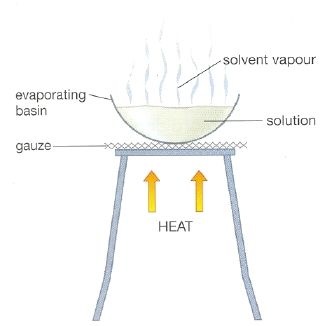
- Pie de imagen: Image showing evaporation
-
- Fresh water can be obtained from sea water by the process of desalination.
- Desalination means any process that removes the excess salt and other minerals from water in order to obtain fresh water suitable for animal consumption.
- Another word for this is evaporation
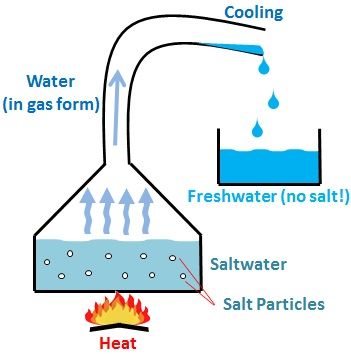
- Pie de imagen: Image showing Desalination
-
- Simple distillation is a procedure by which two liquids with different boiling points can be separated.
- It is Evaporation followed by condensation.
- Simple distillation can be used effectively to separate liquids that have at least fifty degrees difference in their boiling points.
- You would have 2 liquids that are not chemically combined(a mixture) .For example one with a boiling point of 100 degrees and one with a boiling point of 50 degrees.
- You would then heat the mixture at 50 degrees so then the liquid with a boiling point of 50 degrees will eventually evaporate and you will be left with the liquid that has a boiling point of 100 degrees.
- Then the liquid with a boiling point of 50 degrees will become condensation and you will have both liquids again only they are not combined in any way.
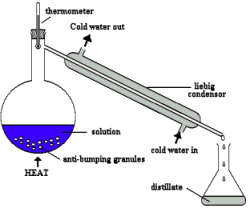
- Pie de imagen: Image of Simple Distillation
-
- Fractional Distillation is only different to Simple Distillation because instead of separating it into two parts you separate it into a number of different parts(Fractions-hence the name fractional distillation).
- This is mainly used for oils-Crude oil and fuel e.t.c
Información
- Descripción
- Year 8 Chemistry Diapositivas sobre Chemistry, creado por Ella Southall el 08/05/2017.
- Creado por
- Ella Southall
- Visitas
- 3
- Valoración