
Fichas
DNA replication
Fichas del conjunto (26)
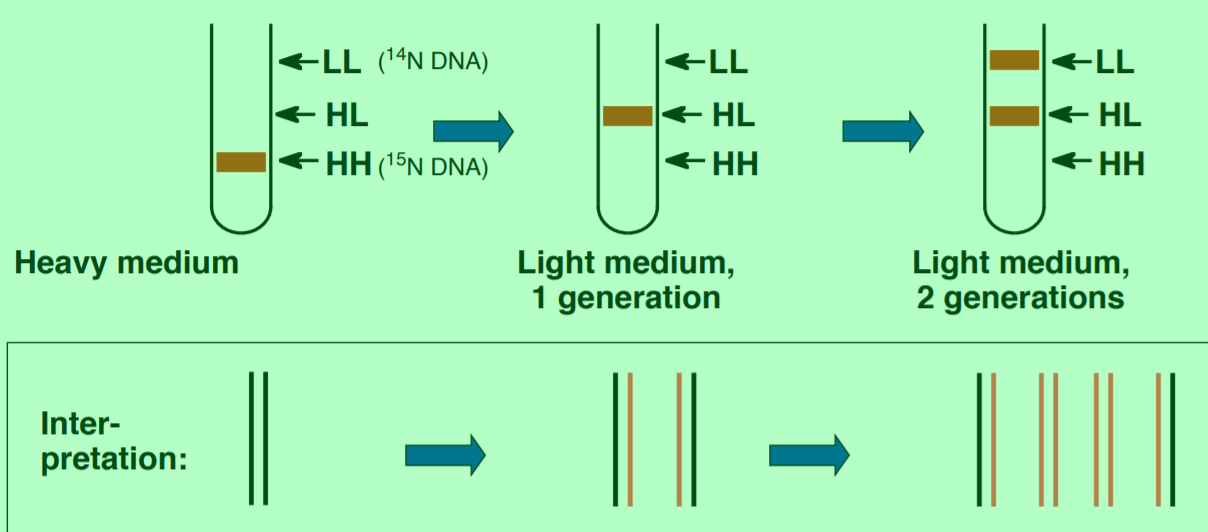
- 1How was it determined and that DNA replication is conservative?E. coli cells. Grown and transferred.Analysed by density centrifugation
- 2How many hydrogen bonds between G&C, and A&T?Three and two, respectively
- 3Principles of DNA synthesis- Primer must expose 3' hydroxyl
- DNA polymerase is synthesised in the 5' to 3' direction (leading Strand same direction as fork, lagging strand opposite direction – Okazaki fragments - 4How long are Okazaki fragments?Eukaryotes: 160 – 200 nucleotides
bacteria: 1000 – 2000 nucleotides - 5Which RNA polymerase are used by bacteria and eukaryotes respectively?Bacteria: DNA polymerase three
eukaryotes: DNA polymerases alpha, delta, Epsilon - 6What do the three copies of DNA polymerase three do in bacteria during replication?One is associated with the leading strand while the other two may take it in turns to replicate the Okazaki fragments
- 7Name and give the functions of the DNA polymerases involved in eukaryotic replicationAlpha: primates subunit – primes Okazaki fragments and leading strand during initiation, extends RNA primer with a few DNA bases
Delta: binds PCNA and finishes synthesising the Okazaki fragment
Epsilon: binds PCNA and synthesises the leading strand - 8How to DNA polymerase as remain associated with replication forks?By binding to processivity factors (processivity factors stay associated with DNA by clamping around it)
- 9What is PCNA?A processivity factor
- 10As DNA is unwound, the adjacent parts experience torsional stress/super coiling. How was this relieved?By topoisomerases
- 11What is the function of single-stranded DNA binding proteins (SSBs)?Stabilise unwound conformation, protect ssDNA from hydrolysis and formation of hairpin helices
- 12What are DNA primases?RNA polymerases that make new RNA strands for elongation by DNA polymerases
- 13What's in the CMG complex ? (A.k.a. helicase in eukaryotes)CDC 45, MCM 27, GINS
- 14Describe what is going on at the eukaryotic replication fork
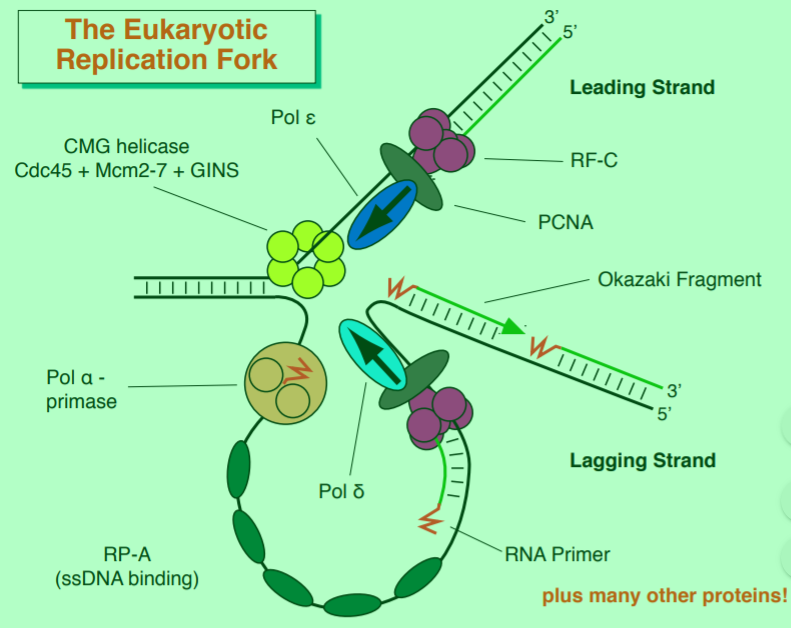
- 15Which two processing factors that every polymerase need? What are their functions?PCNA: sliding clamp (encircles double-stranded DNA and tethers polymerase to DNA)
RFC: loader (installs PCNA onto DNA/ATP -dependent, opens up PCNA, ATP hydrolysis sparks its dissociation) - 16During what Stage is the replication origins fire at in eukaryotes?S phase
- 17How did blow and Lasky, (1988) discover the licensing factor?Isolated nuclei from frog eggs at different stages of the cell cycle, transfer them to fresh extract.
Result: interphase nuclei did not re-replicate. Entry into mitosis or artificial nuclear envelope permeabilitsation allowed for replication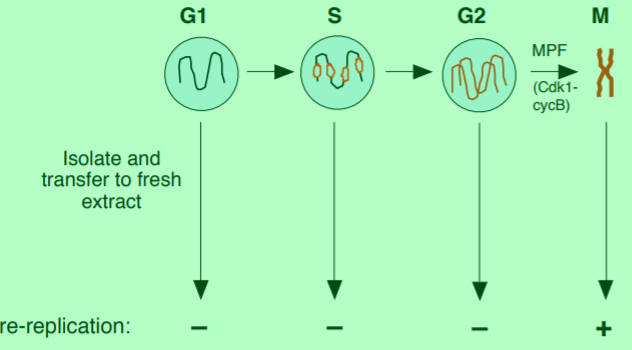
- 18Describe the licensing factor model– Licensing factor binds stably to replication origins
– LC can't access DNA once nuclear assembly has occurred
– LC required for replication initiation
– LC inactivated as it drives replication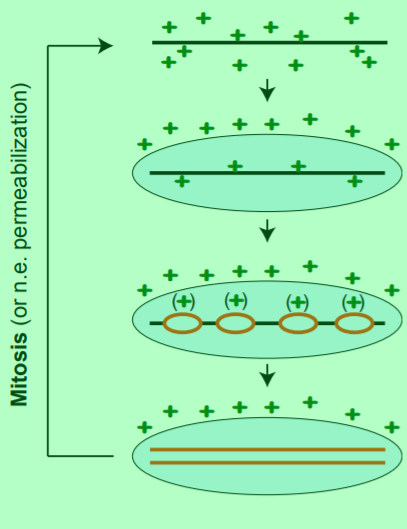
- 19Why does licensing not occur in S and G2 phase in metazoans?Low Cdt1 activity
- 20What is Geminin?A metazoan licensing inhibitor.
(Active in nuclei in late G1, S, G2 – destroyed during late mitosis, binds and inhibits Cdt1) - 21Describe the organisation of the replication origin in prokaryotesSingle origin of replication per circular chromosome, sequence specific (DnaA = replication initiator protein)
- 22How is the replication of large eukaryotic genes facilitated?Large number of replication origins that may fire at different times
- 23What was the basis of the initial licensing factor model?the essential replication factors are unable to penetrate the nucleus unless the nuclear membrane is broken (only at M phase), and hence the re-replication is prevented, due to absence of replicating factors throughout interphase
- 24Describe the licensing cycleLate mitosis and G1: replication origins licensed by loading Mcm2-7 complexes.
Other stages: licensing inhibited - 25What happens during the timing decision point?Different chromosomal regions become programed to replicate at different stages of S-phase
- 26What is the pre-replication complex composed of?-ORC (origin replication complex – already bound to origin and doesn't leave throughout cell cycle)
- Cdc6
- Cdt1
- these then load Mcm2-7
Información
- Descripción
- https://learn-eu-central-1-prod-fleet01-xythos.s3-eu-central-1.amazonaws.com/5c000dbaa1288/1679828?response-content-disposition=inline%3B%20filename%2A%3DUTF-8%27%27Ge%2520%2526%2520Blow%252C%25202009.pdf&response-content-type=application%2Fpdf&X-Amz-Algorithm=AWS4-HMAC-SHA256&X-Amz-Date=20190417T092750Z&X-Amz-SignedHeaders=host&X-Amz-Expires=21600&X-Amz-Credential=AKIAIZ3QX2YUHH4EOO3A%2F20190417%2Feu-central-1%2Fs3%2Faws4_request&X-Amz-Signature=723f8e18f54c9ebdc01dda112fb435d7679fbc83b4c457358
- Creado por
- Sophia Puliasis
- Visitas
- 9
- Valoración