
Fichas
5.2.2 Respiration
Fichas del conjunto (86)
- 1What is the need for the cellular respiration?Releases energy in organic molecules and immediately used to synthesise ATP from ADP and Pi to drive biological processes.
- 2What biological processes are driven by ATP?Active transport
Endocytosis and exocytosis
Cell division
DNA replication
Movement - 3Explain the structure of ATPATP is a phosphorylated nucleotide consisting of adenine, five carbon sugar ribose and three phosphate groups.
- 4How does ATP release energy?when it is hydrolysed
- 5Which cells are mitochondria present in?all eukaryotic cells
- 6Length of mitochondria2 - 5 um
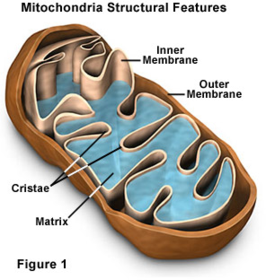
- 7Name 4 features of mitochondriainner & outer phospholipid membrane make up the mitochondrial envelope
Cristae
Intermembrane space
Mitochondrial matrix - 8What makes up the mitochondrial envelope?Inner and outer phospholipid membrane
- 9cristaeinner highly-folded mitochondrial membrane which contain electron carriers and ATP synthase enzymes
- 10intermembrane spacespace between the inner and outer mitochondrial membranes
- 11mitochondrial matrixfluid-filled inner part of mitochondria where the link reaction and Krebs cycle takes place
- 12What does the mitochondrial membrane contain?mitochondrial ribosomes, mitochondrial DNA, enzymes for the link reaction and Krebs cycle, coenzymes NAD and FAD and oxaloacetate
- 13oxaloacetate4C compound that accepts acetyl group from the link reaction
- 14Draw a mitochondrion
- 15glycolysisfirst stage or respiration which converts glucose to pyruvate, which occurs in the cytoplasm
- 16NADnicotinamide adenine dinucleotide, a coenzyme . Each NAD can accept two hydrogen atoms to become reduced NAD.
- 17Role of NAD in glycolysisa coenzyme which help dehydrogenase enzymes to oxidise triose phosphate by removing the hydrogen atoms. Each NAD can accept two hydrogen atoms to become reduced NAD.
- 18Role of reduced NAD in aerobic resirationReduced NAD carriers protons and electrons from glycolysis, to cristae so they can be used in oxidative phosphorylation.
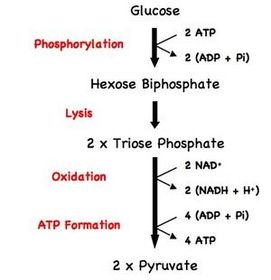
- 193 stages of glycolysisPhosphorylation of glucose to hexose bisphosphate
Lysis of hexose bisphosphate to triose phosphate
Oxidation of triose phosphate to pyruvate - 20Explain phosphorylation in glycolysis1st stage of glycolysis. ATP is hydrolysed and the released phosphate group is added to glucose making hexose monophosphate. Another ATP is hydrolysed and the released phosphate group is added to hexose monophosphate making hexose bisphosphate.
- 21Hexose bisphosphate is made during the first stage of glycolysis. What happens next?Hexose bisphosphate is split into two molecules of triose phosphate
- 22What happens to triose phosphate in glycolysis?Triose phosphate is oxidated to become pyruvate. Dehydrogenase enzymes remove hydrogens from triose phosphate and 2 molecules of NAD accept the hydrogens and become reduced NAD. Four molecules of ATP are produced from ADP and Pi.
- 23Products of glycolysis for 1 glucose molecule2 ATP (4 produced, but 2 needed for the initial phosphorylation step)
2 reduced NAD
2 pyruvate - 24Draw a diagram to explain glycolysis.
- 25Where does the link reaction occur?mitochondrial matrix
- 26Where does glycolysis occur?cell cytoplasm
- 27What is the reaction after glycolysis in aerobic respiration called?link reaction
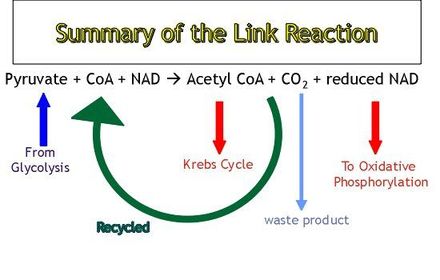
- 28Explain the link reaction.Pyruvate is decarboxylated and dehydrogenated, catalysed by pyruvate dehydrogenase enzyme, producing 1 molecule of carbon dioxide, combining 1 molecule of coenzyme A with the acetyl group making acetyl CoA and reducing NAD to reduced NAD
- 29Role of acetyl CoAcarries the acetyl group from the link reaction to the Krebs cycle
- 30For every molecule of glucose, what does the link reaction produce?For every molecule of glucose, two molecules of pyruvate produce 2 CO2, 2 red NAD and 2 acetyl CoA in the Link reaction.
- 31Draw a summary diagram of the link reaction
- 32What happens in aerobic respiration after the link reaction?Krebs cycle
- 33Where does the krebs cycle occur?mitochondrial matrix
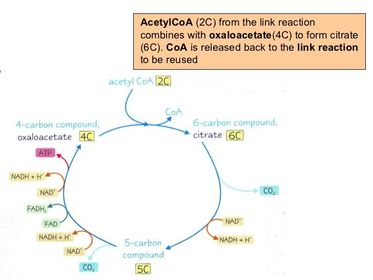
- 34Explain the krebs cycle.Acetyl group (2C) combines with oxaloacetate (4C) to produce citrate (6C)
Citrate (6C) is decarboxylated and dehydrogenated to form a 5C compound, 1 molecule of CO2 and 1 molecule of red NAD
The 5C compound is decarboxylated and dehydrogenated to form a 4C compound, 1 molecule of CO2 and i molecule of red NAD
The 4C compound undergoes substrate-level phosphorylation, producing 1 molecule of ATP
The 4C compound is dehydrogenated to form a different 4C compound and 1 molecule of red FAD
The 4C compound is dehydrogenated to form red FAD and oxaloacetate. - 35For every molecule of glucose, the krebs cycle produces .......For every molecule of glucose, the Krebs cycle produces 6 red NAD, 2 red FAD, 4 CO2 and 2 ATP
- 36Draw a diagram of the Krebs cycle
- 37Oxidative phosphorylationthe last stage of aerobic respiration which involves the formation of ATP using energy released in the electron transport chain and in the presence of oxygen
- 38Where does oxidative phosphorylation occur?In the mitochondria
- 39What structures does oxidative phosphorylation involve and where are they?Takes place in the mitochondria, involving electron transport chains and ATP synthase enzymes which are both embedded in the inner mitochondrial membranes
- 40Chemiosmosisflow of protons, down their concentration gradient, across a membrane, through a channel associated with ATP synthase
- 41Explain oxidative phosphorylation.1. Red NAD and red FAD deliver hydrogen atoms to the electron transport chain and are reoxidised
2. Hydrogen atoms are split into protons and electrons
3. Electrons pass along a chain of electron carriers which releases some energy
4. Protons are pumped across the inner mitochondrial membrane into the inner membrane space
5. Protons accumulate in the intermembrane space and a proton gradient forms.
6. Protons diffuse down concentration gradient through protein channels associated with ATP synthase enzymes, which allows ADP and PI to combine to form ATP. This is chemiosmosis.
7. Oxygen combines with electrons from the electron transport chain and protons from ATP synthase channel to form water - 42First step of oxidative phosphorylationRed NAD and red FAD deliver hydrogen atoms to the electron transport chain and are reoxidised
- 43What happens to the hydrogen atoms in oxidative phosphorylation once they leave red NAD and red FAD?split into protons and electrons
- 44Once hydrogen is split into protons and electrons in oxidative phosphorylation, what happens to the electrons?Electrons pass along a chain of electron carriers which releases some energy
- 45Once hydrogen is split into protons and electrons in oxidative phosphorylation, what happens to the protons?Protons are pumped across the inner mitochondrial membrane into the inner membrane space. Protons accumulate in the intermembrane space and a proton gradient forms. Protons diffuse down concentration gradient through protein channels associated with ATP synthase enzymes, which allows ADP and PI to combine to form ATP. This is chemiosmosis.
- 46What is the final stage of oxidative phosphorylation?Oxygen combines with electrons from the electron transport chain and protons from ATP synthase channel to form water
- 47Explain chemiosmosis in oxidative phosphorylation.4. Protons are pumped across the inner mitochondrial membrane into the inner membrane space
Protons accumulate in the intermembrane space and a proton gradient forms. Protons diffuse down concentration gradient through protein channels associated with ATP synthase enzymes, which allows ADP and PI to combine to form ATP. This is chemiosmosis. - 481 molecule of glucose in oxidative phosphorylation produces ....28 molecules of ATP
- 49Draw a table of the stages of aerobic respiration, what the products are in each stage and how many ATP molecules this makes.
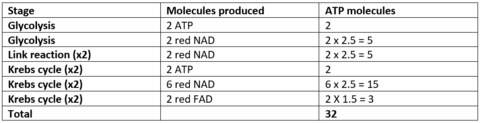
- 501 molecule of glucose theoretically produces ____ ATP molecules32
- 51Why isn't the yield of ATP as high as the theoretical yield for aerobic respiration?some ATP used to actively transport pyruvate into mitochondria
some ATP used to transport red NAD (made during glycolysis) into mitochondria
some protons may leak out through outer mitochondrial membrane - 52Explain why aerobic respiration can't occur without oxygen.Oxygen can't accept electrons at the end of oxidative phosphorylation and protons diffusing ATP synthase channels can't combine with oxygen. Concentration of protons in matrix increases and reduces proton gradient across inner mitochondrial membrane. Oxidative phosphorylation stops. Red NAD and red FAD are able to donate electrons to the electron transport chain. Krebs cycle and link reaction stops
- 53Can glycolysis occur without oxygen?yes, red NAD generated (during oxidation of triose phosphate to pyruvate) has to be reoxidised in a different way other than the electron transport chain.
- 54How can red NAD be reoxidised without aerobic respiration?Fungi & plants use the ethanol fermentation pathway
Mammals use the lactate fermentation pathway - 55What are the anaerobic respiration pathways? For which organisms?Fungi & plants use the ethanol fermentation pathway
Mammals use the lactate fermentation pathway - 56Explain what the products are of anaerobic respiration and which stage of respiration they came from.Anaerobic respiration only produce a net gain of 2 ATP. Neither ethanol or lactate fermentation produce ATP, but they allow glycolysis to continue which produces net 2 ATP per glucose
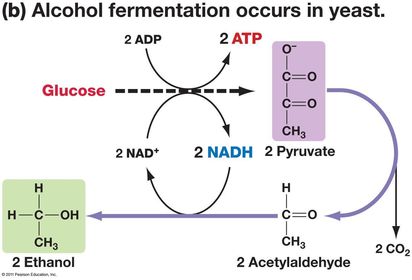
- 57Explain the ethanol fermentation pathway.Pyruvate from glycolysis is decarboxylated producing 1 CO2 and ethanal, catalysed by pyruvate decarboxylase enzyme. Ethanal accepts hydrogen atoms from red NAD forming NAD and ethanol, catalysed by ethanol dehydrogenase enzyme. Ethanal is reduced and red NAD is oxidised.
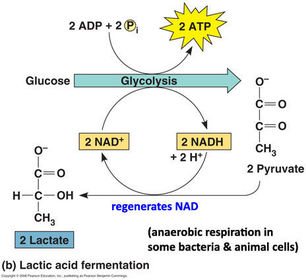
- 58Explain the lactate fermentation pathway.Pyruvate accepts hydrogen atoms from red NAD to form lactate, catalysed by lactate dehydrogenase. Red NAD has been oxidised and therefore glycolysis can continue to make ATP.
- 59Draw a diagram to explain the lactate fermentation pathway.
- 60Draw a diagram to explain the ethanol fermentation pathway.
- 61Explain what happens to the lactic acid in your muscles after anaerobic respiration.Lactate causing the muscles to lower in pH. If too much lactate is produced, it is removed from the mucles to the liver, via the bloodstream. When more oxygen is present, lactate is converted to pyruvate which may enter the Krebs cycle via the link reaction or it is recyled to glucose by gluconeogenesis.
- 62What happens to the lactate stored in the liver from anaerobic respiration when there is more oxygen present?lactate is converted to pyruvate which may enter the Krebs cycle via the link reaction or it is recyled to glucose by gluconeogenesis.
- 63Explain an experiment with yeast to investigate aerobic respiration?Put a known volume and concentration of a substrate solution such as glucose into a test tube, along with a buffer solution. Put in a 25 degree water bath and leave to stabilise for 10 mins.
Add a known mass of dried yeast to the test tube and stir for 2 mins. After it has dissolved, put a bung in the test tube with a tube to a gas syringe set to 0.
Start the stop watch and every 30 secs record the volume of CO2 gas in the gas syringe.
Repeat with a control where no yeast is present.
Repeat 1-4 three times and calculate a mean rate of CO2 production. - 64Explain an experiment with yeast to investigate anaerobic respiration?Put a known volume and concentration of a substrate solution such as glucose into a test tube, along with a buffer solution. Put in a 25 degree water bath and leave to stabilise for 10 mins.
Add a known mass of dried yeast to the test tube and stir for 2 mins. After it has dissolved, put a bung in the test tube with a tube to a gas syringe set to 0.
Trickle some liquid paraffin down the inside of the test tube so that a layer settles on the surface and stops oxygen getting to the solution beneath. Yeast will respire anaerobically.
Start the stop watch and every 30 secs record the volume of CO2 gas in the gas syringe.
Repeat with a control where no yeast is present.
Repeat 1-4 three times and calculate a mean rate of CO2 production. - 65Explain how fatty acids can be used in aerobic respiration.Fatty acids broken down to many molecules of acetate that enter the Krebs cycle via acetyl CoA
- 66Explain how glycerol can be used in aerobic respiration.Glycerol is converted to pyruvate and enters Krebs cycle via the link reaction
- 67Explain how amino acids can be used in aerobic respiration.Amino acids are deaminated and enter Krebs directly or may be changed to pyruvate or acetyl CoA
- 68Explain how carbohydrates can be used in aerobic respiration.carbohydrates undergo processes to turn into glucose which is then respiried
- 69Explain how proteins can be used in aerobic respiration.only occurs in situations such as fasting, starvation and prolonged exercise. Proteins from muscles can be hydrolysed and amino acids respired directly. Amino acids are deaminated and enter Krebs directly or may be changed to pyruvate or acetyl CoA
- 70Can proteins be respired anaerobically?No, only aerobically
- 71Respiratory substratean organic substance that can be oxidised by respiration, releasing energy to make molecules of ATP
- 72Are all respiratory substrate the same energy value?Each respiratory substance has a different relative energy value
- 73Put these in order of energy value, highest to lowest: protein, carbohydrate, proteinlipid
protein
carbohydrate - 74Why are lipids the highest energy value?because the most ATP is made in oxidative phosphorylation, which requires hydrogen atoms from red NAD and red FAD. Lipids have the most hydrogen atoms per unit mass, so more molecules of ATP are made.
- 75What order do our bodies respire respiratory substrates?glucose
glycogen (carbohydrate stores)
fatty acids (in lipids)
proteins (only in starvation conditions) - 76cardiac muscles only respire ____fatty acids
- 77respiratory quotientRespiratory quotient (RQ) is the volume of carbon dioxide given out in respiration to that of oxygen used.
- 78formula for respiratory quotientRQ = carbon dioxide produced / oxygen consumed
- 79What does it mean if an organisms respiratory quotient is higher than 1?If RQ is greater than 1, some anaerobic respiration is taking place, because more CO2 is produced than oxygen being consumed.
- 80respiratory quotient of carbohydratesalways 1
- 81Respirometerapparatus used to measure the rate of respiration of living organisms by measuring the rate for exchange of oxygen and carbon dioxide
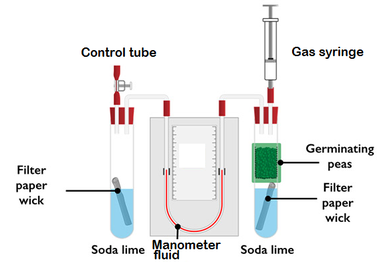
- 82Explain briefly how a respirometer works.Soda lime (aka potassium hydroxide) absorbs any CO2 produced. The oxygen in the test tube is absorbed by the respiring organism. The volume of air in the test tube decreases and so the pressure decreases. The manometer fluid is drawn up the capillary tube. The distance the fluid has moved is used to work out the volume of oxygen absorbed.
- 83Describe how to set up a respirometerSet up apparatus as shown.
Put the same mass of glass beads in the control tube as the mass of respiring organisms in the test tube
Use the syringe to set the manometer at a known level
Leave the apparatus for a set time (i.e. 20 mins)
Measure the distance moved by the manometer fluid
Distance moved X cross sectional area of capillary tube = volume of oxygen taken in
Calculate volume of oxygen per min per gram - 84Draw a diagram of a respirometer.
- 85Explain how a respirometer can be used to investigate yeast respiration.If the potassium hydroxide solution is omitted, and a suspension of yeast is put into one of the tubes, the evolution of carbon dioxide per unit time can be measured
- 86Explain how a respirometer can be made more accurate and reliable results.An oxygen sensor can be set up with a respirometer to measure the oxygen concentration inside the respirometer chamber at set time intervals. Data loggers can automatically record the data measured by the oxygen sensor. This reduces the chance of human area. The results can also be put into data analysis software which can help to draw conclusions from the data set .
Información
- Descripción
- A level (Module 5: Communication, homeostasis and energy) Biology Fichas sobre 5.2.2 Respiration, creado por Zoe Mitchell el 22/02/2017.
- Creado por
- Zoe Mitchell
- Visitas
- 18
- Valoración