
Fichas
Making crude oil useful
Fichas del conjunto (30)
- 1Why are fossil fuels finite resources?Fossil fuels are finite resources because they are no longer being made, or are being made extremely slowly.
- 2Fossil fuels are called a ...... resource?Fossil fuels are a non-renewable resource.
- 3Which specific difficulties are associated with the finite nature of crude oil?Specific difficulties associated with the finite nature of crude oil include:
- all the readily extractable resources will be used up in the future
- finding replacements. - 4What is crude oil?Crude oil is a mixture of many types of oil.
- 5Crude oil is a mixture of many types of oil. What can these types of oil be referred to as?Crude oil is a mixture of many types of oil, which are all hydrocarbons.
- 6What is a hydrocarbon?A hydrocarbon is made up of molecules containing carbon and hydrogen only.
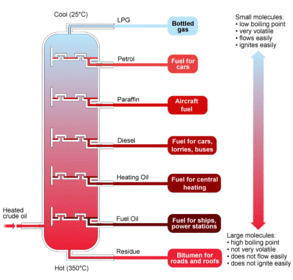
- 7Crude oil is heated at the bottom of a fractionating column. Draw a diagram of this fractionating column.
- 8Oil that doesn't boil sinks as a thick liquid to the bottom. What is this oil called?Oil that doesn't boil sinks as a thick liquid to the bottom. This is bitumen.
- 9Does bitumen have a very low or a very high boiling point?Bitumen has a very high boiling point. It 'exits' at the bottom of the column.
- 10What happens to the other fractions containing mixtures of hydrocarbons with similar boiling points?Other fractions, containing mixtures of hydrocarbons, boil and their gases rise up the column.
- 11The column is cooler at the top. Do fractions with higher or lower boiling points 'exit' towards the top column?The column is cooler at the top. Fractions with lower boiling points 'exit' towards the top of the column.
- 12Why can crude oil be separated?Crude oil can be separated because the hydrocarbons in different fractions have different sized molecules.
- 13What are the forces between the molecules called?The forces between molecules are intermolecular forces.
- 14What are intermolecular forces?The forces between molecules.
- 15What happens to the intermolecular forces during boiling?The forces between the molecules are intermolecular forces and are broken during boiling.
- 16What happens to the molecules of the liquid when these forces are broken?The molecules of the liquid separate from each other as molecules of gas.
- 17Why is a lot of energy needed to break the forces between large molecules, such as those of bitumen and heavy oil?Large molecules, such as those of bitumen and heavy oil, have strong forces of attraction, so a lot of energy is needed to break the forces between the molecules.
- 18Consequently, do these fractions have high or low boiling points.These fractions have high boiling points.
- 19Why do these fractions have high boiling points?These fractions have high boiling points because large molecules have strong forces of attraction. A lot of energy is needed to break the forces between the molecules, so a greater amount of heat is needed.
- 20Why is less energy needed to break the forces of smaller molecules, such as petrol?Small molecules, such as petrol, have weak attractive forces between them and are easily separated, so less energy is needed to break the forces between the molecules.
- 21Consequently, do these fractions have high or low boiling points?These fractions have low boiling points.
- 22Why do these fractions have low boiling points?These fractions have low boiling points because smaller molecules, such as petrol, have weak attractive forces between them and are easily separated. Less energy is needed to break the forces between the molecules, so a lower amount of heat is needed.
- 23What problems can transporting oil cause?Transporting oil can cause problems.
- Oil slicks can damage birds' feathers and cause their deaths.
- Clean-up operations use detergents that can damage wildlife. - 24Why may there be political problems related to the extraction of crude oil, particularly where the UK is dependent on oil and gas from politically unstable countries?There may political problems related to the extraction of crude oil as oil-producing nations can set high prices and cause problems for the future of non-oil producing nations.
- 25Why is there a conflict between the needs for making petrochemicals and for making fuels?There is conflict between the needs for making petrochemicals and for making fuels because the demand for oil and its products is very high.
- 26What is a fraction called naphtha in high demand for?A fraction called naphtha is in high demand for use in medicines, plastics and dyes.
- 27What is the process of cracking?Cracking is a process that turns large alkane molecules into smaller alkane and alkene molecules.
- 28What is special about an alkene molecule?An alkene molecule has a double bond.
- 29What does this double bond make it useful for?An alkene molecule has a double bond, which makes it useful for making polymers.
- 30What else can cracking helps oil manufacturers to do?Cracking also helps oil manufacturers match supply with demand for products like petrol.
Información
- Descripción
- GCSE Science Year 10 Fichas sobre Making crude oil useful, creado por annjb2898 el 18/05/2014.
- Creado por
- annjb2898
- Visitas
- 181
- Etiquetas
- Valoración