
Flashcards
Conversación #8
Cards in this deck (38)
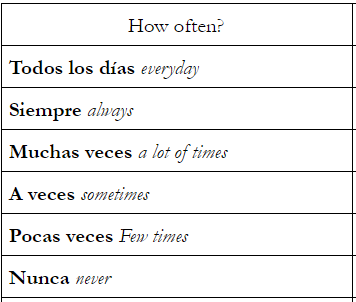
- 1Vocabulary practiceWhat house chores do you like to do?
Name 2 of them.
Me gusta... - 2Vocabulary practiceWhat house chores you don’t like to do? Name 2 of them.
No me gusta.. - 3Vocabulary practiceSay the name of an appliance that you have ("Tengo…") and, using "pero", add an appliance that you don’t have but you need ("Necesito..."). Do this three times per person. Follow the example:
Ejemplo: Tengo una lavadora, pero necesito una secadora… - 4Vocabulary practiceHow often do you do the following house chores (quehaceres de la casa)?
Hacer la cama - 5Vocabulary practiceHow often do you do the following house chores (quehaceres de la casa)?
Limpiar el baño - 6Vocabulary practiceHow often do you do the following house chores (quehaceres de la casa)?
Lavar los platos - 7Vocabulary practiceHow often do you do the following house chores (quehaceres de la casa)?
Lavar la ropa - 8Vocabulary practiceHow often do you do the following house chores (quehaceres de la casa)?
Barrer el piso/el suelo - 9Vocabulary practiceHow often do you do the following house chores (quehaceres de la casa)?
Aspirar el piso/el suelo - 10Voabulary practiceHow often do you do the following house chores (quehaceres de la casa)?
planchar la ropa - 11Vocabulary practiceHow often do you do the following house chores (quehaceres de la casa)?
Sacar la basura - 12Vocabulary practiceHow often do you do the following house chores (quehaceres de la casa)?
Sacar el reciclaje - 13Vocabulary practiceHow often do you do the following house chores (quehaceres de la casa)?
Regar las plantas - 14Vocabulary practiceHow often do you do the following house chores (quehaceres de la casa)?
Aspirar los muebles - 15Estar practice (emotional and physical states)What do you do when...?
1) Cuando estás contento/a
Ejemplo: Cuando estoy contento, veo series. - 16Estar practice (emotional and physical states)What do you do when...?
2) Cuando estás triste
Ejemplo: Cuando estoy triste, escucho música. - 17Estar practice (emotional and physical states)What do you do when...?
3) Cuando estás emocionado/a - 18Estar practice (emotional and physical states)What do you do when...?
4) Cuando estás enfermo/a - 19Estar practice (emotional and physical states)What do you do when...?
5) Cuando estás preocupado/a - 20Estar practice (emotional and physical states)What do you do when...?
6) Cuando estás furioso/a - 21Estar practice (emotional and physical states)What do you do when...?
7) Cuando estás cansado/a - 22Estar practice (emotional and physical states)What do you do when...?
8) Cuando estás aburrido/a - 23Estar practice (present progressive)What are you doing at different times?
For the following times, use the present progressive tense:
estar + present participle
Son las cinco de la mañana.
¿Qué estás haciendo? - 24Estar practice (present progressive)What are you doing at different times?
For the following times, use the present progressive tense:
estar + present participle
Son las once de la mañana.
¿Qué estás haciendo? - 25Estar practice (present progressive)What are you doing at different times?
For the following times, use the present progressive tense:
estar + present participle
Son las dos de la tarde.
¿Qué estás haciendo? - 26Estar practice (present progressive)What are you doing at different times?
For the following times, use the present progressive tense:
estar + present participle
Son las cinco de la tarde.
¿Qué estás haciendo? - 27Estar practice (present progressive)Son las ocho de la noche.
¿Qué estás haciendo? - 28Estar practice (present progressive)Es el mediodía.
¿Qué estás haciendo? - 29Estar practice (present progressive)Son las once de la noche.
¿Qué estás haciendo? - 30Affirmative tú commandsFor the following situations give advice to your friends using affirmative tú commands. What should they do?
1) No me gusta estar en casa.
Ejemplo: Sal al parque. - 31Affirmative tú commandsFor the following situations give advice to your friends using affirmative tú commands. What should they do?
2) No me gusta mi nuevo compañero de apartamento - 32Affirmative tú commandsFor the following situations give advice to your friends using affirmative tú commands. What should they do?
3) No tengo comida en casa - 33Affirmative tú commandsFor the following situations give advice to your friends using affirmative tú commands. What should they do?
4) No me va bien en las clases
(My classes are not going well) - 34Affirmative tú commandsFor the following situations give advice to your friends using affirmative tú commands. What should they do?
5) Estoy muy cansado/a - 35Affirmative tú commandsFor the following situations give advice to your friends using affirmative tú commands. What should they do?
6) Estoy aburrido/a - 36Affirmative tú commandsFor the following situations give advice to your friends using affirmative tú commands. What should they do?
7) Mi dormitorio está sucio - 37Affirmative tú commandsFor the following situations give advice to your friends using affirmative tú commands. What should they do?
8) Tengo mucha hambre (hungry) - 38Affirmative tú commandsFor the following situations give advice to your friends using affirmative tú commands. What should they do?
9) No tengo tiempo (time) de cocinar.
Information
- Description
- Los quehaceres del hogar, mandatos afirmativos en la forma de tú, práctica de estar.
- Created by
- Anneliese Thomae Elias
- Views
- 37
- Rating