
Flashcards
Edexcel Core 1 Maths - Key Facts
Cards in this deck (50)
- 1Formula for the gradient of a line joining two points\[ m=\frac{y_2-y_1}{x_2-x_1}\]
- 2The midpoint of \( (x_1, y_1) \) and \( (x_2, y_2) \) is...\[ \left ( \frac{x_1+x_2}{2}, \frac{y_1+y_2}{2} \right ) \]
Think of this as the mean of the coordinates \( (x_1, y_1) \) and \( (x_2, y_2) \) - 3The quadratic equation formula for solving \[ax^2+bx+c=0\]\[x=\frac{-b\pm \sqrt{b^2-4ac}}{2a}\]
- 4A line has gradient \(m\). A line perpendicular to this will have a gradient of...\[ \frac{-1}{m}\]
- 5If we know the gradient of a line and a point on the line, a formula to work out the equation of the line is...\[ y-y_1=m(x-x_1)\]
- 6Formula for the distance between two points...\[ \sqrt{\left ( x_2-x_1 \right )^2 + \left ( y_2-y_1 \right )^2} \]
- 7To find where two graphs intersect each other...... solve their equations simultaneously.
- 8To simplify \( \frac{a}{\sqrt{b}} \)... (a.k.a. 'rationalising the denominator')Multiply by \[ \frac{\sqrt{b}}{\sqrt{b}} \]
- 9To simplify \( \frac{a}{b+\sqrt{c}} \)... (a.k.a. 'rationalising the denominator')Multiply by \[ \frac{b-\sqrt{c}}{b-\sqrt{c}} \]
- 10\[\left(\sqrt{m} \right)^{3}=... \]\[\left(\sqrt{m} \right)^{3}=\sqrt{m}\sqrt{m}\sqrt{m}=m\sqrt{m}\]
- 11\[\sqrt{a}\times \sqrt{b}=...\]\[\sqrt{a}\times \sqrt{b}=\sqrt{ab}\]
- 12\[\frac{\sqrt{a}}{\sqrt{b}}=...\]\[\frac{\sqrt{a}}{\sqrt{b}}=\sqrt{\frac{a}{b}}\]
- 13To find the gradient of a curve at any point, use...Differentiation
- 14Parallel lines have the same...Gradient
- 15To find the gradient of the line \(ax+by+c=0\)...Rearrange into the form \(y=mx+c\). The value of \(m\) is the gradient.
- 16Where is the vertex of the graph \[y=\left ( x+a \right )^2+b\]?\[\left ( -a,b \right )\]
- 17The discriminant of \(ax^2+bx+c\) is...\[b^2-4ac\]
- 18The discriminant of a quadratic equation tells us...How many roots (or solutions) it has.
This will be how many times it crosses the \(x\)-axis - 19If a quadratic equation has two distinct real roots, what do we know about the discriminant?\[b^2-4ac>0\]
- 20If a quadratic equation has two equal roots, what do we know about the discriminant?\[b^2-4ac=0\]
- 21If a quadratic equation has no real roots, what do we know about the discriminant?\[b^2-4ac<0\]
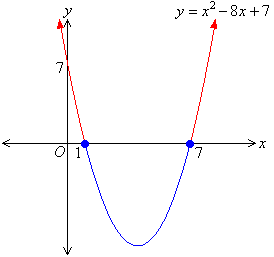
- 22Here is the graph of \(y=x^2-8x+7\). Use it to solve the quadratic inequality \(x^2-8x+7>0\)\(x<1\) or \(x>7\)
These are the red sections of the curve.
Note - do not write \(x<1\) and \(x>7\) - the word 'and' implies \(x\) would need to be \(<1\) and \(>7\) at the same time... which is clearly not possible! - 23If \(y=ax^n\), then \(\frac{dy}{dx} =...\)\[\frac{dy}{dx} =anx^{n-1}\]
- 24If \(y=ax^n\), then \(\int y\; dx = ...\)\[\int ax^n \, dx = \frac{ax^{n+1}}{n+1}+c\]
- 25What effect will the transformation \(y=f(x)+a\) have on the graph of \(y=f(x)\)?Translation \(a\) units in the \(y\) direction.
i.e. the graph will move UP by \(a\) units - 26What effect will the transformation \(y=f(x+a)\) have on the graph of \(y=f(x)\)?Translation \(-a\) units in the \(x\) direction.
i.e. the graph will move LEFT by \(a\) units - 27What effect will the transformation \(y=af(x)\) have on the graph of \(y=f(x)\)?Stretch, scale factor \(a\) in the \(y\) direction.
i.e. the \(y\) values will be multiplied by \(a\) - 28What effect will the transformation \(y=f(ax)\) have on the graph of \(y=f(x)\)?Stretch, scale factor \(\frac{1}{a}\) in the \(x\) direction.
i.e. the \(x\) values will be divided by \(a\)
[This could also be described as a 'squash', scale factor \(a\) in the \(x\) direction] - 29If we differentiate \(y\) twice with respect to \(x\), what do we get?\[\frac{d^2 y}{dx^2}\]
- 30What effect will the transformation \(y=f(-x)\) have on the graph of \(y=f(x)\)?Reflection in the \(y\) axis
- 31What effect will the transformation \(y=-f(x)\) have on the graph of \(y=f(x)\)?Reflection in the \(x\) axis
- 32\[\left ( \sqrt[n]{x} \right )^m=... ?\]\[\left ( \sqrt[n]{x} \right )^m=x^\frac{m}{n}\]
- 33\[a^{-n}=...?\]\[a^{-n}=\frac{1}{a^n}\]
- 34\[a^0=...?\]\[a^0=1\]
- 35\[x^{\frac{1}{n}}=...?\]\[x^{\frac{1}{n}}=\sqrt[n]{x}\]
- 36\[\left ( ab \right )^n=...?\]\[\left ( ab \right )^n=a^n b^n\]
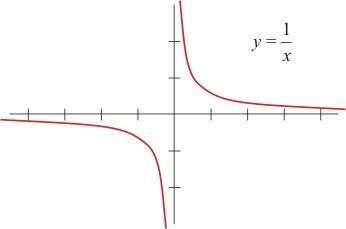
- 37What does the graph of \(y=\frac{1}{x}\) look like?
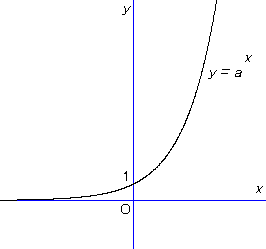
- 38What does the graph of \(y=a^x\), where \(a>0\) look like?The \(x\) axis is an asymptote
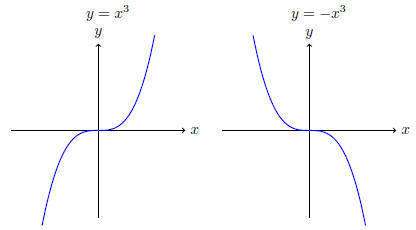
- 39What do the graphs \(y=x^3\) and \(y=-x^3\) look like?
- 40What does \(\sum_{r=1}^{4}a_r\) mean?\[\sum_{r=1}^{4}a_r=a_1+a_2+a_3+a_4\]
- 41Formula for the \(n\)th term of an arithmetic sequence... [given in the formulae booklet]\[u_n=a+(n-1)d\]
- 42Formula for the sum of the first \(n\) terms of an arithmetic sequence... [given in the formulae booklet]\[S_n=\frac{n}{2}\left ( 2a+(n-1)d \right )\]
or
\[S_n=\frac{n}{2}\left ( a+l \right )\]
where \(l\) is the last term - 43If we are given \(\frac{dy}{dx}\) or \(f'(x)\) and told to find \(y\) or \(f(x)\), we need to...Integrate
[remember to include \(+c\)] - 44Integration is the reverse of ... ?Differentiation
- 45Differentiation is the reverse of ... ?Integration
- 46The rate of change of \(y\) with respect to \(x\) is also called...?\[\frac{dy}{dx}\]
- 47The formula for finding the roots of \[ax^2+bx+c=0\]\[x=\frac{-b\pm \sqrt{b^2-4ac}}{2a}\]
- 48\[a^m \div a^n = ... ?\]\[a^m \div a^n = a^{m-n}\]
- 49\[\left (a^m \right )^n=...?\]\[\left (a^m \right )^n=a^{mn}\]
- 50To simplify \( \frac{a}{b-\sqrt{c}} \)... (a.k.a. 'rationalising the denominator')Multiply by \[ \frac{b+\sqrt{c}}{b+\sqrt{c}} \]
Information
- Description
- Key points and important formulae for the Edexcel GCE Maths C1 module
- Created by
- Daniel Cox
- Views
- 473
- Tags
- History
-
- Created by Daniel Cox · Apr 12, 2016
- Copied by Daniel Cox · Apr 12, 2016
- Rating