
1023038


| Question | Answer |
| Name some materials that come from living things. | -cotton -paper -silk -wool |
| How are synthetic materials produced? | by chemical synthesis |
| what can crude oil be used for? | -fuel -lubricants -raw materials for chemical synthesis |
| where is crude oil found? | The earth's crust |
| what is crude oil a mixture of? | hydrocarbons |
| What are hydrocarbons made from? | carbon and hydrogen atoms |
| do hydrocarbons have short or long molecules? | they can have both short and long chain molecules |
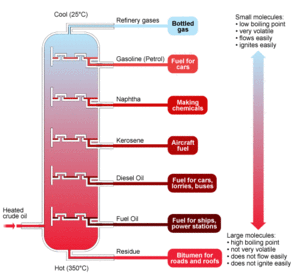
| how is crude oil separated? | by fractional distillation |
| what is similar about the hydrocarbons in a fraction? | their boiling points |
| what are the stages of fractional distillation? | 1) crude oil is heated to evaporate all of the hydrocarbons 2) the vapour passes into the fractionating column near the bottom and cools as it rises 3) each fraction condenses to a liquid and runs off when it has cooled below its boiling point 4) any remaining gases leave the tower at the top and are used as gaseous fuels |
| Fractional Distillation Tower | |
| what is the force called that hold molecules together in a solid or a liquid? | intermolecular forces |
| The longer the hydrocarbons the ........ these intermolecular forces are | stronger |
| what do stronger intermolecular forces forces need to overcome the strong forces? | more energy |
| a ...... temperature is needed to boil longer hydrocarbon fractions. | higher |
| Name some differences in solid materials. | -different melting points -different densities -can be either strong or weak -can be rigid or flexible |
| what do manufactures test their materials for? | -durability -effectiveness of the product |
| what are the properties and uses of 1) unvulcanised rubbers 2) vulcanised rubbers 3) plastic (polythene) 4) plastic (polystyrene) 5) synthetic fibers (nylon) 6) synthetic fibers (polyester) | 1) soft and flexible - erasers 2) hard and flexible - car tyres 3) lightweight - plastic bags 4) lightweight - coffee cups 5) lightweight - Clothing 6) lightweight - clothing |
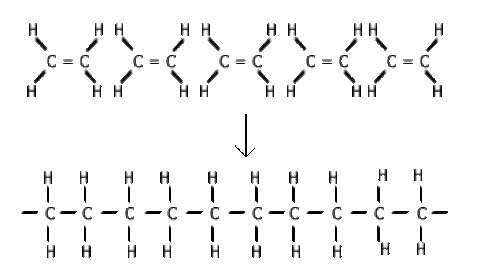
| what is the process of polymerisation? | monomers are joined together to make very long molecules called polymers |
| an example of polymerisation. | the polymer poly(ethene) is made from ethene monomers |
| what must be the same in both the reactants and products during a chemical reaction? | the number of atoms in each element |
| the production of polythene | |
| by choosing different monomers for the polymerisation process, what can chemists produce? | a range of polymers with different properties |
| name the properties and uses for 1) monomer - Chloroethene polymer - polychloroethene 2) monomer - tetrafluiriethene polymer - polytetrafluiriethene | 1) rigid and resistant to UV, Window frames 2) Very slippery, high melting point, non-stick frying pans |
| why have natural materials been replaced by polymers? | because they have superior properties |
| give an example of a natural material that has been replaced by a polymer and state its use | paper bags have been replaced by plastic bags because they are stronger and more water proof |
| what do the properties of solid materials depend on? | the way their particles are arranged and held together |
| describe the molecules, bonds and forces in natural rubber | it has long-chain molecules, the atoms within the chains are held together by strong covalent bonds, however there are weak forces between the molecules |
| what is natural rubber so flexible? | the polymer molecules can slide over each other and the material can stretch |
| why does natural rubber have a low melting point? | it needs little energy to separate the molecules |
| what is vulcanised rubber? | a ass of tangled molecules where the atoms within a chain are held together by strong covalent bonds |
| what is a cross link? | a very strong covalent bond between long chain molecules |
| what are the properties of vulcanised rubber? | -quite rigid and hard to stretch as the molecules won't slide over each other -needs lots of energy to separate the molecules and has a high melting temp |
| what causes the properties of polymers to change? | modification |
| what does increasing the chain length do to a polymer? | it means there is more contact and therefore there are stronger forces between the molecules, this makes the plastic stronger |
| what are cross links formed by? | atoms bonding between polymer molecules |
| what do cross links do? | they prevent the polymer from moving and it makes it a harder, stronger and stiffer material |
| give an example of cross-linking and explain what this means | vulcanisation - atoms form cross-links between the rubber molecules |
| what does a plasticizer do? How? | makes a polymer soft and more flexible, this is because it makes the chains weaker and then molecules can move more easily |
| what is a plasticizer? | a small molecule that sits between molecules and forces chains apart |
| what is plasticized PVC used in? | children's toys |
| what is a crystalline polymer? | molecules in a polymer have been packed closely together |
| what are the properties of a crystalline polymer? | it is stronger, denser and has a higher melting point |
| how big is a nanometre? | one millionth of a millimetre |
| how do nanoscale particles occur? | -naturally in sea spray -accidental result of human activity, e.g. particulates from carbon -being made by scientists, this is nanotechnology |
| why do nanoscale particles have different properties to larger particles? | smaller molecules have a larger surface area |
| what is nanotechnology? | the production, study and control of tiny particles on a nanoscale |
| give two examples how nanoparticals have been used to modify properties of other materials | -silver nanoparticals used to give fibers in clothes an antibacterial property -adding carbon nanotubes to sports equipment such as tennis rackets to make them lighter and stronger |
| why are people worried about nanotechnology? | it is very new and has not been properly tested, this could lead to health problems in the future |
Want to create your own Flashcards for free with GoConqr? Learn more.