
Flashcards
Phonetics Flashcards
Cards in this deck (147)
- 1citation stylestyle of speech based on what the word should be pronounced
- 2connected speechstyle of speech used in everyday conversation
- 3free variationpronunciation of a phoneme differs but does not affect meaning
- 4complementary distributionthe two different phonemes never occur in the same environment (eg one always before a vowel, the other never before a vowel)
- 5allophoneall the various pronunciations of a phoneme
- 6diacriticsmarkings that can be added to transcriptions to add extra detail
- 7broad transcriptionsimplest type of transcription - basic phonemes only
- 8narrow transcriptiona more detailed form of transcription that distinguishes between allophones and uses diacritics
- 9impressionistic transcriptiona transcription made without knowledge of the allophonic distributions of sounds, eg because it is a language the transcriber doesn't know
- 10phonemic transcriptionbasic, based on theory
- 11phonetic transcriptioncomplex, based on actual speaking
- 12supraglottal / supralaryngeal tractspace above the glottis (oral cavity)
- 13larynxcontains vocal folds
- 14glottisspace between vocal folds
- 15subglottal / sublaryngeal tractspace below the glottis (pulmonic cavity)
- 16pulmonicusing the lungs
- 17pharyngeal cavitytube-like cavity above the larynx and behind the tongue
- 18oral cavitycavity that contains the most articulators, that we can feel with our tongue
- 19nasal cavityabove the oral cavity
- 20initiationgetting the air moving
- 21phonationwhat is happening at the vocal folds
- 22articulationwhat the speech articulators are doing to modify the air flow
- 23airstream mechanismsall the different ways we can produce an airflow for speech
- 24active articulatorthe moving articulator
- 25passive articulatorthe stationary articulator
- 26egressiveair moving outwards
- 27ingressiveair being pulled inwards
- 28vital capacitytotal amount of air that can be expelled from the lungs
- 29expiratory phasebreathing out
- 30arytenoid cartilagessmall pieces of cartilage that control part of the movement of the vocal folds
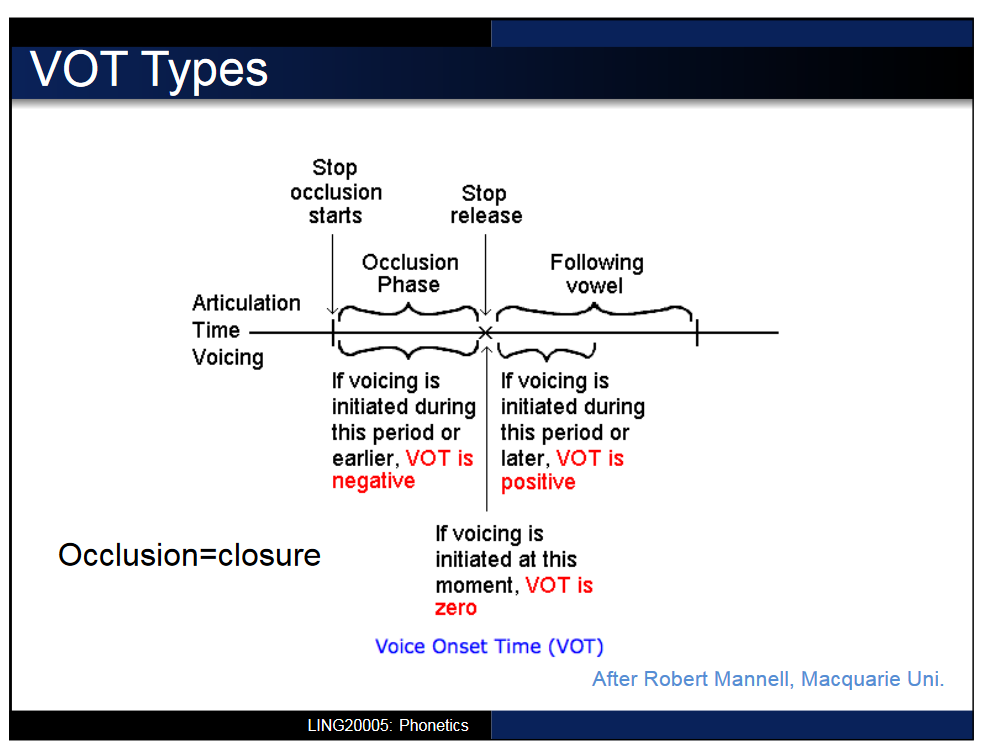
- 31voice onset time (VOT)the space of time between the release of a consonant and voicing
- 32glottisspace between the vocal chords
- 33thyroid cartilagecartilage in front of the larynx (adam's apple)
- 34cricoid cartilagecartilage underneath the larynx, at the top of the trachea
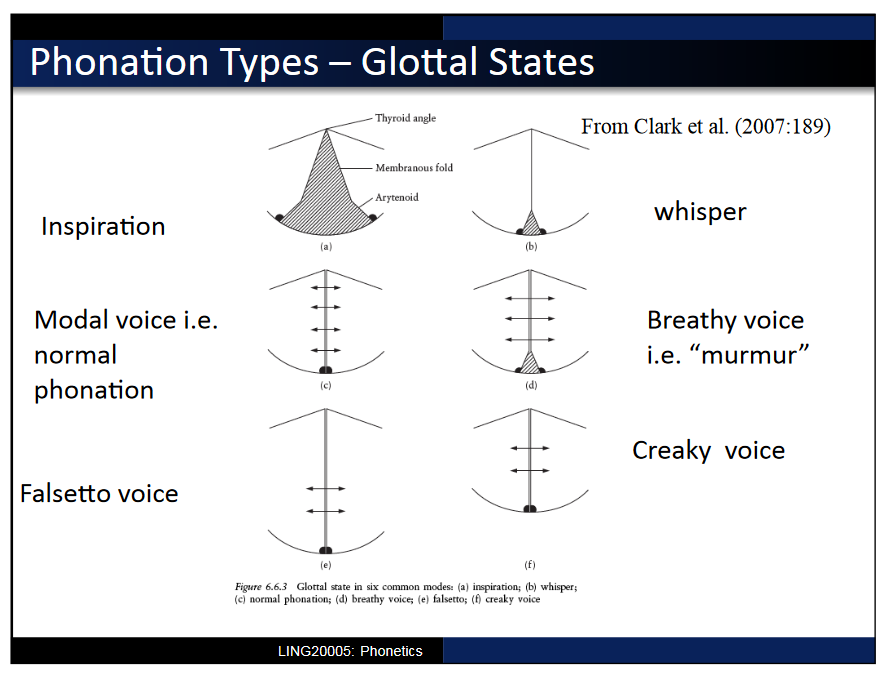
- 35epiglottisa flap attached to the front of the throat which shuts off the glottis when swallowing
- 36pharynxarea between the root of the tongue and the throat, above the vocal chords
- 37normal (modal) voicingvocal chords work along their whole length
- 38voicelessvocal chords are completely held apart
- 39whispera narrow opening is left, usually at the arytenoid cartilages
- 40breathy voicethe vocal chords flap without touching
- 41creaky / laryngeal voiceshortened, thickened chords move slowly
- 42hertzrate of vibration cycles in one second. 175 hertz means 175 vibrations per second
- 43VOT leadvoicing starts before release of the consonant (eg a voiced stop)
- 44VOT lagvoicing follows after release of the consonant (eg a voiceless aspirated stop)
- 45coincident VOTvoicing starts exactly when the release of the consonant ends (eg a voiceless stop)
- 46stop / plosiveair is completely blocked off and then released
- 47lateralchannels air to the sides of the tongue
- 48affricatea stop followed by a fricative
- 49fricativeobstructs, but doesn't completely stop, the flow of air
- 50sibilantthe 's' family
- 51approximantmore open than a fricative
- 52trillrapid and repetitive contact between two articulators
- 53tap / flapone articulator taps very briefly against another
- 54vocal folds are apartabducted
- 55vocal folds are togetheradducted
- 56bernoulli effectstatic pressure + dynamic pressure = total pressure
- 57opening quotientproportion of each vibration cycle in which vocal folds are open
- 58jitterrandom variation in frequency (across time)
- 59shimmerrandom variation in amplitude (height)
- 60how the glottis looks for different phonation types
- 61closed phase of a stopocclusion
- 62diagram of how VOT works
- 63preaspirationaspiration begins before the stop
- 64the six features used to describe consonantsairstream
laryngeal quality
nasality
laterality
stricture
place - 65escape channeloral or nasal
- 66stricturestops
affricates
fricatives
approximants
trills
taps and flaps - 67velar portthe place where the velum can open or close to make a nasal or not
- 68what sort of noise quality are fricatives characterised by?aperiodic (no patterns in close up sound waves)
- 69taparticulators move up and down
- 70flaparticulators move back to front
- 71obstruentsstops, fricatives and affricates
- 72sonorantsnasals and approximants
- 73glidessemi-vowel approximants (w, j)
- 74liquidsrhotics and laterals
- 75referring to use of the full tonguelingual
- 76referring to use of the tip of the tongueapical
- 77referring to use of the blade of the tonguelaminal
- 78referring to use of the back part of the tonguedorsal
- 79coronaltongue tip and blade
- 80dorsaltongue dorsum (centre)
- 81radicaltongue root
- 82bilabialinvolving both lips
- 83linguo-labialtongue touches inner edge of top lip
- 84labio-dentallips and teeth
- 85apico-dentaltip of tongue against teeth (dental sounds)
- 86lamino-dentalblade of tongue against teeth
- 87apico-alveolarapex of tongue on alveolar ridge
- 88lamino-alveolarblade of tongue on alveolar ridge
- 89apico-postalveolarapex of tongue on or near back end of alveolar ridge
- 90lamino-postalveolar / palato-alveolarblade of tongue against extreme back of alveolar ridge
- 91sublamino-postalveolar (retroflex)underside of blade against extreme back of alveolar ridge
- 92dorso-prepalatal / alveo-palataldorsum against or very close to touching the front of the hard palate
- 93dorso-palataldorsum against middle of hard palate
- 94dorso-velardorsum of tongue against velum
- 95dorso-uvulardorsum against uvula
- 96pharyngeal (radical)in the pharynx (back of mouth, tongue straight backwards)
- 97glottal (laryngeal)using the glottis
- 98coarticulationvariation in how a phoneme is pronounced to make it easier to say next to other phonemes (like a labiodental 'm' in 'emphasis'
- 99anticipatory coarticulationthe previous phoneme is affected
- 100carryover (perseverative) coarticulationthe sound after is affected
- 101homorganicarticulators used in successive sounds are the same
- 102heterorganicarticulators used in successive sounds are different
- 103vowel apertureheight
- 104backingposition of the tongue - front, centre, back
- 105roundingwhether or not the lips are rounded
- 106vowel lengthlong or short
- 107tensenesstense or lax (tense is longer, lax is shorter)
- 108vowel complexitymonophthongs, diphthongs, triphthongs
- 109how many aperture contrasts are there for vowels?ipa says 7, but there is evidence for 4 in some languages
- 110added features that may be found in vowelsnasalisation
advanced tongue root
rhoticity - 111fricative vowelssequences of fricatives that aren't vowels, but sound like a vowel when they are pronounced
- 112closing diphthongmoves upwards in vowel space
- 113centering diphthongvowel moves towards the centre of vowel space
- 114offglide and onglideone vowel in a diphthong is stronger than the other and this is transcribed using superscripting
offglide: weak comes after
onglide: weak comes before - 115fronting diphthongsmoving towards the front of the vowel space
- 116rounding diphthongsmovement from unrounded to rounded
- 117frequencynumber of cycles per second
- 118periodtime it takes to complete one cycle
- 119sinusoidal wave(sine wave) - a periodic / simple wave
- 120complex wavethe combination of two or more sinusoidal waves
- 121difference between periodic and type of waveformperiodic relates to several waveforms in a row
type of waveform relates to just one wave - 122fundamental frequency (F0)the basic rate of vibration at the vocal folds
- 123formanta resonating frequency in the vocal tract
- 124in what order are formants numbered?low to high
- 125what is the first formant equivalent to?opening
(high vowel = low F1
low vowel = high F1) - 126what is the second formant equivalent to?backing
(the backer the vowel, the lower F2) - 127deletionsegments can be deleted in rapid speech to make speaking easier
- 128lenition / flappingthings are pronounce more weakly (like in "water")
- 129spirantisationwhen stops are pronounced more like fricatives in connected speech
- 130affricationwhen clusters of sounds become joined to become an affricate (like in "Tuesday")
- 131pre-glottaisationthe last stop of a word is also pronounced with a glottal stop
- 132suprasegmentals are the same as what?prosody
- 133the three main linguistic descriptors made evident by suprasegmentalsstress
tone
intonation - 134two types of tone languagesregister and contour
- 135what can stress be characterised by?length, volume and pitch
- 136what is intonation?patterns of rises and falls in F0 across a stretch of speech
- 137what suprasegmental is ToBI used for?intonation
- 138downdriftthe gradual lowering of pitch across many segments
- 139difference between full and partial tone languagesfull tone languages have tone on every vowel, partial tone languages have tone usually just on the main vowel of the word
- 140accentthe general prominence of one word or syllable relative to others in the speech stream
- 141onsetconsonants before the main vowel in a syllable
- 142nucleusthe main vowel / segment of the syllable (nucleus is the only necessary part of a syllable)
- 143codaanything coming after the nucleus in a syllable
- 144rhymethe nucleus and anything after it, combined
- 145nuclear pitch accentthe last pitch accent in an intonation phrase. must occur on a stressed syllable.
- 146phrase accentwhat happens after the last pitch accent in a phrase. the intonation 'resets' afterwards.
- 147boundary tonethe edge of an intonation phrase (%)
Information
- Description
- Phonetics Flashcards on Phonetics Flashcards, created by C L on 26/02/2018.
- Created by
- C L
- Views
- 3
- Rating