
Flashcards
Chapter 5: Elasticity & its application
Cards in this deck (16)
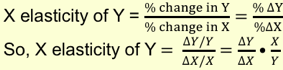
- 1Elasticity- Measures how responsive one variable (Y) is to a change in another variable (X)
- In economics, it is a measure of the responsiveness of quantity demand or quantity supplied to one or more of its determinants - 2Calculating elasticity as a ratioElasticity is a ratio of percentage changes, so is free from measurement units
- 3(Own) price elasticity of demandA measure of how much the quantity demanded of a good responds to a change in price of that good
NB: always negative, so drop the sign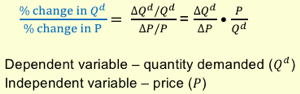
- 4Price elasticity of demand and the demand curvePrice elasticity of demand and slope inversely related i.e. ∆Q / ∆P = 1 / slope
Demand is:
- Perfectly elastic if elasticity = infinity (horizontal demand curve)
- Elastic if elasticity > 1
- Unit elastic if elasticity = 1
- Inelastic if elasticity < 1
- Perfectly inelastic if elasticity = 0 (vertical demand curve)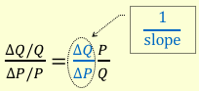
- 5Relationship between price elasticity of demand and price- On a linear demand curve, elasticity rises as price rises
- Even though the slope is constant, elasticity is not
- This is because the slope is the ratio of changes whereas elasticity is the ratio of percentage changes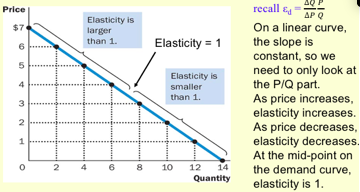
- 6Determinants of price elasticity of demand1. Availability of substitutes (no close substitute —> inelastic, close substitute —> elastic)
2. Necessities vs luxuries (necessity —> inelastic, luxury —> elastic)
3. Market definition (broad definition of market —> inelastic, narrow definition of market —> elastic
4. Time horizon (now —> inelastic in short run, future —> elastic in long run) - 7Calculating elasticity using mid-point- Elasticity calculated will be different, depending on which price and quantity are used as the base
- Therefore, use the mid-point (average) of the two prices and the mid-point (average) of the two quantities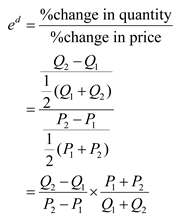
- 8Total revenue (R)Amount paid by buyers and received by sellers of a good i.e. R = P x Q
- 9Inelastic demand and total revenueFor inelastic demand, %∆Q / %∆P < 1:
- An increase in price leads to a decrease in quantity demanded that is proportionately smaller, and hence an increase in total revenue
- If demand is inelastic, then price and revenue move in the same direction - 10Elastic demand and total revenue- For elastic demand, %∆Q / %∆P > 1:
- An increase in price leads to a decrease in quantity demanded that is proportionately larger, and hence a decrease in total revenue
- If demand is elastic, then price and revenue move in opposite directions - 11Unit elastic demand and total revenueA change in price does not affect total revenue
- 12Cross price elasticity of demand- A measure of how much the quantity demanded of a good responds to a change in price of another good
- If positive, the two goods are substitutes (as quantity demanded and price of related good move in the same direction)
- If negative, the two goods are complements (as quantity demanded and price of related good move in opposite directions)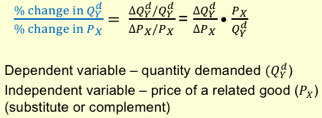
- 13Income elasticity of demand- A measure of how much the quantity demanded of a good responds to a change in customers’ income
- If positive, the good is normal (as quantity demanded and income move in the same direction)
- If negative, the good is inferior (as quantity demanded and income move in opposite directions)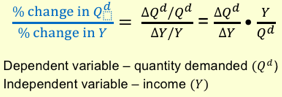
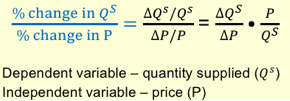
- 14Price elasticity of supplyA measure of how much the quantity supplied of a good responds to a change in price of that good
- 15Determinants of price elasticity of supply- More elastic if production capacity is more flexible e.g. supply of books is more elastic than supply of beachfront land
- More flexible in the long run so supply is more elastic in the long run - 16Price elasticity of supply and the supply curve- Perfectly elastic => horizontal supply curve
- Perfectly inelastic => vertical supply curve
Information
- Description
- Business/Economics (ECC1000: Principles of Microeconomics) Flashcards on Chapter 5: Elasticity & its application, created by Melina Mackey on 26/03/2018.
- Created by
- Melina Mackey
- Views
- 1
- Rating