
Elasticity
35 resources created by 32 users
This Elasticity page on GoConqr gathers community-made quizzes, mind maps, flashcards and notes on price, income and cross elasticity of demand, plus price elasticity of supply. It's built for school students, university students and professional candidates revising or filling gaps, and for teachers after ready-made material. There are over 240 resources here, including more than 30 quizzes and over 100 mind maps, made by more than 170 contributors. Open a mind map to get the formulas straight, then test yourself with a quiz.
Top Elasticity resources
-
43 cardsChapter 6 Homework
-
105 cardsecon final Flashcards on econ final, created by Jordyn McEvoy on 12/17/2018.
-
12 questionsECO 231 test If the price of a good increases by 15%and the quantity demanded changes by 20%, then the price elasticity ...
-
Mind map Price Elasticity of Demand
-
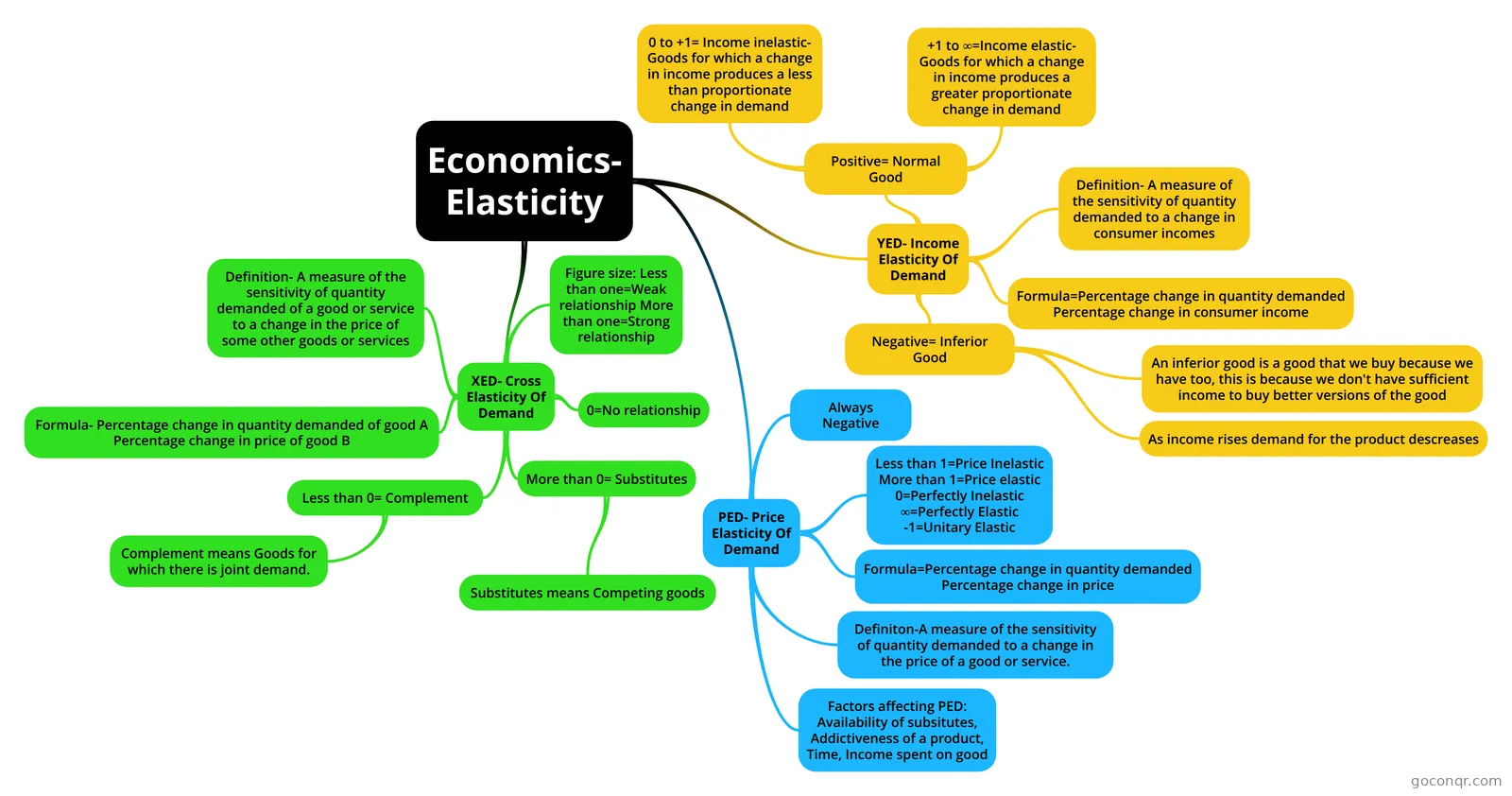 Mind map Economics- Elasticity Mind Map Defining and Explaining Elasticity of Demand
-
6 questionsChương 5 1. A life-saving medicine without any close substitutes will tend to have a. a small elasticity of demand. ...
-
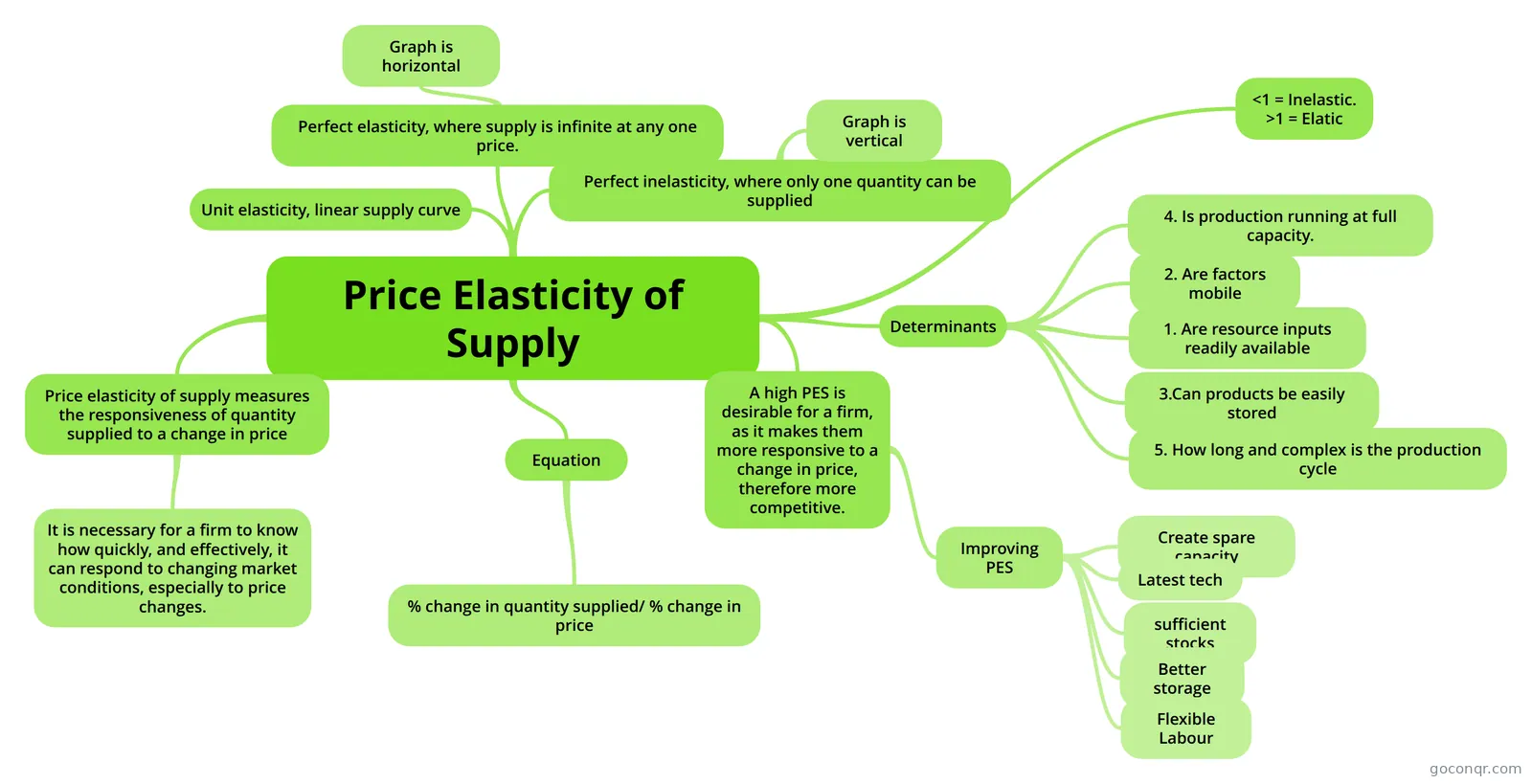 Mind map Price Elasticity of Supply
-
6 cardsChapter 3: Elasticities - Important Equations What is the formula for price elasticity of demand?
Quizzes
See all 10 quizzes-
12 questionsECO 231 test If the price of a good increases by 15%and the quantity demanded changes by 20%, then the price elasticity ...
-
6 questionsChương 5 1. A life-saving medicine without any close substitutes will tend to have a. a small elasticity of demand. ...
-
16 questionsECO.5 1. In general, elasticity is
-
10 questionsElasticity Week 4 The price elasticity of demand is a measure of
-
10 questionsMicroeconomics When is demand inelastic?
-
9 questionsPrice elasticity of demand Quiz on Maximum and minimum pricing , created by Flora Halfhide on 20/02/2018.
-
10 questionsAP Microeconomics quiz The demand for school biology textbooks is inelastic. This happens because:
-
10 questionsAp Microeconomics Quiz Perfect Competition is the opposite of?
Mind maps
Flashcards
See all 13 flashcards-
43 cardsChapter 6 Homework
-
105 cardsecon final Flashcards on econ final, created by Jordyn McEvoy on 12/17/2018.
-
6 cardsChapter 3: Elasticities - Important Equations What is the formula for price elasticity of demand?
-
71 cardsChapter 6 The ease of switching from one good to another
-
49 cardsEcon Test test 2
-
15 cardsEconomics - unit 2 - M.E., PED/IED/CED/PES Define market equilibrium.
-
21 cardsElasticity What is elasticity?
-
12 cardsEconomics Define Cross Price Elasticity of Demand (XPed)
Notes
-
Economics - Elasticity Elasticity - Various Elastic Demand: A good with many close substitutes tends to have an elastic demand. Because buyers are easily able to switch between substitutes, they are relatively sensitive to price changes. In...
-
Income Elasticity of Demand Income Elasticity of Demand The Income Elasticity of Demand (YED) of a good measures the responsiveness of the quantity demanded of a good to a change in incomeIn other words, it measures how much demand would r...
-
Formulas for Income Elasticity of Demand & Cross Elasticity of Demand
-
INCOME ELASTICITY OF DEMAND (YED)
Slides
More Economics topics
About Elasticity
GoConqr OriginalWhat this unit covers
The page is built around the main elasticity measures. The mind map Economics- Elasticity pulls together PED, YED and XED, with the percentage-change formula for each. Separate maps and flashcard decks then go deeper on Price Elasticity of Supply, price elasticity of demand and income elasticity of demand.
Where to start
Begin with an overview, then narrow down.
- Open the Economics- Elasticity mind map to see how the measures fit together.
- Read the notes Types of Elasticity and Calculating PED, then try Worked Examples for Elasticity Formulas.
- Move to the single-topic maps, such as Income Elasticity of Demand, for definitions of income elastic and inelastic goods.
Using quizzes and maps together
Read a map first, then take a quiz without looking at it. The quiz ECO 231 test includes a worked calculation: a 15% price rise and a 20% change in quantity demanded gives a PED of 1.33. Try the same sum yourself before checking the answer. If a question catches you out, go back to the matching map and read that branch again.
The flashcard deck Chapter 3: Elasticities - Important Equations is handy for memorising the PED, XED and YED formulas. Decks numbered 3.1 to 3.4 split the same ground into four short sets.
Exams and levels
Most of the material is aimed at secondary study, with a good share at university level. Some resources mention A-level Economics, IB Economics and AP Microeconomics, and there is an AP Microeconomics quiz for practice. Others are chapter quizzes from university courses, so check the title and pick what suits you.
Where it fits
Elasticity sits in the Markets and Consumers strand of Economics. Pick a resource that matches where you are now, then make your own flashcards from the formulas you keep forgetting.
Frequently asked questions
Which resource should I open first?
Start with the mind map Economics- Elasticity. It sets out PED, YED and XED together with their formulas, so you see the whole unit on one screen. After that, move to the single-topic maps or the notes on calculating PED, depending on which part you find hardest.
What do the mind maps cover?
They cover price elasticity of demand, price elasticity of supply, income elasticity of demand and cross elasticity of demand. Some also look at applications, such as how useful PED and XED are for business decisions, and at the factors that determine PED. Several are short, single-topic maps.
Are the resources free to use?
Yes. Every resource on this page is free to open, study and take, and you do not need an account. The resources were made by GoConqr users, not by GoConqr itself, so styles and depth vary from one to the next.
Which exams and levels do they suit?
Most resources suit secondary students, and a good share suit university study. Some mention A-level Economics, IB Economics or AP Microeconomics. Others follow university chapter or week numbering, so read the title and the first few questions before settling on a set.
Can I practise the formulas?
Yes. Try the flashcard deck Chapter 3: Elasticities - Important Equations for the formulas, then the notes Worked Examples for Elasticity Formulas. Quizzes such as Price Elasticity of Demand and Income Elasticity of Demand & Cross Elasticity of Demand let you check your calculations afterwards.
What if I can't find what I need?
Try a different format on the same topic, since many topics appear as a map, a deck and a quiz. A free account also lets you save quiz scores and build your own quizzes, maps, flashcards and notes for any gap you spot.