
Flashcards
Units and Dimensions
Cards in this deck (21)
- 1Units and DimensionsUnit
It is an internationally accepted standard reference.
These are used to distinguish fixed quantity.
S.I-Le systeme internationale d Unites - 2Fundamental QuantityThey are also known as base quantities
They are fundamental quantities as
a.Fundamental quantites are independent of each other.
b.All other quantities may be expressed in terms of the fundamental quantities.
No of fundamental quantities=7
Lenght /m/L
Mass/kg/M
Time/sec/T
Electric current/A/I or A
Temperature/K/K or theta
Luminous intensity/ cd /cd
Amount of Substance/mol/mol
One fundamental quantity cannot be expressed in terms of other fundamental quantities. - 3Derived QuantityThe quantites which are derived using other fundamental quantities.
For eg v=d/t etc - 4Supplementary QuantitiesNeither derived nor fundamental
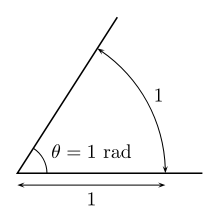
a.Angle radian/rad
l=theta*r
b.Solid angle steradian/sr
A=omega*r^2
These are dimensionless quantities.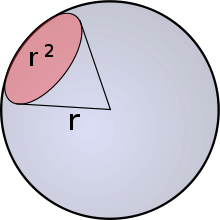
- 5DimensionsDimensional Formula
when a physical quantity is expressed in terms of powers of base quantities
The exponent used is called dimension. - 6Condition For homogenityAll equations used in physics are homogenous.
1.Two equation can be added if they have same dimensions.
2.Two quantities can be subtracted if they have the same dimensions.
3.2 quantities can be equated if they have same dimensions. - 7Quantities inside mathematical functionThey are dimensionless
for eg 2^2 Dimension= 1 - 8Derivation of formula by dimensional methodLimitations
a.This method is applicable only for power function.
b.Value of constant can not be determined.
c.If a quantity depends on more than 3 quantities then method is not applicable.
As equation will be 3 but variables equal to or >4.
d.If a quantity depends on 2 quantities having same dimensions then this method is not applicable. - 9Unit ConversionBy method of n1u1=n2u2 we can convert units.
n1/n2=u1/u2 - 104 types of quantities1.Variables with dimensions(F,density,Energy)
2.Constants with dimensions(G=6.67*10^-11 N m^2/kg^2)
3.Variable without dimensions(Refractive index(it keeps on changing=sin i/sin r)
4.Constants without dimensions
(T.S.A=4 pi r^2)
4 pi is constant - 11Some important resultsUnitless quantities cannot have dimensions.
Dimensionless quantities can have units.For eg steradian,radian etc. - 12Important Constants[G]=[M^-1 L^3 T^-2]
[c]=[LT^-1]
[h]=[ML^2 T^-1] - 13Vernier Caliper,s scaleLeast Count
It is the smallest value that can be measured by an instrument.
Actually in usual vernier scale
10*M.S=9*V.S
V.S=9/10*M.S
Clearly L.C=M.S-V.S
L.C(Least count)=1/10*M.S
=0.1mm - 14Measurement on vernier scaleLength of object=M.S+L.C*V.S
Positive error-It is to be subtracted from actual reading.
Negative error-It is to be added to actual reading. - 15Measurement on Screw GaugeIn this usually no of division=100=1 mm
1 division on circular scale is 0.01mm which is L.C.
Measurement=M.S+L.C*C.S
Pitch-It is the distance moved by the guage in one complete rotation.
Backlash error-The error during rotation of screw gauge.
To remove it re roll the screw gauge. - 16ErrorsSystematic error-It is the error in which the sign of error is same.
It can be controlled by correcting formula or correcting external condition.
Random error-In this sign of error is different for different observations.It can be minimized by taking average of observation. - 17Error due to instrumentsError due to least count
The minimum reading by an instrument is it,s least count.
Zero error-When nothing is being measured still there is some reading in instrument.
There are two types of errors 1.Positive error 2.Negative error - 18Actual Reading and ErrorActual reading(a)-It is the mean of all observation.
Mean absolute error-It is the mean of error in positive/no. of observation
Error Δa=a(i)-a(mean)
Relative error=|Mean Δa/a mean|
% error=100*|Mean Δa/a mean|
Note-2.54 cm has 0.01 that is least count as error. - 19Error in addition,subtraction and MultiplicationError in x+y =Δx+ Δy
Error %=Δx+ Δy/x+y*100
Error in x*y=|(Δx)*y|+ |x*(Δy)|
Error %=(|Δx/x|+ |Δy/y|)*100
Note:-In expression x^2*y
x should be measured more carefully. - 20Precision and AccuracyPrecision:-This gives to how many decimal places is the experimental value taken.Also,it gives the closeness of experimental value.Large random errors gives in precision for the experiment.
It depends on least count of instrument.
Accuracy:-Accuracy is how close is the experimental value to the actual value.
For a set of observations.how close is the average value to true value.Large difference in these values gives large systematic errors.
Accuracy depends on number of significant digits.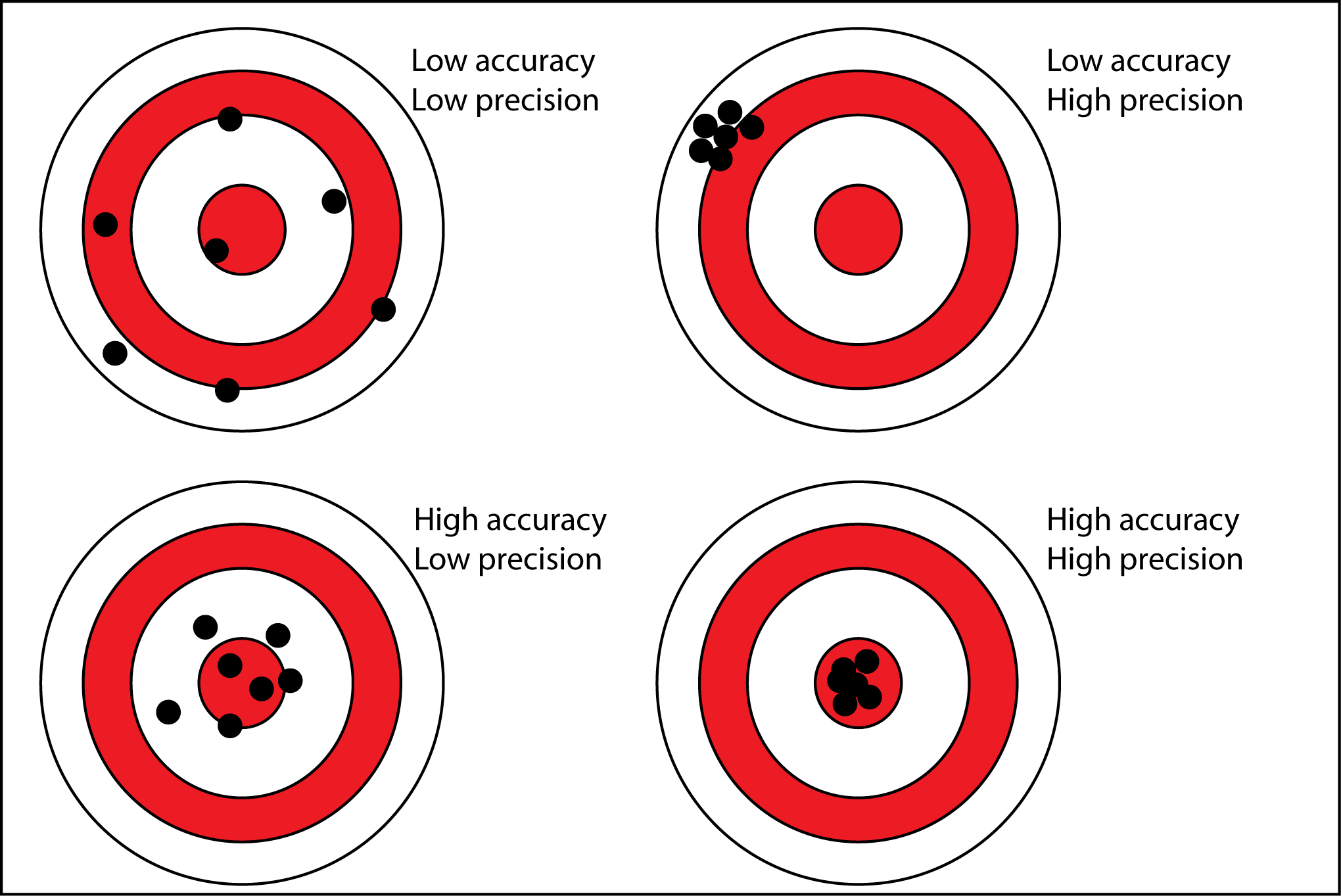
- 21More on errorsSuppose A=x/x-y
Then,Error A %=
|Δx/x|*100+|Δx+Δy/x-y|*100
Q.Velocity of (keeping mass constant) is increased by 2% then the kinetic energy will be increased by how much % ?
Ans.4%(By error method)
Q.Suppose if velocity is increased by 50%,then K.E increases by how much % ?
Ans.125%(By % method)
Information
- Description
- Flashcards on Units and Dimensions, created by Prajjwal Sanskar on 13/04/2018.
- Created by
- Prajjwal Sanskar
- Views
- 13
- Rating