
Flashcards
Unit 5 - transition metals
Cards in this deck (92)
- 1definition of a transition metal is...an element have an incomplete d or f shell either in it's element or in one of it's ions
- 2is zinc a transition metal?no
- 3is scandium a transition metal?yes, however doesn't behave like a transition metalnion when Sc3+
- 4the physical properties of transition metals from titanium to copper are...1. good conductor of heat
2. good conductors of electricity
3. hard
4.strong
5.shiny
6. have high melting and boiling points - 5what is the reactivity like in transition metalsfairly low, making these metals very useful
- 6for the electronic configuration of transitions metals, all of them have two outer 4s electrons in them except...the 2 c's
chromium and copper - 7generally as we go across the transition metalsthe electrons are added to the inner 3d sub level, which holds 10 electrons
- 8describe the electron configuration of chromiumit has a half full d sub level (3d5), and only 1 electron in the 4s sub level
- 9describe the electron configuration of coppera full d sub level (3d10) and only one electron in the 4s
- 10do the electronic configuration with a full 3d and 4s sub level1s2 2s2 2p6 3s2 3p6 3d10 4s2
note: you always fill the 4s shell first and then the 3d sub level - 11what are the 4 chemical properties of transition metal?1. variable oxidation states
2. colour
3. catalysis
4. complex formation - 12what does variable oxidation states mean?transition metal have more than one oxidation state in their compounds, e.g. Cu(I) and Cu(II)
- 13if an element has many oxidation states, what does this mean?they can take part in many redox reactions
- 14what does colour mean as a characteristic of a transition metal?majority of transition metal ions are coloured, e.g Cu2+(aq) is blue
- 15what does catalysis mean?many transition metals and their catalytic compounds show catalytic activity.
- 16where is iron used as a catalysthaber process
- 17where is vanadium oxide used as a catalystcontact process
- 18what is manganese oxide used as a catalysis for?used in the decomposition of hydrogen peroxide
- 19what does complex formation mean?transition elements form complex ions.
- 20when is a complex ion formedwhen a transition metal ion is surrounded by ions or other molecules, collectively called ligands.
- 21how are the ligands bonded to the transition metal in a complex ion?bonded to it by co-ordinate bonds
- 22[Cu(H20)6]2+ is an example of acomplex ion that is formed when copper sulfate is dissolved in water
- 23all transition metals can form co-ordinate bonds byaccepting electron pairs from other ions or molecules.
- 24a ligand isan ion or molecule with a lone pair of electrons that forms a co-ordinate bond with a transition metal
- 254 examples of ligands are:1. H20:
2. :NH3
3. :Cl-
4. :CN- - 26the co-ordination numberthe number of co-ordinate bonds to ligands that surround the d-block metal ion is called
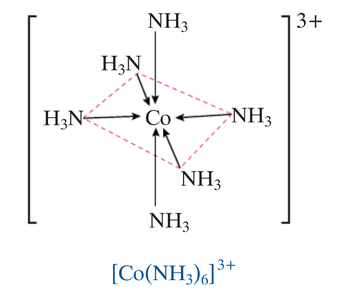
- 27an ion with an octahedral shape hasa co-ordination number of 6, meaning six ligands
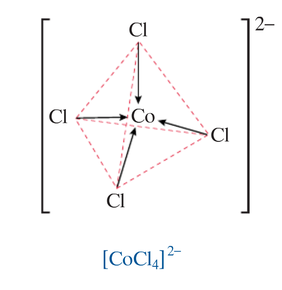
- 28a tetrahedral shape isan ion with a co-ordination number of 4, therefore 4 ligands
- 29[Co(NH3)6]3+is an example of an octahedral
- 30[CoCl4]2- is an example ofa tetrahedral
- 31draw [Co(NH3)6]3+
- 32draw [CoCl4]2-
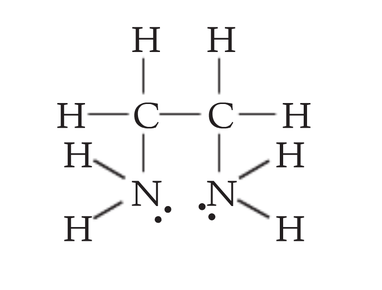
- 33Multidentate ligands arewhen some molecules have more than one lone pair which can bond to a transition metal ion
- 34ethane-1,2-diamine is an example ofa bidentate ligand
- 35draw ethane-1,2-diamine
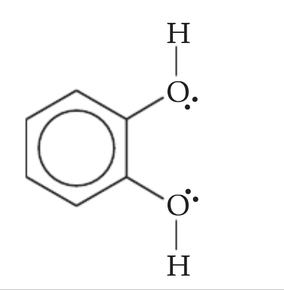
- 36benzene-1,2-diol is an example ofa bidentate ligand
- 37draw benzene-1,2-diol
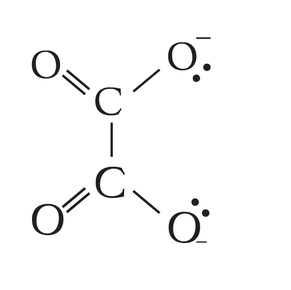
- 38ethanedioate ion, (C2O4)2-, is an example of abidentate ligand
- 39draw ethanedioate ion, (C2O4)2-
- 40(EDTA)4- is an example of amultidentate ligand
- 41(EDTA)4- is calledethylenediaminetetracetate
- 42draw (EDTA)4-
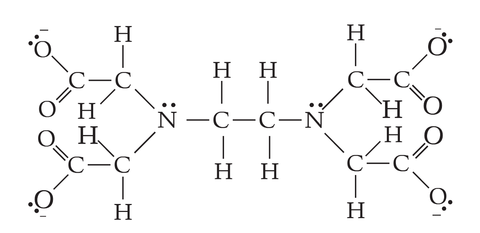
- 43(EDTA)4- can act as ahexadentate ligand using lone pairs on four oxygens and both nitrogen atoms
- 44chelates arecomplex ions with polydentate ligands
- 45chelate can be used toeffectively remove d-block metal ions from solution
- 46haemoglobin isthe red pigment in blood
- 47haemoglobin is responsible forcarrying oxygen from the lungs to the cells of the body
- 48haemoglobin consists of anFe2+ ion with a co-ordinate number of 6.
- 49from the 6 co-ordination number, 4 of themare taken up by a ring system, called a porphyrin, which acts as a tetradentate
- 50all ligands areneutral
- 51Cl- ion is a bigger ligand than the ammonia andso few molecules can fit around the transition metal
- 52the oxidation state of the metal ion =the total oxidation state of the complex - the sum of the oxidation states of the ligands
- 53work out the oxidation state of [CoCl4]2-(aq)Co oxidation state = total ox state - sum of Cl- ox states
= (-2) - (4x-1)
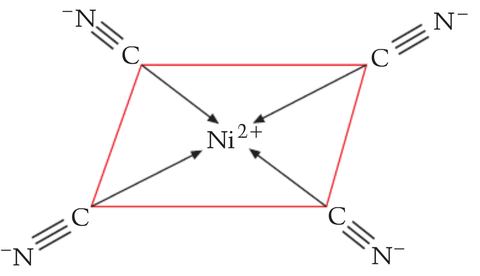
= +2 - 54most complexes with four ligands usually have a tetrahedral shape, howeversome have a square planar shape
- 55complexes with two cordinate bonds arelinear shape
- 56—this is square planar
- 57cisplatin (Pt(NH3)2Cl2) is square planar
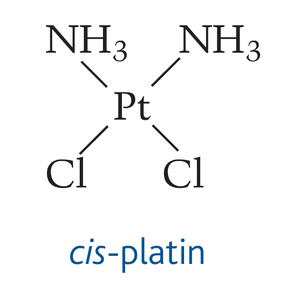
- 58what is cisplatin?it is a successful anti-cancer drug.
- 59how does cisplatin work?it bonds with the DNA to prevent the replication of cancer cells
- 60cisplatin has a isomer calledtransplatin
- 61transplatin looks like
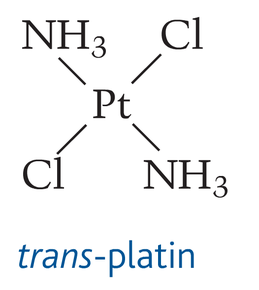
- 62what effect does trans-platin have on cancer?has no anti cancer effect
- 63the downside of cis-platin is...it can also prevent normal cells from reproducing, including blood and hair cells, causing hair loss, or suppressing of the immune system, meaning infection is more likely
- 64why are transition metal complexes coloured?due to having partly filled d-orbitals there is the chance for electrons to move up to higher energy levels. when they move up the energy levels they often absorb energy in the visible region of the spectrum that is equal to the difference in energy of the levels. the colour we see is the remaining colours in the spectrum that have not been absorbed
- 65the frequency of the light is =delte E = hv,
E = energy
H = planck's constant
v = frequency - 66the frequency is related to thecolour of the light
- 67violet ishigh frequency
- 68red islow frequency
- 69the colour of the transition metal complexes depends onthe oxidation state of the metal
and
the ligands, therefore the shape - 70what can we use to find the formula of a transition metal complex?a colorimeter
- 71how does a colorimeter determine the formula of the complex?by measuring how much light it absorbs
1. white light is shone through a filter which is chosen to only let the colour of light that is absorbed by the sample
2. light passes through the sample to the filter to the colorimeter, which shows how much light is absorbed
3. the more concentrated the colour solution is, the more light it absorbs - 72the results of the colorimeter are plotted on a graphabsorbance against test tube number
- 73iron has two stable oxidation statesFe3+ and Fe2+
- 74Which oxidation state of iron is less stable, Fe2+ or Fe3+?Fe2+ is less stable as it can be oxidised to Fe3+ by the oxygen in the air and also by chlorine
- 75show the equation and the changing oxidation states when Cl reacts with Fe2+

- 76Cl oxidation number drops from 0 to -1, while Fe2+ goes uo from +2 to +3. what is Cl acting asCl act as the oxidising agent when it reacts with Fe2+
- 77Potassium manganate (VII) acts as an oxidixing agent in acidic solution and can oxidiseFe2+ to Fe3+
- 78in the reaction between maganese and iron, the maganeses oxidation state goes from+7 to +2
- 79show the half equation of MnO4- going to Mn2+ and Fe2+ going to Fe3+ and then the overall equation
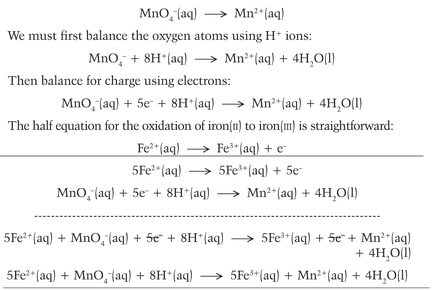
- 80when maganese is titrated against Fe2+ the endpoint is whenturns purple
- 81the burette in a titration is filled withthe oxidising agent e.g. potassium maganese or potassium dichromate,
- 82what is in the conical flask of the titration?the known amount of reducing agent with excess dilute sufuric acid
- 83why is sulfuric acid added to the reducing agentto allow the oxidising agent to be reduced
- 84draw an example of the titration
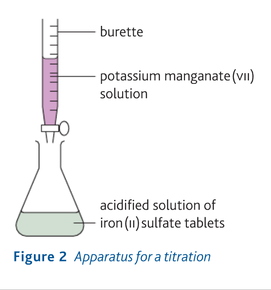
- 85Fe2+ can also be oxidised bypotassium dichromate Cr207-
- 86the endpoint of potassium dichromate and Fe2+ is when the colour changesto orange
- 87the equation for the reaction of potassium dichromate and Fe2+ is
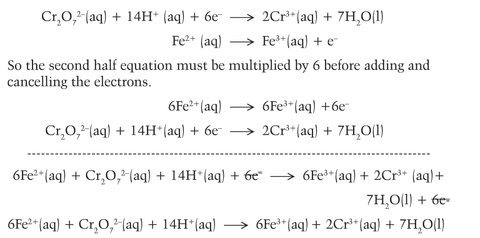
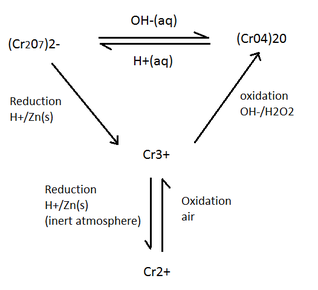
- 88(Cr2O7)-2 what is oxidation state? what is the colour of the ion?+6
orange - 89(CrO4)2- what is oxidation state? what is the colour of the ion?+6
yellow - 90Cr3+ what is oxidation state? what is the colour of the ion?+3
green/violet - 91Cr2+ what is oxidation state? what is the colour of the ion?+2
blue - 92summary of the chromate reactions
Information
- Description
- Flashcards on Unit 5 - transition metals, created by jasmin.sahota on 16/06/2013.
- Created by
- jasmin.sahota
- Views
- 174
- Rating