
Flashcards
Marketing_ZHAW_SEM2
Cards in this deck (179)
- 1A definition of Marketing by P. Kotler is...Marketing is the social and managerial PROCESS by which individuals and groups obtain what they need and
want through creating an exchanging products, services and value with others - 2Maslow Pyramid! The 5 basic human requirements are?1. Physiological needs (water, food..)
2. Safety needs
3. Belongingness and love needs (friend)
4. Esteem needs (prestige)
5. Self-actualization (full potential, creative activities) - 3Marketing is all about creating value for customers. As the first step in the marketing process, the company must fully understand consumers. Customer needs are what? example: "I am hungry"Human needs are states of felt deprivation. They include basic physical needs (Maslow)
- 4Customer wants are?Needs + Culture + Personality
Wants are the form human needs take as they are shaped by culture and individual personality. An American needs food but wants a Big Mac. - 5Customer demands are?wants + buying power
Given their wants and resources, people demand products and services with benefits that add up to the most value and satisfaction. - 6Marketing myopia (railroad example in slides W2, p.24)The mistake of paying more attention to the specific products a company offers than to the benefits and experiences produced by these products.
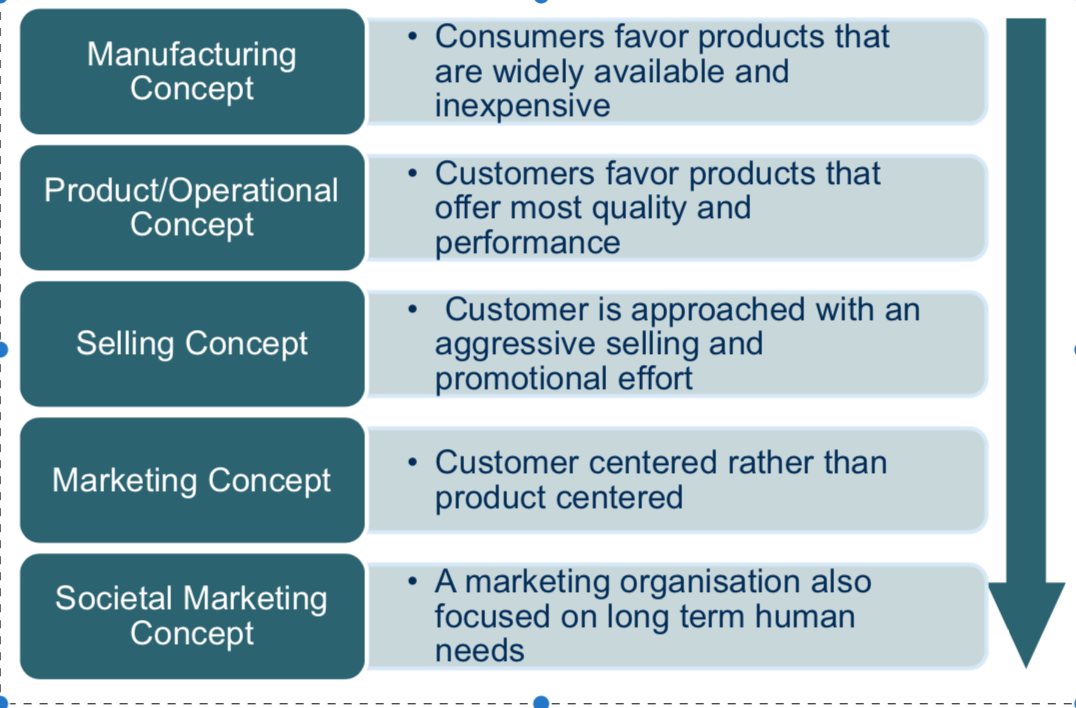
- 7Name 5 Marketing Management Orientations (1-3. are product centered, 4. customer c., 5. society c.)
- 8Name 3 marketing types1. Product: Marketing for goods and services
2. Profit: Classical (Profit-), or Non-profit marketing
3. Customer: B2B (70% of sales) or B2C - 9Defining marketing’s role in company-wide strategic planning. Name the 5 steps of strategic planning:1. Define the company mission
2. Setting company/business objectives and goals
3. Designing the business portfolio (marketing objectives like increasing brand name relevance or develop a specific service)
4. Creating the marketing strategy & program
5. Marketing activities (z.B. Networking events, partnerships) - 10Example of Product vs. Market oriented business definitionRevlon
Product oriented: We sell cosmetics
Market oriented: We sell lifestyle, hopes and dreams - 11Analyzing current business portfolio with the BCG (Boston consulting group) a growth-share matrix. 1. Name the 4 areas within market growth rate and relative market share. 2. repeat the calculation exercise Volkswagen W2, p.57Questionmark: Non profit, Very high investment requirements.
Star: High profit, High requ. investments, Modest net cash flow
Dog: negative profits, Disinvestment, Cash flow will be positive from disinvestment proceeds or savings
Cash Cow: High profit, Low required investment, High net cash flow - 12whats the main goal of marketing?Create value for and with customers and build customer relationships
- 135-Step model of the strategic marketing process
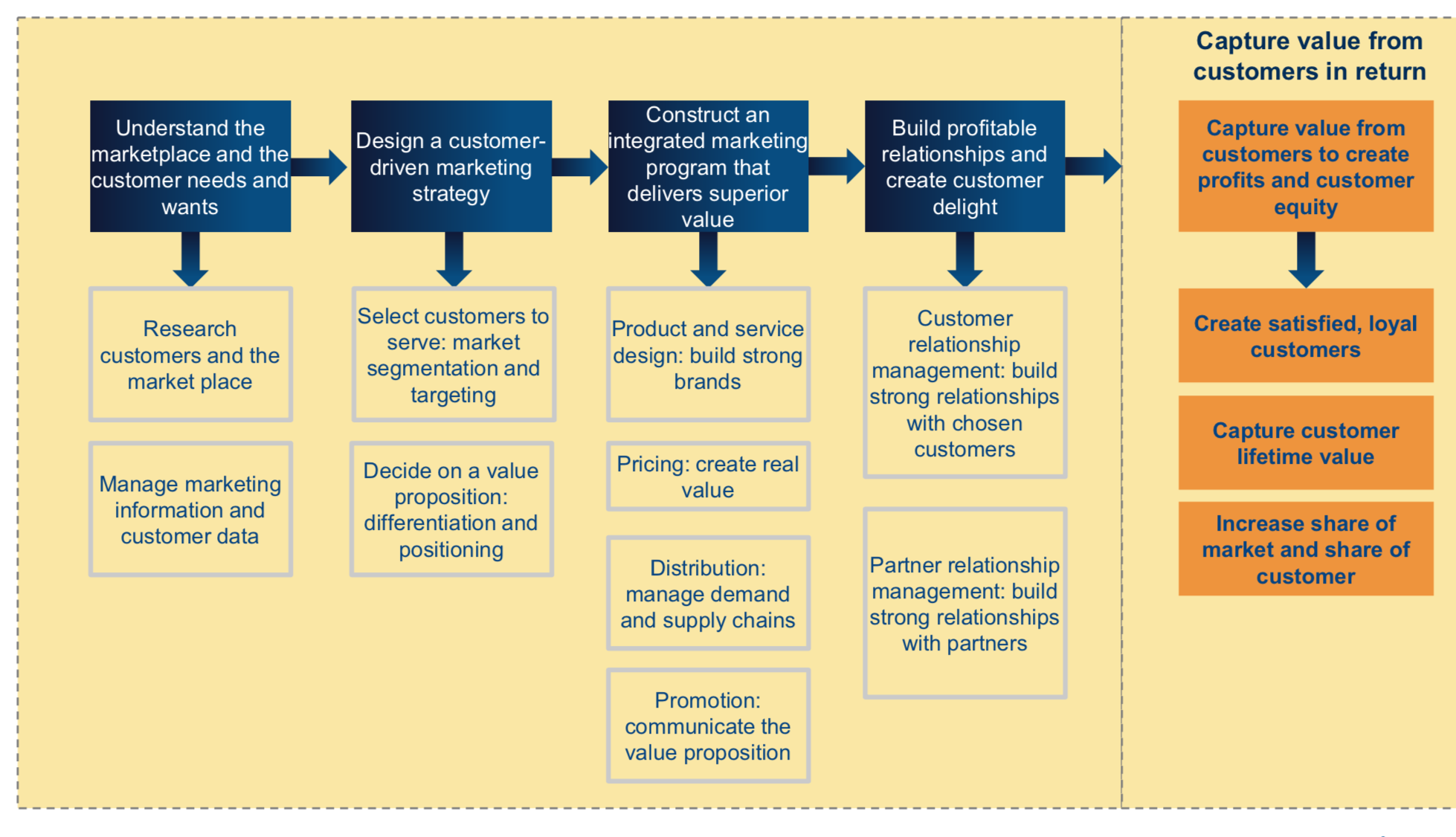
- 14The aim of marketing is? by Peter Drucker a management guru.."The aim of marketing is to emphasize customer wants and not customer needs"
- 15A firm that uses the selling concept takes an ________ Approach.inside-out
- 16The societal marketing concept seeks to establish a balance between what?consumer short-run wants and consumer long-run welfare
- 17A church targeting different demographic groups to increase attendance is an example of?non-Profit marketing
- 18What is the Product/market expansion grid?A portfolio-planning tool for identifying company growth opportunities through market penetration, market development, product development, or diversification.
- 19explain from the product/market expansion gird the 4 areas: *market penetration *market development *product development *diversification1.Market penetration
Company growth by increasing sales
of current products to current market segments without changing the product.
2.Market development
Company growth by identifying and developing new market segments for current company products.
3.Product development
Company growth by offering modified or new products to current market segments.
4. Diversification
Company growth through starting up
or acquiring businesses outside the company’s current products and markets. - 20Marketing strategy involves two key questions. Which ones?Which customers will we serve (segmentation and targeting)? and How will we create value for them (differentiation and positioning)?
- 21The marketing mix consists of everything the firm can do to influence the demand for its product. The many possibilities can be collected into four groups of variables. the 4 P's are?product
price
place
promotion
4 P's consists of tactical marketing tools blended into an integrated program that actually engages target customers and delivers the intended customer value. - 22Market capacity / potentialPossible capacity of the market at a certain price level and optimal application of marketing instruments
(in units or value). - 23Market volume or Market valueTotal sales of all providers combined, measured in units or value.
- 24Market saturationThe ratio of the actual market volume (or value) divided by the market capacity/potential
- 25Market shareA company’s sales revenue divided by the total sales revenue available in that market (by volume or value)
- 26Relative market shareSales volume ($ or units) of the company, divided by the sales volume of the largest competitor
- 27Market size assessment: explain the 3 methods1. Method of Analogy
2. Chain Ratio Method
3. Expert opinions - 28Method of Analogy How does this ratio look like?Pick a country at same stage of economic development as the
country of interest and the market size is known.
The relationship between the demand for a product and a particular indicator (e.g. the demand for a related product) is similar in both countries.
Example Ukraine, Poland p. 10, W2 - 29Chain Ratio Method Explain with an example of JapanIt starts with a very rough-base number as an estimate
for the market size.
The base number is then systematically fine-tuned by applying a string of relevant
percentages to come up with the closest estimate for the total market potential.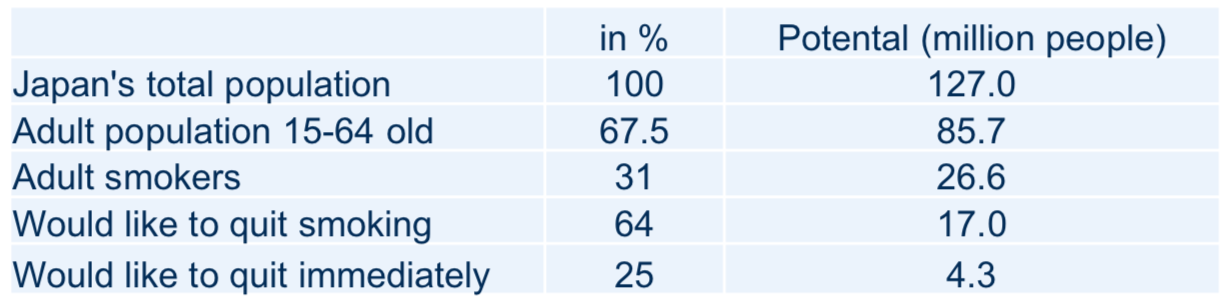
- 30Expert opinionsExperts can be used to estimate the market size.
A good option might be to consult different experts to avoid biases. - 31The difference between Microeconomic environment and MacroeconomicThe microenvironment consists of the actors close to the company that affect its ability to engage and serve its customers—the company, suppliers, marketing intermediaries, customer markets, competitors, publics.
The macroenvironment consists of the larger societal forces that affect the microenvironment—demographic, economic, natural, technological, political, and cultural forces. - 32Microeconomic environment of Marketing the 6 actors are?*The company
*Suppliers
*Marketing intermediaries
*Competitors
*Public
*Customers (most important actor) - 33Topic Microeconomic environment marketing: Customers. The company might target any or all of five types of customer markets. Five types?*Consumer markets
*Business markets buy goods and services for further processing or use in their production processes.
*Reseller markets buy goods and services to resell at a profit.
*Government markets consist of government agencies that buy goods and services to produce public services or transfer the goods and services to others who need them.
*International markets consist of these buyers in other countries, including consumers, producers, resellers, and governments. - 34Topic Microeconomic environment marketing: Publics. The 7 groups are?Any group that has an actual or potential interest in or impact on an organization’s ability to achieve its objectives.
• Financial publics (influences the company’s ability to obtain funds)
• Media publics (carries news, features, editorial opinions)
• Government publics (issues of product safety, truth
in advertising)
• Citizen-action publics (con-
sumer organizations, environmental groups)
• Local publics (neighborhood residents and community organizations)
• General public (general public’s attitude
toward its products and activities)
• Internal publics (workers, managers, volunteers, and the board of
directors) - 35Topic Microeconomic environment marketing: Marketing intermediaries. 1. What's that? 2. Name 4 firm types.Firms that help the company to promote, sell, and distribute its goods to final buyers.
They include resellers, physical distribution firms, marketing services agencies, and financial intermediaries. - 36Macroeconomic environment (consists of broader forces that affect the actors in the microenvironment.) PESTEL framework explain the 6 factorsPolitical
Economic
Social
Technological
Environmental
Legal - 37Macroeconomic environment – PESTEL framework Social and Cultural FactorsDemographic changes
• Value change = ecological
thinking
• Cultural change = digital
nomads
• Changes of family structure
• Change in workforce - 38PESTEL-Analyse Consumer trends 10 hot consumer trends from 20171. AI everywhere
2. Setting the pace for Internet of Things
3. Pedestrians drive autonomous cars
4. Merged reality
5. Bodies out of sync
6. The smart device safety paradox
7. Social silos
8. Augmented personal reality
9. The privacy divides
10. Big tech for all - 39SWOT pulls together external and internal analysis
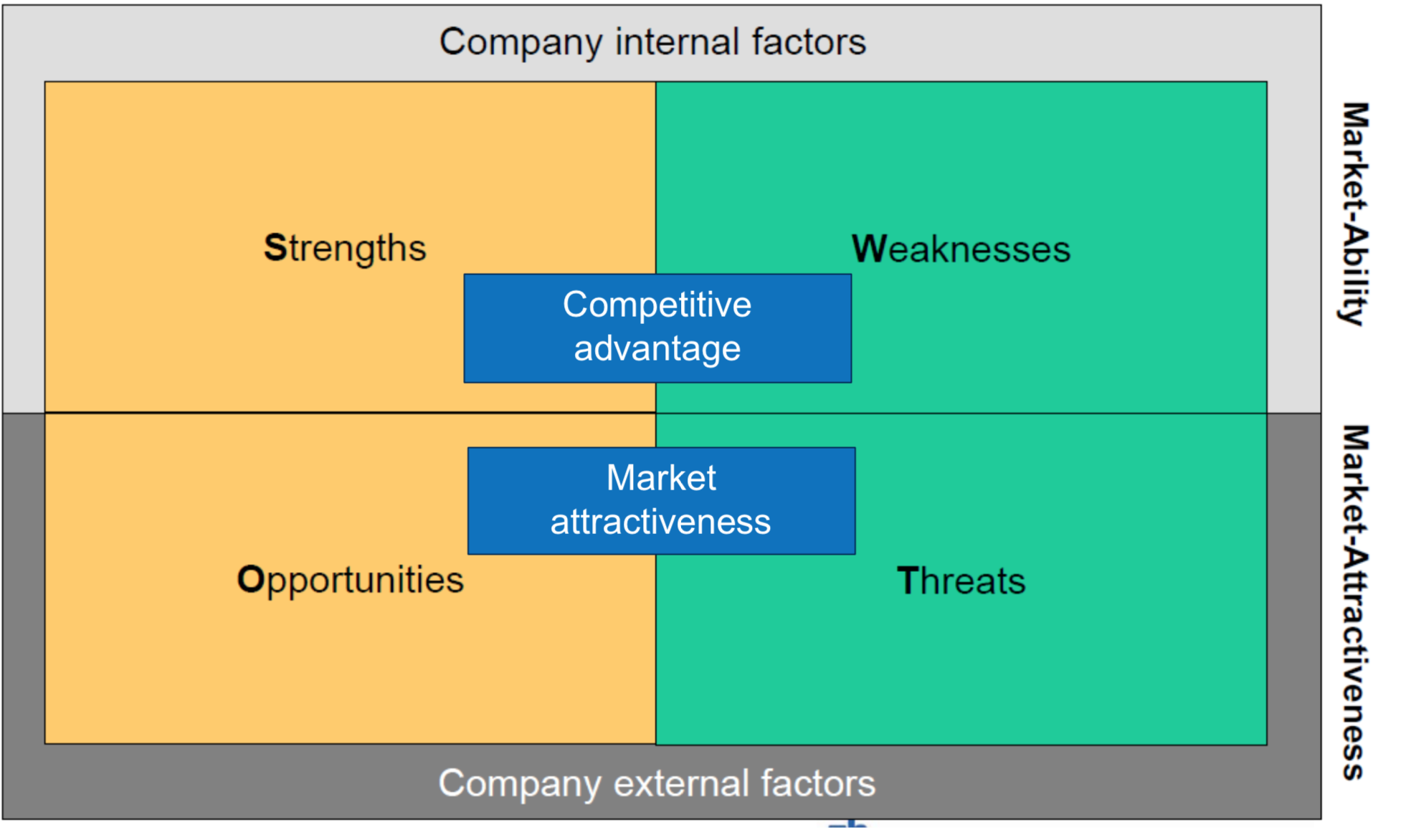
- 40TOWS Analysis Formulate strategies based on SWOT Analysis
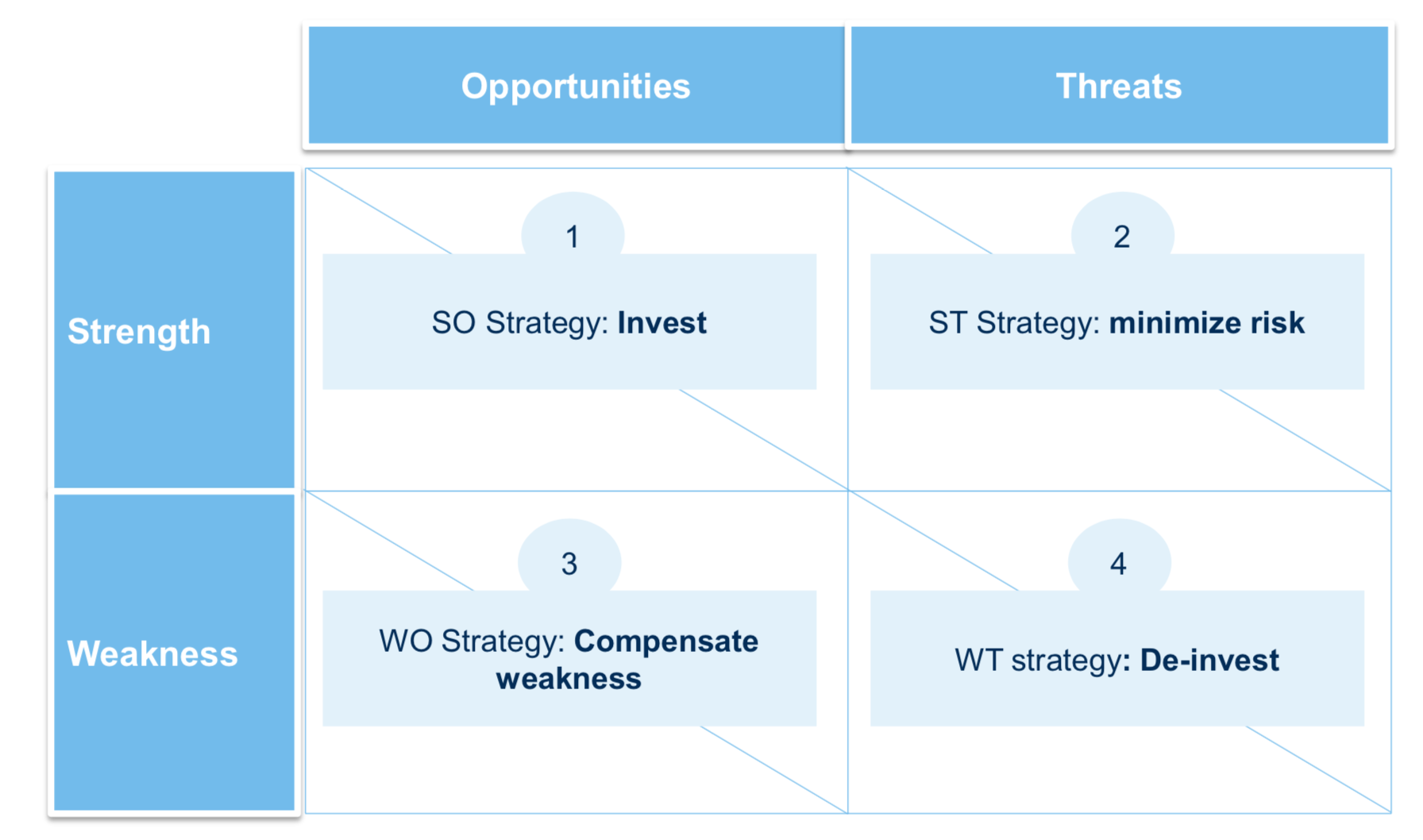
- 41Market Research Process The 4 steps are?1. Defining Problem & Research Objectives
2. Developing the Research Plan
3. Implement the plan+collect the data
4. Analyze, interpret & report the findings - 42Market Research Process: 1. Defining Problem & Research Objectives• Assess market potential for product or service
• Assess consumer acceptance for new marketing mix
• Evaluate usage & attitudes towards a brand or product range - 43Market Research Process: 2. Developing the Research PlanDevelop a plan for gathering information needed efficiently.
• Secondary research
• Primary research: Qualitative, Quantitative
• Research methods: Observation, Survey
• Sampling plan: Who? How many? How chosen? - 44Difference Primary vs. Secondary research dataSecondary data consist of information that already exists somewhere, having been collected for another purpose. Primary data consist of information collected for the specific purpose at hand.
- 45Market Research Process: 3. Implement the plan+collect the data«Field phase»
• Identify and contact target group
• Collect data (e.g. questionnaire, focus group, individual interview...) - 46Market Research Process: 4. Analyze, interpret & report the findings• Analyze the data
• Compare findings vs.
hypotheses
• Deduct marketing approaches and business decisions or further research need - 47Nonprofit organizations• It exists mainly for a charitable purpose and for public benefit
• They are usually exempted from corporate tax
Most non-profits are by definition, less concerned with profit than they are with meeting some particular need in society. - 48THE MARKETING MIX is a tool used by businesses and Marketers to help determine a product or brands offering. Explain the extended 7 Ps. (1981 by Booms & Bitner )Product
Price
Place
Promotion
People
Processes
Physical Evidence - 49Explain ::Product:: form the MarketingmixThe Product should fit the task consumers want it for, it should work and it should be what the consumers are expecting to get.
- 50Explain ::Place:: form the MarketingmixPlace – The product should be available from where your target consumer finds it easiest to shop. This may be High Street, Mail Order or the more current option via e-commerce or an online shop.
- 51Explain ::Product:: form the MarketingmixThe Product should always be seen as representing good value for money. This does not necessarily mean it should be the cheapest available; one of the main tenets of the marketing concept is that customers are usually happy to pay a little more for something that works really well for them.
- 52Explain ::Promotion:: form the MarketingmixAdvertising
PR
Sales Promotion
Personal Selling
Social Media
are key communication tools.
These tools should be used to put across the organisation’s message to the correct audiences in the manner they would most like to hear, whether it be informative or appealing to their emotions - 53Explain ::People:: form the MarketingmixAll companies are reliant on the people who run them from front line Sales staff to the Managing Director. Having the right people is essential because they are as much a part of your business offering as the products/services you are offering.
- 54Explain ::Processes:: form the MarketingmixThe delivery of your service is usually done with the customer present so how the service is delivered is once again part of what the consumer is paying for.
- 55Explain ::Physical Evidence:: form the MarketingmixAlmost all services include some physical elements even if the bulk of what the consumer is paying for is intangible. For example a hair salon would provide their client with a completed hairdo and an insurance company would give their customers some form of printed material. Even if the material is not physically printed (in the case of PDFs) they are still receiving a “physical product” by this definition.
- 56The 8th P of the Marketing Mix is?Productivity & Quality -
This P asks “is what you’re offering your customer a good deal?” This is less about you as a business improving your own productivity for cost management, and more about how your company passes this onto its customers. - 57Marketing is what at a conceptual level?At a conceptual level, marketing represents a philosophy or approach to management that places the customer right at the centre of everything that an organisation does.
- 58Marketing is what at a functional level?At the functional level, it is that part of the organisation which gathers research, helps design new services, prices them, distributes them and ultimately promotes them to the consumer.
- 59Is Ethics an Additional Marketing Mix "P" for non-profits?The study of ethics involves determining right from wrong.
• It is different from legal implications
• Some actions may not be illegal how ever they may be unethical.
(• Many authors argue that ethics is a separate component)
*Sargeant (2009) believes ethics should be integrated in the previous 7Ps and everything that nonprofit does. - 604 Factors Affecting Consumer Behavior1) Cultural (culture, subculture, social classe)
2) Social (groups, social network, role&status and family the most important consumer-buying organization)
3) Personal (age, occupation, lifestyle, economic situation, hobbies)
4) Psychological (beliefs, attitudes, motivation, learning) - 61Consumer Behavior.. There are different factors of culture: Explain subculturesSubcultures are groups of people within a culture with shared value systems based on common life experiences and situations.
(hipster, rocker, vegan..) - 62Consumer Behavior.. There are different factors of culture: Explain Social classesSocial classes are society’s relatively permanent and ordered divisions whose members share similar values, interests, and behaviors.
• Measured as a combination of occupation, income, education,
wealth, and other variables
• Major (American) Social Classes: Upper Class, Middle Class,
Working Class, Lower Class - 63Consumer Behavior.. There are different social factors: Explain Groups− Membership Groups: Groups with direct influence and to which a person belongs
− Aspirational Groups: Groups an individual wishes to belong to
− Reference Groups: Groups that form a comparison or reference in forming attitudes or behavior - 64Consumer Behavior.. There are different social factors: Explain Social NetworksSocial Networks:
− On- and offline social networks
− Buzz marketing, Social media sites,
Virtual worlds
− Word of mouth & Opinion leaders - 65Consumer Behavior.. There are different personal factors: Explain Economic situation & Lifestyle− Economic situation, determined by trends in spending, personal income, savings, interest rates.
− Lifestyle is a person’s pattern of living as expressed in his or her psychographics (AIO: activities, interests and opinions). - 66Consumer Behavior.. There are different psychological factors: Explain the term PerceptionEach of us receives, organizes, and interprets the 5 human senses sensory information in an individual way.
Perception is the process by which people select, organize, and interpret information to form a meaningful picture of the world. - 67Explain the Perceptual Process
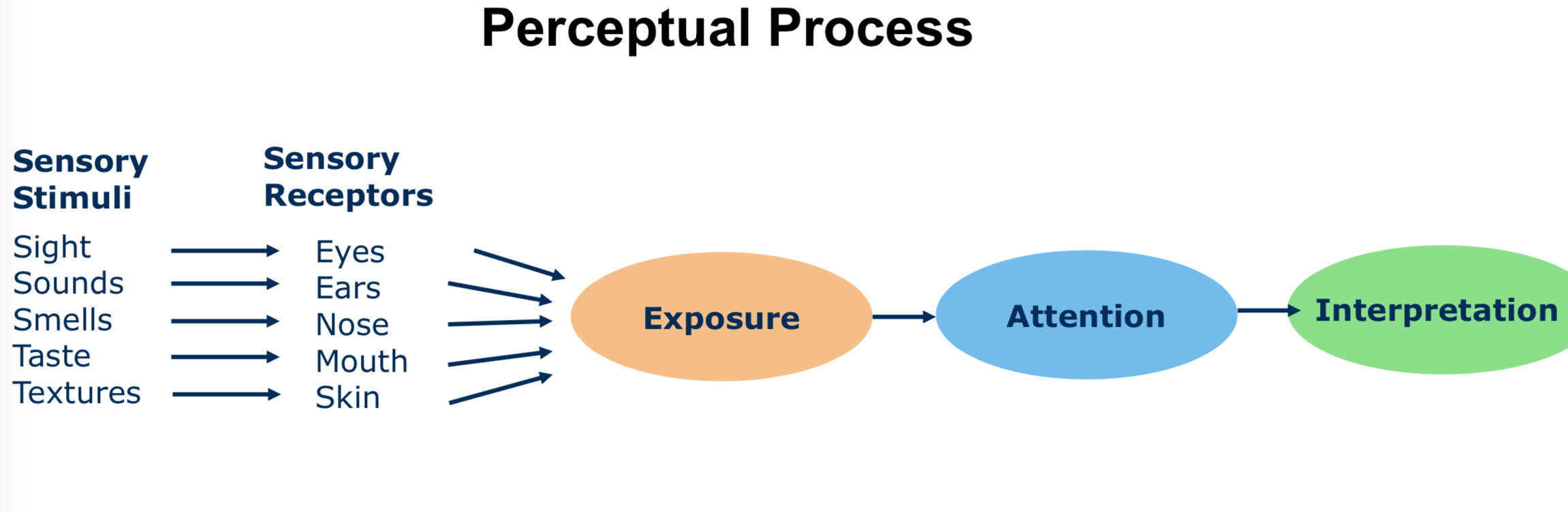
- 68Explain cognitive strainOnly the smallest part of the available information is perceived and processed.
Off all available information (stimuli) at the POS, only 0.0004% (that is less than one tenth of a percent!) are perceived and processed. Scientific research shows that human beings perceive and process only 2% of all information communicated through mass media - 69Consumer Behavior.. There are different psychological factors: What are the human's 5 senses?1. Sight (ambient marketing)
2. Smell (used in stores, packages)
3. Sound (Ambient marketing with selected playlists, Faster boarding process on planes)
4. Texture/Touch (Touching things influences consumption decision, higher quality is oftentimes associated with certain surfaces)
5. Taste - 70There are different psychological factors: Explain the connection to consumer behavior with beliefs and attitudes−A belief is a descriptive thought that a person has about something based
on knowledge, opinion, and faith.
−An attitude describes a person’s relatively consistent evaluations, feelings, and tendencies toward an object or idea. - 71Involvement *Involvement is a person’s readiness and willingness to search, perceive, process and store information. Trommsdorff (2009) Explain the influencing factors (what determines a persons involvement?) and consequences (how does involvement affect behavior?)
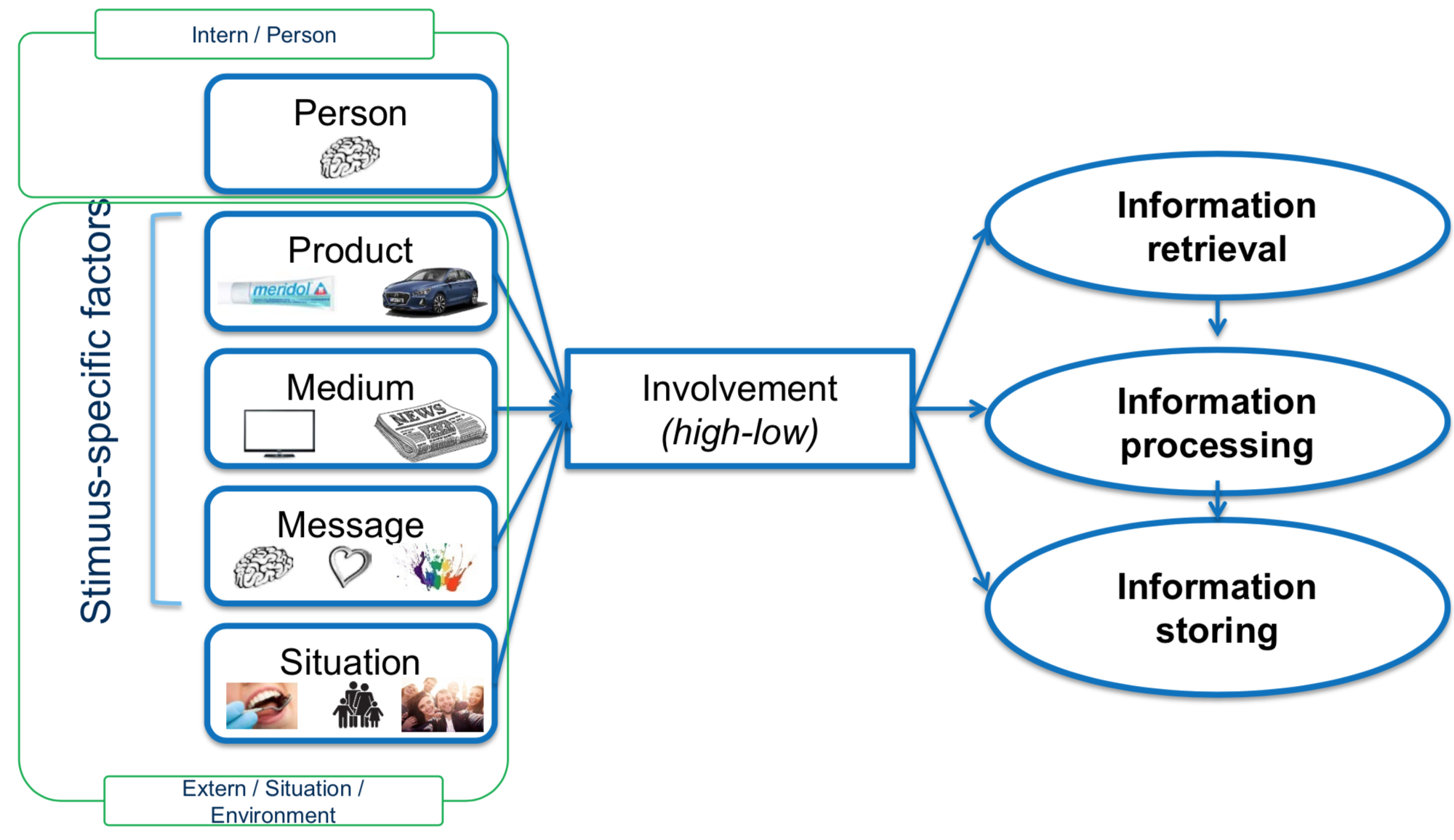
- 72Consumer buying behavior is determined by the level of involvement within a purchase decision. Where do this 4 products belong to? Insurance ( as marketing manager provide information), Cereal (focus on visibility), Jeans (emotional experience), Rolex (mixed positioning)
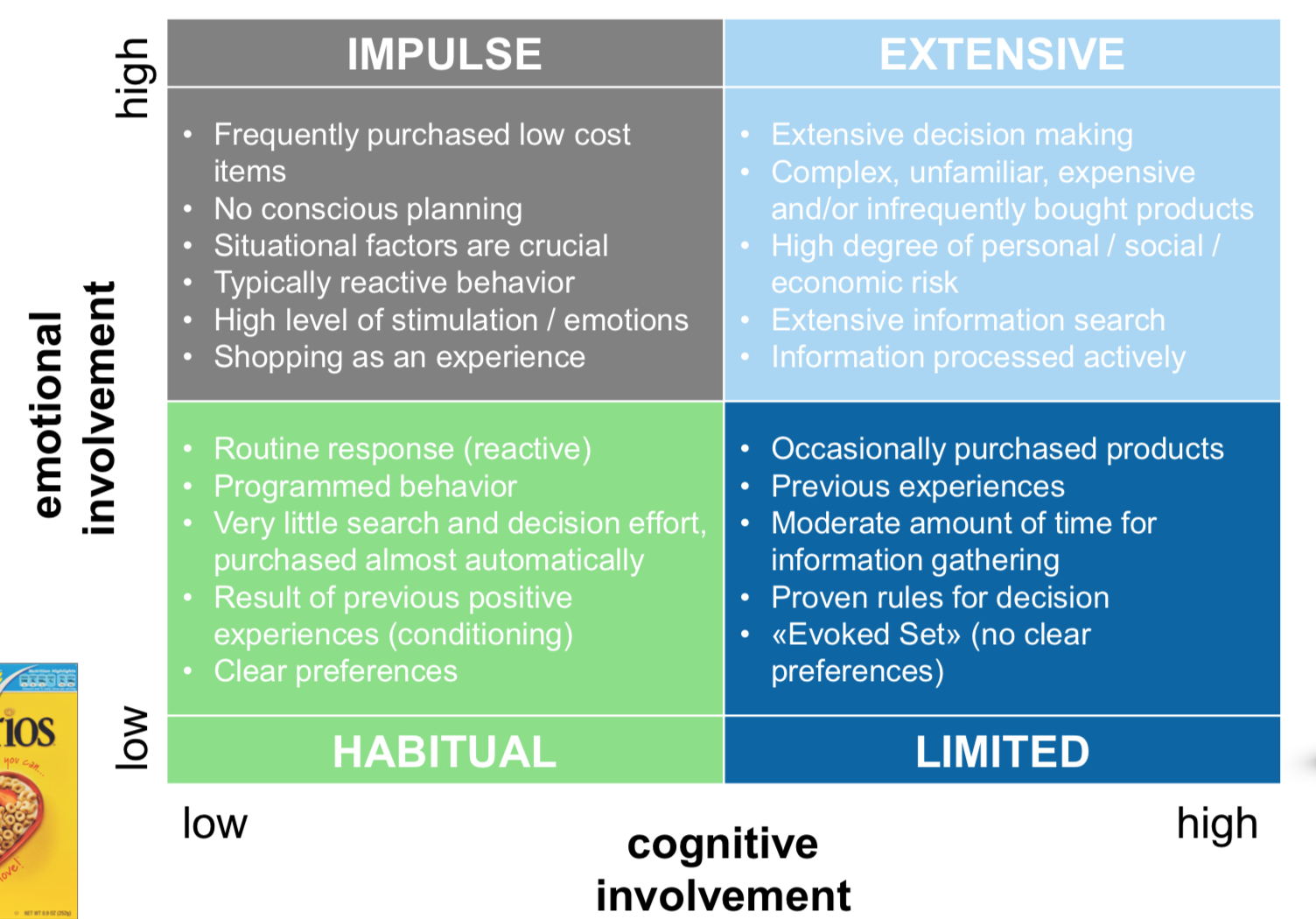
- 73Marketing communication with low involvement. Explain the goal, content, length, tone, style, timing etc.Goal of the message: Stay top of the mind
Content of the ": say just something
Length ": short
Tone ": Emotional
Communication style: Pictures and music
Repetition: High (TV...)
Timing: Always (TV again..)
Interaction with: POS aka. point of sale Communication - 74Marketing communication with high involvement. Explain the goal, content, length, tone, style, timing etc.Goal of the message: Convince
Content of the ": Describe USP (unique selling proposition)
Length ": Long
Tone ": Fact-based
Communication style: Text
Repetition: few
Timing: Before and during purchase
Interaction with: Individual salesperson - 75Customer insight trough data collection.. primary market research: Explain qualitative and quantitative data inkl. methods.Qualitative data: exploratory or subjective information (opinions, judgements; small number of respondents). Methods: Focus groups, in-depth interviews, observation, expert interviews etc.
Quantitative data: data that can be statistically analyzed and results which can be expressed numerically (large sample size). Methods: Structured surveys (via personal/ face-to-face interviews, telephone, online, postal/mail), experiments etc. - 76Market research Observation methods Name 4 areas where a observation can be done.1) Human behavior (Child plays with toy)
2) Physical objects (Garbage analysis in different living areas (high vs. low income)
3) Mechanical observation (video, tracking system, radio & tv monitoring)
4) Content analysis (how much and which type of information is used in advertisements, newspaper articles, social media etc.) - 77A buyer's decisions are influenced by ________ such as the buyer's age and life-cycle stage, occupation, economic situation, lifestyle, personality, and self-concept.personal characteristics
- 78________ is the most basic determinant of a person's wants and behavior.Culture
- 79What role do the four Ps play in consumer behavior?The four Ps are the marketing stimuli that affect buyer behavior: marketers use product, price, place, and promotion to attract the targeted consumers.
- 80Companies can research many aspects of buying decisions. The most difficult to identify is...why they buy
- 81Nationalities, religions, geographic regions, and racial groups are all examples of?Subcultures
- 82Explain the 4 marketing Stimuli Ps and 4 other stimuliMarketing stimuli consist of the four Ps: product, price, place, and promotion.
Other stimuli include major forces and events in the buyer’s environment: economic, technological, social, and cultural. - 83Explain the difference between Complex Buying Behavior and Dissonance-Reducing Buying BehaviorComplex buying behavior
*high consumer involvement in a purchase
*significant perceived differences among brands. Example: expensive watch
Dissonance-reducing buying behavior
*high involvement in a purchase
*few perceived differences among brands. Example: expensive carpet - 84Name the 4 Types of Buying Decision Behavior. Some purchases are simple and routine, even habitual. Others are far more complex, involving extensive information gathering and evaluationComplex Buying Behavior (car)
Dissonance-reducing buying behavior (carpet)
Habitual buying behavior (barilla pasta)
Variety-Seeking Buying Behavior (food) - 85The Buyer Decision Process Name the 5 stages1) need recognition
2) information search
3) evaluation of alternatives
4) purchase decision
5) postpurchase behavior (evtl. cognitive dissonance)
Marketers want to be involved throughout the entire buyer decision process. - 86Postpurchase Behavior.. Explain Cognitive dissonance (Buyer discomfort caused by postpurchase conflict)Almost all purchases result in cognitive dissonance, or discomfort caused by postpurchase conflicts. Every purchase involves compromise. So consumers feel uneasy about acquiring the drawbacks of the chosen brand and about losing the benefits of the brands not purchased.
- 87Difference between market segmentation and market targeting?What customers will we serve?
Major segmentation variables:
geographic, demographic, psychographic, and behavioral
Targeting:
Which customers will the company serve?
Evaluating each market segment’s attractiveness and selecting one or more segments to enter. - 88Geografic segmentationDividing a market into different geographical units, such as nations, states, regions, counties, cities,
or even neighborhoods. - 89Behavioral segmentationDividing a market into segments based on consumer knowledge, attitudes, uses of a product, or responses to a product.
- 90Socio-demographic SegmentationDividing the market into segments based on variables such as age, life-cycle stage, gender, income, occupation, education, religion, ethnicity, and generation.
(needs change due to life-cycle & situation) - 91Segmenting Business Markets vs. Consumer Markets
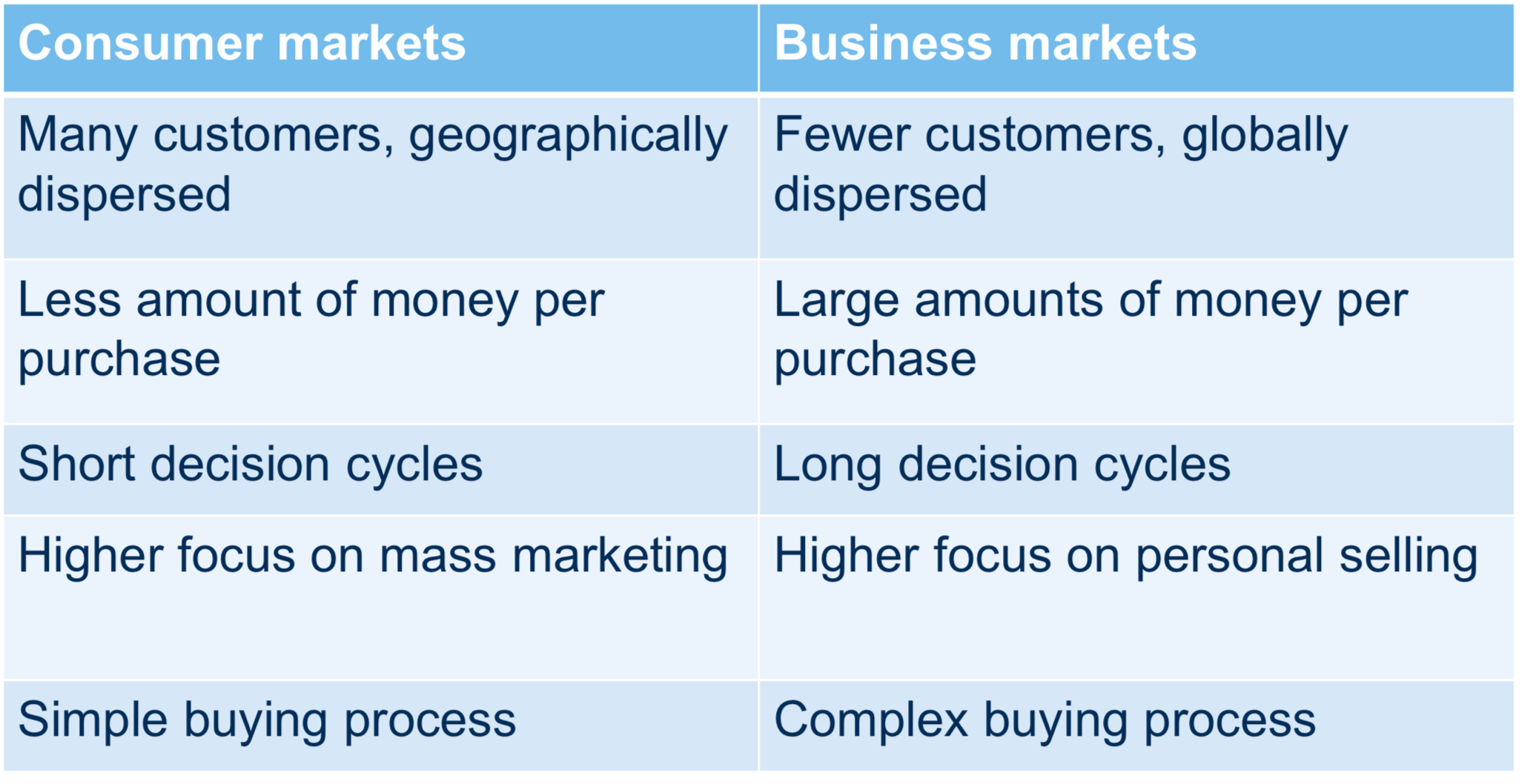
- 92Effective Segmentation (Buyers of salt could be divided into blonde and brunette. But hair color does not affect the purchase of salt.) To be useful, market segments must be.. name 5• Measurable
• Accessible
• Substantial: A segment should be the largest possible homogeneous group worth pursuing with a tailored marketing.
• Differentiable.
• Actionable: Effective programs can be designed for attracting and serving the segments. - 93Explain Koller's STP-Marketing processMarket Segmentation
Market Targeting
Product Positioning - 94Target Market is a set of buyers sharing common needs or characteristics that the company decides to serve. Market-Targeting Strategies: Name 4 different*Undifferentiated (mass) marketing
*Differentiated (segmented) marketing
*Concentrated (niche) marketing
*Micromarketing (local or individual marketing) - 95Market-Targeting Strategies Explain: *Undifferentiated (mass) marketing *Differentiated (segmented) marketingUndifferentiated marketing targets the whole market with one offer.
*Mass marketing
*Focuses on common needs
Differentiated marketing targets several different market segments
*Individual offers for each segment
*Achieve higher sales and stronger position
*More expensive than undifferen-
tiated marketing - 96Market-Targeting Strategies Explain: *Concentrated (niche) marketing *Micromarketing (local or individual marketing)Concentrated marketing targets a large share of a smaller market.
*Limited company resources
*Knowledge of the market
Micromarketing is the practice of tailoring products and marketing programs to suit the tastes of specific
* individuals and
* locations. - 97Value Creation for targeted customers Explain the 4 steps
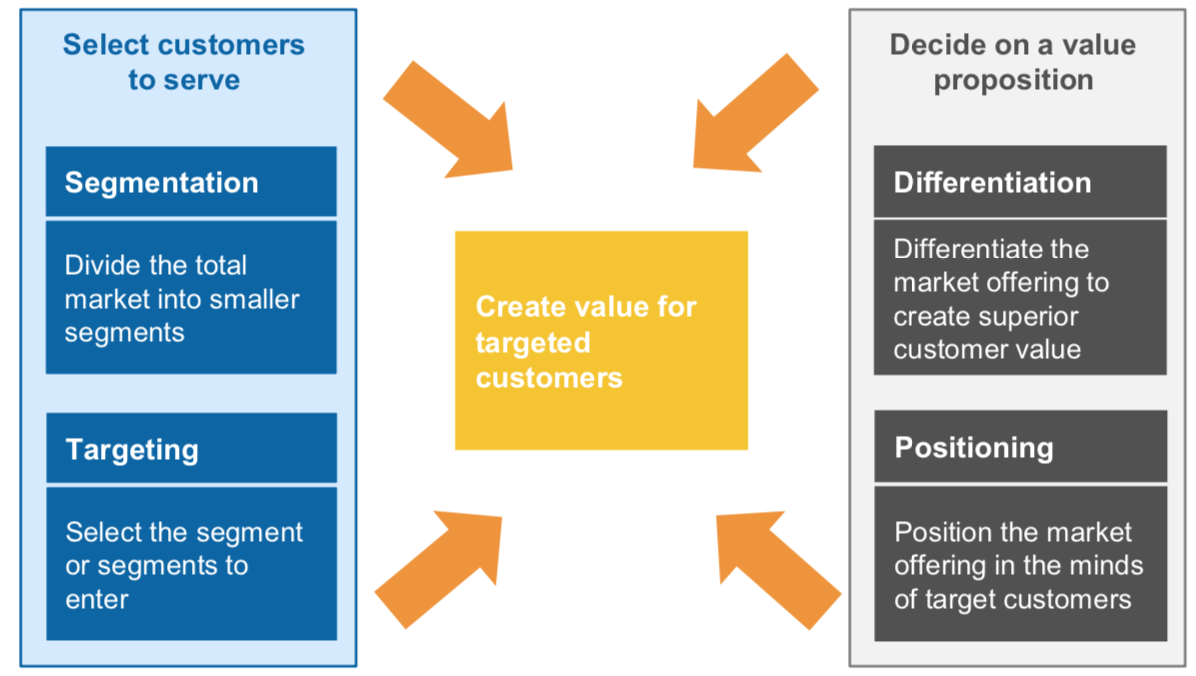
- 98Decide on a value proposition Explain DifferentiationMarketers need to think through the customer’s entire experience with the product or service. It needs to differentiate along lines that matter to customers.
How will we serve them? - 99The differentiation and positioning task = Value Proposition (Creating differentiated value for target segments and deciding which positions the brand wants to occupy in those segments.) Why should I buy your brand? 3 steps are necessary..1) identifying a set of differentiating competitive advantages on which to build a position
2) choosing the right competitive advantages
3) selecting an overall positioning strategy
The company must then effectively communicate and deliver the chosen position to the market. - 100Positioning Maps are?In planning their differentiation and positioning strategies, marketers often prepare perceptual positioning maps that show consumer perceptions of their brands versus those of competing products on important buying dimensions.
- 101Product Positioning is?The way a product is defined by consumers on important attributes—
the place the product occupies in consumers’ minds relative to competing products. - 102What is a disadvantage of using a differentiated marketing strategy?The costs of doing business increase.
- 103"Companies that rely on a few segments for all of their business will suffer if a segment turns sour." Is this statement true about the concentrated marketing strategy?yes
- 104Products and Service classifications name the two classes:Products and services fall into two broad classes based on the types of consumers who use them:
1. consumer products
2. Industrial product
A product bought by individuals and organizations for further processing or for use in conducting a business. - 105Marketing Considerations for Consumer Products a brief overview of the 4 types in this class...
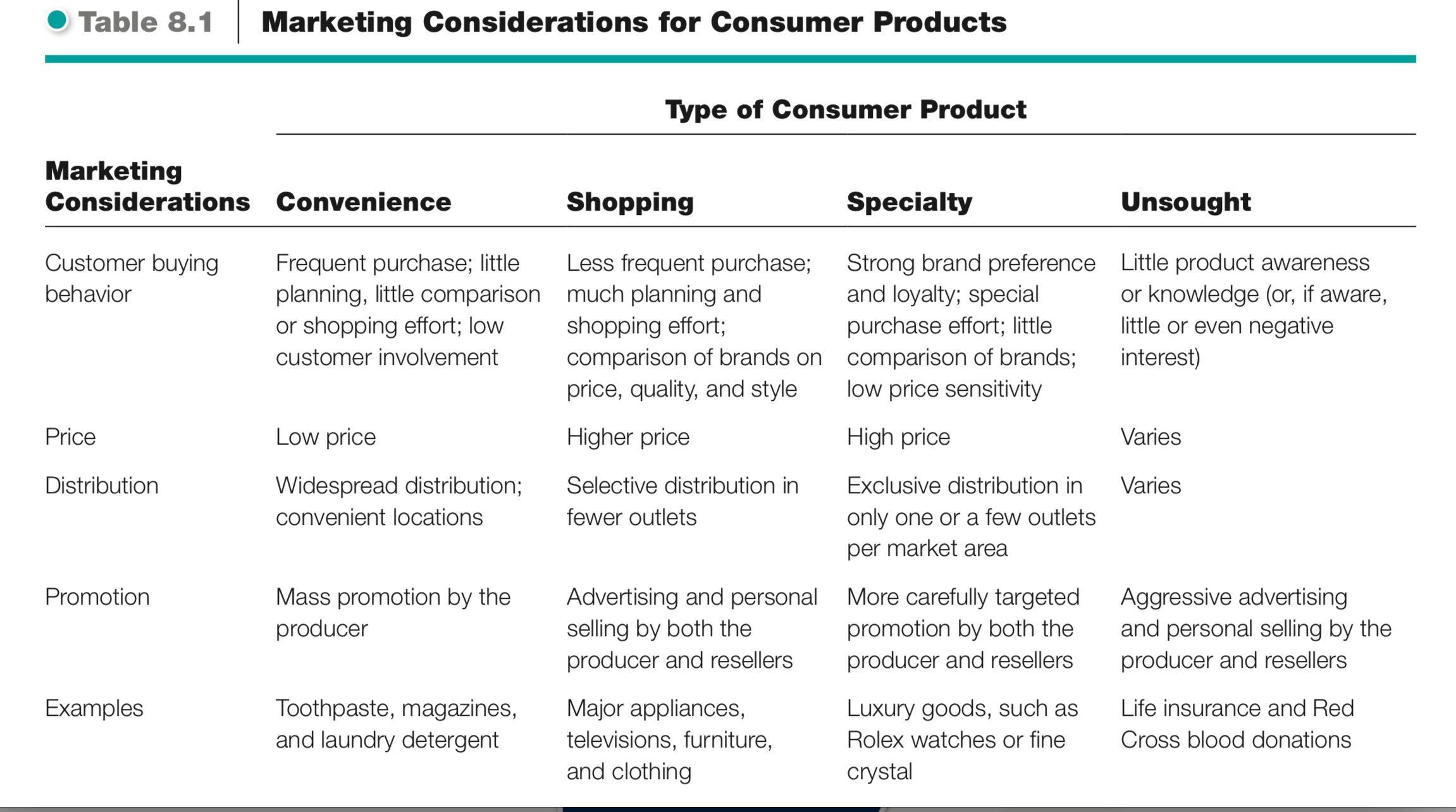
- 106Consumer Products There are 4 classifications based on how consumers go about buying the products.Convenience product
Customers usually buy frequently, immediately, with minimal comparison/ buying effort. (food)
Shopping product
Time consuming process of selecting and purchasing, usually compares on such attributes as suitability, quality, price, and style. (games, hotel services)
Specialty product
A consumer product with unique characteristics or brand identification for which a significant group of buyers is willing to make a special purchase effort. (cars, camera, cosmetic surgery)
Unsought product
A consumer product that the consumer either does not know about or knows about but does not normally consider buying. (life insurance, preplanned funeral)
much advertising and personal selling needed. - 107The important decisions in the development and marketing of individual products and services. (The focus of 5 decisions to create core customer value.)* Attributes
*Branding
*Packaging
*Labeling
*Product Support Service - 108Product and Service Attributes the benefits that it will offer..Benefits are communicated and delivered by product attributes such as
1. Product quality is one of the marketer’s major positioning tools.
2. features
3. style and design - 109Packaging (a tool to communicate product values) & LabellingPackaging involves designing and producing the container or wrapper for a product.
Labels identify the product or brand, describe attributes, and provide promotion. - 110Three Levels of Product Product planners need to think about products and services on three levels. Each level adds more customer value.
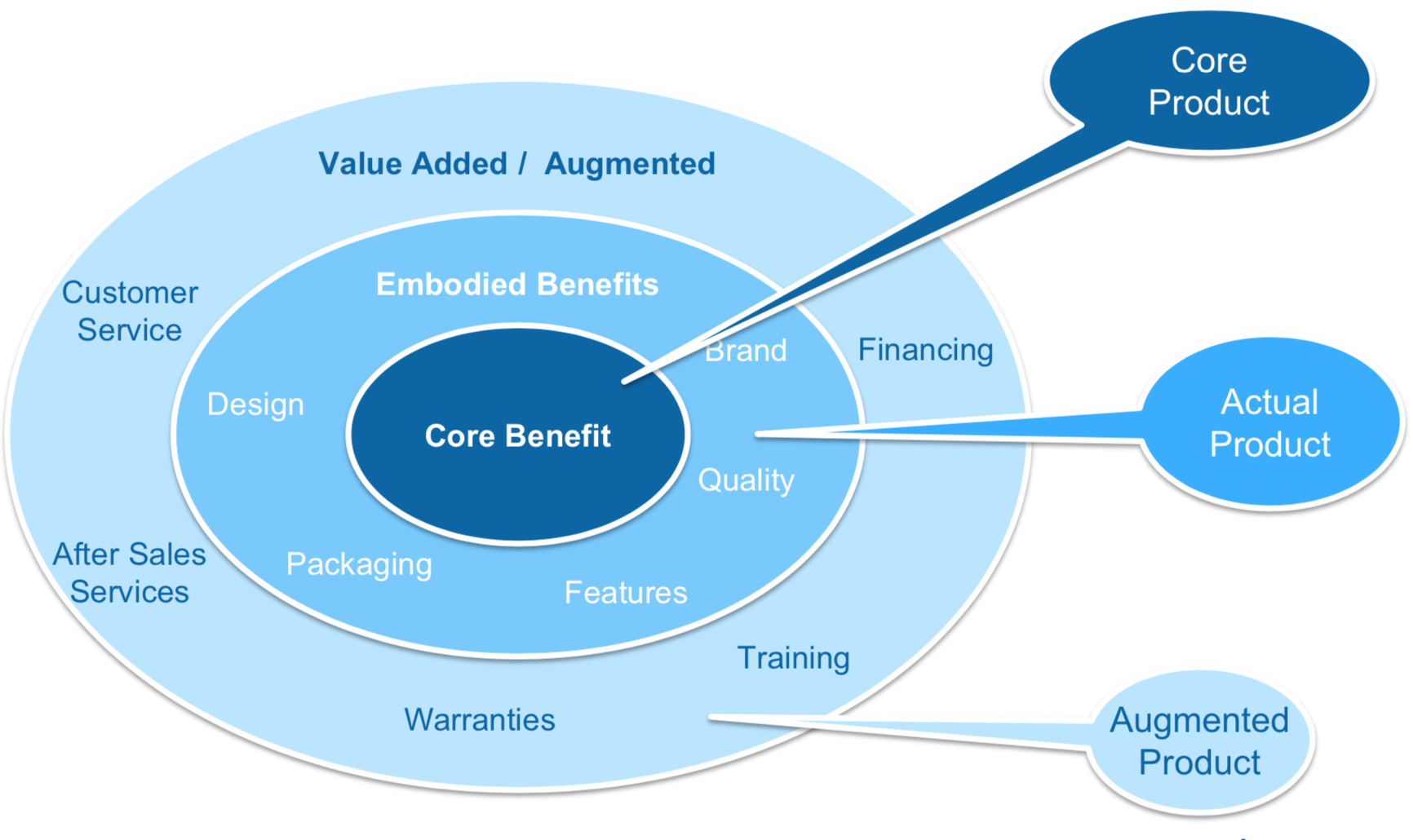
- 111Explain Core Benefit the core product (1st level)What is the buyer really buying?
When designing products, marketers must first define the core, problem-solving benefits or services that consumers seek.
iPad not just a tablet: entertainment, self-expression, productivity, and connectivity with friends and family. - 112Explain actual product (2nd level)At the second level, product planners must turn the core benefit into an actual product. They need to develop product and service features, a design, a quality level, a brand name, and packaging.
- 113Explain augmented product (3rd level)Finally, product planners must build an augmented product around the core benefit and actual product by offering additional consumer services and benefits.
- 114Services Marketing Explain the four service characteristics (Services are intangible & created through direct interactions with customers.)
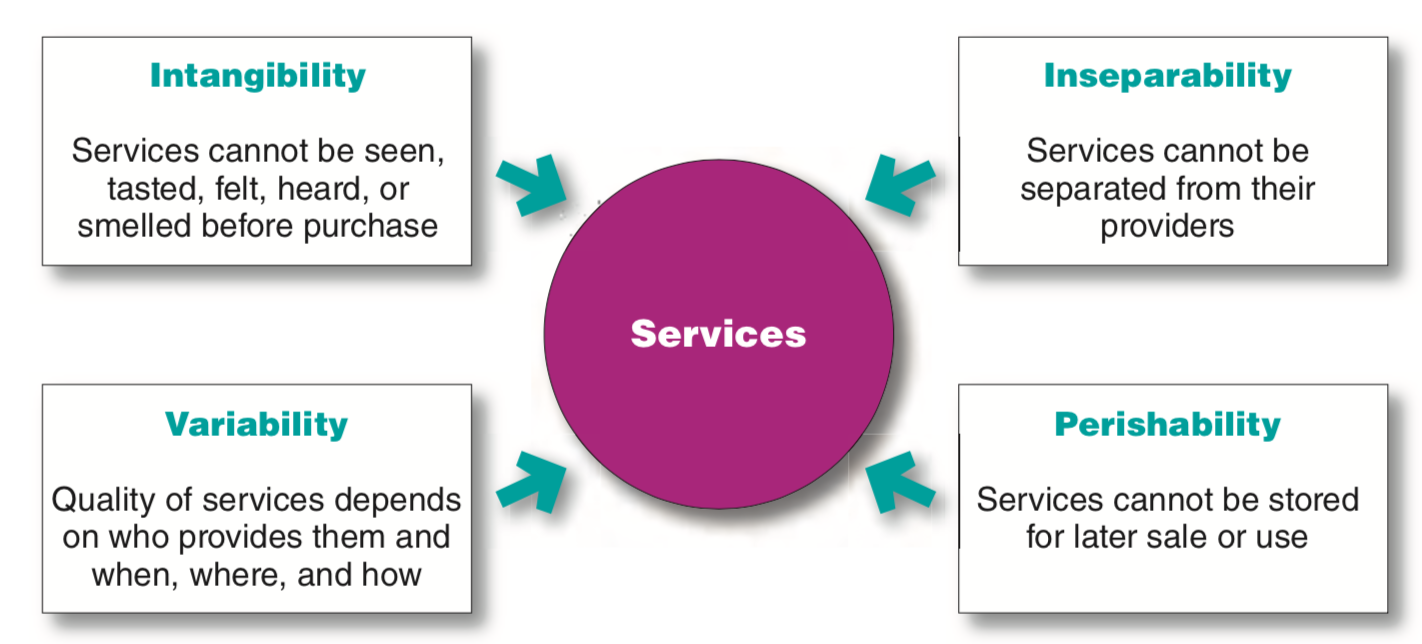
- 115Service Characteristics Explain Service intangibility & Service inseparabilityService intangibility
Services cannot be seen, tasted, felt, heard, or smelled before they are bought.
• Difficulty to promote benefits: sell a promise
• Limited unit measurements makes pricing difficult
• Consumers cannot take possession
Service inseparability
Services are produced and consumed at the same time and cannot be separated from their providers.
• Consumers must be present during delivery
• Other customers can affect service outcome
• Service employees are critical (ensure the same level of quality) - 116Service Characteristics Explain Service variability & Service perishabilityService variability/heterogenity
The quality of services may vary depending on who provides them and when, where, and how they are provided.
• Difficulty to deliver consistent quality
• Limited standardization opportunities
• Customization opportunities (at high cost)
Service perishability
Services cannot be stored for later sale.
• Time- and place- sensitive demand
• Facilities & equipment idle - 117Service profit chainThe chain that links service firm profits with employee and customer satisfaction.
- 118Extended Marketing Mix: 7 Ps1. Product
2.Price
3.Place
4.People
5. Promotion
6. Physical evidence
7. Process - 119Brand architecture There are 3 typesSingle or product brand: One brand for a single product (Nutella, red bull)
Family brand: One brand for a product group (knorr, Nivea)
Umbrella or corporate brand: One brand for all products and services from a company (google) - 120An increasing number of retailers and wholesalers have created their own ________, also called store brands.private brand
- 121Which Marketing Instruments are especially important for Service Providers? hint: think on the 7 Ps.physical evidence
processes
people - 122________ represent(s) consumers' perceptions and feelings about a product and its performance.Brands
- 1231) The manufacturer’s cost per toaster is given by the following: 2) Now suppose the manufacturer wants to earn a 20 percent markup on sales. The manu- facturer’s markup price is given by the following:1) unit cost = variable cost + (fixed costs/unit sales)
$10 + ($300,000/50'000) = $16
2) markup price =
unit cost/(1 - desired return on sales)
= $16/( 1 - 0.2) = $20 - 124Value - Demand curvep (x) = a + bx
x: volume / quantity (Demand)
p: Price per piece (Value) - 125price elasticity describes what?describes the effect of a change in price on overall demand (inelastic vs. elastic).
- 1263 Elements of strategic pricing strategiesValue-based pricing strategy
Competition-based pricing strategy
Cost-based pricing strategy - 127Customer value-based pricingSetting price based on buyers’ desires of value rather than on the seller’s cost.
Value-based pricing means that the marketer CANNOT design a product and marketing program and THEN set the price. Price is considered along with all other marketing mix variables BEFORE the marketing program is set. - 128Cost-bades pricingThe company designs product, adds up the costs of making the product, and sets a price that covers costs plus a target profit. Marketing must then convince buyers that the product’s value at that price justifies its purchase.
- 129With a Cost-bades pricing strategy the seller always whats to minimize production costs?NO!
Costs set the floor for price, but the goal isn’t always to minimize costs. In fact, many firms invest in higher costs so that they can claim higher prices and margins. The key is to manage the spread between costs and prices— how much the company makes for the customer value it delivers. - 130Value-Based Pricing vs. Cost-Based Pricing
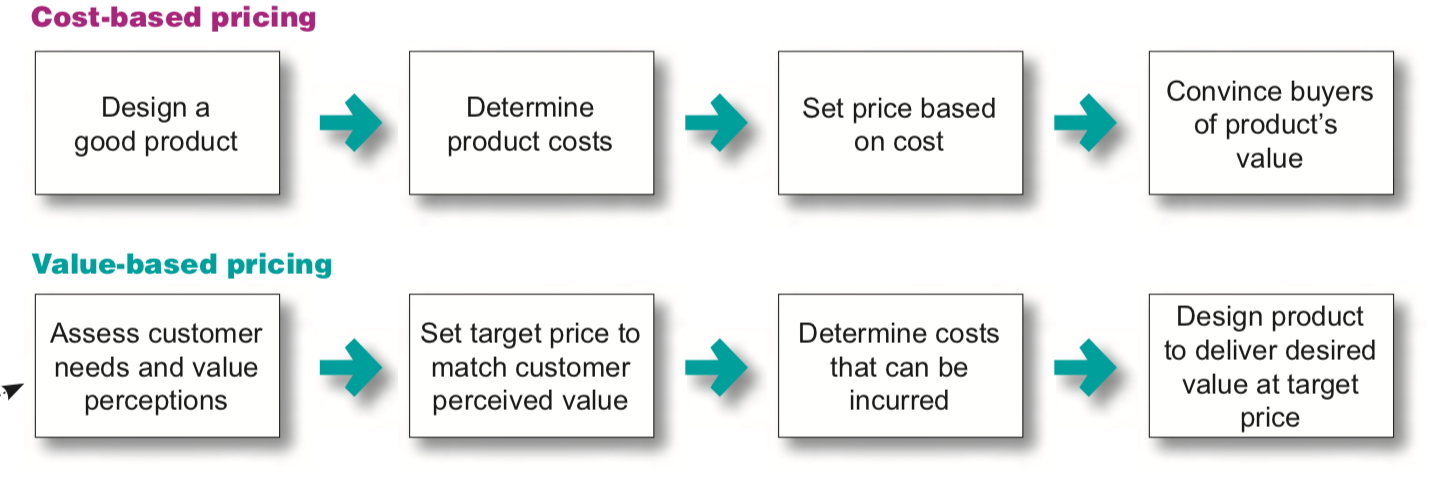
- 131Competition-based pricingThe marketer sets prices in accordance with competitors. Prices may be below, at the, or above the market, depending on customer loyalty, services provided, image, real or perceived differences between brands or stores, and the competitive environment.
In setting prices, the company must also consider competitors’ prices. The company must be certain to give customers superior value for the price. - 132Cost Based Pricing («Cost Plus») Cost based methods price calculation based on variable costscost of material and supply of product A
+ cost of production of product A
+ other costs (warehousing, development etc.) of product A
+ costs of administration and sales of product A
= variable costs of product A
(in order to calculate..)
=>variable unit costs
+ Contribution margin (in %)
= Cost plus price - 133variable unit costsvariable costs (product A)
/
production volume (product A) - 134break-even volumefixed cost/ (price - variable cost)
$300,000/ ($20 - $10)= 30000 pieces - 135Market-skimming pricing (price skimming) example: Apple with introduction from iPhoneSetting a high price for a new product to skim maximum revenues layer by layer from the segments willing to pay the high price; the company makes fewer but more profitable sales.
The product’s quality and image must support the higher price, and enough buyers must want the product at that price. Secondly, the costs of producing a smaller volume cannot be so high that they cancel the advantage of charging more. Finally, competitors should not be able to enter the market easily and undercut the high price. - 136Market-penetration pricing example: Samsung used this strategy to quickly build demand for its mobile devices in fast-growing emerging markets.Setting a low price for a new product in order to attract a large number of buyers and a large market share.
The market must be highly price sensitive so that a low price produces more marketgrowth. Second, production and distribution costs must decrease as sales volume increases. Finally, the low price must help keep out the competition, and the penetration pricer must maintain its low-price position. Otherwise, the price advantage may be only temporary. - 137How to vary the price Price Differentiation Concept Name 7 concepts..Individual = auctions (ricardo)
Benefit based = first class (dropbox)
Quantity based = Quantity discount (rising % discount)
Bundling = Holiday packages, macdonalds menu
Person based = student prices
Region based = country prices
Time based = weekend prices - 138When theaters vary seat prices due to audience preferences for seats in coveted rows, they use ________ pricing.location-based
- 139Segmented pricing is only effective when ________.the cost of segmenting does not exceed the revenue obtained from the price difference.
- 140Consumers are less likely to use price to judge the quality of a product when they ________.have experience with the product
- 141Price Elasticity Reaction of the market to price Under certain circumstances customers are less price-sensitive Name 5• When the price is only a small part of the total cost of obtaining, operating and servicing the product
• there are few or no substitutes or competitors
• they only slowly change buying habits
• they think higher prices are justified
• they do not readily notice the price - 142When does it help to use the price as an indicator of quality? 7 ideas• when quality is important
• customers have only few experience with the product category
• objective product quality is difficult to asses
• prestige product (provides social benefits)
• customer wants to simplify the complexity of the decision
• perceived differences in quality between alternatives
• time pressure - 143Explain cognitive, affective and conative communication goals- cognitive (informational): brand awareness, knowledge
- affective (emotional): liking, preference
- conative (behavioral): trial, purchase - 144AIDA model1. Awareness (Attract the attention of the customer)
2. Interest (Raise customer interest by focusing on product benefits)
3. Desire (Convince customers that product will satisfy their needs)
4. Action (Lead customers towards taking action) - 145A company’s total promotion mix—also called its marketing communications mix.. what is it?The promotion mix is the marketer’s bag of tools for engaging and communicating with
customers and other stakeholders.
It consists of the specific blend of advertising, public relations, personal selling, sales promotion, and direct marketing tools. - 146The five major promotion tools in the marketing communications mix are defined as follows:Advertising
Sales promotion
Personal selling
Public Relations
Direct and digital marketing - 147Explain advertisingAny paid form of nonpersonal presentation and promotion of ideas, goods, or services by an identified sponsor.
Examples: Print ads, TV spots, billboards, catalogues, mass mailings, brochures etc. - 148Explain Public Relations (PR)Building good relations with the company’s various publics by obtaining favorable publicity, building up a good corporate image, and handling or heading off unfavorable rumors, stories, and events.
Examples: press releases, press conferences; personal dialogue (in the course of conventions); specific explanatory material for selected groups, relationship management with journalists - 149Explain PromotionsThey are temporally limited, short-term supportive incentives (e.g., in the course of a new product launch) to encourage the purchase or sale of a product or a service.
-Consumer promotions (free samples)
-Sales promotions (support material)
-Trade promotions (trainings, provision of display material) - 150Explain SponsoringSystematic support of persons and/or organizations in the realm of sports, culture, social service through money, goods, or services
• Quid pro quo: Spill-over-effects, „do good and talk about it“ - 151Explain Product Placementsurreptitious advertising (Schleichwerbung)
Companies incorporate a product or brand in another work, such as a film or TV program, with a specific intent to promote said product.
Examples: movie, TV show, novels, music, computer games - 152Explain Event MarketingAim of company/product presentation to a limited audience (expert audience, B2B audience) or to the interested public
Examples: sports and cultural events, press conferences, seminars, conventions; participation at trade fairs and exhibitions (trade fair marketing sometimes separated from event marketing) = e.g. Redbull - 153Explain Direct & Indirect MarketingDirectly through personal addressing in order to enter into an immediate communication with the individual customer
• indirectly as a basis for a dialogue in the second step
• Examples: production and distribution of catalogues, customer magazines, flyers - 154Explain Personal SellingMainly used with complex problem solutions with high degree of customization (e.g. consumer goods in high need of explanation or B2B goods/services)
Examples: sales conversations, sales presentations, presentations at trade fairs, customer club meetings. - 155Explain Ambush MarketingAmbush marketing is a marketing strategy in which an advertiser "ambushes" an event to compete for exposure against competing advertisers.
Unter Ambush Marketing (auch Parasite Marketing) versteht man Marketingaktivitäten, die darauf abzielen, die mediale Aufmerksamkeit eines Großereignisses auszunutzen, ohne selbst Sponsor der Veranstaltung zu sein. - 156Give the definition of Integrated marketing communications (IMC)Carefully integrating and coordinating the company’s many communications channels to deliver a clear, consistent message about the organization and its products.
The company’s goal should be to deliver a consistent and positive message at each contact. - 157Advertising strategyThe strategy by which the company accomplishes its advertising objectives. It consists of two major elements:
creating advertising messages
selecting advertising media - 158Companies are doing less ________ and more ________ as a result of the explosive developments in communication technologies to better target smaller customer segments.mass marketing
digital marketing - 159Retail shopping is changing. Name the 5 biggest technologies that will affect your shopping experience1. Beacons (bridging online and physical experience)
2. Facial Recognition (identify who buys a lot when entering the store)
3. Robot Shopping Assistant (but also for supply chain)
4. Smart Mirrors
5. Auto/Self Checkout - 160Relationships in the Supply Chain Explain Up- and DownstreamUpstream from the company is the set of firms that supply the raw materials, components, parts, information, finances, and expertise needed to create a product or service.
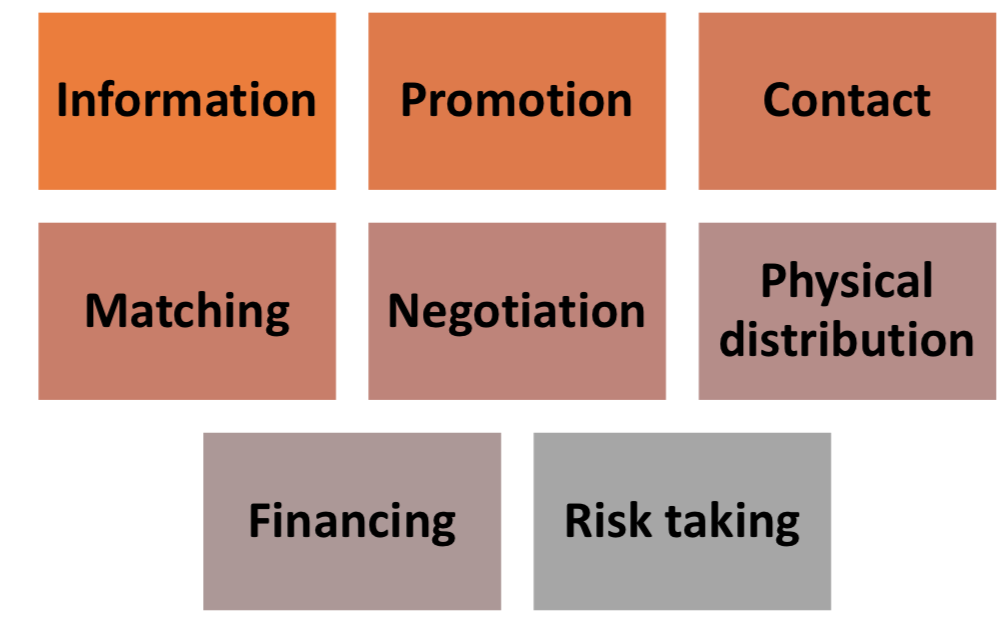
Downstream marketing channel partners, such as wholesalers and retailers, form a vital link between the firm and its customers. - 161Producers use intermediaries to improve efficiency in making goods available to target markets. How do channel partners add value ?In making products and services available to consumers, channel members add value by bridging the major time, place, and possession gaps that separate goods and services from those who use them.
- 162Direct and indirect channel levels. Whats the difference?Direct marketing channel
A marketing channel that has no intermediary levels. (producer to consumer)
Indirect marketing channel
A marketing channel containing one or more intermediary levels. (producer, wholesaler, retailer, consumer) - 163Indirect channel pull-strategy1. Producer gives information regarding Product/brand (Stimuli)
2. End user wants the product (Reaction)
3. Distributor includes the product (Reaction) - 164Indirect channel push-strategy1. Producer gives financial and non financial incentives (Stimuli)
2. Distributor includes the product in his sales mix (reaction). Positions the product against competitor brands
(Stimuli)
3. End user buys the product / brand (Reaction) - 165Multichannel distribution marketing occurs when a single firm sets up two or more marketing channels to reach one or more customer segments. Whats the advantage and disadvantage?+) with new channels the company gains opportunities to tailor its products and services to the specific needs of diverse customer segments.
-)multichannel systems are harder to control, and they can generate conflict as more channels compete for customers and sales.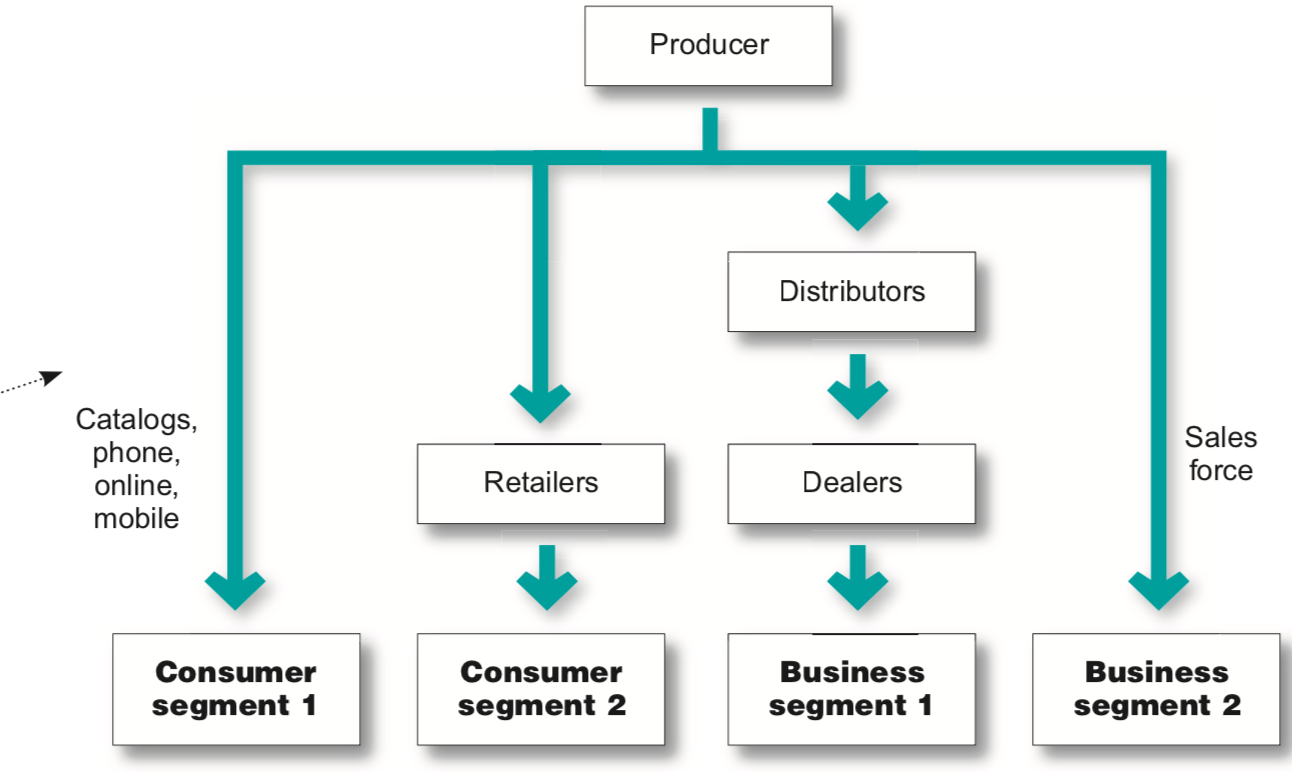
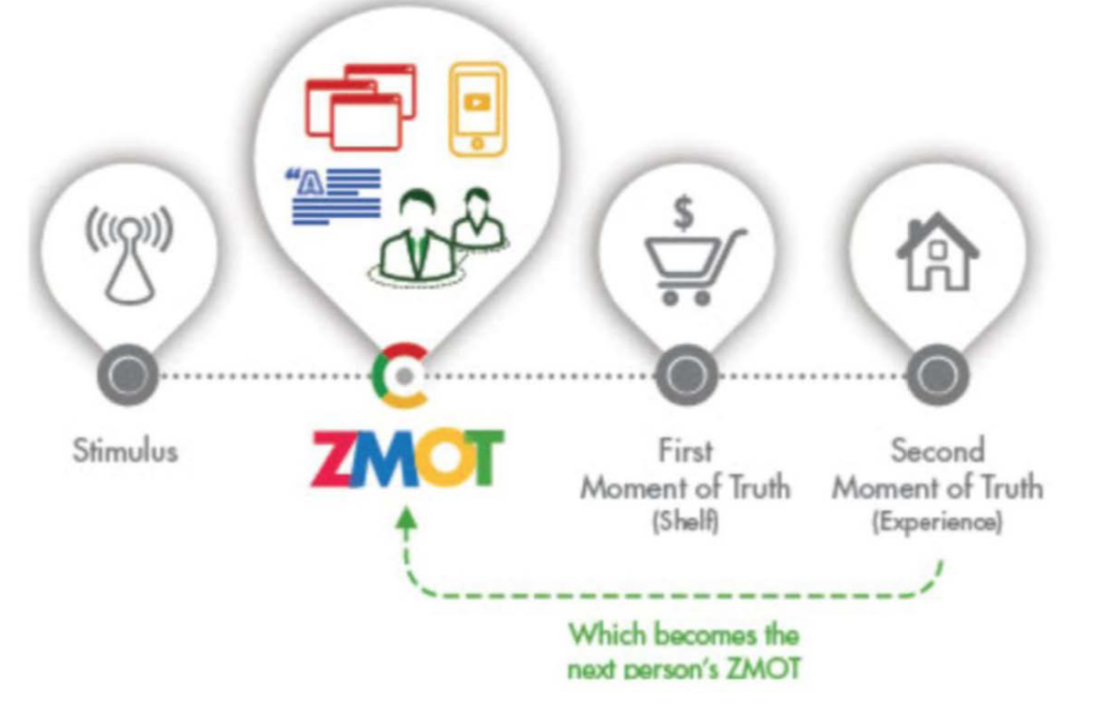
- 166Whats ZMOT?Zero moment of truth refers to the point in the buying cycle when the consumer researches a product, through pre-shopping, in-store or in-home.
- 167Explain Omni-Channel-MarketingOrganizations must employ omni-channel marketing methods to meet customers where they are. Consumers expect more personalized communication with companies through the various channels they use (physical store, online via websites and mobile apps, through physical and virtual catalogs, and through social media).
- 168Marketing channel designRequires analyzing consumer needs, setting channel objectives, identifying major channel alternatives, and evaluating those alternatives:
1. Types of intermediaries
2. Number of intermediaries
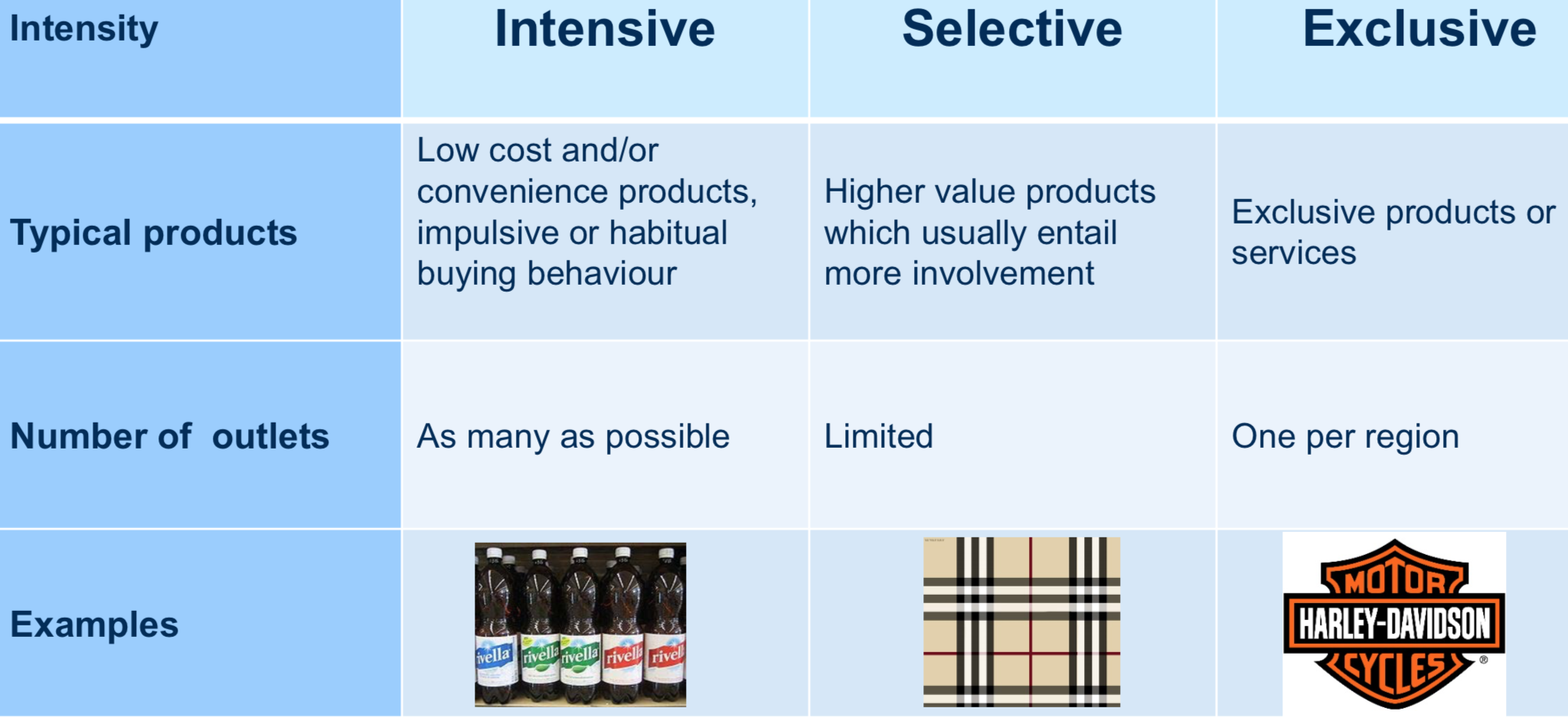
3. Channel member responsibilities - 169Number of intermediaries Three strategies are available: intensive distribution, exclusive distribution, and selective distribution.
- 170A ________ is made up of the company, suppliers, distributors, and customers who partner to improve the performance of the entire system.value delivery network
- 171A ________ is a layer of intermediaries that performs some work in bringing the product and its ownership closer to the final buyer.channel level
- 172How do companies select channel members?1. evaluate each channel member's qualifications and select those who best fit its channel objectives.
2. use economic criteria (evaluate each channel member’s years in business, other lines carried, location, growth and profit record, cooperativeness, and reputation) - 173Customer Relationship Management a definitionThe overall process of building and maintaining profitable customer relationships by delivering superior customer value and satisfaction.
- build up long-term relations (customer acquisition)
-intensify the relation over time (customer development)
-to maintain and continue (customer retention) - 174Measurement of Customer Value explain the One-dimensional model1. ABC analysis
2. customer break-even analysis
3. activity based costing - 175Measurement of Customer Value explain the Multi-dimensional model1. Customer portfolio
2. RFM model
3. Scoring model
4. CLV customer lifetime value - 176Explain the ABC-AnalysisItems that have different levels of significance and should be handled or controlled differently. The items are grouped into three categories (A, B, and C) in order of their estimated importance. 'A' items are very important.
Cumulative share of turnover % to cumulative customer share %
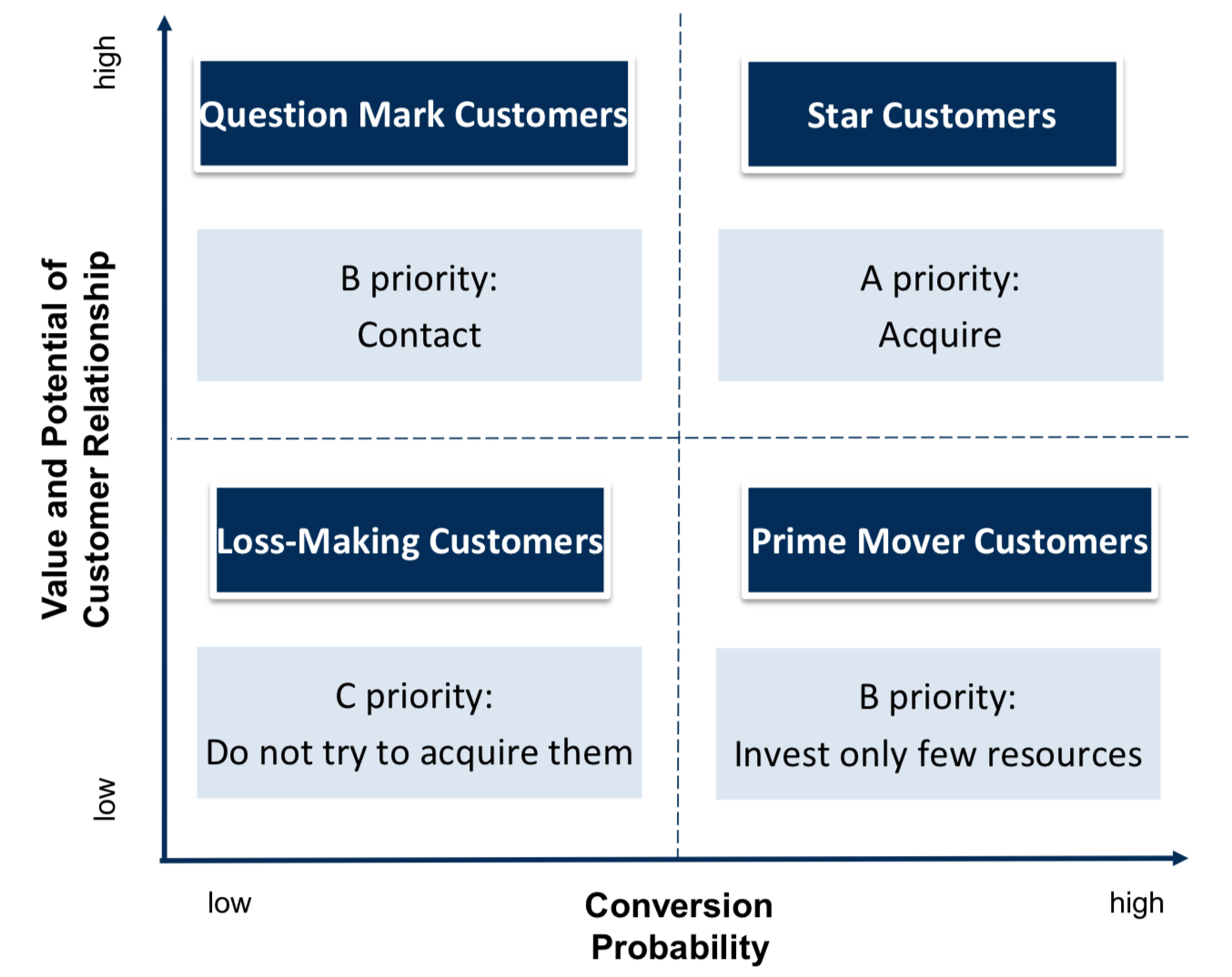
"20% of customers ("A-list clients") account for 80% of turnover" - 177Customer portfolio explain the graph of segmentation by value and conversion probability
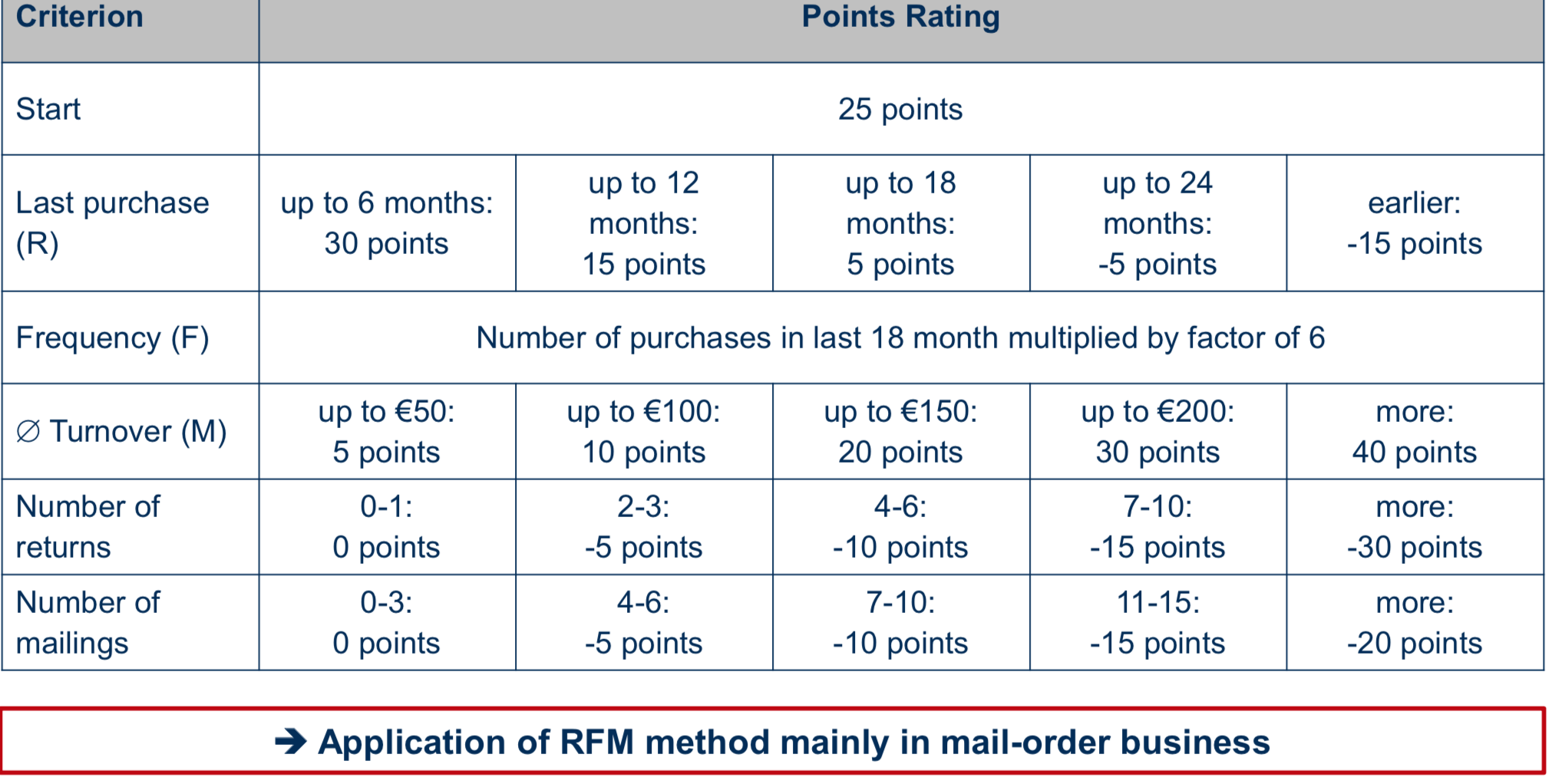
- 178RFM Model Recency, Frequency and Monetary value
- 179Explain the Customer Lifetime Value (CLV) formula Future turnover and costs as basis for customer equity Der Wert, den ein Kunde über die gesamte Zeit seiner Kundschaft für ein Unternehmen darstellt.Die Dauer der Geschäftsbeziehung T wird mit 10 Jahren angesetzt. Entsprechend beträgt der Kalkulationszinssatz 10 %, also 0,1 zur Einsetzung in die Formel. Alle zwei Jahre kauft der Kunde sich ein neues Smartphone im Wert von 400 Euro (eT). Der Hersteller wendet 50 Euro (aT) pro Jahr für die Kundenpflege in Form von Korrespondenz, Telefongesprächen und Email auf. Da eT und aT Werte sind, die sich auf den Zeitraum des Kundendaseins beziehen müssen, werden sie vorab gerechnet: 5 * 400 ergibt 2000 Euro, und 50 * 10 ergibt 500 Euro. Nun werden die Werte in die CLV-Formel eingesetzt.
CLV= (2000 – 500 / (1 + 0,1)*10)
Information
- Description
- Wirtschaftswissenschaft Flashcards on Marketing_ZHAW_SEM2, created by phil mar on 04/05/2018.
- Created by
- phil mar
- Views
- 3
- Tags
- History
-
- Created by Nora Mahrer · Feb 26, 2018
- Copied by phil mar · May 4, 2018
- Rating