
Flashcards
LDS Definitions

Cards in this deck (93)
- 1What are the 3 components of a logic?Syntax (definition of the well-formed formulae of the logic)
Semantics (association of meaning and truth to the formulae)
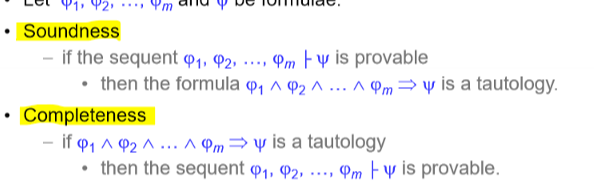
Proof system (manipulation of formulate according to a system of rules) - 2What are completeness and soundness?Completeness (all of the true formulae should be provable)
Soundness (a formula that is provable should be true) - 3What are formal methods and model checking?Formal methods - use of mathematically-based techniques for hte specification and verification of computer systems (prove that programs have certain properties)
Model checking - branch of formal methods where computer system modelled as some mathematical strycytre (eg a finite state process), then a specific property that a system might have is expressed by some logic fomula - 4What are propsitions and what are they represented by?-Declarative sentences that can be either true or false
-Propositions are represented by propositional variables (Bools, atoms) which can take a truth value - 5What are the semantics of propsitional logic?All propositional variables take the value T or F
The value of a formula under some truth assignment is ascertained by using the truth tables for the logical connectives - 6How many truth assignments and truth tables for a formula have?2^n truth assignments
2^2^n distinct truth tables - 7What do satisfy, tautology, contradiction, literal mean?f satisfies a formula if the truth assignment makes the formula evaluate to T
a formula is a tautology if the truth assignment f makes the formula evaluate to T for every f
a formula is a contradiction if the truth assignment f makes the formula evaluate to F for every f
A literal is a propsitional variables or the negation of one - 8When are two prop formulae logically equivalent?If they have identical truth tables.
- 9What are the generalised De Morgan's Laws?
- 10What are normal form results?A propositional formula in the form where it is built from literals using only /\ and \/ (negations only appear directly in front of variables to create literals)
- 11What are the generalised distributive laws?

- 12What is disjunctive normal form? What is conjunctive normal form?A disjunction of conjunctions of literals
A conjunction of disjunctions of literals - 13What is the depth of a logic circuit?Maximal distance from any input to the output gate
- 14What is a proof system?-Defines the proofs (valid mathematical arguments) of the system
It is a collection of rules of interence - 15What is an argument form in propsitional logic? When is it valid?A sequence of formulae (fig 1). Valid if whenever a truth assignment f is s.t.
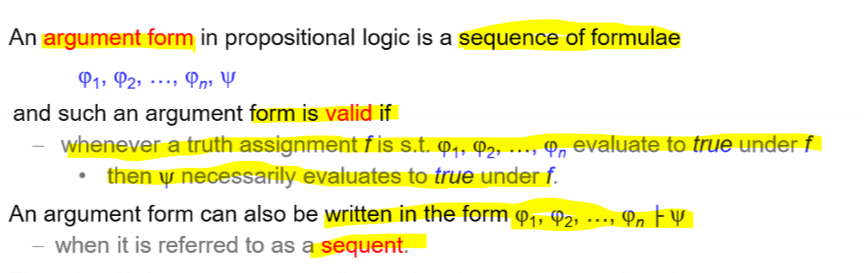
- 16What is the rule of inference corresponding to the above argument?

- 17What is the proof system natural deduction?Consists of a collection of valid rules of inference and is used to obtain proofs of sequents (of the form x1,x2|- y)
- 18What is /\-introduction
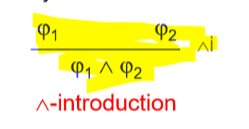
- 19What is /\-elimination?
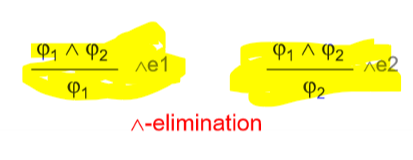
- 20What is ¬¬-introduction?
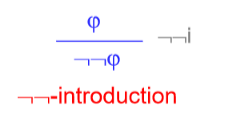
- 21What is ¬¬-elimination?
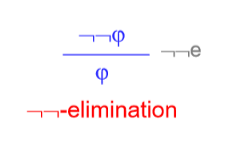
- 22What does it mean if x1,x2|- y is proven?If x1 and x2 are true under some truth assignment, y is necessarily true under this truth assignment.
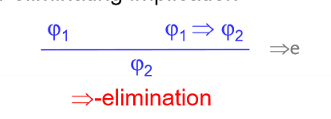
- 23What is => elimination?
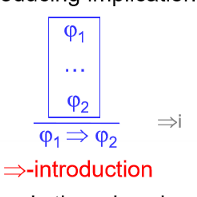
- 24What is => introduction?
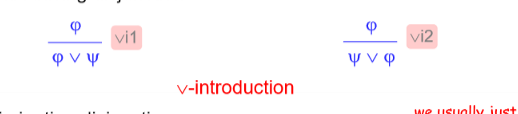
- 25What is \/-introduction?
- 26What is \/-elimination?
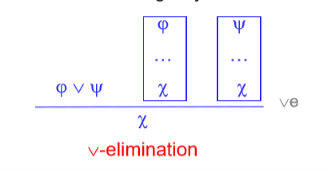
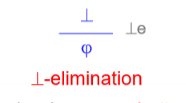
- 27What is ⊥-elimination?
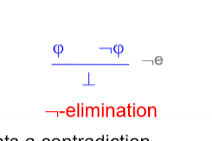
- 28What is ¬-elimination?
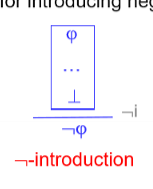
- 29What is ¬-introduction?
- 30What is soundness and completeness within the context of natural deduction?
- 31What is a theorem in natural deduction?The formula y for which the sequent |- y is provable
- 32What is the rule of resolution?

- 33How do we go about resolution?-Given a propsitional formula X
-Take -X and rrite it in cnf as C1/\C2/\.../\Cn
-Start with the clauses C1,C2...Cn
-continually apply resolution rule to infer new clauses
-If we ever infer the empty clause, halt, output X is a theorem
-If we get to the point where we have not inferred the empty clause and we cannot infer any new clauses, halt, output X is not a theorem. - 34Why isn't resolution always good at giving a quick answer?-In the worst case, Resolution involves an exponential number of applications
-A reason for this is that application of the resolution rule can result in a new clause of larger size - 35What do SAT-solvers do? Compare and contrast with proof systems.Check whether or not a given formula of propositional logic is satisfiable, whereas proof systems aim to prove theorems
-Two tasks are different sides of the same coin
If X is satisfiable, then there is a t.a. making X true - and a t.a. making -X false. ie -X is not a tautology.
If -X is not a tautology, there is a t.a. making -X false, thus a t.a. making X true, thus X is satisfiable
X is satisfiable iff -X is not a tautology - 36When are two sets X and Y equal?-Iff they contain exactly the same elements, or
for every x, x∈X implies x∈Y
for every x, x∈Y implies x∈X - 37For any set S, what can we say about the ∅?The ∅⊆ S
(if ∅ is not a subset of S there must exist some x ∈ ∅ that is not in S, but such an x cannot exist as ∅ is empty, thus ∅ is a subset of S) - 38If A⊆∅, what can we say about A?A = ∅
Suppose that A⊆ ∅ and let x∈ A
So, x ∈ ∅ - 39What is the power set of S?The set of all subsets of S
if S is of finite size n then P(S) is finite, of size 2^n - 40What is the Cartesian product XxY{(x,y) : x ∈ X and y ∈ Y}
- 41What is the cartesian poduct of A1 x A2 x ... x An?{(a1,a2,...,an) : a ∈ Ai for all i = 1,2,...,n}
- 42Define disjoint setsTwo sets are disjoint if their intersection is the empty set
- 43What is the principle of inclusion-exclusion?

- 44What is the difference of A and B? What is the complement of A?1. Set containing all elements that are in A but not in B
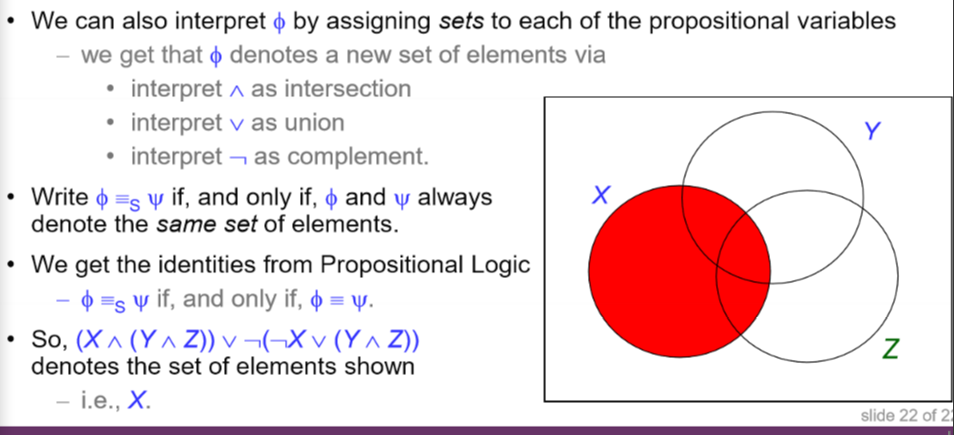
2. Set containing all elements that are not in A. - 45How can we use sets/venn diagrams to s give semantics to a formula of propositional logic?Interpret X by assigning sets to each propositional variable, /\ = intersection, \/ = union, negation = complement
- 46What is a binary relation from A to B?Set of ordered pairs where the first element comes from A and the second comes from B
- 47What does R(a,b) holds mean?(a,b) is in the binary relation R.
- 48how can functions be viewed as binary relations?if f : A->B then the graph of f is the binary relation {(a,f(a)) : a ∈ A} ⊆ AxB
- 49Can every binary relation from A to B be cnsidered to be the graph of a function?No. We need R to have the property that every element a of A appears in exactly 1 element (a,b) of R
If this is so, then f(a) = the unique element b ∈ B for which (a,b) ∈ R - 50What is the arity of a relation that is a subset of A1xA2x...xAn?n
- 51What is the binary relation R on a set A?A relation from A to A (a subset of AxA)
- 52When is a binary relation reflexive?if (a,a) ∈ R, ∀a ∈ A
- 53When is a binary relation irreflexive?if (a,a) ∉ R, ∀a ∈ A
- 54When is a binary relation on A symmetric?if (a,b) ∈ R whenever (b,a) ∈ R, ∀a,b ∈ A
- 55When is a binary relation on A anti-symmetric?whenever (a,b), (b,a) ∈ R then a=b,b ∈ A
- 56When is a binary relation on A transitive?when (a,b),(b,c) ∈ R, then (a,c) ∈ R, ∀a,b,c ∈ A
- 57Let R ⊆ AxB and S ⊆ BxC be relations. What is the composite relation S ∘ R ⊆ AxC defined as?{(a,c) : a ∈ A, c ∈ C, ∃b ∈ B s.t. (a,b) ∈ R and (b,c) ∈ s}
- 58How do we define R^2 ie composed with itself?{(a,c) a, C ∈ A, ∃b ∈ A s.t. (a,b),(b,c) ∈ R}
- 59How do we project from an n-ary relation R s.t. R ⊆ A1 x A2 x ... x A n ?Choose i1,i2,...,im ∈ {1,2,...,n} where i1 < i2 < .... < im
Build the m-ary relation S ∈ Ai1 x Ai2 x ... x Ain by taking all those m-tuples that are obtained from some n-tuple of R by only including the elements in coponents i1,i2,...im
The relation S is the projection of R in components i1,i2,...im - 60What is the reflexive closure of R?The smallest reflexive relation that contains R, obtained by adding to R all the pairs(x,x) that do not already lie in R.
- 61What is the symmetric closure of R?The smallest symmetric relation that contains R. It is obtained by adding to R all the pairs (x,y) for which (y,x) (but not (x,y)) lies in R
- 62What is the transitive closure of R?The smallest transitive relaiton that contains R. It is defined as
{(a,b) : a,b ∈ A, (a,b) ∈ R^n, for some n>=1} = U(n=1, infinity) R^n - 63What is an equivalence relation?A relation is an equivalence relation if it is reflexive, symmetric, and transitive
if (a,b) ∈ R, then a and b are equivalent. - 64Let a ∈ A. What is the equivalence class containing a?Written as [a]R, it is the set of all elements x that are equivalent to a.
- 65How can we write out the set A in terms of equivalence classes?A can be written as the disjoint union of distinct equivalence classes.
- 66What is a partial order? What is a poset?A binary relation that is reflexive, anti-symmetric, and transitive.
A set S together with a partial order R on S is a poset, written (S,R) - 67If (S, <=) is some poset then what can we say about two elements of S?They are comparable if either a<=b or b<=a, and incomparable otherwise.
- 68What is a totally ordered/linearly ordered set?If (S,<=) is a poset and every two elements in S are comparable then S is a totally ordered set, with <= a total ordering.
- 69What is a well-ordered set?If (S,<=) is a poset and <= is a total ordering and every non-empty subset of S has a least element (under <=) then (S,<=) is a well-ordered set.
- 70If (A,<=a) and (B,<=b) are two posets then define the lexicographic ordering <= on AxB(a,b) <= (a',b') iff
a<=a a' and a !=a' or
a =a' and b<=b b'
with (a,b) = (a',b') iff a=a' and b=b'
(AxB,<=) is a poset. - 71What is a function f from A to B?An assignment of an element of B to every element of A.
- 72What is the domain? codomain? image? pre-image?the set A
the set B
if f(a) = b then b is the image of a
the pre image of b is the subset {a : f(a) = b} of A - 73What is a partial function?One such that either f(a) ∈ B or f(a) is undefined
- 74What's an injective function?For every a ∈ A and a' ∈ A
if f(a) = f(a') then a=a' - 75What is a surjective function?every B ∈ B is such that there exists some a ∈ A s.t. f(a) = b
- 76What is a bijective function?One that is both injective and surjective.
- 77Suppose f: A-> B and g : B-> C are functios. What is the composition of g and f?g o f : A-> defined as (g o f)(x) = g(f(x))
- 78What is the inverse of a function f : A->B?f-1 : B-> A where
f-1(f(a)) = a, every a ∈ A
f(f-1(b)) = b, every b ∈ B - 79When does f have an inverse?iff f is a bijection
- 80When do two sets have the same cardinality?iff there is a bijection from A to B
- 81When is a set countable? When is a set uncountable?If it is fintie or has the same cardinality as N. (aleph zero)
uncountable if it does not have cardinality aleph zero. - 82What is the fundamental building block in first order logic and what is it?The predicate
A predicate symbol is just a symbol with an associated arity - 83What is an atomic formula?Given a predicate symbol P of arity r and some variables x1,x2...xr
the formula P(x1,x2...xr) is an atomic formula - 84How can we work out if P(x1,x2...xr) is true or false?We need to be given an r-ary relation P' over some domain D, and values v1,v2,...,v2 from D for x1,x2....,xr
- 85How do we build more complicated formulae from atomic formulae?Using connectives of propositional logic, formulae of the form x = y. These are called quantifier-free formulae.
We can add quantifiers (there exists an element, or for all elements) too, we can apply them to quantifier-free formulae even when there is more than one free variable in the formula. - 86Syntax of atoms.If P is a relation symbol of arity r and y1,...,yr are variables or constants, then P(y1,...,yr) is an atom with free variables from y1,...,yr.
If C and D are constant symbols and x and y are variables then C=D, C=x, x=y are all atoms with free variables empty set, {x}, {x,y} - 87What is the signature of a formula?Its finite set of predicate (relation) and constant symbols.
- 88How do we define constructions?if A and B are formulae with free variables free(A) and free(B), then
A\/B,A/\B, -A are formulae
with free variables free(A)Ufree(B), free(A)Ufree(B) and free(A)
If A is a formula with free variables free(A) then
∃x(A), ∀x(A)
are formulae, with free variables free(A)\{x}. x is a bound occurence. - 89When is a formula a sentence?If it has no free variables.
- 90What is an interpretation for a first-order formula A?A domain of discourse D
a value from D for every free variable of A
A relation over D for every relation symbol involved in A
A value from D for every constnat symbol involved in A. - 91When are two formulae logically equivalent?If they have the same set of models.
- 92What is prenex normal form?If a formula is written in the form
Q1x1Q2x2...QkxkA
where each Qi is a quantifier
each xi is a varible
the formula A is quantifier-free - 93—
Information
- Description
- Flashcards on LDS Definitions, created by SEZ McKelvey on 13/05/2018.
- Created by
- SEZ McKelvey
- Views
- 0
- Rating