
14576861
Description

Flashcards by Olivia Gniadek, updated more than 1 year ago

|
Created by Olivia Gniadek
over 7 years ago
|
|
| Question | Answer |
| What are the 7 Earth systems cycles | Climate cycles - climate change Sea level cycles Atmospheric circulation Oceanic circulation Hydrologic cycle Plate tectonic cycle Rock cycle |
| What piece of technology records the way seismic waves are transmitted through the earth's interior | Seismographs |
| Why does the earth have magnetic poles? | the inner core spins slightly faster than inside the liquid outer core acts as an electric generator to produce a electromagnetic field that extends into space |
| How does the earth work? | The outer part of the earth moves a few cm per year driven by a solid convection in the earth's interior |
| How do we know the sea floor is spreading | the pattern of magnetic anomalies parallel to the rift valley of a mid-ocean ridge |
| Are earthquakes and volcanoes distributed evenly? | Earthquakes and volcanoes occur mostly at the plate boundaries |
| What drives plate tectonics? | Mantle Convection Heat and hot rock circulating through mantle cold, dense slabs are recycled back into mantle for subduction |
| What is a rock? | Made up of groups of minerals (ign/ met) or particles of other rocks (sed) |
| What is a mineral? | naturally occurring solid specific chemical composition repeating structure of atoms |
| What is the continental crust made up of? | Granite |
| What is the oceanic crust made up of | Basalt |
| What creates mountain ranges | Continental collisions |
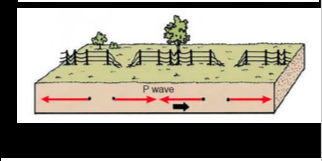
| What are primary waves (P-waves) | Push/pull effect Compresses and expands particles Fastest wave Travels through any medium Faster in dense rocks i.e. faster at depth |
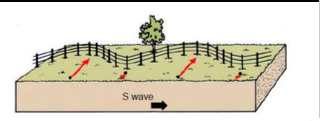
| What are secondary waves (S-waves) | Side to side movement at right angles Slower than p-waves Travels only through solids |
| How is wave energy reflected and refracted | Ref- waves refract away from interface if material it enters causes slow movement of waves - waves refract towards interface if the material causes speed up of waves |
| What does the mantle consist mostly of | Peridotite |
| what occurs with depth | velocities increase with depth |
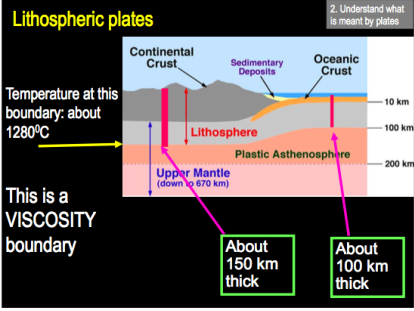
| At approximately 100 to 200km depth what happens to the peridotite | the pressure and temperature makes the peridotite melts a little (<2%) due to slow seismic wave travel, a low velocity this weak zone causes the movement of oceanic plates |
| what is the mantle density in the crust, mantle, upper mantle, transition zone and the lower mantle | 3.5gm/cm3 5.5gm/cm3 400km 670 km 2900 km |
| How dense is the oceanic crust | 7-10 km |
| How dense is the continental crust | 35-40 km |
| W | Crust-mantle boundary |
| How dense is the inner core | 10-13 gm/cm3 |
| How dense is the outer core | 2900 to 5155 km |
| what is the outer core composition | iron alloy |
| How dense is the inner core | 5155 km to 6371 km |
| What is the composition of the inner core | solid iron alloy |
| What generates the magnetic field | convective fluid motion in outer core generates magnetic field movement of conducting iron generates magnetic field radioactive heating and chemical differentiation - in state of convection |
| W | record of ancient magnetism preserved in rock |
| what is the orientation of the magnetic force field | perpendicular to the earth's surface at poles field points downwards in the Northern Hemisphere and vice versa in the south |
| What are the two components of rock magnetism | direction of magnetic 'pointing' inclination with the earth's surface |
| what does the magnetic record give and indication of | where the rock was on the surface when it was magnetised |
| Certain minerals are ... | magnetic when cooling, magnetic minerals alight with the magnetic field when cooled below curie point (i.e. 580º for magnetite) grain alignment freezes in |
| What has occurred with the earth's polarity during history | magnetic field has reversed polarity at various times can occur in 10's to 1000's of years |
| What are positive anomalies due to | presence of rocks with 'remnant' magnetism of normal polarity |
| what are negative anomalies due to | presence of rocks with remnant magnetism of reversed polarity |
| what will be the effects of a future magnetic reversal | Solar wind hits earth more intensely increased radiation = skin cancer disaster unlikely |
| What does the rock found in the oceanic show | preserved record of earth's magnetic polarity at the same time the crust formed |
| What does a collisional convergent zone begin as | Andean type |
| What occurs at continent-continent plate boundaries | crustal shortening and thickening |
| what are the two types of convergent plate boundaries | subduction zones collisional zones |
| what happens to the lithosphere at subduction zones | Lithosphere is consumed surface area of earth remains constant |
| what is a continental rift | divergent boundary on a continent e.g. the red sea rift |
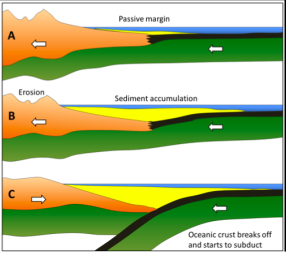
| What happens to the oceanic crust | Old is cold and cold is dense after 80Ma crust wants to subduct destructive plate margins |
| What happens at convergent plate boundaries | Two plates collide one oceanic plate bends and sinks into asthenosphere (if one is oceanic) lithosphere is more dense than asthenosphere |
| What are the three types of convergent boundaries | ocean-ocean ocean - continent continent-continent |
| What is a Viscosity boundary | |
| What is the crust composed of | composition: felsic, intermediate, mafic igneous, sedimentary and metamorphic rocks |
| What is the age of the crust | 0-4 billion years |
| What are the properties of the continental crust | thicker, less dense, heterogeneous, old |
| From the oceanic crust, what is the depth of the moho | approx 7 km |
| What is the composition of the oceanic crust | mafic igneous rocks (basalt and gabbro) thin layer of sediments on top |
| what is the approximate age of the oceanic crust | 0-200 million years |
| What are the properties of the oceanic crust | thin, more dense, homogeneous, young |
| How would you describe the movement of transform plates | slide past each other |
| How does a divergent boundary start | lithosphere stretches due to rifting continental rift is a belt or zone where the rifting occurs if rifting is successful, lead to formation of ocean basins |
| How does a subduction zone begin and stop | |
| Where do the deepest and the largest earthquakes occur | at subduction zone |
| Where do volcanoes originate | subducting plates |
| What are plumes | mantle convection rising from core-mantle boundary |
| What is a slab pull? | derived from negative buoyancy of slab weight of slab pulls plate to subduction zone resisted by viscous mantle |
| What is trench suction | slab drags against viscous mantle, causes flow in mantle wedge towards subduction zone flow sucks in nearby plate i.e. pulling plug of bathtub |
| What is slab rollback | small scale convection on back side of subducting slabs |
| WHat are plate tectonic resistive forces | exerted on overriding plate results in sheer stress distributed on subduction thrust interface |
| What is a basal sheer traction (mantle drag) | resistance associated with mantle/lithosphere interface |
| What can you construct if you correct local movements | global hotspot reference frame = absolute plate motion w.r.t core mantle boundary |
| What is important factor in the thermal cycle | upwelling in mantle plumes |
| What can mid-ocean ridges and sea floor spreading be a factor of | passive phenomena |
| What do LLSVPs sit above | plate motion and plate force divergent zones, edges mark hotspot sites and kimberlite magmatism |
| What drives plate motion | ridge push slab pull basal drag mantle resistance/friction |
| W | Mantle plume activity Volcanoes are not necessarily near plate boundary |
| What does convective motion require | heat source heat from earth comes in two ways: radioactive decay residual heat |
| What is a rock? | Naturally occurring Aggregate of minerals |
| What is an igneous rock | crystallisation from molten rock rising from earth's interior |
| What are sedimentary rocks | aggregates of sediment chemical (precipitated from water) organic sediments e.g. coal, oil |
| W | changed from one form (igneous or sedimentary, metamorphic etc) exposed to intense heat, pressure, hot fluids growth of new minerals which exist in new pressure and temp conditions |
| What is the earth's crust composed of | igneous rock |
| Where does igneous activity primarily occur | at or near tectonic plate boundaries |
| What types of rocks are formed at divergent boundaries | mafic igneous |
| What type of rocks form at convergent boundaries | intermediate to felsic igneous rock, is due to the partial melting which produces magmas |
| What rock is found at divergent plate boundaries | Igneous rock i.e. Basalt Metamorphic rocks from heated water |
| Where else can igneous activity occur and why | Inside plates rising mantle plumes produce hotspots & volcanoes which rise through oceanic or continental crust i.e. Hawaii |
| All three rock types form at convergent plate boundaries, how is sedimentary rocks form | sediments compressed and cemented |
| How are metamorphic rocks formed | compressed, heated and change minerals DO NOT MELT |
| How are igneous rocks formed | When rocks melt, magma is formed, rises, cools and crystallises |
| What occurs at transform plate boundaries | Mid ocean ridge is formed at transform faults shallow earthquakes generated igneous activity is rare rocks can be any of the three types |
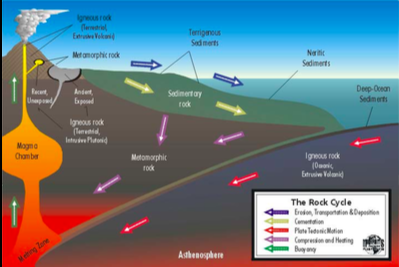
| How is the rock cycle integrated into plate tectonics |
Want to create your own Flashcards for free with GoConqr? Learn more.