
Flashcards
ETC2410: Week 2

Cards in this deck (17)
- 1Random variableAssigns a numerical outcome to an event e.g. rolling a die, starting wage offer to a graduate
- 2Discrete random variable (DRV)- Takes on a finite number of values
- E.g. Bernoulli (binary) random variable can only take the values 0 and 1
- Fully described by its possible values and the probability corresponding to each value - 3Continuous random variable (CRV)- Takes a continuum of values within some interval
- Can take on so many possible values that we cannot count them or match them up with positive integers => probability is zero - 4Probability distribution (pdf) for DRV- Probabilities sum to 1
- 5Probability distribution (pdf) for CRV- Function f such that P(a ≤ X ≤ b) is the area under the pdf between a and b
- Area under pdf = 1 - 6Mean / expected value
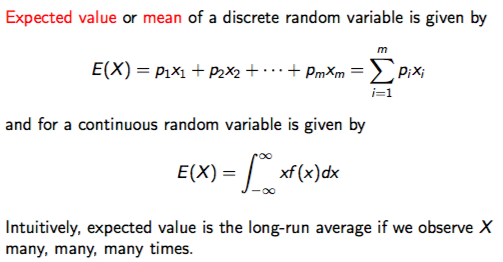
- 7Properties of expected value
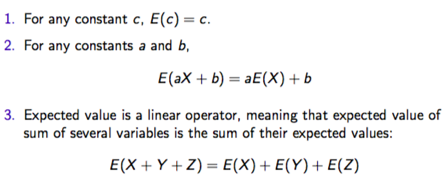
- 8Median and mode- Median - middle-most outcome of X (preferred to mean when the distribution is heavily skewed e.g. income, house prices)
- Mode - most likely value - 9Variance- Measures average spread of distribution of X around its mean
- Indicates riskiness of an action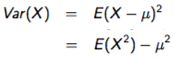
- 10Properties of variance
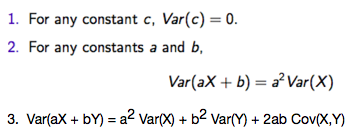
- 11Standard deviation- Positive square root of the variance
- Called the volatility in X
- Advantage: has the same units as X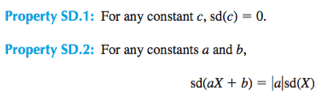
- 12Properties of conditional expectation- Weighted average of possible values of Y, given that X has a specific value
1. Conditional on X, any function of X is no longer a random variable and is treated as a known constant i.e. E (XY|X) = X E (Y|X)
2. If E (Y|X) = c, where c is a constant that does not depend on X, then E (Y) = c - 13Joint probability distribution- Analyses the nature of dependence
- Can be used to find both the marginal and conditional densities of X and Y - 14Covariance- Measures amount of linear dependence between two random variables
- Magnitude changes with scaling, so only sign is important (+ve => same direction, -ve => opposite direction)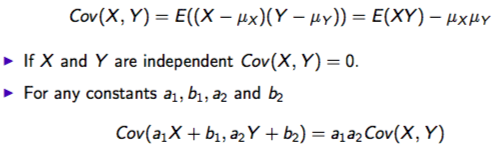
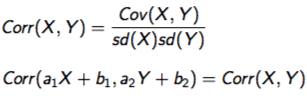
- 15Correlation- Both magnitude and sign are important
- 16Diversification- Averaging is a form of diversification that reduces risk
- Mean is the same, but variance is smaller
(observations must be independent and identically distributed)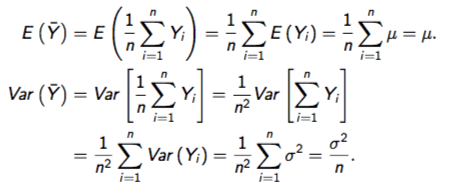
- 17Conditional expectation function- This model is incomplete as it does not specify the pdf of Y conditional on X
- If we assume that Var (u|x) = σ^2 and the distribution is normal, then we have a complete model (classical linear model)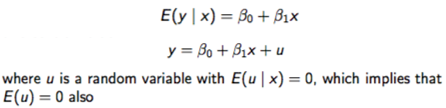
Information
- Description
- Business/Economics (ETC2410: Introductory Econometrics) Flashcards on ETC2410: Week 2, created by Melina Mackey on 17/08/2018.
- Created by
- Melina Mackey
- Views
- 2
- Rating