
Flashcards
Research Midterm
Cards in this deck (29)
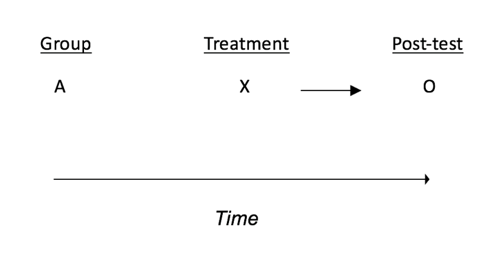
- 1—Single Group, post-test only
Example: a class is given a study guide and then takes an exam - 2—Non-equivalent Groups, post-test only
Example: two classes, one gets a study guide, then they take the same exam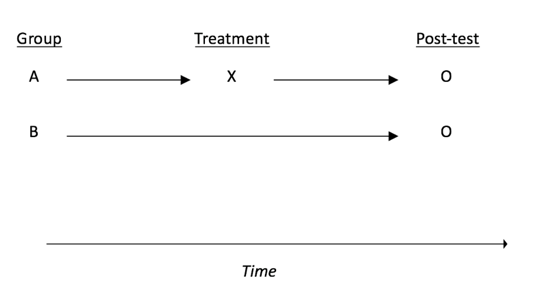
- 3—True Experimental
Example: patients are randomly assigned to groups, take a health test, one group goes through a health program, one doesn’t, then they take the same health test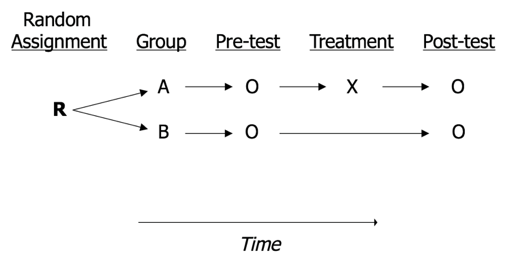
- 4—Quasi-experimental
Example: patients self-selected into groups, take a health test, go through a health program, then take the health test again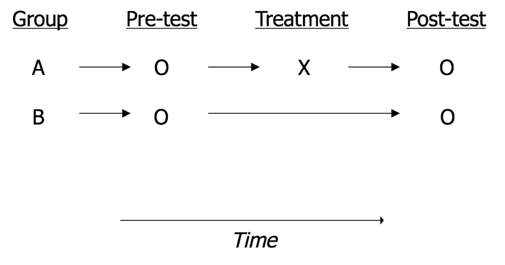
- 5Describes the aspects or characteristics of a population using statistics, providing data. a. What are the average ages of students living in sororities at UVA? b. What is the breakdown of racial/ethnic demographic information in first year students at UVA?Descriptive
- 6Comparing dependent variables using two or more levels of an independent variable. a. Comparing academic success of first-generation students and non first generation students based on grades in introductory English course b. Class attendance rates between the football team and basketball team at UVAComparative
- 7Measures the strength of the relationship between two variables a. Measure the correlation between high school students’ SAT scores and their college GPA after 4 years b. Squat weight vs 40-yard dash speedCorrelational
- 8How one or more variables predicts something else a. Pages read per week, hours spent per week on homework, hours spent in professors office predicts college GPA over four years b. Stress levels and hours of sleep per night predict first year GPAPredictive
- 9Suggesting causal conclusions by comparing groups in naturally occurring settings. Ex post facto means you’re looking into the past and basing your results on what has already happened. a. Retention based on first generation and non-first generationCausal-comparative & ex post facto
- 10• Probability (random) sampling technique - All individuals have an equal and independent chance of being selected • Should ALWAYS use if possible • Allows for reduced and/or lack of bias • Example: Studying graduate students at UVA: Obtain list from registrar and use an online random number generator to determine the selected sampleSimple random
- 11• Probability (random) sampling technique • All persons in population placed on list and every nth person is selected • Used because it’s typically easier, but introduces bias, especially depending on organization of list • Example: Studying undergraduate students at a university: Obtain list from registrar and choose every 5th student (If you’re not the 5th, 10th, 15th, etc. student, you have no chance of being selected)Systematic
- 12• Probability (random) sampling technique • Selected in a way that certain sub-groups of the sample are represented in the sample in a way that are proportional to their representation in the population • People from each population are selected using Simple Random sampling • Example: Researching college students’ average GPAs across majors within a university: in the university’s population, 12% of students are English majors, 25% are Engineering majors, and 22% are Business majors. - The sample population should include 12% English, 25% Engineering, and 22% Business to be representative of the populationStratified
- 13• Naturally occurring groups are selected randomly, and all members of the selected groups are chosen for the sample • Example: Alcohol Use and Abuse on an Urban Commuter Campus study-- all students in randomly selected classesCluster
- 14• Similar to stratified sampling, but participants are not chosen randomly • Example: Taking race (as proportional to the the population) and purposefully choosing individuals within that category-- sampling the 7 Native Americans that you knowQuota
- 15• Participants selected on basis of availability • Example: Dining services is interested in how customers like the new Starbucks in Newcomb Hall. Distribute surveys to all that come in over a week.Convenience
- 16• Participants selected due to some desired characteristics • Example: Surveying all 4th year students who attended at least 4 basketball games.Purposeful
- 17• Participants are selected because they reflect the average person or instance on a particular topic Examples: - Choosing to interview full-time, undergraduates students from UVA about their utilization of dining services - Interviewing female elementary school teachers who have been teaching for 5-10 years on their satisfaction with Common CoreTypical
- 18• Participants are selected because they are unusual or unique in some way • Example: The Career Center is interested in conducting a study of student needs and begins by interviewing students who started their own businesses while they were in college.Extreme/Deviant
- 19• Participants are selected because they are illustrative of the issue being studied • Example: A university is considering changing vendors for its office furniture. Recently, there has been a rise in office-related issues from faculty and staff with back troubles and carpal tunnel syndrome. Before a decision is made regarding office furniture vendor, the Office of Planning decides to conduct several focus groups with faculty and staff with these ailments.Criterion/Critical
- 20• Participants are selected to represent the widest range of characteristics • Example: doing a study on student athletes; take a student from each sport to studyMaximum variation
- 21• Participants are chosen in the hope that they will disconfirm what has already been learned • Example: You interview faculty about treatment of women faculty members on campus and suddenly realize you’ve only interviewed men. You interview women.Disconfirming/negative case
- 22• Respondents are asked to recommend who else might be interviewed who could provide knowledge on this topic. • Example: Interviews with Black LGBTQ students at UVa about their experiences on grounds.Snowball (chain)
- 23• Participants are identified, in the middle of data collection, who would be valuable as an additional source of information. • Example: You’re conducting a study on racial identity development, and you have the chance to interview William Cross.Opportunistic
- 24• Process of describing and analyzing practices and beliefs of a culture-sharing group - Ex: Understanding the culture of a particular sorority at UVa.Ethnography
- 25• In-depth exploration of a ‘bounded system’ (an activity, event, process or individuals) based on extensive data collection - Ex: Study involving the change of leadership (President, COO, and Provost) at UVa. Could also examine at multiple institutions and compare across cases.Case Study
- 26• General methodology for developing theory that is grounded in data systematically gathered and analyzed - Ex: Developing a theory of identity for 1.5 generation students (students who arrived in the US as young children) – in-depth interviews with 1.5 generation immigrants.Grounded Theory
- 27• The study of lived experiences and ways we understand those experiences to develop a worldview - Ex: How does social media effect identity development?Phenomenology
- 28• Focus on systems of power and control, privilege, inequity, inequality, dominance, and influence based on race, gender and socioeconomic - Ex: Examining Tinto’s theory of departure for female students who are also single parents receiving public assistance.Critical Studies
- 29• First-person accounts of experience, told in story form. Focuses on studying a small number of people, gathering data through the collection of stories, reporting individual experience for the individual - Ex: What are the key events of a student in a master’s of higher education program at the University of Virginia for a year?Narrative Inquiry
Information
- Description
- Flashcards on Research Midterm, created by Danny Housier on 10/10/2018.
- Created by
- Danny Housier · Oct 2018
- Updated
- Oct 11, 2018
- Views
- 68
- Rating