
Flashcards
FSC239 Midterm
Cards in this deck (90)
- 1What is forensic science?The principles and methods used in [insert discipline] to matters related to the law.
Disciplines:
-Chemistry
-Toxicology
-Psychology
-Biology
-Anthropology
-Pathology - 2Describe Locard's Principle of Exchange.Dr.Edmond Locard was a French Criminologist (1877to1966). He speculated that every time you make contact with another person, place, or thing, it results in an exchange of physical materials.
- 3What is trace evidence?Refers to physical evidence that is found in small but measurable amounts, such as strands of hair, fibres, or glass. It may be transferred between people, objects or the environment during the commission of a crime.
- 4What is physical evidence?Anything that may be found, by investigators, to have a connection with a crime.
Non-biological: footprint, tire marks
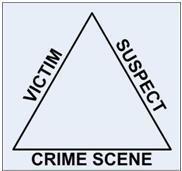
Biological: DNA - 5Label the crime scene investigation triangle.
- 6Describe the methods involved in looking for trace evidence.Lighting is key.
Oblique Lighting: Oblique lighting uses a light source positioned at a low angle. Oblique lighting is usually used to show detail by creating shadows on the surface of the evidence. Oblique lighting is commonly used when photographing impressions, tool marks and certain types of fingerprints.
Alternative light source (ALS): Any light source other than natural. Physiological fluids (semen, urine, and saliva) can be identified through their natural fluorescent properties utilizing UV light.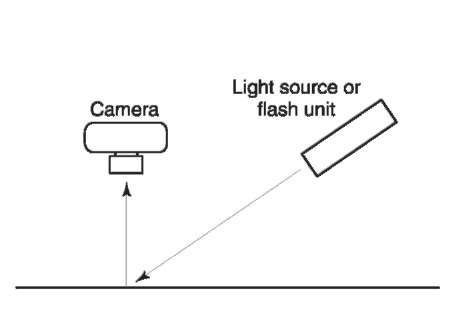
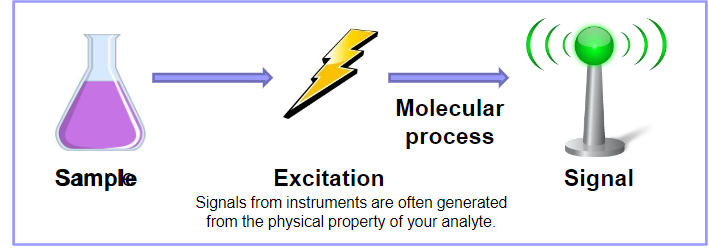
- 7Signals from instruments are often generated from the physical property of your analyte. Outline this process.
- 8Describe the process of examining gphysical evidence.1. Identify (Q) physical properties and chemical properties
2. Compare (K) control and reference standard
3. Does Q share a common origin as K? - 9Identify what type of sample was taken in K to compare to Q.Hair sample from a brush
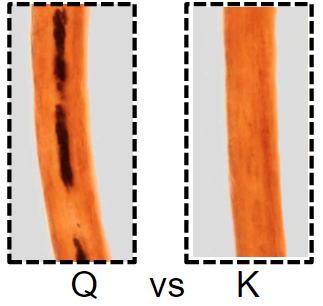
- 10Identify what type of sample was taken in K to compare to Q.Paint sample from a car.
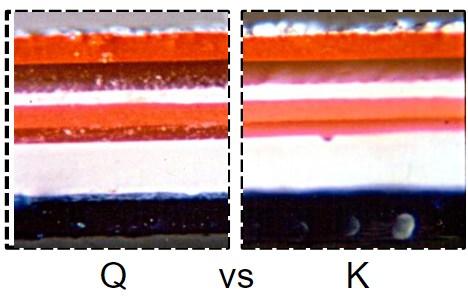
- 11What conclusions can be made by examining the physical evidence?-Common origin or not? Same source?
If the properties measured disagree, than they did not originate from the same source. If the properties measured agree, then they come from the same source or not another source with indistinguishable properties. - 12What is forensic identification?Forensic identification refers to the application of scientific techniques used in a medicolegal context, to assist in the investigation and identification of objects and materials deposited after contact with a surface, particularly at a crime/accident scene.
- 13Forensic identification relies heavily on the analyses of ___.Trace evidence
- 14Identify and explain the role of "the players" in forensic identification.First Officer On Scene/Investigating Officer: General patrol training, any other special training obtained
Scene of Crime Officer (SOCO)/Specialized Officer: SOCO officers are taught advanced crime scene investigation and photography skills to assist in the processing of less complicated crime scenes (e.g., Break & Enter). Specialized Officers may posses specific training related to a particular type of investigative skill (e.g., traffic reconstruction, underwater recovery, drug officers, K-9 handlers, etc.).
Possibly Forensic Identification Officer (FIO): FIO officers are taught advanced crime scene investigation and photography skills to assist in the processing of all criminal investigations (including more serious cases like homicides).
Possibly Forensic Scientist (Centre of Forensic Sciences): The Centre of Forensic Sciences (CFS) in an independent laboratory that provides scientific support to law enforcement agencies across Ontario. - 15What does forensic identification rely on?Collaboration of scene investigators, forensic identification specialists and forensic scientists to assist in the collection, analysis and interpretation of trace evidence identified at a crime scene/accident.
- 16Scientists at the CFS possess specific training and expertise in the following scientific divisions/sections:-Biology (DNA and body fluid analysis)
-Chemistry (physical and chemical comparison of materials and trace evidence analysis)
-Toxicology (biological and non-biological analysis for drugs and alcohol)
-Documents (examination and assessment of authenticity/alteration)
-Physical Sciences: Firearms and toolmarks (examination of firearms, ammunition, target surfaces and toolmarks) - 17FIO training is prescribed by the Criminal Code of Canada under what act?s. 14 (3) of O. Reg. 3/99 - Adequacy of Effectiveness of Police Services
- 18What two colleges offer the only proper FIO training?Ontario Police College and the Canadian Police College
- 19Describe FIO training.8-10 week intensive course, followed by a series of additional, shorter and more specialized training courses (e.g., bloodstain pattern analysis, footwear analysis, friction ridge analysis, applied photography and videography, fire scene investigation, recovery of human remains, shooting scene examination, etc.)
- 20What are the two categories for forensic identification?1. Forensic identification of human biological materials: To assist in the interpretation of human materials within the context of an investigation. This might include DNA, hair, skin cells, blood, body fluids, etc.
2. Forensic identification of non-biological materials: To assist in the interpretation of non-biological materials within the context of an investigation. This might include footprints, fingerprints, digital evidence, etc. - 21What are the types of human biological forensic identification?-DNA analysis: several types of biological evidence are commonly used in forensic science for the purpose of DNA analysis, including blood, saliva, semen, skin, urine and hair. DNA profiling was introduced in the 1980s, and has been successfully utilised in the identification and elimination of suspects in a large number of criminal cases.
2. Forensic odontology: the application of dental knowledge in a medicolegal context. Often used to identify human remains inadequate for visual/other identification. Also used in criminal investigations to include/exclude suspects based on dental comparisons.
3. Facial reconstruction: the process of recreating an estimate of facial features from existing skeletal remains. - 22What are the types of non-biological forensic identification?1. Friction ridge analysis: The practice of identification through fingerprint analysis, based on the principle that friction ridge formations are sufficiently unique to individualize. Friction ridge patterns are established during early fetal development and are definitive prior to birth, unique, unalterable.
2. Biometric analysis and comparison: the use of specific body measurements and calculations to assist in the interpretation of human characteristics to assist in identification. Voice recognition - analysis of the parameters of an individuals speech to assist in identification through comparision. Gait recognition - Analysis of parameters of an individuals locomotion to assist in identification through comparison.
3. Footwear/Impression Analysis: Examination of the impressions left by an individual due to the contact of the soles of the feet with the ground surface.
4. Digital Forensic Evidence: The recovery and identification of material obtained from digital and electronic devices.
5. Blood stain pattern analysis: The study of the size, shape, distribution and (cont.) - 23(cont.)location of bloodstains in relation to a crime scene investigation. It provides information about the events that created the bloodstains and patterns.
6. Forensic photography: The process of photographing a crime scene to record and document the initial appearance and evidence in situ
7. Chemical Crime Scene Processing: The use of chemicals to improve scene processing and evidence collection. - 24What is luminol?A chemi-luminscent product that reacts with iron in the blood to luuminesce under blue light and allow police to identify blood residue even after a scene has been cleaned.
- 25What crime was OJ Simpson accused of?Stabbing his girlfriend, Nicole Simpson Brown and her friend Ron Goldman to death outside her condo on June 13th, 1994.
Trial began on January 24th, 1995.
OJ was acquitted on October 3rd, 1995. - 26What was the forensic evidence in the OJ Simpson case?-Both bodies had deep knife wounds and extensive bleeding
-Blood was found in Mr. Simpson's Bronco and other places around his home (including on a pair of his socks)
- DNA that was tested matched OJ, Nicole, and Ron
-DNA from both victims found on bloody glove near the bodies
-Glove allegedly belonged to Mr. Simpson - 27What were the challenges faced in the OJ Simpson trial?-Despite the evidence against Mr. Simpson, he was acquitted on both counts
- General processing of the inital scene was sloppy: Items of evidence not processed properly, photographs taken without scales for reference, scene contamination, failure to collect relevant evidence (bloody fingerprint on gateway not documented), poor continuity of evidence (blood sample collected not logged as evidence, not properly stored), accusations of falsified evidence and incrimination (Mark Fuhrman) - 28In the The People of Manitowoc County v. Steven Allan Avery case, what was Mr. Avery charged with?In 1985, Mr. Avery was tried and convicted for sexual assault and attempted murder, and was sentenced to 32 years in prison. In 2002, the Wisconsin Innocence Project used DNA evidence to exonerate him of this charge, and he was ultimately released in September 2003. Mr. Avery filed a civil lawsuit for damages arising from his wrongful conviction against Manitowoc County in the amount of $36 million. In fall 2005, photographer Theresa Halbach disappeared, Her last known appointment was with Mr. Avery at his home/property of Avery’s Auto Salvage. Her car was found abandoned at his property.
- 29What was the forensic evidence in Mr. Avery's case?-Bloodstains were found inside Ms. Halbach’s vehicle
-When DNA was tested, results demonstrated that the blood inside Ms. Halbach’s vehicle was a match to Mr. Avery
-Ballistic evidence identified Ms. Halbach’s DNA on a single bullet fragment found in Mr. Avery’s garage
-Charred burned fragments matching Ms. Halbach were found in a burn pit near Mr. Avery’s home
-The key to Ms. Halbach’s vehicle was found in Mr. Avery’s bedroom - 30What were the challenges in the Steven Avery case?-Issues around the general processing of the various scenes (e.g., vehicle recovery scene, burn pit scene, Mr. Avery’s bedroom)
-Items of evidence not processed properly
-Involvement of Manitowoc County Sheriff's department despite obvious conflict of interest (case lead was conceded at outset of investigation to Calumet County to address possible COI)
-Alleged scene and evidence contamination (tampering of blood evidence)
-Alleged coercion of key witness statements (Mr. Avery’s nephew Brendan Dassey) - 31In the R vs. Jane Doe case, what was the forensic evidence?-The accused became involved as the caregiver for the deceased in the weeks leading up to his death due to extenuating circumstances
-Evidence of fraudulent chequesalleged to have been written by the deceased to the accused in large sums of monies prior to fire/death
-Forensic examination of digital evidence indicates multiple searches on the accused’s computer: Specific drug use combinations and effects (e.g., overdose), How to create/notarize a last will and testament, Exotic vacation destinations/travel deals
-Further examination indicates creation/printing of victim’s last will and testament from accused’s personal computer after victim’s death
-Accused filled multiple personal prescriptions for alprazolam in days/weeks leading up to fire/death of victim
-Accused seen to be behaving strangely in 24 hours leading up to discovery of house fire (noted to be on premises in one hour prior to estimated start of fire)
-Victim’s blood tested positive for alprazolam, despite no prescription history of this drug (cont.) - 32(cont.)-Discovery of hand written rough draft of last will and testament in accused’s handwriting
-Fire investigation reveals possible arson as cause of fire
-Accused attempts to flea via small airport travel into US upon police interrogation - 33What must be asked upon examining a crime scene?-Was it a homicide? Suicide? Natural causes?
-What was the offender doing before they entered the scene? (surveillance)
-How did the offender get into the scene? (access points) (doors, windows, roof top access)
-Did they use a tool to enter? (Lock broke, door broken, window broken) - 34What do you look for at a crime scene?-Fingerprints
-Footwear impressions
-Trace evidence - 35Where do you start when investigating a crime scene?-Start by layering yourself into the crime scene
-Outside: Scan the area. Note the weather conditions, lighting conditions, the location of other buildings, cars etc.
-Note the location of this building. Is it stand alone? Is it attached to another building? Where is it situated? Where are the access points? How can I get to them, vehicle or foot? - 36What makes fingerprints reliable?-Persistency: They are formed during the second trimester of pregnancy and do not change until decomposition after death
-Uniqueness: No two people have the same fingerprints - 37Describe the anatomy of fingerprints.-Impressions made by the friction ridges palmar surfaces of our hands
-Generally sweat deposits
-Often invisible and require some type of enhancement
-Fragile in nature
-Effected by the environment - 38What is AFIS?Automated Fingerprint Identification System.
-A.F.I.S only a search tool it does not make identifications it only gives possible matches
-Identification are made trained human examiner
-Two separate data bases
- - 39Describe the process of footwear identification.Identification is established by the agreement of: Class Characteristics –trend pattern, size, shape
AND
Accidental (Randomly acquired) Characteristics - 40What is a fingerprint?The fingerprint impression or mark is a replication or transference of the patterned skin. The fingerprint impression or mark is a replication or transference of the patterned skin.
- 41What are "The Four Premises" of friction ridge identification?1. Friction ridges develop on the fetus in their definitive form prior to birth.
2. Friction ridges are persistent throughout life except for permanent scarring, disease, or decomposition after death.
3. Friction ridge paths and the details in small areas of friction ridges are unique and never repeated.
4. Overall, friction ridge patterns vary within limits, which allow for classification. - 42What is the anatomy of a fingerprint?-Friction skin is also known as "volar" skin
-Seen in primates
-Assists in ability to hold onto things, or have traction
-Prominent in the study of volar skin development were Inez Whipple, Harris Wilder and Alfred Hale, among many many others - 43What characteristics do volar surfaces have?-No sebaceous (oil) glands
-Sweat glands only
-More sweat glands per square inch than other skin
-No hair
-Lack of pigmentation
-Over-abundance of nerve-endings - 44Label and list the structure of volar skin.-Ridges made up of ridge units, each unit has one sweat gland & one pore
-As ridge units grow they fuse together to form ridges
-All grow for the same amount of time but at different rates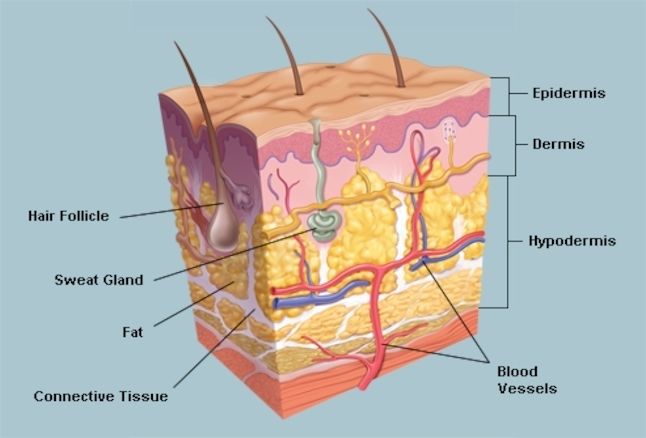
- 45Describe the structure of the volar skin. (2 layers)Dermis –thick foundation layer
Epidermis –thin outer layer of 15-20 layers of dead cells that are shed/abraded off & replaced continuously from the basal layer between these layers
Epidermis is attached to dermis by a double row of dermal papillae –little skin pegs - 46What are the layers of epidermus?-Stratum corneum(horny)
-Stratum lucidum(hyalin/hyaline)
-Stratum granulosum(granular)
-Stratum spinosum(spinous)
-Stratum basal/basale(basal) The basal (i.e., the stratum basal) is often referred to as the generating layer. It is within this layer that epidermal cell rejuvenation occurs. Cells created in the basal layer will migrate upward through the other four layers of the epidermis to the surface where eventually they are sloughed off as dead skin cells. This process takes approximately one month to complete.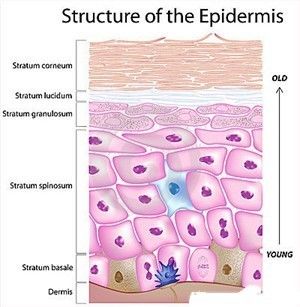
- 47What are fingerprints composed of?In most instances, a fingerprint deposit is a combination from different sources, including naturally secreted materials such as sweat, sebum or lipids, and foreign materials picked up through daily contact with items and surfaces other than bodily secretions. There are three sources of natural secretion on the human body: eccrineglands, sebaceous glands, and apocrine glands. However, only two are considered significant for fingerprint identification purposes: the eccrine and sebaceous glands. Apocrine sweat is not normally a consideration as these glands are primarily found in the underarm and genital areas. Eccrine sweat glands are located over the entire body and are the only sweat glands located on the palmar and plantar surfaces. Sweat pores located along the peak areas of friction ridge skin secrete eccrine sweat. Although eccrine sweat is the only secretion emanating from the palmar surface and a primary contributor to a fingerprint deposit, it is not the only ingredient. (cont.)
- 48(cont.)Sebaceous glands are found on areas of the body associated with hair follicles. Sebum is secreted from these glands and is comprised mainly of saturated fats, waxes, and squalene. Although sebum is not produced on palmar and plantar surfaces, it readily migrates and is accumulated there as we touch areas of our bodies where it is excreted.
- 49What is fingerprint identification?Fingerprint Identification is established through the continuous agreement of friction ridge formations, in sequence, having sufficient uniqueness to individualize.
- 50Describe the levels of friction ridge detail.Level 1 -Overall ridge flow. Identifications cannot occur at this level of information, however, exclusions can occur.
-Orientation
-Pattern Type
-Focal Points (core, deltas, scars, creases)
Level 2 - Minutiae
-Ridge ending
-Bifurcation
-Ridge dot
-Continuous ridges
Level 3 - Size and shape of pores and ridges/Friction ridge dimensional attributes. Identification and exclusion decisions can be supportedat this level of information.
-Pores (shape and size)
-End shapes and angles
-Edge shapes
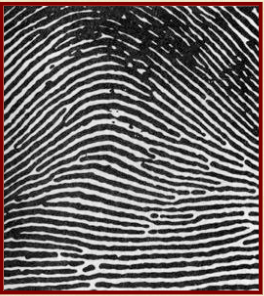
-Width - 51Identify this type of fingerprint.Arch
- 52Identify this type of fingerprint.Loop
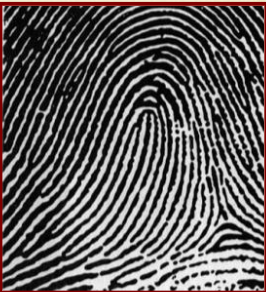
- 53Identify this type of fingerprintWhorl
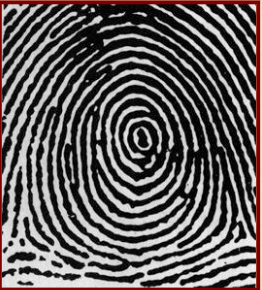
- 54Define an arch pattern fingerprint.A pattern type in which one or more frictions enter on one side of the impression, and flow or tend to flow, out the other side with a rise or wave in the centre.
- 55Define a loop pattern fingerprint.A pattern type in which one or more frictions ridges enter upon on side, recurve, touch, or pass an imaginary line between delta and core, and tend to flow out, on the same side the friction ridges entered.
- 56Define a whorl pattern fingerprint.A type of pattern which consists of one or more ridges that make, or tend to make, a complete circuit, with two deltas, between which, when an imaginary line is drawn, at least one recurving ridge within the inner pattern area is cut or touched.
- 57Identify this type of fingerprint characteristic.Ridge ending
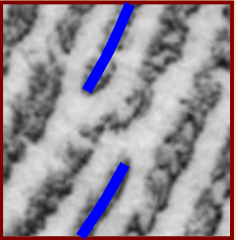
- 58Identify this type of fingerprint characteristic.Bifurcation
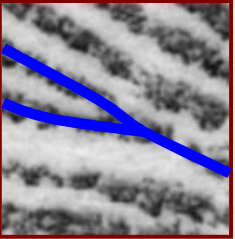
- 59Identify this type of fingerprint characteristic.Ridge dot
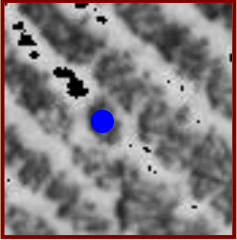
- 60Identify this type of fingerprint characteristic.Continuous ridges
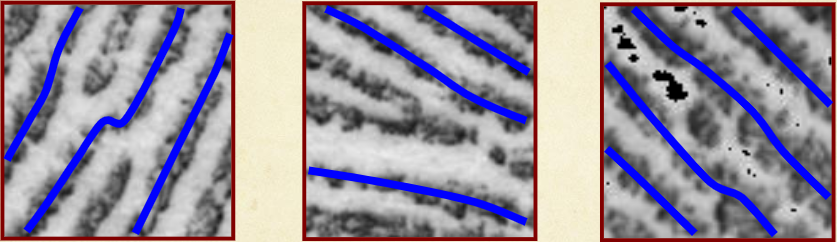
- 61Describe the levels of detail seen in fingerprints.First level –Henry
-Visible to naked eye
-ridge flow and pattern, core, delta, useful to give indication of where to look –but can be misleading due to distortion etc.
Second level –Galton
-Need magnifying glass
-ridge characteristics (ridge endings, bifurcations, islands, lakes), aka minutiae or Galton details)
-primary source of individualization
Third level –Ashbaugh
-microscopic
-the location of pores in the ridges, shapes of the edges of the ridges. (“Poroscopy” and “Edgeoscopy”), how ridges affect each other
-useful if there is insufficient 2ndlevel detail - 62Describe fingerprint ridge characteristics.-Ridge unit (Ridge dot): An isolated ridge unit whose length approximates its width in size. Contains one pore.
-Short ridge (Island): A single friction ridge beginning, travelling a short distance, and ending.
-Ridge ending (Ending ridge): A single friction ridge that terminates within the friction ridge structure.
-Bifurcation (Dividing ridge): The point at which one friction ridge div-ides into two friction ridges.
-Enclosure (Lake): A single friction ridge that bifurcates and rejoins af-ter a short course and continues as a single friction ridge. - 63What porous products are used in fingerprint examination?-1,2-Indanedione (reacts with amino acids, visualized with laser 532nm)
-1,8-Diazafluren-9-one (DFO) (Reacts with amino acids, Visualized with blue/green light (450nm to 550nm))
-Ninhydrin (reacts primarily with amino acids, visualized under ambient light) - 64Name the porous and non-porous products used in fingerprint examination.Porous: tape, leather
Non-porous: firearms, plastic bags, some tapes - 65List and describe the type of fingerprint examination processes.1. CA fuming - Polymer forms on the fingerprint residue, may require further enhancement
2. Chemicals - CA fuming enhancement Rhodamine 6G Fluoresces under 532nm light (laser), Basic Yellow Fluoresces under 450nm light (blue), Ardrox Fluoresces under UV light, Powders Adhere to cyanoacrylate
3. Tape - Non-adhesive side: (Cyanoacrylate + Dye stain), Adhesive Side: Cyanoacrylate + Dye stain (duct tape), Sticky side powder, Tape Glo (450nm light), Gentian Violet
4. Two substrates - CA + dye stain = indanedione
5. Vacuum Metal Deposition - Gold + Zinc Fuming. 15% more FP impressions developed using VMD sequentially.
6. Blood - Amido Black, Acid Yellow (450nm light), Leucocrystal Violet, Hungarian Red
7. Filter (Narrowband pass filter) - Further isolation of target fluorescence from background, Leakage on the left side of the bandpass filter, Addition of a barrier filter blocks all reflections from the source and much of the unwanted substrate fluorescence - 66What is bloodstain pattern analysis?he study of the shape, size, distribution & location of bloodstains
- 67Blood produces patterns that are ___.Predictable and reproducible
- 68What are some altered bloodstain patterns causes?-Dilution (cleanup)
-Insect activity
-Drying
-Clotting
-Decomposition
-Voids - 69What are the classifications of bloodstain patterns and describe.Passive: Bloodstains created or formed by the force of gravity acting alone (blood drops/splashes/pools)
Transfer: Bloodstain resulting from contact between a blood bearing surface and another surface (prints/wiping)
Splatter: A bloodstain resulting from a blood drop dispersed through the air due to an external force (high energy produces smaller sized drops, projected, spit, gun splatter/mist) - 70What is the area of origin?The area of originis the three-dimensional location from which spatter originated.
- 71What is the equation to determine angle of impact?a=sin^-1 width/length
- 72What is the definition of impression evidence?Objects or materials which have retained the characteristics of other objects or materials which have been impressed against them.
- 73According to Bodziak, why are footwear impressions frequently overlooked at crime scenes?-Not believing impressions will be found
-Incomplete searches
-Failing to examine due to scene contamination
-Shoe/substrate conditions not conducive
-Impressions intentionally destroyed
-Exterior impressions destroyed by weather - 74Define "Path of Contamination".The route responders create to avoid disturbing evidence at a scene
- 75What is a gel lifter?Gelatin layer covered by a clear acetate and supported by a black or white rubber backing used for lifting fingerprints, footwear impressions (especially dust impressions, but also blood impressions).
Advantages: Produces fine detail, Comes with clear acetate cover to preserve impression, Easy to use
Disadvantages: Cost appx. $10 for sealed package of 2, Needs to be kept cool in storage (appx. 60°F), Gel can dry out over time - 76What are the advantages/disadvantages of an electrostatic lifting device?Advantages: Easy to use, Mylar®can be reused (wipe clean with smooth cloth), Provides fine detail, Mylar®doesn’t lose it’s static properties
Disadvantages: Cost –Pathfinders cost over $800 & Mylar® is expensive - 77What information should be included on a recovery label?-Footwear Identifier (eg. FW #1)
–Date
–Case Identifier #
–Identifier info of Officer recovering impression
–North Arrow - 78What materials may be used to cast a footprint impression?-Dental Stone
-SnowStone
-Sulfur
-Sulphur Mortar - 79What is 3D forensic facial reconstruction?Means to establish possible ID
1.Create a likeness of the individual
2.Present the likeness to the public
3.Generate new investigative leads
4.Establish a positive ID - 80What can not be deducted from a facial reconstruction?-hair color or style (unless samples are available)
-skin blemishes or scarring (without related traumatic or pathological damage to bone)
-eye colour - 81How is facial reconstruction done?- Tissue depth markers on a clay sculpture
- Digital method (Still modeled by hand - no digital automation involved.The same standards of practice were used) - 82What are the common types of physical evidence?-Impressions (footprints, tire marks, fingerprints)
-Blood, semen, saliva (liquid or dried that may suggest a relation to the offence, detection of possible existence of drugs or poisons).
-Drugs(any substances seized in violation of laws regulating the sale, manufacture, distribution and use of drugs.)
-Firearms and ammunition (evidence involved in criminal offence)
-Explosives (device containing explosive discharge)
-Glass (transfer of glass particle/fragment from person/object)
-Paint (transfer, liquid or dried, from one surface of an object to another during commission of a crime)
-Toolmarks (impression made by a tool in a crime)
-Hair and Fibre (may assist in establishing transfers between individuals or objects) - 83What are some physical properties?-Colour, texture, state
-Odour
-Boiling point, Melting point
-Density
-Solubility
-Optical
-Conductivity (thermal)
-Flammability
-Radioactivity
-Oxidation
-Enthalpy of formation
-Heat of combustion - 84What is a Microspectrophotometer?Microscope + Spectrometer
Magnification: tentative ID based on morphological features, how it interacts with light
Spectrometer: UV-Vis, IR
Specimen are typically small fine particles
Specimen are viewed under a microscope while a beam of light is directed at the particle in order to obtain its absorption spectrum
Paint, fiber and ink typically analyzed visually first - 85What are class characteristics?Properties of evidence that can be associated only with a general group and never with a common source. (e.g., Nike Air Max shoe)
- 86What are individual characteristics?Properties of evidence that can be attributed to a common source (or single source) with an extremely high degree of probability. (e.g., Vivienne’s Nike Air Max shoe)
- 87What is Ninhydrin?Ninhydrinis effective on many porous surfaces, it is most commonly used for developing latent prints found on paper
- 88What are the forensic databases?-Fingerprints: AFIS (FBI, 1999)DNA: CODIS (FBI, 1998)
-Markings in firearms transferred onto projectiles and cartridge casings from crime scenes: NIBIN (Bureau of Alcohol, Tobacco, Firearms and Explosives); IBIS
-Paint: PDQ (RCMP) - 89What style should forensic reports be written in?JFS (Journal of Forensic Science)
- 90What are some 3D technology used in forensics?-Firing pin impressions
-Structured light scanners: devices that project pulses of light in certain patterns and are usually used to document small objects
-Laser scanners: based on Lidar, a light detection and ranging radar using light, measures distance using light
There are two types of laser scanners:
1. Phase based scanners
2. Pharo scanners
Information
- Description
- Forensic Science Flashcards on FSC239 Midterm , created by Taylor Buote on 22/10/2018.
- Created by
- Taylor Buote
- Views
- 0
- Rating