
Flashcards
Stats 2

Cards in this deck (11)
- 1What is a lagrangian? For this module, what equations are born from it?Lagrangian is just a function of generalised coordinates and their derivatives
L=L(q(i) , q'(i) , t) where i is the index of the particle
Euler lagrange Equations of motion
d/dt ( d/dq' ( L )) = d/dq (L)
The canonical momenta
p(i) = - d/dq'(i) (L)
Hamiltonian(p(i),q(i)) = sum(p(i)*q'(i)) - L
where q' = p/m - 2For phase space, how many dimensions do you work with? What is the basic equation of probability to find a particle in a particular region of phase space?For each degree of freedom, there are 2N dimensions (position and momentum (perhaps more later)), where N is the total number of particles (indiviually we index them i (or j))
So for 3d, 6N dimensions - 3What is Liouvells theorem about? What do we use to notate volume of phase space? What is the notation for the boundery of the flux space.The change of the density function (p,q) in time. Or more simply, the amount of phase points that leave vs the ones that enter the system.
We use omega (w) so dw = d^3(q) * d^3(p) for 3d real space
The o (sigma) term is the boundery (surface area) - 4What is the continuity of phase space? What is the difference between d and the curly d for the derivatives of density with time?normal d is change of density function as seen by an observer moving at the trajectory of the system (e.g tracking an object through phase space)
Curly d is change of density in a fixed point in the phase space.
- 5Initialise a state in a point in phase space, then let it evolve, what do you expect to see?For short evolutions, it will be easy to see the origin of an evoulution and you could index the intial conditions to where it ends up (e.g ball at top of mountain intially, ball rolling of the side of the top of the mountain. Can associate it from that)
Compared to long evoultions where the time signature may have no resemblence to the intial conditions, (ball at bottom of valley, which mountainside did it come from?)
Therefore we say initially the drho/dt depends explicitly on time, but this dependence disapears for longer evolutions - drho/dt=0 - 6In the regime for long time evolution, what generally is d (density)/dt =? (using curly d) Are the cases where this doesn't happen?Time dependence disappaers so d rho/dt = 0
(curly d means density change at a fixed point so after a system settles density flux is near 0)
Cases where there is a time dependent external influence, such as the oscillating field of charged particles. Those particles will always have a explicit time dependence - 7What is the postulate of equal a priori probabilities and where does the idea originate? What is the microcanonical enesemble?for a system with an energy that is fixed (closed system), each configuration (phase space point) with that energy, is equally probable to be visited by the phase space trajectory in the course of time
Needed to satisfy equilibrium which requires {rho, H} =0.
The postulate suggests: that there is an uncertainty in precision of p and q, bounded by Heisenburg.
- 8What is the canonical distribution?

- 9What is an ensemble?Any particular choice for the density function of states. In other words its the explains a group of independent systems with different microstates yet still share the same external controllable parameters.
- 10What is the fundamental postulate of statistical mechanics?= ensemble average=sum over all states weighted by their probability
- 11—The volume's are equal, despite the different shape.
This gives explanation for why entropy increases with time as entropy is related to the number of states (squares) needed to cover the volume. More states are clearly needed after time has evolved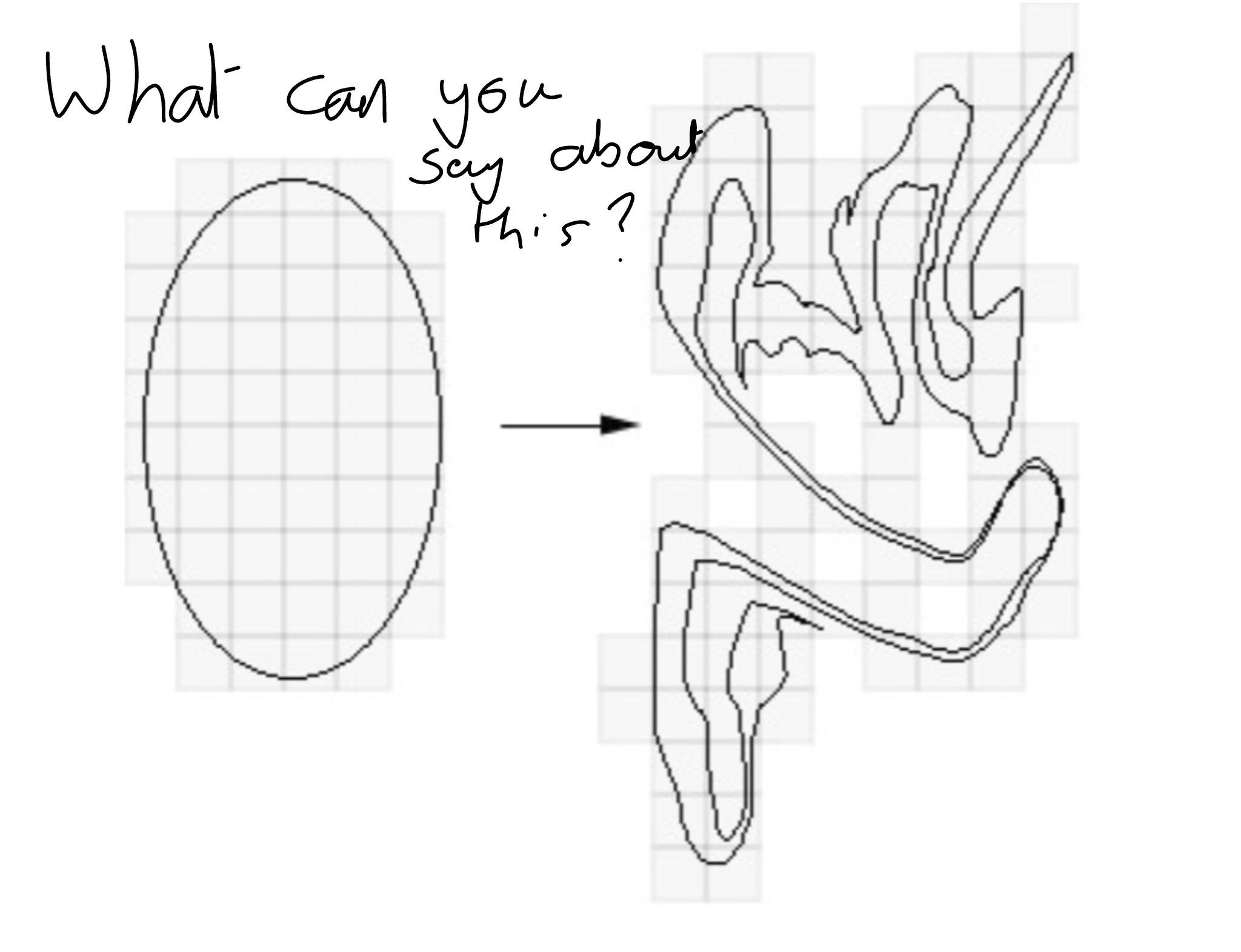
Information
- Description
- Flashcards on Stats 2, created by Elliot Bryce on 07/11/2018.
- Created by
- Elliot Bryce
- Views
- 0
- Rating