
Flashcards
Thermodynamics
Cards in this deck (37)
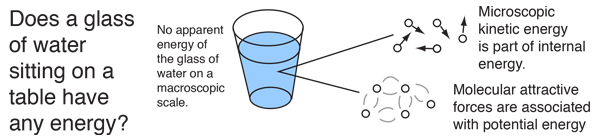
- 1What is the thermal/ internal energy of a substance?All substances have internal energy
Int. En. is the sum of kinetic & potential energies of the substance's molecules - 2Formula for internal energyInternal Energy = Ep + Ek
where Ep is potential energy (energy in bonds between molecules & energy held in nuclei of atoms) & Ek is Kinetic Energy of particles - 3Under what conditions do changes in temperature occur but state of substance is constant?Internal Energy = Ep + Ek
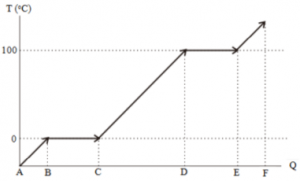
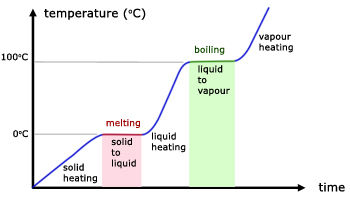
Changes in temperature occur when Ek changes, due to the heating or cooling of a substance - 4Under what conditions does a phase change in a substance occur but temperature of substance is constant?Internal Energy = Ep + Ek
Change in phase (solids, liquids, gases) occurs when the potential energy/ or the molecular bonds between particles of a substance become weaker or stronger - 5What is the relationship between the changes in Ep and the changes between states of matter?Solid -> Liquid
increase in Ep
Liquid -> gas
increase in Ep
But, gases of 0 Ep - 6What is special about the internal energy of gases?Inter-molecular bonds do not exist in gases
Hence, there is 0 Ep and energy is entirely made of Ek - 7What is heat?Heat is the transfer of energy from higher temp. to low temp.
- 8How does heat affect a substance? Hint: consider Temp., Ek and Inteneral energySubstance absorbing heat
Increase in Temp., Ek & Internal Energy
Substance releasing heat
Decrease in Temp., Ek & Internal Energy - 9Define temperatureTemperature is a measure of the average Ek of a substance
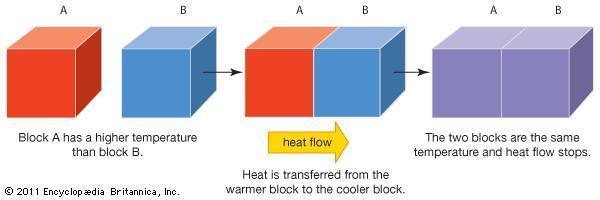
- 10What is Thermal Equilibrium and how is it achieved?Thermal Equilibrium: when there is no net change in temperature between 2 objects in contact. i.e. no heat transfer & objects are at the same temp.
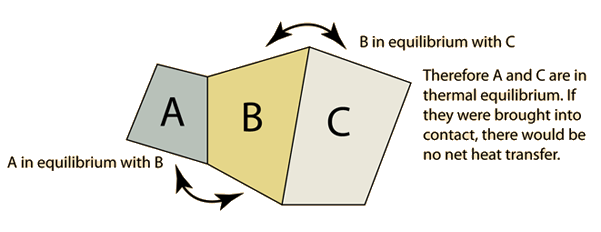
- 11Explain the Zeroth LawWhen A is in thermal equilibrium with B, and B is in thermal equilibrium with C, then C is in thermal equilibrium with A
- 12Types of temperature scales.1. The Kelvin Scale - starts from absolute zero (particles have 0 Ek)
2. Celsius Scale - based on O degrees celsius (freezing pt. of water)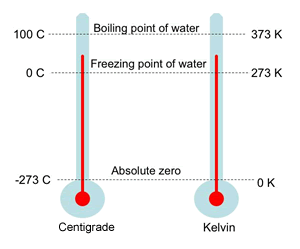
- 13Convert 0 degrees celsius to Kelvin0 degrees = 0 degrees + 273 Kelvin = 273 K
- 14Convert 0 Kelvin to degrees celsius0 K = 0 K - 273 degrees celsius = -273 degrees
- 15How to convert between Kelvin and Degrees CelsiusKelvin -> Degrees Celsius
- 273 to the kelvin
Degrees Celsius -> Kelvin
+ 273 from degrees celsius - 16What is the Specific Heat Capacity of a substance?The S.H.C is the energy required to increase the temperature of a 1kg substance by 1 degrees celsius/ kelvin without changing state
- 17Substances A and B are absorbing energy at the same rate and substance A increases by 1 degrees celsius first. What does this tell us about the S.H.C of the substances.Substance B has a higher S.H.C since it requires more energy than substance A to increase its temperature.
Meanwhile, substance A has a lower S.H.C since it requires less energy to increase its temperature. - 18Formula for Specific Heat Capacity
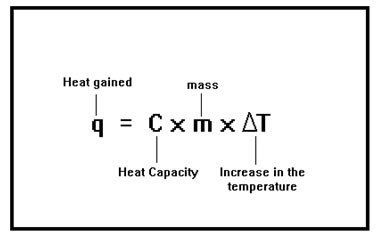
- 19Mass and Volume equivalence of water1mL = 1 g
1000mL = 1000g = 1L = 1kg - 20What is a calorimeter and how does it work?A device used to find the S.H.C of a substance
Heated objected placed in thermally isolated container containing a known amount of water. Object & liquid reach thermal equilibrium & final temp. is used to determine the S.H.C of the object.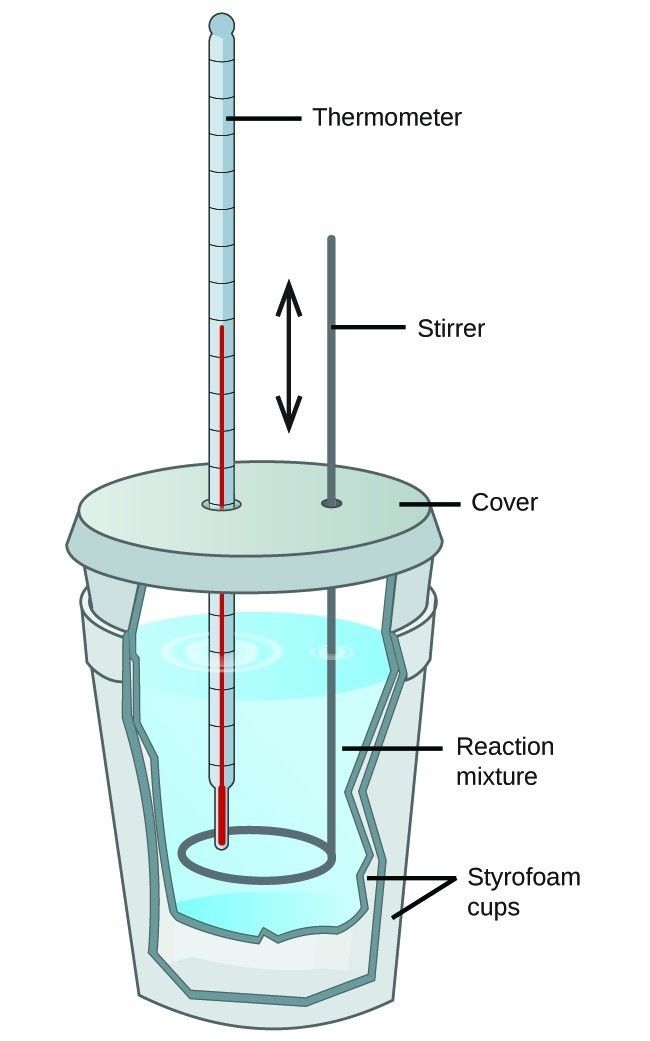
- 21Explain Latent HeatThe energy required to change the state of a substance i.e. weaken/ break inter-molecular forces without changing the temperature of the substance
It is a change in Ep not Ek - 22Explain Latent Heat of Fusion + formulaThe energy required to convert 1kg of a solid into liquid without changing the temperature
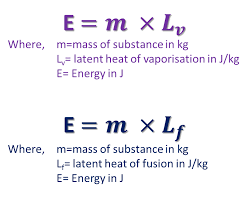
- 23Explain Latent Heat of VaporisationThe energy required to convert 1kg of a liquid substance to gas without changing its temperature
- 24—
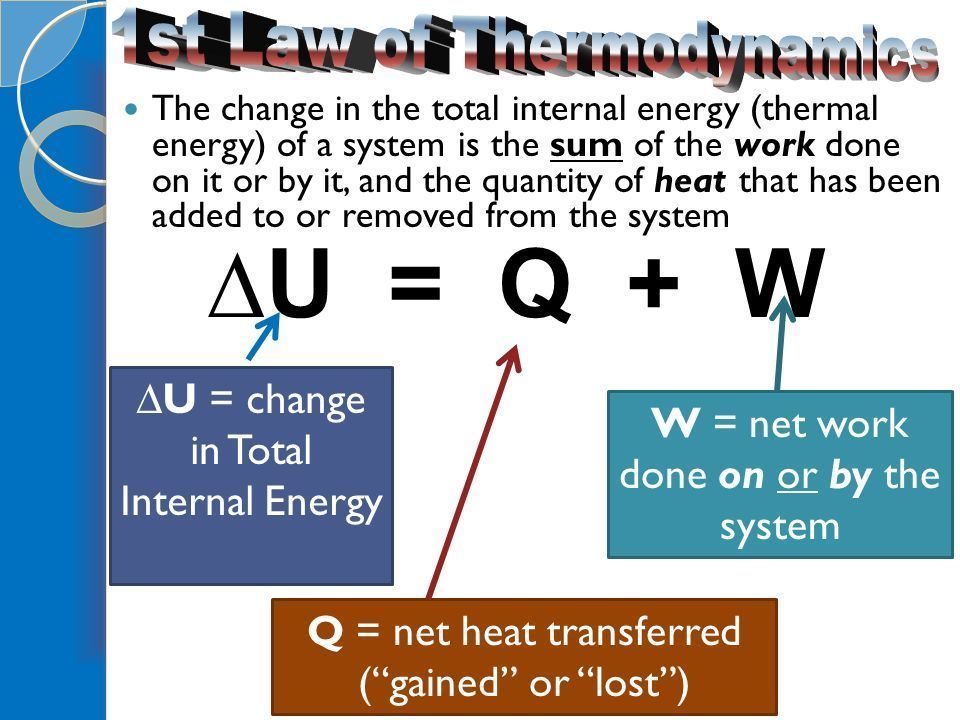
- 251st Law of Thermodynamics Hint: Conservation of Energy
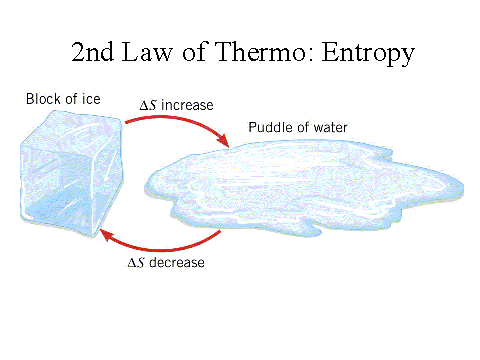
- 262nd Law of ThermodynamicsAs energy is transferred, the quality of the energy gets worse. i.e. the natural tendency of a system to degenerate into a more disordered state, this is known as "entropy"
"Entropy" - a measure of the molecular disorder of s system - 27Explain the image in terms of the 2nd Law of ThermodynamicsAs ice melts, its molecules become more disordered, hence entropy increases. The molecules of the melted ice has a natural tendency to remain in this disordered state, therefore it cannot freeze back into a perfect cube. Hence, entropy never decrease.
- 28The Ideal Gas Law
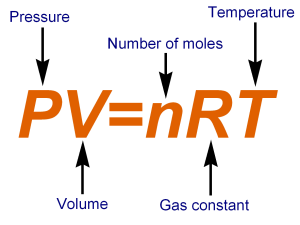
- 29Explain the effects of temperature on an object.As the temperature increase, Ek of molecules increase and vibrate faster. Rapid vibrations cause increase in pressure which cause the substance to expand/ increase volume until pressure is neutralised.
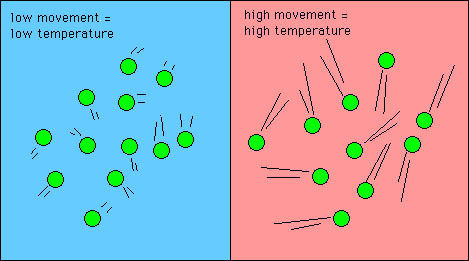
- 30The relationship between variables of the Ideal Gas LawPV = nRT
Pressure and volume is directly proportional to temperature
Volume is inversely proportional to pressure
Pressure is inversely proportional to volume - 31Interpret the following graphSubstance T1 has a lower temperature since the majority of its molecules have a smaller Ek than the molecules of T2
Substance T2 have a greater number of molecules that have enough Ek to escape from liquid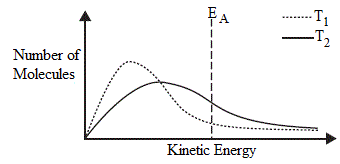
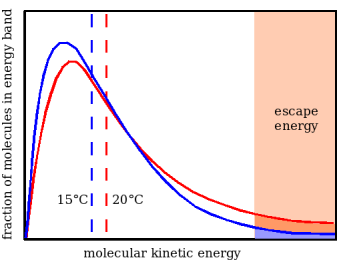
- 32What is the difference between boiling and evaporisation?Evaporisation occurs on the surface of a liquid when it changes to gas.
Boiling occurs when all the particles in a liquid is heated up.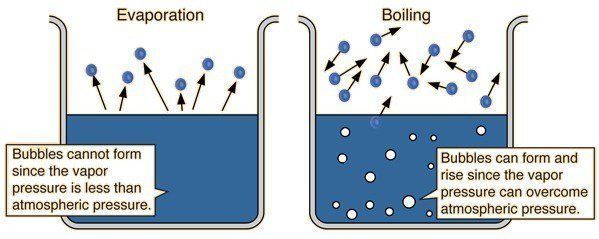
- 33Define ConductionThe transfer of thermal energy from atom/ molecule to another in direct contact
Good conductors of electricity = good conductors of heat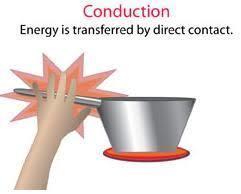
- 34Why are solids better conductors of heat than liquids or gases?Molecules in solids are closer than in liquids and gases. Hence, vibrations between molecules transfer heat quicker
- 35Define RadiationElectromagnetic waves that is emitted by warm/ hot objects and can be absorbed by another object.
e.g. UV light from sun, heat from stove, x-rays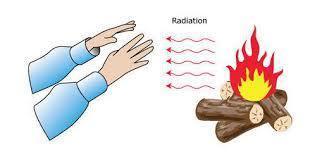
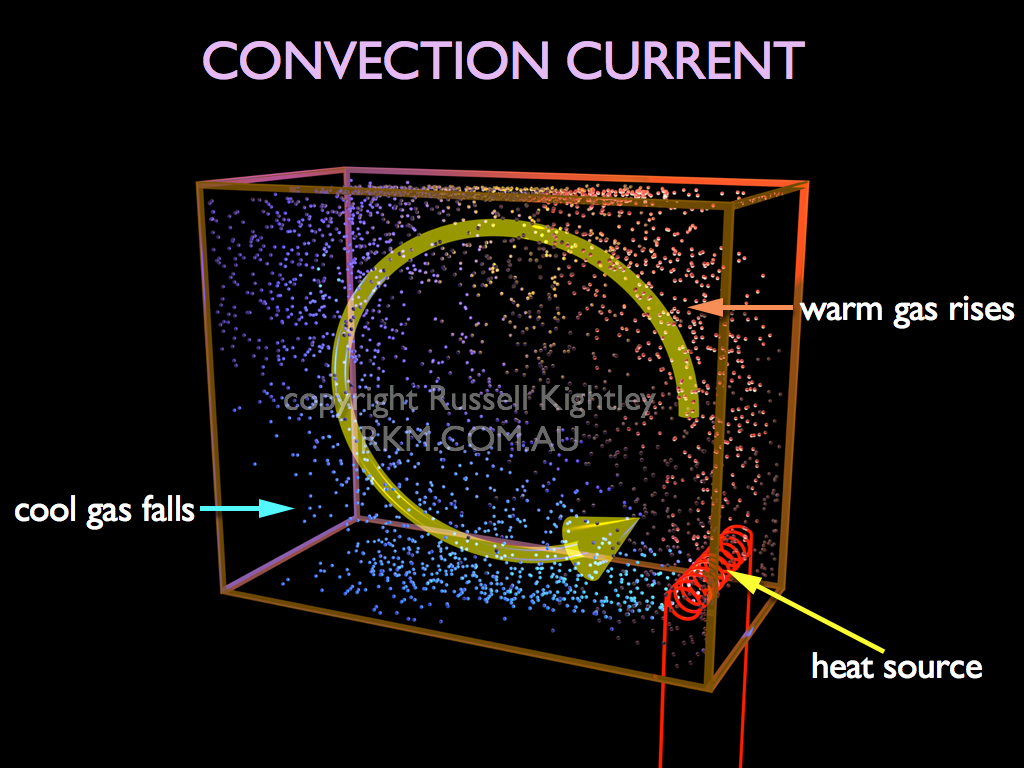
- 36Define ConvectionThe movement of heated molecules, heating other molecules around it
Applies only to liquids and gases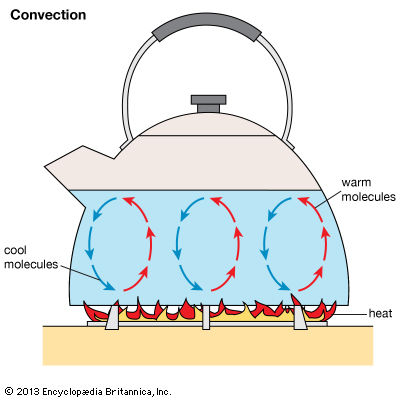
- 37How heaters work
Information
- Description
- Year 11 Physics Flashcards on Thermodynamics , created by Tamika Demiyah on 16/11/2018.
- Created by
- Tamika Demiyah
- Views
- 0
- Rating