
Flashcards
Physics Paper 1
Cards in this deck (65)
- 1Kinetic energy0.5 x mass x velocity squared
- 2Elastic potential equation0.5 x spring constant x extension squared
- 3Gravitational potential energyMass x gravitational field strength x height
- 4Change in thermal energy?Mass x specific heat capacity (j/kg/c) x change in temperature (°c)
- 5Power?energy transfer divided by time
- 6Power w/ work done?Work done divided by time
- 7what's the law of conservation energy?energy cannot be created or destroyed only transformed into another type of energy
- 8What is wasted energy? An example?Didn't intend to make it.
EG - electrical energy in a light bulb also makes thermal energy - actually don't need this. - 9What are the methods for keeping homes insulated?cavity wall, double glazing, loft insulation, carpets curtains, draught excluders, jacket around the hot water tank
- 10Efficiency =useful energy out divided by total energy in
- 11efficiencyuseful power out / total power in
- 12what is a renewable and finite energy resource?renewable is an energy resource that is not going to run out where as finite is going to run out eventually and we cannot get more.
- 13examples of renewable energy sourcessun wind water tidal wave hydroelectric and geothermal energy
- 14examples of finite resourcesfossil fuels like coal oil gas and nuclear energy
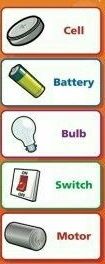
- 15Draw these circuit symbols.
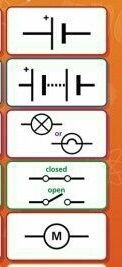
- 16Draw these circuit symbols.
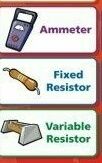
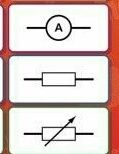
- 17what is chargevalue for electricity flowing through a circuit
- 18what is currentthe flow of electrons
- 19what is potential differencepushes the current around
- 20what is resistancewhatever slows the current down
- 21equation for charge?current x time
- 22what is charge measured in?coulombs
- 23potential difference equationcurrent x resistance
- 24what is potential differenceohms
- 25what are the three potential difference graphsresistor equals directly proportional
filament lamp equals rules off at the ends (as temperature increases resistance increases)
diode = flows in one direction therefore starts at the origin - 26what does a thermistor docontrols are central heating and only lets current flow at certain temperatures
- 27on a graph what would a thermistor show if it was a high temperaturea steep line
- 28what does an LDR docontrol Street and security lights
- 29if there is a bright light what would an LDR show on a grapha steep line
- 30Current is the same in which circuit?series
- 31the current is shared in which circuitparallel
- 32the potential difference is the same in each of the branches in which circuitparallel
- 33how do you find the total resistance in a series circuitadd them all up
- 34how do we find resistance in a parallel circuit?1 over resistance and so on
- 35what is the mains electricity of the UK?230 volts and 50 Hz
- 36what are the different components inside a plug and their colours?earth = green and yellow
neutral = blue
live = brown
cable grip
flex
fuse - 37how does a fuse work in a plug?the fuse will overheat if the current is too much
- 38power is also equal to what in terms of current?power = potential difference times current
- 39power is also equal to what related to resistancecurrent squared times resistance
- 40what is the equation links energy power and time?energy = power x time
- 41what is energy related to in terms of charge the equationenergy = charge x potential difference
- 42what are the steps of the national Grid?power stations generate electricity
use a step-up transformer to increase p.d
use lots of cables to transport it to the step-down transformer
delivered to consumers - 43cladding gas particles create pressure. how?particles in gases are free to move, and as they do so they bang into each other and the container. when trying they exert a force on it.
pressure is the force exerted per unit area. - 44how does increasing the temperature of a gas increases pressure?increasing the temperature means increasing the speed, as particles have more kinetic energy to move.
this also means they have a large and momentum so they exert a larger force when they collide with the container. - 45density =mass divided by volume
- 46how do we find the density of a solid object?balance the mass
measure length width and height
calculate volume - 47how do we find the density of an irregular solid object?submerge that solid into a eurake can filled with water.
the water displaced by the object will be transferred to the measuring cylinder.
the water displaced is now the volume so plugs object's mass and volume into the formula. - 48what are alpha particles and their properties?2 neutrons and 2 protons
don't penetrate very far into materials and are stopped quickly absorbed by a sheet of paper and strongly ionising - 49what are beta particles and their properties?fast moving electron released by nucleus
moderately ionising have a range in air so penetrate moderately and absorbed by sheet of aluminium - 50what are gamma rays and their properties?waves of electromagnetic radiation released by the nucleus
penetrate far into materials and will travel and distance through air
weakly ionising because they passed through rather than collide
absorbed by lead or metres of concrete - 51what do gamma rays not do?they don't change the mass or charge of the nucleus
- 52alpha decay decreases the charge and mass of the nucleus. true or falsetrue as particles are made up of two protons and two neutrons so its atomic number is reduced by 2 and its mass number reduces by 4.
- 53beta decay decreases the charge of the nucleus true or false.false they increase the charge of the nucleus, the atomic number, by one.
- 54What are the energy stores for a kettle?kettle transfers energy electrically from the mains AC supply to the thermal energy store.
- 55what's the difference between AC and DC current?AC supplies the current that is constantly changing where is direct current is always flowing in the same direction by direct voltage.
- 56how can we investigate adding resistors in series circuits!four identical resistors are needed.
build a series circuit using one of the resistors and making out of the potential difference of the battery.
measure the current through the circuit using the ammeter and use this to calculate the resistance.
add another resistor in series with the first.
repeat steps 4 and 5 until you've added all the resistors.
plot a graph of the number of resistors against the total resistance. - 57how can we investigate resistance in parallel circuitsusing the same equipment as investigating series build the same initial circuit.
measure the total current through the circuit and calculate the resistance.
add another resistor in parallel with the first.
measure the current through the circuit - use this and the potential difference of the battery to calculate the overall resistance.
repeat steps 3 and 4 until the other resistors are added
plot a graph - 58how can we investigate the factors affecting resistance?attach a crocodile clip to the wire level with 0 cm on ruler
attach the second crocodile clip to the wire 10 cm away.
close the switch and record the current and the p d.
open the switch and move the second crocodile clip 10 cm away
close the switch again and record the new length current and pd.
repeat this for a number of different lengths.
calculate the resistance.
plot a graph of resistance - 59what does the ammeter and voltmeter measure?ammeter measures the current and must always be placed in series circuits
the voltmeter measures potential difference and must always be placed in parallel circuits. - 60what is specific latent heat?is the energy required to change the state of a 1 kg mass.
- 61what is a half life!the time taken for the number of radioactive nuclei in an isotope to half
- 62how do we find the half-lifefind the activity after each half Life by dividing the initial activity by 2.
x 100 to make it percentage if that is what is required. - 63exposure to radiation is called..irradiation.
- 64contamination is..radioactive particles getting onto an object
- 65the most dangerous sources are beta and gamma. why?beta and gamma can penetrate the body and get to the delicate organs
Information
- Description
- Flashcards on Physics Paper 1, created by Isabelle Neale on 20/11/2018.
- Created by
- Isabelle Neale
- Views
- 0
- Rating