
Flashcards
LTM: Processes
Cards in this deck (17)
- 1The processing approach to memory-Memory as a series of processes operating at three interconnected stages:
-Encoding, Storage, Retrieval (Melton, 1963)
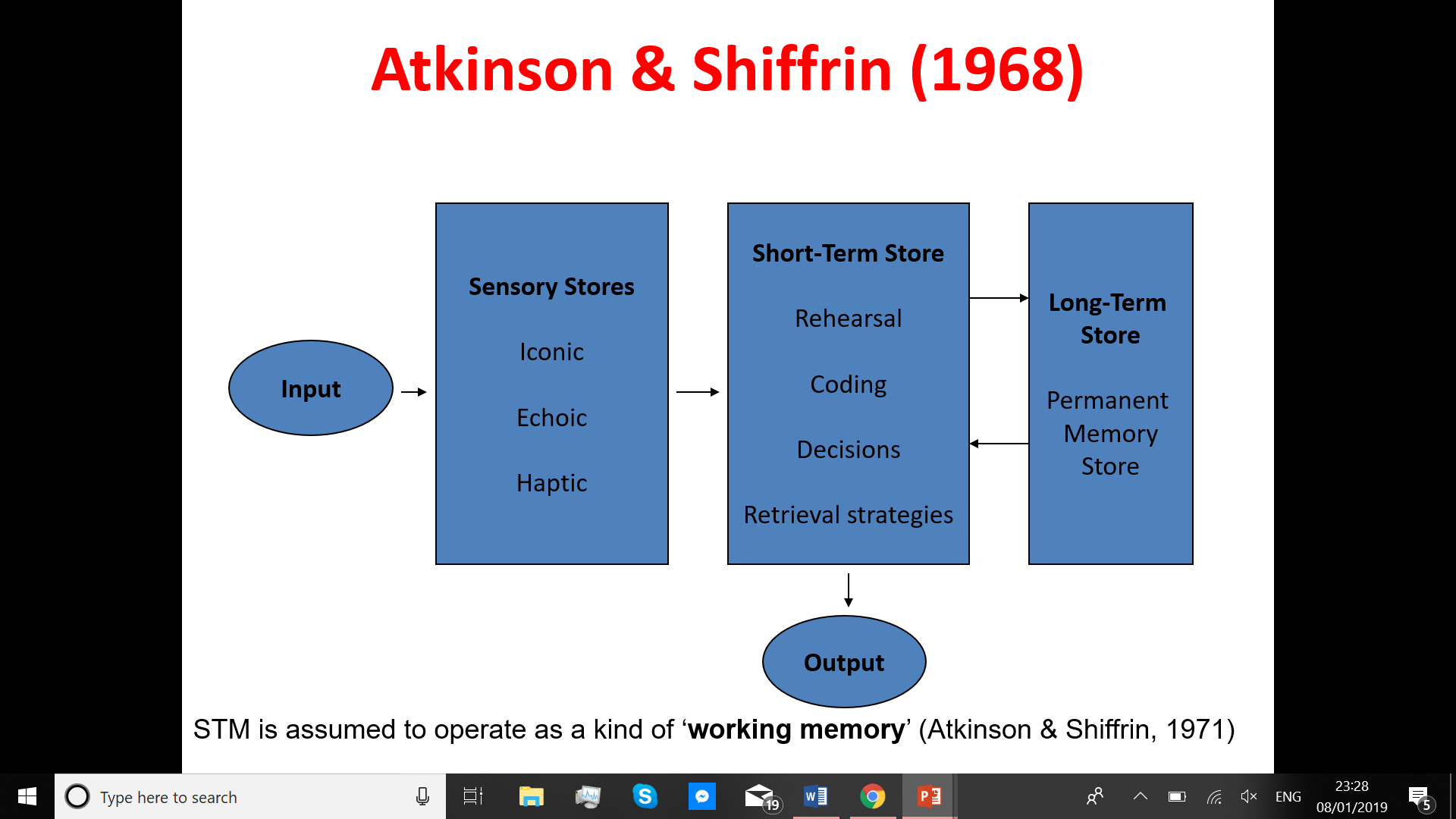
-The emphasis is drawn away from memory systems and stores, and placed on the processes in operation. - 2Atkinson & Shiffrin (1968)-Assumption: The longer an item stays in STM through rehearsal, the more likely it is to move to LTM.
- 3Encoding Processes-This is where the Levels of Processing (LOP) framework comes in (Craik & Lockhart, 1972).
-This article (largely single-handedly) changed the focus from memory stores to memory processes.
-“… Running counter to the ‘boxes in the head’ information-processing approaches of the 1960s” (Roediger et al., 2002:321)
-The article was cited in other journal articles 2700 times between its publication and 2002 – when a special 30th anniversary issue of Memory came out (volume 10, 5/6). - 4Pt. 2-LOP position:
-The level or depth of processing of a stimulus has a large effect on its memorability
-Deeper levels of analysis (at encoding) produce more elaborate, longer lasting, and stronger memory traces than shallow levels of analysis.
-Distinction between maintenance rehearsal (i.e. mere repetition of original analysis) and elaborative rehearsal (more and more semantic analysis, further associations).
-Only elaborative rehearsal should lead to improved retrieval from LTM. - 5Craik & Tulving (1975)

- 6Continued-“It is abundantly clear that what determines the level of recall or recognition of a word event is not intention to learn, the amount of effort involved, the difficulty of the orienting task, the amount of time spent making judgments about the items, or even the amount of rehearsal the items receive…: rather it is the qualitative nature of the task, the kind of operations carried out on the items that determines retention.” (p.290)
-EMPHASIS on HOW not WHERE. - 7Pt. 3-GREAT! Mystery solved! All memory researchers can retire to a tropical island!
Not quite… problems with the LOP framework:
-Circularity (due to vague operationalization of ‘level’ – no independent measure of depth of processing)
-Glenberg et al. (1977): Maintenance rehearsal does not benefit free recall, but it does appear to benefit recognition memory.
-Amnesic patients: Intact deep processing BUT impaired LTM! - 8Item-specific and relational processing (Mandler, 1979)-I-S example: Create a sentence using a stimulus word
-R example: Create a story using the stimulus words
- 9Hunt & Einstein (1981)-36 words from 6 categories OR 36 unrelated words.

- 10Continued-An explanation why maintenance rehearsal (item-specific) benefits recognition (Glenberg et al., 1977).
-Also, a demonstration of the link between encoding and retrieval processes (differences between free recall and recognition).
-The systems approach would have trouble accounting for all these differences in performance (all involve differences within episodic memory!). - 11Encoding and retrieval-Transfer-appropriate processing – TAP (Morris et al., 1977):

- 12(Morris et al., 1977)-Emphasis NOT on encoding exclusively, but on the overlap between encoding and retrieval.
-Memory performance is determined by how appropriately encoding processes transfer to retrieval (i.e. their compatibility).
-HOWEVER, the semantic-semantic combination produces superior retrieval to the phonemic-phonemic combination. - 13Encoding Specificity Principle (Tulving & Thomson, 1973)-A retrieval cue will be effective to the extent that information in the cue was incorporated in the trace of the target event at the time of the encoding.
-Notice the difference with TAP, which emphasises the compatibility of processes not the match between pieces of information. - 14Encoding Specificity Principle (Tulving & Thomson, 1973)1. Encoding: BLACK – train
2.‘Filler task’: Generate 6 associates to word WHITE (e.g. sheet, snow, colour, black, grey, crayon)
3.Recognition task: Circle any of the generated words that were on the initial list (e.g. BLACK)
4.Cued-recall test: _______- train
Recognition performance (24%) was lower than cued-recall (63%). - 15Godden & Baddeley (1975): Context-dependent memory

- 16Is it really the MATCH between encoding and retrieval that makes the difference?-Nairne (2002): “The link between the encoding-retrieval match and retention, although generally positive, is effectively correlational rather than causal” (p. 390)
-Roediger & Guynn (1996) – Two things determine retrieval:
The match between encoding and retrieval cues
-The principle of cue overload (Watkins & Watkins, 1975)
-Nairne (2002) argues that what is important is the diagnostic value of the retrieval cue.
How well the cues specify a particular target item to the exclusion of others. - 17Continued-A thought experiment:
-Participants encode:
“write – right – rite – rite – write – right”
-Test: Condition A: Retrieve the third word Condition B: Retrieve the third word which sounds like ‘rayt’
-Performance won’t be better in condition B, although there is a greater match between the encoding and the retrieval cue.
Information
- Description
- Cog Exam Flashcards on LTM: Processes, created by Veton Vishka2 on 09/01/2019.
- Created by
- Veton Vishka2
- Views
- 0
- Rating