
Flashcards
Steel - Eric Palmiere
Cards in this deck (23)
- 1Define grain coarsening temperatureTemperature above which undissolved precipitates can no longer suppress grain growth or Temperature above which grain coarsening by secondary recrystallisation starts
- 2What is normalising?Process of heating the steel to above its upper critical temperature (810-930) followed cooling in still air
- 3What is the purpose of normalising?1. To relieve internal stresses
2. To refine grain structure
3. To improve machinability
4. To improve strength and toughness - 4What is the major difference between normalising and annealing?Cooling rate
- 5What process has a slightly higher cooling rate: normalising or annealing?Normalising
- 6Where does steel cool during annealing?In the furnace
- 7Are grains coarse or fine after annealing?Coarse
- 8Are grains coarse or fine after normalising?Fine
- 9What is a cheaper reheating process: annealing or normalising?Normalising
- 10What are two factors that influence growth rate of austenite?1. Concentration gradient
2. Rate of diffusion of C in austenite
(both factors increase with T) - 11What are two factors influencing rate of austenite formation?1. Temperature
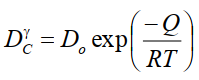
2. Initial Structure - 12What is the equation of the diffusion of C in austenite?
- 13What are the problems associated with austenitisation of alloy steels?1. Alloy elements segregate and are difficult to homogenise due to lower diffusivity
2. Steels containing strong carbide/nitride forming elements must be austenitised at high temperatures to dissolve them
3. Segregation during solidification gives uneven transformation characteristics and microstructures - 14What may happen if you choose too low austenitisation temperature?1. Incomplete dissolution
2. Too long = too expensive - 15What may happen if you choose too high austenitisation temperature?1. Austenite grain size increases, causing large quenching strains
2. Localised melting
3. Excessive oxidation
4. Excessive fuel costs - 16What is the name of preferred orientation relationship of grain boundary allotriomorphs with one austenite grain?Kurdjumov-Sachs (K-S) orientation
{111}gamma parallel to {110}alpha - 17What does growth of allotriomophs or idiomorphs require?1.Long range C transport into austenite
2. Requires transport across the ferrite/austenite interface - 18What are the assumptions of the Johnson-Mehl equation?1. Random Nucleation
2. Constant nucleation rate
3. Constant growth rate - 19What is sensitisation?Corrosion along grain boundaries by formation of Cr23C6 precipitates
- 20How to avoid sensitisation?1. Heat treat at 1050-1100C followed by water quench
2. Reduce [C]
3. Use stabilising elements (Ti and/or Nb) - 21What is critical diameter?The diameter for a steel composition and quench that would harden to 50% martensite at the centre.
It is a function of ideal diameter and severity of quench. - 22What is ideal diameter?The diameter that would harden to 50% in an ideal quench.
It is a function of the base diameter & multiplying factors. - 23What is ideal quench?A quench for which there is no resistance to heat transfer from the bar to the quenching medium so the surface comes immediately to the temperature of the bath.
Information
- Description
- Flashcards on Steel - Eric Palmiere, created by Anton Permyakov on 15/01/2019.
- Created by
- Anton Permyakov
- Views
- 6
- Rating