
Flashcards
9. Media
Cards in this deck (38)
- 1List: Types of advertisingTypes of advertising include:
1) Corporate image
2) Brand support
3) Public service
4) Direct-response
5) Business-to-business
6) Co-operative - 2Describe: The campaign development processCampaign development process
Objectives --> money --> message and media --> control - 3List: The basic functions of advertisingThe basic functions of advertising include:
1) Informing
2) Influencing (persuading)
3) Reminding and increasing salience
4) Adding value
5) Assisting other company efforts - 4Discuss: What does theory say about advertising?• Strong theory: Persuasion occurs by moving passive buyers toward a purchase by easing them through a series of steps, prompted by timely and suitable promotional messages
- Advertising is believed to be capable of increasing sales for a brand and for the product class
• Weak theory: This holds that advertising is used to maintain awareness and provide reassurance. This helps customers repeat their pattern of thinking and behaviour. Advertising reinforces existing attitudes, and does not necessarily change them
- Advertising’s role is to breed brand familiarity and identification to retain customers and to increase product or brand usage. - 5Define: Media planningSeries of decisions involved in delivering the promotional message to the prospective users of the product or brand
- 6Define: Media objectivesObjectives formulated to organise a media plan
- 7Define: Media strategiesPlans of action designed to attain the media objectives
- 8Define: MediumGeneral category of available delivery systems
- 9Define and explain: Media vehicle• Media vehicle: Specific carrier within a medium category
- Reach: Measure of the number of different audience members exposed at least once to a media vehicle in a given period of time
- Coverage: Potential audience that might receive the message through a vehicle
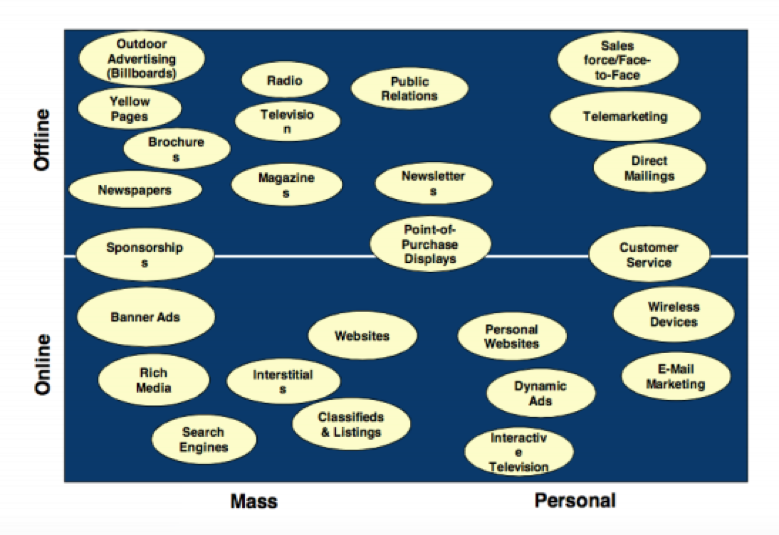
- Frequency: Number of times the receiver is exposed to the media vehicle in a specified - 10Examples: Types of media
- 11Explain: The aperture concept in media planningThe aperture concept in media planning states that perspective customers have an ideal time and place at which they can be reached with an advertising message.
- The goal of the media planner should be to expose the target audience to the advertiser’s message at these critical points, known as aperture - 12Explain: A media mixA media mix adds more versatility to the media strategies by increasing coverage, reach and frequency levels and improving the likelihood of achieving overall communications and marketing goals.
- 13Define and explain: Target market coverageTarget market coverage matches the most appropriate media to a market.
• The goal is to extend media coverage to members of the target audience while minimising waste coverage.
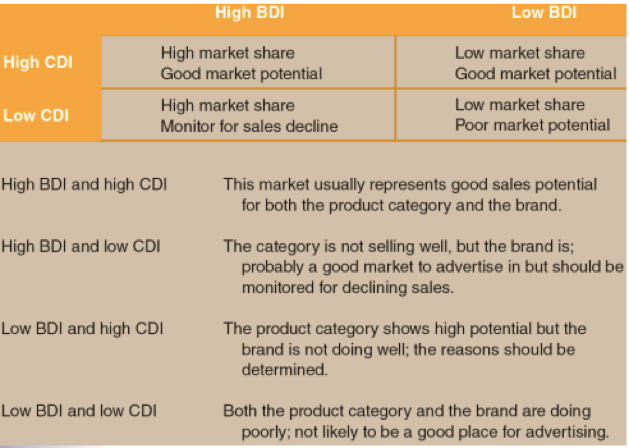
- Waste coverage: Media coverage that reaches people who are not potential buyers and / or users - 14Explain: The use of indexes to determine where to promote• Survey of buying power index: Charts the potential of a particular metro area, county or city relative to a country
• Brand development index (BDI): Factors the rate of product usage by geographic area into the decision process
• Category development index (CDI): Provides information on the potential for development of the total product category and not specific brands - 15Discuss: The use of indexes and where to promote
- 16Questions to be asked when scheduling the media strategy• Who is our target audience?
- Has it been well-defined?
- Where and when can the target be reached effectively?
- Which are the territories to be covered?
• How long should the campaign run for?
• What is the content and size of the ad? Have these been well-defined?
• What is the best media category and vehicle mix we are going to use to reach our audience?
• Is the budget enough to cover the overall media strategy?
• Are there opportunities in the media vehicle mix to be considered?
• Do we have a contingency plan? If yes, how flexible and responsive is it? - 17Describe: Methods of promotional scheduling• Timing promotional efforts such that they coincide with the highest potential buying times requires certain methods:
- Continuity: Regular pattern of advertising without gaps or non-advertising periods
- Flighting: Involves intermittent periods of advertising and non-advertising
- Pulsing: Maintains continuity but with promotional efforts stepping up at times - 18State: Factors determining promotional frequency1) Marketing factors: Brand loyalty, usage circle, brand history, target group
2) Message / creative factors: Message complexity, message uniqueness, new vs. continuing campaigns, image vs. brand sell, message variation
3) Media factors: Clutter, number of media, repeat exposure, attractiveness, frequency - 19State: Basic criteria considered in the development of media plans• The media mix
• Target market coverage
• Geographic coverage
• Scheduling
• Reach and frequency
• Recency
• Creative aspects and mood
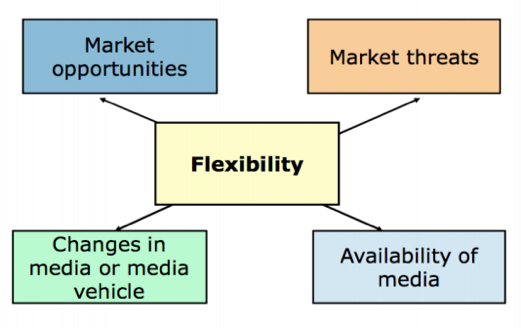
• Flexibility
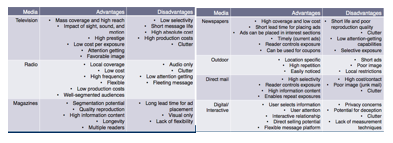
• Budget considerations - 20Describe: Media characteristics
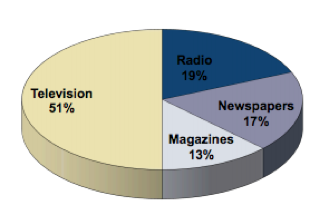
- 21State: Major traditional advertising media and approximate spending
- 22Discuss: TV's strengths and limitations- Demonstration ability
- Intrusion value
- Ability to create excitement
- One-on-one reach
- Ability to use creativity tools, i.e. humour
- Effective with sales force and trade
- Ability to achieve impact
- Escalating costs
- Erosion of audience
- Audience fractionalisation
- Zipping and zapping - 23Discuss: Radio's strengths and limitations- Can reach segmented audiences
- Intimacy
- Economy
- Short lead times
- Transfer of imagery from TV
- Use of local personalities
- No visuals
- Audience fractionalisation
- Buying difficulties - 24Discuss: Magazine's strengths and limitations- Can reach large audiences
- Selectivity
- Long life
- High reproduction quality
- Detailed information possible
- Convey information with authority
- High involvement potential
- Not intrusive
- Long lead times
- Clutter
- Limited geographic options
- Circulation varies by market - 25Discuss: Outdoor advertising strengths and limitations- Broad reach and high frequency
- Geographic flexibility
- Low cost per thousand
- Prominent brand identification
- Opportune purchase reminder
- Non-selectivity
- Short exposure time
- Difficult to measure audience size
- Environmental problems - 26Explain: Direct response advertisingDirect response advertising involves the use of any of several media (e.g. direct mail, television, magazines, web) to transmit messages to encourage buyers to purchase directly from the advertiser.
• Features of direct-response advertising include:
- Making a definite offer
- Containing all information necessary to make a decision
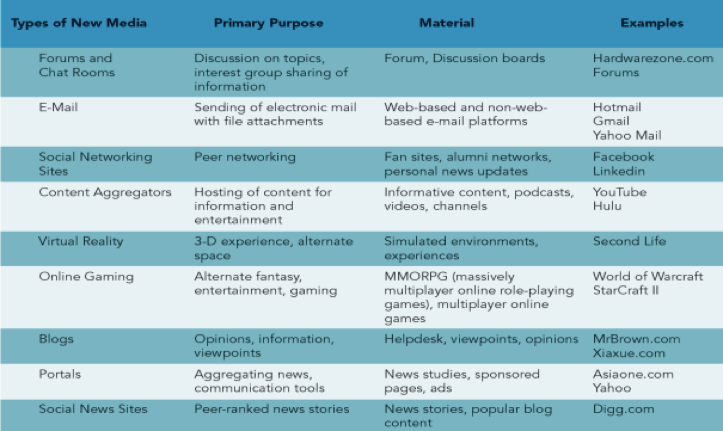
- Including a responsive device (e.g. website, toll-free number, coupon) to facilitate action - 27Explain: New advertisingNew advertising: Electronic media are making advertising more intimate, interactive and personalised.
• Advertising must involve in order to keep up with technology
• Creativity involves more than just the ads’ big idea, but finding new ways to engage consumers beyond traditional mass media - 28Explain: Types of new media, their primary purpose, material and examples
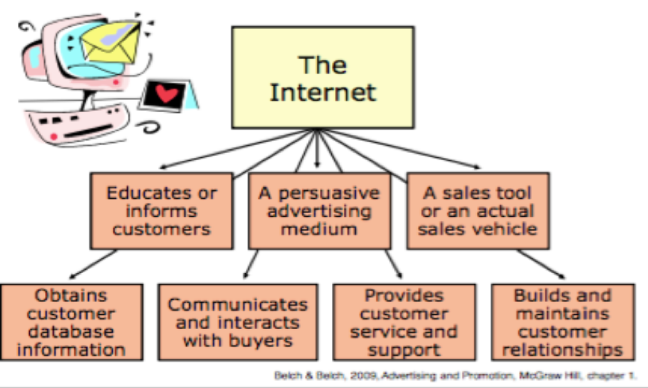
- 29How do we achieve communications? The internet
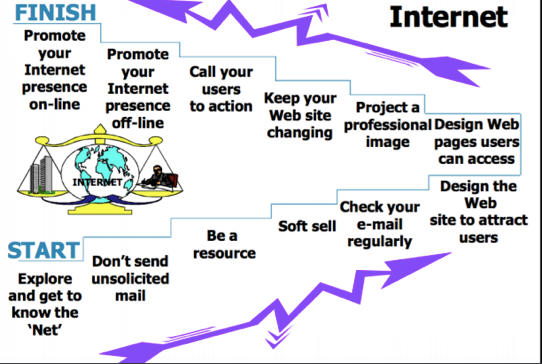
- 30Describe: Marketing on the internet
- 31Discuss: Comparison of new and traditional media• Reach: Both offer scale but traditional media is more centralised, while social media is decentralised
• Usability: Traditional media requires specialisation skills and training. However, anyone with online access can generate content for social media
• Immediacy: Traditional media often has long time lags, whereas social media can be generated very quickly
• Permanence: Once created, traditional media cannot be altered, whereas changes can be made “on the fly” with social media - 32Discuss: New Media advantages and disadvantages• Advantages:
- Flexibility
- Reach
- Consumer engagement
- Two-way dialogue
- Integration
- Improved metrics
- Cost effectiveness
• Disadvantages:
- Privacy and censorship
- Lost productivity, addiction and fatigue
- Meaningless comments
- Hackers and frauds
- Negative comments - 33State: New media mix criteria (qualitative, quantitative, technical)• Qualitative:
- Reach
- Speed of reach
- Frequency
- Message life – continuity
- Selectivity
- Geographic flexibility
- Seasonal influence
• Quantitative:
- Image-building capacity
- Emotional impact
- Medium involvement
- Active vs. passive medium
- Attention devoted to the medium
- Amount of information that can be conveyed
- Demonstration capacity
• Technical:
- Production cost
- Quality of reproduction
- Media buying characteristics (lead time, cancellation)
- Media availability - 34State: Media planning1) Analyse the market
2) Establish media objectives
3) Develop media strategy
4) Implement media strategy
5) Evaluate performance - 35Explain: The importance of flexibility
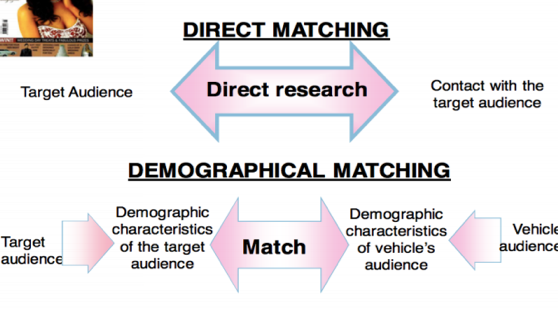
- 36Describe: Vehicle selection
- 37Discuss: Problems in media planning- Measurement problems
- Lack of information
- Inconsistent terms
- Time pressure - 38Summarise the importance of new mediaNew media is the key to capture consumers’ attention. As content distribution channels are becoming very important, the quality of the content is key.
Information
- Description
- Marketing Communications Flashcards on 9. Media, created by Nina Olsson on 25/04/2019.
- Created by
- Nina Olsson
- Views
- 1
- Rating