
Flashcards
11. Creative Strategy: Planning, Development, Implementation and Evaluation
Cards in this deck (19)
- 1Messages may pertain to......humour, fear, celebrities, sex, comparison, cartoons, other creativity tools
- 2Explain: Informative or emotional appeals• Advertisements can appeal to the informative or emotional
- Informative appeals include price, quality, performance, components, availability, special offers, taste, nutrition, packaging, warranties, safety, independent research, company research and new ideas
- Emotional appeals can be:
Positive: Humour, eroticism (sex appeal), love, nostalgia, family
Negative: Fear, shock, guilt, sorrow - 3Explain: The two-stage model of making people laugh• Surprise:
- The incongruity of the situation depicted causes feelings of surprise
- If the situation is familiar to the audience, it can cause higher levels of surprise
• Humour:
- When the incongruity is easily resolved
- And when the ad is high in playfulness and warmth
- The surprise is transformed into humour - 4Explain: How to use humour effectively• Avoid jokes (punchlines wear out too fast)
• Relate to the human experience
• Make your product central to the message
• Understand your audience’s sense of humour
• Avoid humour that’s at the expense of others
• Have fun with your product (don’t make fun of it)
• Use smart humour - 5Describe: Three models to explain how fear works• There are three models to explain how fear works in advertising (from attribution theory):
- Drive explanation model: Fear creates a state of drive that is unpleasant. As fear increases, you’d be more likely to take the recommended attitude to reduce the tension
- Resistance explanation model: High levels of fear will produce the appearance of defensive mechanisms
- Curvilinear model: Positive responses tend to be lower, whereas fearful ones tend to be extreme. Moderate fearful messages tend to produce optimal results - 6Explain: How to use the brand features to build an image• There are several types of endorsers out there: Celebrities, professionals and the typical customer
• Even the voice (or pitch) of the spokesperson influences the perception of the brand and the brand equity. The pitch of the voice is the “rate of vibration of the vocal folds” - 7Explain: How to connect with endorsersCo-branding or appeal through ads
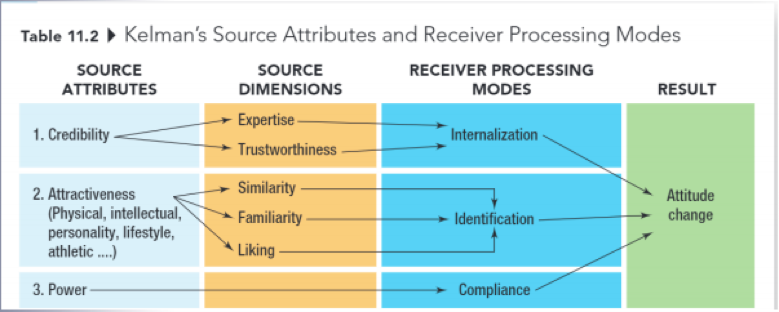
• Credibility / trustworthiness
• Familiarity
• Likability
• Celebrity / audience match-up
• Celebrity / product match-up
• Attractiveness
• Experience - 8Explain: Cultural meaning transfer• Celebrities embody a unique constellation of meanings, e.g. success, excellence, fame
• When a celebrity is repeatedly paired with a brand it thus takes on a much more vivid and interesting character than what it would do on its own
- E.g. when you think of Nike what celebrities do you also think of - 9Evaluate: The use of celebritiesPros of using celebrities
• Celebrities can…
- Cut through advertising clutter
- Enhance the image of a mundane product
- Get more attention than other spokespersons
- Lead to higher purchase intention
- Have stopping power
- Be idolised by fans
- Fascinate people by their stories
- Have unique characteristics that can help communicate the selling idea
- Be experts in their fields
Cons of using celebrities
- Expensive
- When they misbehave that negative image is also passed onto the brand
- Often a quick-fix and not a long-term strategy
- May lack credibility
- May endorse too many products
- May overshadow the product
- Bad press can hurt the sponsor - 10Describe: Receiver processing modes
- 11Explain: Comparative advertisingComparative advertising
• Situational factors play an important role in the effectiveness of advertising
- Comparative advertising is more effective with new brands with distinct advantages
- It seems to work with low-involvement products
- More effective with credible claims
- Established brands with static sales - 12Explain: The effects of comparative advertising• The effects of comparative advertising could be the following:
- Increased awareness of competitors
- Increased misidentification
- Less credible
- Decreased message acceptance
- Encouraging information processing
- Increased similarity between brands
- Increased purchase intention for low-share brands
- Sometimes it can backfire and cause the viewer to not want to buy the product – e.g. if the comparison is too harsh, like when political advertising is too nasty - 13Explain: Factors to consider when using comparative advertising- Consumers’ response to the ad
- Perceptions of credibility
- Characteristics of the target audience
- The company’s position in the market
- Power of the competitors - 14Consider: Comparative advertising and legislation• Some countries do not allow comparative advertising
- Others allow it, but you have to prove any statements you make - 15State: Responses to environmental problems• Green advertising
• Packaging responses
• Seal-of-approval programs
• Cause-oriented programs
• Point-of-purchase
You can mix more than one appeal! However, make sure that the net result is to remember the advertisement and not to help in achieving the goals of the campaign. - 16Discuss: The use of colourColour is the simplest form of communication of brand identity.
• In psychiatry, personality may be determined by colour tests
- Colour has been related to culture and religion and favourite colour vary by culture in advertising
- Colour may offer particular connotations for femininity, mourning, money…
- Colour may be linked to emotions
- Colour may convey quality and convey identification
• Four groups of colours:
- Cool colour (calming): Blue, green, turquoise, silver
- Warm colour (exciting): Red, pink, yellow, gold, orange
- Mixed cool / warm: Purple, lavender, green, turquoise
- Neutral (unifying): Brown, beige, ivory, grey, black, white
• Colour in print:
- Spot colour: Using a second colour in addition to black to highlight important elements
- Full colour: When realism is important
e.g. US - mourning black vs. white in India, US - bride white vs. yellow in Hindu India - 17Explain: The use of music• Music can be used to:
- Create an atmosphere
- Enhance emotional appeals in absence of facts
- Entertain
- Increase memorability
- Give information (lyrics)
- Create associations between products and music
- Differentiate the offer - 18Define: JingleA jingle is a short catchy tune which incorporates a product name or slogan. It may be original or taken from a music piece that already exists. The purpose of a jingle is to get consumers to remember the product. A good jingle can make even a low-budget advertisement very memorable.
- 19Discuss: Criteria for evaluating creative approaches1) Is the creative approach consistent with the brand’s marketing and advertising objectives?
2) Is the creative approach consistent with the creative strategy and objectives and does it communicate what it is supposed to?
3) Is the creative approach appropriate for the target audience?
4) Does the creative approach communicate a clear and convincing message to the customer?
5) Does the creative execution overwhelm the message?
6) Is the creative approach appropriate for the media environment in which it is likely to be seen?
7) Is the advertisement truthful and tasteful?
Information
- Description
- Marketing Communications Flashcards on 11. Creative Strategy: Planning, Development, Implementation and Evaluation, created by Nina Olsson on 25/04/2019.
- Created by
- Nina Olsson · Apr 2019
- Updated
- Apr 25, 2019
- Views
- 0
- Rating