
Flashcards
Lecture 7 - Motion Perception
Cards in this deck (45)
- 1Why is motion perception important?Motion surrounds.
Almost always some motion on our retina. - 2What are the 2 reasons for motion occurring on the retina?1. Objects move
2. We move
Visual system has to sort out all this motion and perceive a stable world. - 3How do we detect motion?Cells in V1 (primary visual cortex)
respond to lines and edges moving in a particular direction.
Complex and hypercomplex cells. - 4What is the motion after effect?When viewing a stationary object up and down detectors fire equally - both at baseline so perceive stationary.
Prolonged viewing of downward motion causes reduced firing of down detectors (Adaptation). Due to fatigue.
Viewing a stationary object post-adaptation results in greater up activation than down, hence we perceive an upward motion. - 5What is local motion?Motion of individual (local) elements of a scene.
- 6What is global motion?We can group the motion of many individual elements (local motion) to perceive a complex pattern of global motion.
Perceive a pattern of motion across the whole scene.
- might be all individual elements moving in same direction
- might be individual elements moving in different directions- more complex - 7What do we need to do to process global motion?To process global motion we need to pool information from multiple local motion detectors.
Cells in V1 (complex and hypercomplex) pick up local motion - these responses need to be grouped together into a global motion detector. - 8What have researchers focused on?How good are we at detecting global patterns of motion?
- 9What is one of the main task used to study global motion?Motion coherence:
In this task, observers are presented with a pattern of random dots, moving in random directions.
Researchers select a certain proportion of those dots which move in a coherent direction whilst other dots move in random direction.
Called:
- signal dots (coherently moving dots)
- noise dots (random)
Used to calculate motion coherence threshold:
- minimum proportion of signal dots needed to detect coherent motion - 10What is the motion coherence threshold typically in humans?10%
5% when highly practised. - 11What did Edwards and Badcock 1994 demonstrate?Motion coherence thresholds depend on proportion of signal to noise dots.
Rather than number of signal dots. - 12What did Morrone, Burr and Vaina 1995 show about the spatial distribution of signal dots?Spatial distribution of signal dots does not affect motion coherence thresholds.
When signal dots are close or when they are spread out - makes no difference to motion coherence threshold. - 13What does this finding suggest?Suggests global motion detectors have large receptive fields.
So must be receiving input from a large area of retina. - 14What does evidence from motion coherence experiments suggest about the size of receptive fields of local motion detectors?Local motion detectors - small receptive field. Receive input from small area of retina.
Whereas:
Global motion detectors have large receptive fields. - 15How does the brain process motion?V1 - primary visual cortex
V2 - secondary visual cortex
2 routes:
where/dorsal route - V3
what/ventral route - V4
Where/dorsal route (V3) then goes to V5.
V5 is motion area:
- contains MT and MST - 16What is area MT and MST?V5
MT = Middle temporal
MST - medial superior temporal
See in Macaque monkeys and humans. - 17How do we know MT is an important area for motion processing?range of different evidence
- 18What evidence for motion processing in MT has come from single cell recording?Single cell recording in monkeys
- nearly all cells in area MT respond to motion
- and they have a preferred direction - 19What evidence for motion processing in MT has come from artificial stimulation?Artificial Stimulation - insert electrode into cells of animals in area MT and artificially stimulate them.
Salzman et al 1990:
- identified cells in monkey area MT that all had same preferred direction (e.g. down)
- given motion coherence task to monkeys
- artificial stimulation of cells led to motion judgements being biased towards preferred direction (i.e. down) - 20What evidence for motion processing in MT has come from imaging studies?Tootell et al 1995: In humans
fMRI study of the motion after-effect:
- ppts adapted to expanding stimulus (circles expanding on screen) or expanding and contracting stimulus (control) then tested with stationary stimulus.
When we adapt to motion, then view stationary test, we experience motion in the opposite direction.
- ppts adapted to expanding motion, perceived contracting motion. Motion after effect.
- no motion after effect for stimulus which is contracting and expanding - motion cells balance each other out
fMRI results:
- MT remain active during direct stimulation (when they see expanding motion and expanding+contracting motion) and periods of after-effect (no stimulation but motion is still perceived.
- no MT activation when no motion after effect was perceived
MT active for perceived motion as well as actual motion. - 21What further evidence for motion processing in MT comes from imaging studies?Zeki et al 1993: PET study of illusory motion
- MT active when we experience illusory motion
- e.g. 'The Enigma' - by Isla Leviant
MT is sensitive to perceived motion as well as actual motion on retina. - 22What evidence for motion processing in MT comes from lesions in monkeys?Newsome and Parè (1988)
- introduced small lesion to monkey MT
- given motion coherence task
- monkeys before lesion (undamaged MT) had coherence thresholds of 5%. Very good.
- monkeys after lesion (damaged MT) had coherence thresholds of 80%.
Damage to MT had massive effect on monkeys ability to perceive motion. Monkeys needed lots more coherent dots to perceive motion. - 23What evidence for motion processing in MT comes from lesions in humans?Humans with MT lesions referred to as motion blind or akinetopsic.
World appears frozen in series of still scenes.
Baker et al 1991:
- studied human patient with lesions to MT
- gave motion coherence task
- found motion blind patient had very high motion coherence threshold (almost 100%)
Compared to control.
Many perceptual abilities preserved but patient had profound deficit in motion coherence performance. - 24Overall, what does this suggest about ares MT?Area MT appears to be specialized for processing motion - particularly global motion.
Evidence from:
- single cell recording
- artificial stimulation
-imaging
- lesion and neuropsychological studies - 25What is optic flow?A particular type of global motion.
Patterns of retinal motion produced when we move.
Different patterns of movement we make in the real world produce different patterns of movement on the retina. - 26What pattern is produced when we move forward?Expansion - created by forward translation
FOE - focus of expansion - 27What pattern is created when we move backwards?Contraction - created by backwards translation
- 28What type of pattern is created by eye, head or body rotation?Rotation
- moves in opposite direction to the way we move
- everything moves at same speed across the retina regardless of depth - 29What pattern is created by lateral (sideways) translation?Parallax
e.g. sidestep movement
- closer objects move faster on retina than further objects - 30What type of pattern is created by eye, head or body roll?Roll
Creates spiral pattern
Can be created by walking - swaying motion. - 31We create complex motion; what does this mean?We often aren't using one type of motion.
Instead we are doing combination of these motions.
Complex pattern of motion is created on movement.
E.g. forward translation (walking forward) and rotation at same time. Create a combined pattern of motion on retina. - 32What evidence is there to suggest we are sensitive to these characteristic patterns of optic flow?1. Phantom motion after effect
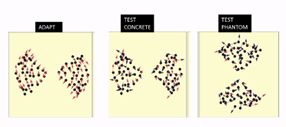
2. Imaging - 33What evidence does the phantom motion after effect provide?Snowden and Milne 1997:
- ppts adapt to patterns of optic flow. Roll movement - but only on left and right.
2 different types of test pattern presented (but always random motion):
- concrete - same place as adapt pattern
- phantom - different place to adapt pattern.
Found:
- no adaptation - no motion after effect
- concrete - big motion after effect (expected)
- phantom - still saw a motion after effect, but less strong than concrete condition.
Suggests:
Pooling of local motion signals for perception of global motion.
The adaptation of cells with large receptive fields. - 34What evidence comes from imaging optic flow?Smith et al (2006)
fMRI study to compare 2 cortical sub-regions: MT and MST (medial superior temporal area). Lie next to each other in brain.
Wanted to see whether there was a difference between the function of these 2 areas.
Measured response of MT and MST to 5 types of motion:
-complex, expansion, rotation, translation and random.
Interested in the difference in response to optic flow compared to random motion.
Found:
- difference in response to optic flow compared to random motion is greater in MST than MT.
Suggests MST is more specialized for processing optic flow motion than MT. - 35What did Gibson think optic flow is used for?Heading:
- Gibson (1950) - we use optic flow to tell us where we are heading and to control locomotion.
- FOE - focus of expansion. The point we are looking at/walking to doesn't move. This point tells us where we are heading. - 36Why has this idea been criticized?Optic flow might not be the only information used for heading.
Land and Lee (1994): Driving
- looked at eye movements whilst driving
- showed we don't look at FOE when driving, we look at other parts of the scene e.g. when on a curved path we look at the tangent.
Philbeck et al (1997): Walking
- we can accurately walk to a target even when optic flow information is minimal.
- e.g. at night
- demonstrated by blind walking experiments - can show ppt a target, blindfold them and they can still walk to a target. - 37What else has optic flow been suggested to be used for?Postural stability (balance)
- balance relies of vestibular and proprioceptive info but visual info also important
- optic flow provides info on how our posture is changing.
- e.g. if you lean forward - expansion on the retina - 38What was some original evidence which suggested optic flow was important for postural stability?Lee and Aronson (1974) - The Swinging Room Experiment
- ppts in box
- moving walls and ceiling but floor fixed
-allow simulation of optic flow that people would experience when swaying
- ppts were 13-16 month old toddlers - easier to get them to overbalance
When room swings towards toddler, it creates pattern of expansion (as would be produced if you swayed forward).
Toddler compensates by swaying backwards.
When rooms swings away, toddler sways forward.
Found - 26% swayed, 23% staggered and 33% fell over
Adults also found to sway in phase with movements of the room.
Suggests optic flow is important source of info for balance and can override other sources of balance info. - 39More recently, what has optic flow been suggested to be used for?Perception of object motion during self-motion (Warren and Rushton, 2009)
- allows us to perceive object motion while we are moving ourselves.
Difficult to perceive this because:
Retinal motion due to 2 sources:
- self motion
-object motion
If you are driving, you will get a pattern of optic flow due to self movement (expansion) and pattern of optic flow due to object movement.
Total optic flow = retinal motion (object motion and self motion).
Visual system initially doesn't know what optic flow is due to what motion. - 40What hypothesis was suggested by Warren and Rushton (2009)?Flow-parsing hypothesis:
- sensitivity to optic flow is used to figure out what motion is due to self movement and then subtract this from total retinal movement.
- retinal motion due to self-motion subtracted
- remaining motion attributed to object motion - 41What evidence supports the flow-parsing hypothesis?Warren and Rushton (2009):
- ppts asked to look at pattern of optic flow (expansion in this case).
- then another object in scene was moving horizontally.
- asked ppts to judge what direction that object was moving.
- found people perceived the horizontally moving object as moving in a downwards trajectory.
- showed that an optic flow field influenced the perceived trajectory of a moving object even when the flow was in a different part of the stimulus.
-Upward motion at object subtracted from horizontal motion of object, so perceived downward.
-Also get same pattern of results when there is only motion in same half of screen as object (top half) and only motion in other part of the screen as object (bottom half)
- provides strong evidence for global processing of optic flow.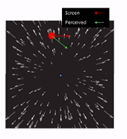
- 42What is biological motion?The motion of another person's body creates a complex pattern of movement on retina - different parts of body are moving in different directions and at different speeds.
Local motion signals need to be integrated to recover the global pattern of motion.
We appear to be particularly adept (skilled) at perceiving biological motion. - 43How is biological motion perception demonstrated?Demonstrated by point-light walker stimuli - small lights placed on a person's joints.
- 44What information can biological motion provide?Biological motion can provide info about what someone is doing but also:
gender
identity
affect - 45Where in the brain is biological motion processed?Grossman and Blake (2001) - fMRI study
- ppts viewed movies of biological motion vs scrambled biological motion
Found:
STS - superior temporal sulcus more active for biological motion compared to scrambled motion.
Seem to be specialized for biological motion.
Grossman et al (2005) TMS experiment:
- ppts viewed biological motion vs scrambled motion
- noise dots added to make task more difficult (random dots on screen too).
Task - is the stimulus biological motion or scrambled motion?
Applied TMS to STS and MT.
Found:
TMS to STS caused sig decreased in ability to distinguish biological motion from scrambled motion.
TMS to MT had no effect on biological motion perception.
Conclusion - biological motion is a special type of complex motion processed in a specialized area of the brain - STS
Information
- Description
- Semester 2 (Perception and Action) Flashcards on Lecture 7 - Motion Perception, created by Jess Grange on 18/05/2019.
- Created by
- Jess Grange
- Views
- 6
- Rating