
Flashcards
Lecture 3 - Object Recognition
Cards in this deck (49)
- 1How is perception of objects different for humans and computers?Humans - perception of familiar items
Computers - perception of familiar patterns - 2Why is object recognition difficult?Environment contains hundreds of overlapping objects.
- 3What is our perception of objects like?Out perceptual experience is of structured, coherent objects which we can recognise, use and usually name.
Apparent size and shape of an object does not change despite large variations in retinal image. - 4What are some examples of variability of objects?These objects are still recognised as the same object.
Other examples include size, colour and partial occlusion and presence of other objects.
Even if another object is partially occluding an object, you can still recognise it. - 5What are some challenges in object recognition?Intra-class variation:
- there is much variation within the category of an object. E.g. many different types of chair.
Recognition when only part of an object is visible.
Viewpoint variation
- recognizing an object from different views can be difficult.
- recognition from usual views - e.g. from above an object - 6What are some theories of 2D pattern matching?Template theory
Prototype theories
Feature theories
Structural descriptions
2D pattern matching - 'how do we recognise the letter A' - 7What is Template Theories for 2D pattern matching?Template theories:
- mini copy or template in LTM of all known patterns.
- compare stimuli to templates in memory for one with greatest overlap until a match is found. - 8What are some real life examples of template theories?Barcodes and fingerprints
- 9What are some criticisms of template theories?Normalization - an 'A' can be written in many fonts, how many A's would be store in LTM? Do we hold numerous templates?
Cannot account for the flexibility of pattern recognition system
Problem of imperfect matches - comparison requires identical orientation, size, position of template to stimuli. - 10What are prototype theories of 2D pattern matching?Modification of template matching (flexible templates)
These flexible templates possess the average of each individual characteristic.
No match is perfect; a criterion for matching is needed. - 11What evidence is there for prototypes theories?Franks and Bransford (1971)
- presented objects based on prototypes
- prototypes not shown
- yet participants are confident they had seen prototype
- suggests existence of prototypes - 12What are feature theories of 2D pattern matching?Pattern consists of a set of features or attributes.
A = 2 straight lines and connecting cross bar. - 13What is a criticism of feature theories?But also need to know relationships between features.
2 straight lines and connecting cross bar could also be a H. - 14What is structural descriptions theory of 2D pattern matching?Describes the nature of the components of a configuration and the structural arrangements of these parts.
Capital letter T = 2 parts; 1 horizontal; 1 vertical; vertical supports horizontal; vertical bisects horizontal. - 15How is 3D object recognition compare to 2D pattern recognition?Similar but a more complex process in 3D object recognition.
First must interpret input to the visual system as coherent structures, segregated from one another and from background (early image processing).
Must be processed to give a description which can then be matched to the descriptions of visual objects stored in memory. - 16What is Marr's Computational Approach?Primal Sketch - 2D description includes changes in light intensity, edges, contours, blobs.
2 1/2 D sketch - includes info about depth, motion and shading. But representation is observer-centered.
3D Representation - representation of objects and their relationships, observer-independent. - 17What did Marr and Nishihara suggest about the structural organisation of objects?Objects comprised of cylinders - must specify the relationships between cylinders = structural description.
Expressed structural relations by a hierarchical organisation of cylinders.
Each cylinder has axis and way in which others are joined are expressed as coordinates.
The position of each cylinder described relative to its own axis, resulting in a description which is invariant across viewpoints. - 18What is a criticism of this?Works well with humans/animals but not so well with other objects.
- 19What was Biederman's alternative model to Marr & Nishihara?Biederman's Recognition-by-components theory: Objects composed of basic shapes.
- we recognise objects by separating them into GEONS = geometrical ions
-GEONS are based on 3D shapes - blocks, cylinders, arcs and wedges
- GEONS can be assembled in various arrangements to form unlimited number of objects.
- approximately 36 different volumetric shapes
-viewpoint invariant theory
Small number of structural relationships:
- relative size
- verticality
-centring
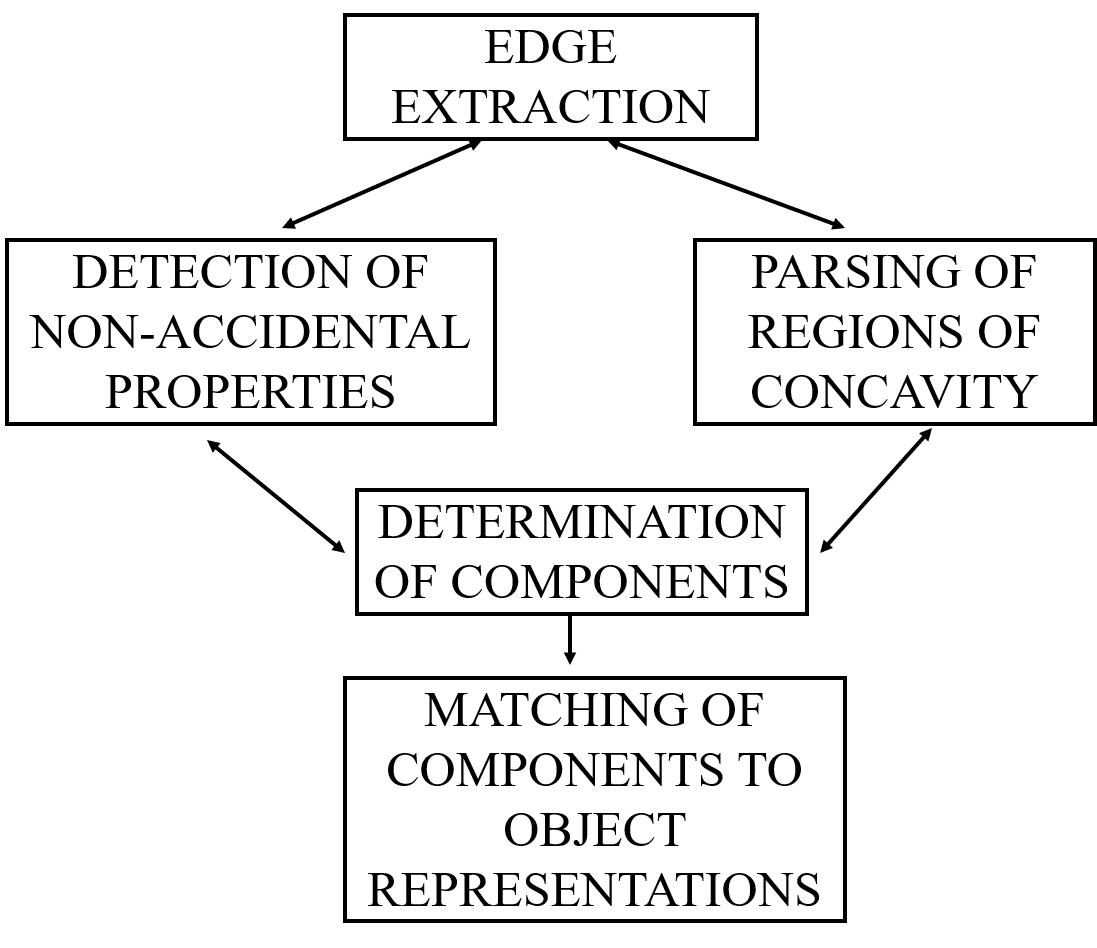
- relative size of surfaces at join - 20According to Biederman's theory, what is the importance of concave parts of an object ?Concave parts of an objects contour helpful in segmenting visual image into parts.
- 21What 'non-accidental' properties are geons specified in?Curvature - points on a curve
Parallel - set of points in parallel
Co-termination - edges terminating in a common point
Symmetry - vs asymmetry
Co-linearity - points in a straight line
E.g. cylinder posses curved edges and two parallel edges connecting the curved edges.
Regularities in visual image thought to reflect actual (non-accidental) regularities in the world. E.g. 2D symmetry in the visual image indicates symmetry in 3D object. - 22What does Biederman's Recognition-by-components theory look like?
- 23According to Biederman, what should makes objects hard to recognise?Forms of degradation which disrupt the basis for identifying geons should make objects more difficult to recognise.
- 24How did Biederman test this idea?Deleted edges at points where easily reinstated or difficult to determine.
Still presented for 100, 200 or 750 msec with 25%, 45% or 65% contours removed.
Found left is more recognizable. Right is more slow and inaccurate.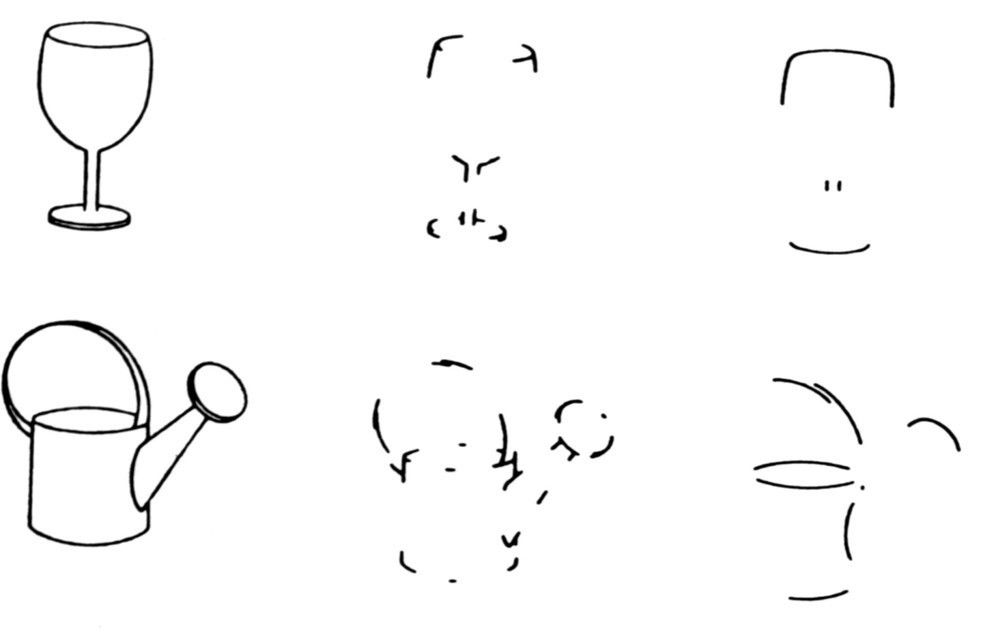
- 25What did Biederman suggest was the effect of component deletion and mid-segment deletion?Deletion of component affects matching stage - reducing number of components to match to.
Midsegment deletion - makes it more difficult to determine components.
Found:
- at brief exposure (65ms) - partial objects better recognised.
- at longer exposure (200ms), midsegment deletion led to less errors.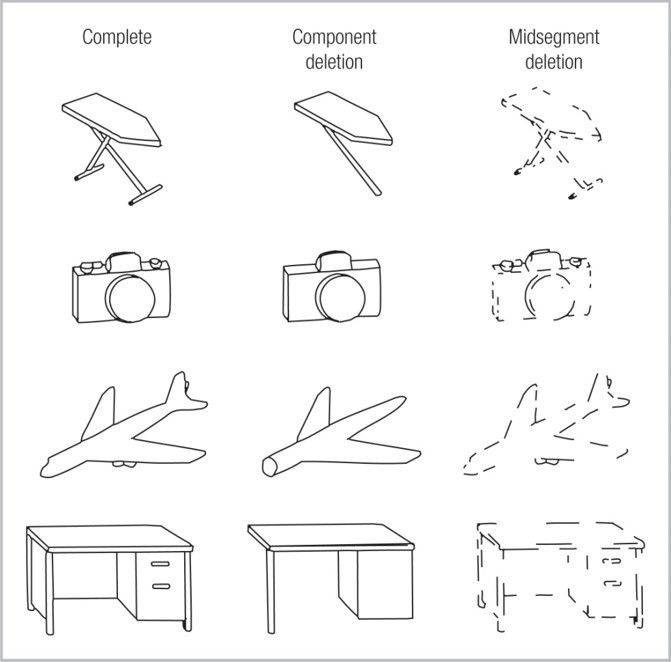
- 26What evidence for geons comes from corticol neurons?Corticol neurons in monkeys sensitive to geons:
- assessed response of individual neurons in inferior temporal cortex to change in geon or change in size of object.
- found some neurons responded more to geon changes, providing support for geons. - 27Evaluation of Biederman's recognition-by-components theory?Recognises importance of the arrangements of the parts.
Parsimonious - small set of primitive shape
Flexible and comprehensive system for describing objects.
Experimental results consistent with model. - 28What are the disadvantagesDoesn't explain how description are matched to those stored.
Why 36 geons?
Structure is not always key to recognition. Peach vs nectarine. Colour and texture also important.
Within-category discrimination (which chair)
De-emphasise role played by context in object recognition (affects later stages of object recognition)
Simplifies the contribution of viewpoint dependence. - 29What is the difference between viewpoint invariance theories and viewpoint dependence theories?Viewpoint invariance theories (Biederman):
- ease of object recognition is not affected by the observers viewpoint.
Viewpoint-dependent theories:
- assume changes in viewpoint reduce the speed/accuracy of object recognition. - 30What is the viewpoint dependent theory of object recognition?Object representations are collections of views that depict the appearance of objects from specific viewpoints.
Evidence suggests viewpoint invariant mechanisms used sometimes in object recognition whereas viewpoint dependent mechanisms used at other times.
Viewpoint dependent more important for within category discrimination (different kinds of car) - 31What evidence is there for viewpoint dependent theory?% correct responses measured for letters and objects when there orientation was altered.
Orientation - 0, 180, +90 and -90 degrees
Found:
% of correct responses decreased at when orientation wasn't 0 degrees.
Recognition 2nd best at 180 degrees.
+90 and -90 degrees even worst.
Viewpoint does seem to effect object recognition - 32According to viewpoint dependent theory, under which circumstances is object recognition viewpoint dependent and viewpoint invariant?Viewpoint dependent = complex within category decisions
Viewpoint invariant = easy categorical decisions - 33What is the binding problem?How do we integrate different kinds of info to produce object recognition?
When presented with several objects how do we decide which features or geons belong to which object? - 34What happens once a structural description of an object is formed?It must be matched to stored representations.
If there is a match, then object is recognised. - 35What is Humphreys et al (1988) model of the recognition process?Model that specifies the stages in recognition process.
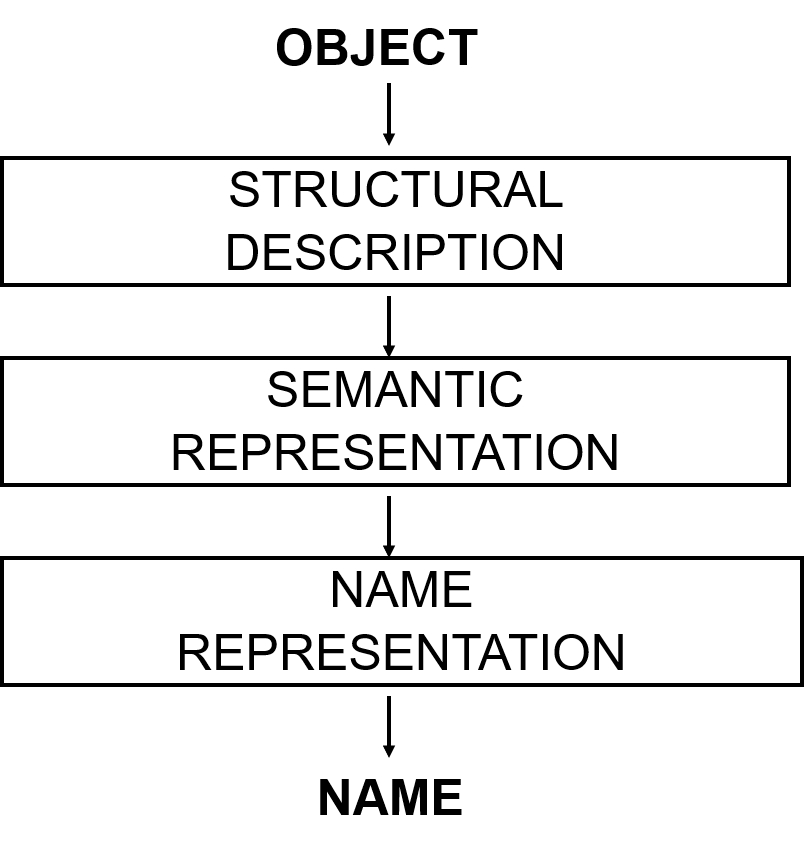
- 36What is the evaluation of this model?General support for model from patients with object recognition difficulties. Associative agnosia. For example patient HJA and JB. Could say what a table was but couldn't recognise a table. Must be stuck in earlier stage.
Oversimplification - as later processes may start before earlier ones have been completed. - 37What was Humphrey's (1988) alternative model?Cascade model:
- structural, semantic and name stages interact
- both within and between stages.
Makes different predictions about how subjects will perform in object naming task. Problems at one stage will have knock on effect at later stages. - 38What support is there for Cascade model?Anecdotal and empirical evidence for separation of structural, semantic and naming processes in recognition.
Patient JB:
Naming visually confusable objects (birds, animals) had knock on effects. making it more difficult to identify their category. - 39What is visual agnosia?Failure of knowledge or recognition
Feature processing and memory remain intact.
Recognition deficits are limited to visual modality. - 40What cognitive processes are not affected in visual agnosia?Alertness, attention, intelligence and language.
- 41What other sensory modalities may substitute for vision in allowing objects to be recognised?Touch and smell
- 42What is apperceptive agnosia (lateral)?Problems with early processing (shape extinction)
Perceptual deficit, affects visual representations directly, components of visual percept are picked up but can't be integrated, effects may be graded, often affected: unusual views of objects. - 43What can be used to diagnose apperceptive agnosia?ability to recognise degraded stimuli is impaired
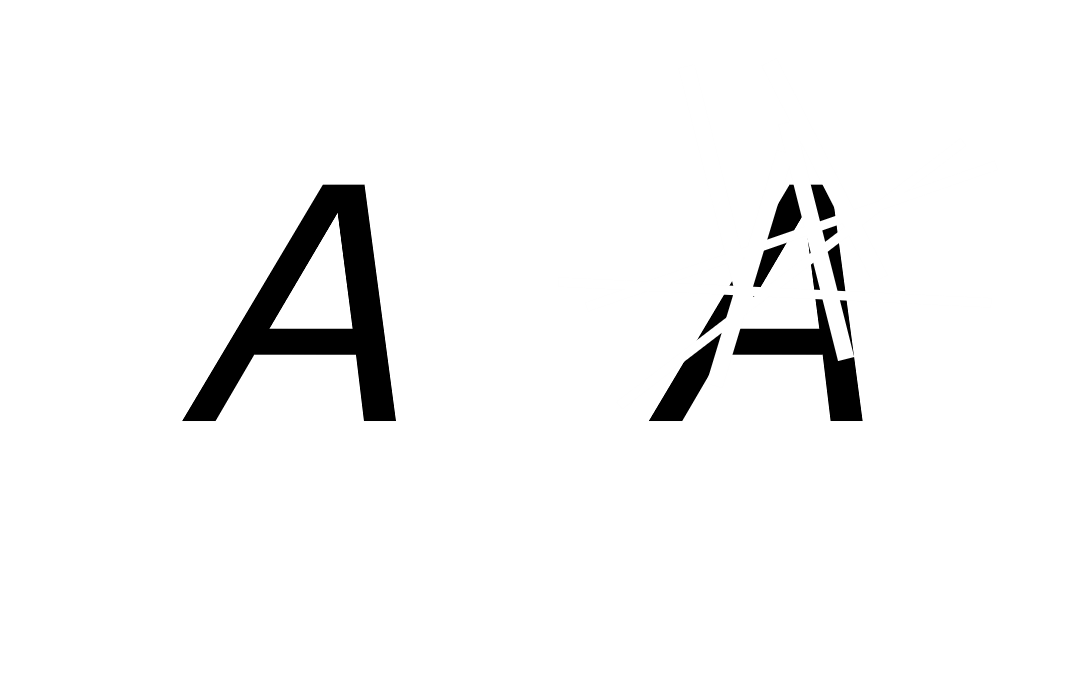
- 44What are some tests for apperceptive agnosia?Some patients would have trouble drawing chair due to missing contours.
Some patients would have trouble recognizing a chair from upper perspective.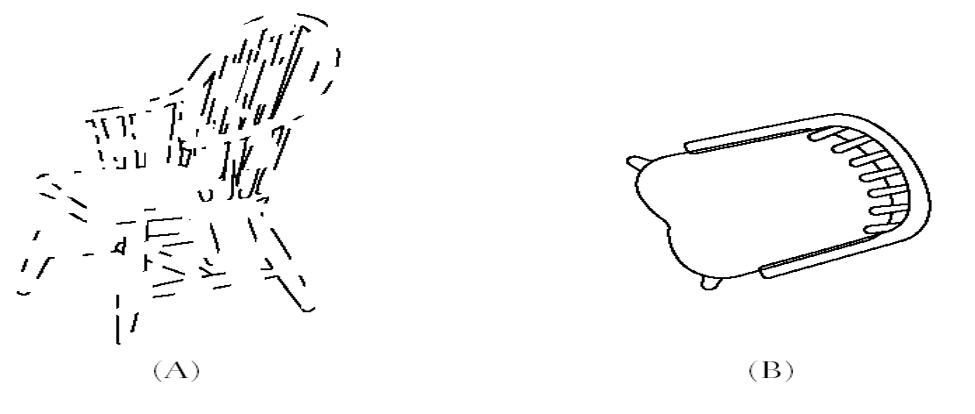
- 45What is associative agnosia? (bilateral)Problems with later processing (recognition)
Visual representations are intact, but cannot be accessed or used in recognition. Lack of info about the percept. - 46How do patients with associative agnosia perform on perceptual tests?Patients with associative agnosia perform well on perceptual tests (degraded images, image segmentation, copying drawings) but cannot access names or other info about objects (naming and recognition).
Fail to experience familiarity with the stimulus.
When given names of objects, they can generally give accurate verbal descriptions. - 47What is agnosia restricted to specific categories?Specific deficits in recognizing living vs non living things.
Warrington and Shallice - Patients with bilateral temporal lobe damage showed loss of knowledge for living things (failure in visual identification and verbal knowledge). - 48What was Warrington and Shallice's interpretation for this?Distinction between knowledge domains.
-Functional significance for non living things (vase-jug)
- vs sensory properties for living things (animals and plants: strawberry vs raspberry) - 49What are some alternative interpretations?Damasio - Many inanimate objects are manipulated by humans in characteristic ways. Inanimate objects tend to evoke kinesthetic representations.
Gaffan and Heywood:
Presented images (line drawings) of animate and inanimate to normal humans and normal monkeys, tachistoscopically (20 ms). Both groups made more errors in identifying animate vs. inanimate objects.
Suggested living things are more similar to each other than non-living things “category-specific agnosia”
Information
- Description
- Semester 2 (Perception and Action) Flashcards on Lecture 3 - Object Recognition, created by Jess Grange on 20/05/2019.
- Created by
- Jess Grange
- Views
- 6
- Rating