
Flashcards
LC Study Cards
Cards in this deck (113)
- 1A general term for the process by which incident flux is converted to another form of energy, usually and ultimately to heat.Absorption
- 2Directional lighting to emphasize a particular object or surface feature, or to draw attention to a part of the field of view.Accent lighting
- 3The process by which all or part of the retina becomes accustomed to more light or less light than it was exposed to during an immediately preceding period. It results in a change in the sensitivity to light. See also chromatic adaptation, scotopic vision, and photopic vision. The term adaptation is also used to refer to the final state of the processAdaptation
- 4The locus of points on a chromaticity diagram representing the chromaticities of blackbodies having various (color) temperatures.Blackbody (Planckian) locus
- 5The dominant or complementary wavelength and purity aspects of the color taken together, or of the aspects specified by the chromaticity coordinates of the color taken together.Chromacity of Color
- 6The ratio of luminous flux (lumens) calculated as received on the work plane to the total luminous flux (lumens) emitted by the lamps alone. It is equal to the product of room utilization factor and luminaire efficiency.Coefficient of utilization,CU
- 7R p A measure for appraising a light source with respect to its ability to enhance the appearance of an object or objects by making their colors tend toward people’s preferences. Judd’s “Flattery Index” is an example.* * Jerome CW. The flattery index.” Journal of the Illuminating Engineering Society. Jul 1973;2(4):351; and Judd DB. A flattery index for artificial illuminants. Illuminating Engineering. 1967;62(10):593Color preference index
- 8Lighting involving luminaires that distribute 90% to 100% of the emitted light in the general direction of the surface to be illuminated. The term usually refers to light emitted in a downward direction.Direct lighting
- 9In television, film and theater lighting: A condensing lens assembly designed to fit on the front of a plano-convex spotlight. Contains a slide and supports an objective lens system so that the luminaire can be used as an effect projector.Dutchman
- 10A number giving the combined reflectance effect of the wall and floor reflectances of the floor cavity.Effective floor cavity reflectance, ρfc
- 11The ratio of radiance in a given direction (for directional emittance) or radiant exitance (for hemispherical emittance) of a sample of a thermal radiator to that of a blackbody radiator at the same temperature.Emittance
- 122] The ratio of the average (time zero) wall exitance or ceiling cavity exitance to the quotient of the total lamp flux divided by the floor area. Notes: (i) Exitance is in lumens per unit area, where the units of area agree with those of the floor area. (ii) Average wall luminance or ceiling cavity luminance can be determined by noting the underlying assumption of lambertian room surfaces, where L = M/π; L is in candelas per unit area; and the units of area agree with those of M. (iii) Exitance coefficients and former luminance coefficients are numerically identical.Exitance coefficient, EC
- 13The angle between the two directions for which the intensity is 10% of the maximum intensity as measured in a plane through the nominal beam centerline. For beams that do not possess rotational symmetry, the beam angle is generally given for two planes at 90 degrees, typically the maximum and minimum angles. Note that in certain fields of application the angle between the 10%-of-maximum directions was formerly called beam angle.Field angle
- 14A system designed for lighting a scene or object to a luminance greater than its surroundings. It may be for utility, advertising, or decorative purposes.Flood lighting
- 15The emission of light as the result of, and only during, the absorption of radiation of shorter wavelengths (timescale less than approximately 10-8 seconds)Fluorescence
- 16A method of calculating the illuminance in a room by taking into account the interreflection of the light flux from the room surfaces, based on the average flux transfer between surfaces.Flux transfer theory
- 17A unit of illuminance. One footcandle is one lumen per square foot (lm/ft2).Footcandle FC
- 18A ray tracing method that casts rays from the light sources to receiving surfaces, and then recasts additional rays from these receiving surfaces to determine the interreflected light within a space or physical environmentForward ray tracing
- 19NOTE: This term was added in RP-16-17 Addendum 1. GAI* is based on the area of the polygon formed by the eight test-color samples (TCS) in the CIE 1976 uniform color space under the light source of interest, relative to the polygon formed by the TCSs when illuminated by an equal energy spectrum (EES) light source.Gamer area index ,GAI
- 20Lighting involving luminaires that distribute 40% to 60% of the emitted light downward and the balance upward, sometimes with a strong component at 90 degrees (horizontal).General diffuse lighting
- 21A photometer for measuring the directional light distribution characteristics of sources, luminaires, media, and surfaces.Gionophotometer
- 22Interior lighting where the roof trusses or ceiling height is greater than approximately 6.1 meters (20 feet) above the floor.Highbay lighting
- 23The attribute that determines whether it is, for example, red, yellow, green, or blue.Hue of a perceived Color
- 24An alternative, but deprecated, term for illuminance. It is sometimes used because illuminance is subject to confusion with luminance and illuminants, especially when not clearly pronounced. Note: The term illumination also is commonly used in a qualitative or general sense to designate the act of illuminating or the state of being illuminated. Usually, the context will indicate which meaning is intended, but occasionally it is desirable to use the expression level of illumination to indicate that the quantitative meaning is intended.Illumination
- 25A line on a surface that shows all the points where the luminance is the same for a given position of an observer and light source(s) in relation to the surface.Isoluminance line
- 26(Iθ = Io cosθ) The law stating that the luminous intensity in any direction from an element of a perfectly diffusing surface varies as the cosine of the angle between that direction and the perpendicular to the surface element.Lamberts cosine law
- 27The ratio of lumens emitted from a luminaire with dirt accumulated to the lumens emitted from the same luminaire when clean.Luminaire dirt depreciation,LDD
- 28The ratio of lumens emitted from a luminaire following permanent deterioration of luminaire surfaces to the lumens emitted from the same luminaire with no surface deterioration. This loss may increase with time if a luminaire continues to degrade.Luminarie surface depreciation factor
- 29The difference in luminance between two areas, such as the detail of a visual task and its immediate background, in which case it is quantitatively equal to the numerator in the formula for luminance contrast. (See note under luminance.)Luminance difference
- 30The minimum perceptible difference in luminance for a given state of adaptation of the eye.Luminance threshold
- 31w = dQ/dV Quantity of light (luminous energy) per unit volume.Luminous density
- 32(of a point source of light in a given direction) The luminous flux per unit solid angle in the direction in question.Hence, it is the luminous flux on a small surface centered on and normal to that direction, divided by the solid angle (in steradians) that the surface subtends at the source. Luminous intensity may be expressed in candelas (cd) or in lumens per steradian (lm/sr).Luminous intensity
- 33A thin-film light emitting diode composed of carbon-based material layered between two electrode surfaces and which serves as a diffuse area source.OLED
- 34An incandescent filament lamp or electric discharge lamp in which the outer bulb is formed of two pressed parts that are fused or sealed together; in particular, a reflectorized bowl and a cover that may be clear or patterned for optical control. Note: Often called a projector lamp or PAR lamp.PAR Lamp
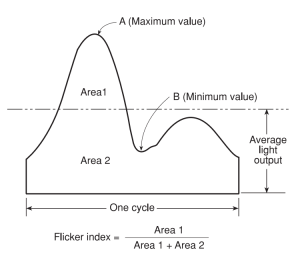
- 35A relative measure of the cyclic variation in output of a light source (percent modulation). it is given by the expression 100(A – B)/(A + B), where A is the maximum and B is the minimum output during a single cycle, and is expressed as a percentageFlicker
- 36The emission of lightas the result of the absorption of radiation, and continuing for a noticeable length of time after excitation (time scale longer than approximately 10-8 seconds).Phosphorescence
- 37An instrument for measuring photometric quantities such as luminance, luminous intensity, luminous flux, or illuminance.Photometer
- 38The property of plants that enables them to utilize radiant energy to control the growth and development of their cells, tissues, and organs.Photomorphogensis
- 39The environmental natural or artificial cycle of light and dark(er) to which living organisms may be exposed; for example, the natural cycle at the earth’s equator of light (L) for 12 hours and darkness (D) for 12 hours, which would be expressed as LD12:12.Photoperiod
- 40The opening of the iris that admits light into the eye.Pupil
- 41Pertains to the distribution of luminance in a visual environment. The term is used in a positive sense and implies that all luminances contribute favorably to visual performance, visual comfort, ease of seeing, safety, and aesthetics for the specific visual tasks involved.Quality of Light
- 42L = d2 Φ/[dω(dA • cosΘ)] = dI/(dA • cosθ) (in a given direction at a point on the surface of a source, of a receiver, or of any other real or virtual surface) The quotient of the radiant flux leaving, passing through, or arriving at an element of the surface surrounding the point, and propagated in directions defined by an elementary cone containing the given direction, by the product of the solid angle of the cone and the area of the orthogonal projection of the element of the surface on a plane perpendicular to the given direction.Radiance
- 43Energy traveling in the form of electromagnetic waves. It is measured in units of energy, such as joules or kilowatt-hours.Radiant Energy, Q
- 44Ft (at a point in space) The omnidirectional radiant flux externally incident on an elementary sphere, per unit cross-sectional area of the sphere. Ft=dΦ/da[=∫4πLdω]{ F }_{ t }=d\Phi /da\left [=\int _{ 4\pi }^{ }{ Ld\omega } \right ] Ft=dΦ/da[=∫4πLdω] where da is the cross-sectional area of the sphereRadiant fluence rate
- 45Φ = dQ/dt The time rate of flow of radiant energy. It is expressed preferably in watts.Radiant Flux (Radiant Power)
- 46An emitter of radiant energy.Radiator
- 47The life value assigned to a particular type lamp. This is commonly a statistically determined estimate of median operational life.Rated Lamp Life
- 48A ballast that is specially constructed, having certain prescribed characteristics, and which is used for testing electric-discharge lamps and other ballastsReference ballast
- 49The ratio of the flux actually reflected by a sample surface to that which would be reflected into the same reflected-beam geometry by an ideal (glossless), perfectly diffuse (lambertian), completely reflecting standard surface irradiated in exactly the same way as the sample. The analogies to reflectance may be noted in the fact that: nine canonical forms are possible paralleling the hemispherical, conical and directional reflectance terms; spectral may be applied as a modifier; and it may be a luminous or a radiant reflectance factor. It should also be noted that reflectance cannot exceed unity, but reflectance factor may have any value from zero to values approaching infinity.Reflectance factor
- 50Reflected raditation coefficient RRCThe ratio of the floor illuminance caused by the reflected flux within a room cavity to the quotient of the total lamp flux divided by the floor area.
- 51Reflector lampAn incandescent filament lamp or electric discharge lamp in which the outer blown-glass bulb is coated with a reflecting material so as to redirect the light (e.g., R- or ER-type lamps). The light-transmitting region may be clear, frosted, patterned, or phosphor coated.
- 52RefractorA device used to redirect the flux from a light source primarily by the process of refraction.
- 53RetinaA membrane lining the posterior part of the inside of the eye. It comprises visual photoreceptors (cones and rods) that are sensitive to light, and nerve cells that transmit to the optic nerve the responses of the receptor elements.
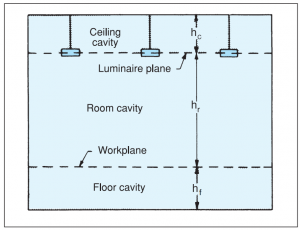
- 54Room cavity ratio, RCRA number computed by using the distance from the work plane to the plane of the luminaires (hr) as Heightcavity in the equations given in cavity ratio, CR.
- 55Saturation of perceived colorThe attribute according to which it appears to exhibit more or less chromatic color, judged in proportion to its brightness. In a given set of viewing conditions, and at luminance levels that result in photopic vision, a stimulus of a given chromaticity exhibits approximately constant saturation for all luminances.
- 56Semi-indirect LightingLighting involving luminaires that distribute 60% to 90% of the emitted light upward and the balance downward
- 57Scotopic VisionVision mediated essentially or exclusively by the rods. It is generally associated with adaptation to a luminance below about 0.034 cd/m2 (0.0032 cd/ft2; 0.01 fL).
- 58Semi-direct LightingLighting involving luminaires that distribute 60% to 90% of the emitted light downward and the balance upward.
- 59SI Unit of luminanceCandela per square meter (cd/m2); also, lumen per steradian-square meter [lm/(sr•m2)]. This unit is sometimes called the nit (the use of nit is deprecated).
- 60Spacing to mounting height ratioThe ratio of the actual distance between luminaire centers to the mounting height [see mounting height, MH (interior)].
- 61Spectral luminouse efficiency of radiant fluxThe ratio of the luminous efficacy for a given wavelength to the value at the wavelength of maximum luminous efficacy. It is dimensionless.
Note: The term spectral luminous efficiency replaces the previously used terms relative luminosity and relative luminosity factor - 62Spectral radiant fluxΦλ = dΦ/dλ
Radiant flux per unit wavelength interval at wavelength λ; e.g., watts per nanometer. - 63Spectral reflectanceρ(λ)
ρ(λ) = Φrλ/Φiλ
The ratio of the reflected flux to the incident flux at a particular wavelength, λ, or within a small band of wavelengths, Δ λ, about λ.
Note: The various geometrical aspects of reflectance may each be considered restricted to a specific region of the spectrum and may be so designated by the addition of the adjective “spectral.” - 64SpectrodiometerAn instrument for measuring radiant flux as a function of wavelength.
- 65State of chromatic adaptationThe condition of the chromatic properties of the visual system at a specified moment as a result of exposure to the totality of colors of the visual field currently and in the past. (See also chromatic adaptation.
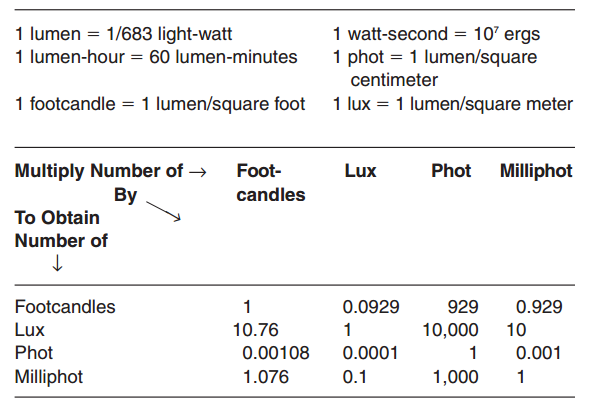
- 66Illuminance Conversion Factors
- 67Task lightingLighting directed to a specific surface or area, providing illumination for visual tasks.
- 68Track lightingA lighting equipment system consisting of an electrified power channel (track) and removable luminaires (lamp holders, track heads) that can be mechanically attached anywhere along the power channel. The luminaires can be repositioned and re-aimed as desired.
- 69Tungsten halogenAn incandescent light source utilizing the halogen regenerative cycle to prevent blackening of the lamp envelope during life. Usually more compact and longer lived than comparable standard incandescent sources. In the vernacular, also called quartz, quartz iodine, quartz halogen, or halogen.
- 70Unit for illuminanceCandela per square foot (cd/ft2). Also, lumen per steradian-square foot [lm/(sr•ft2)].
Other units include the candela per square inch (cd/in2) and the lumen per steradian-square inch [lm/(sr•in2)]. (See footlambert.) - 71Veiling brightnessA brightness superimposed on the retinal image that reduces its contrast. It is this “veiling” effect produced by bright sources or areas in the visual field that results in decreased visual performance and decreased visibility.
- 72Visibility performance criteria functionA function representing the luminance contrast required to achieve 99 percent visual certainty for the same task used for the visibility reference function, including the effects of dynamic presentation and uncertainty in task location
- 73Visual comfort probability, VCPThe rating of a lighting system expressed as the percentage of people who, when viewing from a specified location and in a specified direction, will be expected to find it acceptable in terms of discomfort glare. Visual comfort probability is related to discomfort glare rating (DGR).
- 74Zonal cavity coefficientsCoefficients used in interior lighting design to determine illuminance and exitance or luminance values from room and luminaire parameters.
- 75Zonal factor methodA procedure for predetermining, from typical luminaire photometric data in discrete angular zones, the proportion of luminaire output that would be incident initially (without interreflections) on the work plane, ceiling, walls, and floor of a room
- 76Absorptance, aα = Φa/Φi
The ratio of the absorbed flux to the incident flux.
Note: The sum of the hemispherical reflectance, the hemispherical transmittance, and the absorptance is 1.0. - 77AbsorptionA general term for the process by which incident flux is converted to another form of energy, usually and ultimately to heat.
Note: All of the incident flux is accounted for by the processes of reflection, transmission, and absorption. - 78AccommodationThe process by which the eye changes focus from one distance to another.
- 79Adaptive lightingLighting with the ability to automatically adjust light level and spectral content based on environmental conditions in order to optimize space, human, and building performance.
- 80Ambient lightingLighting throughout an area that produces general illumination.
- 81BallastA device used with an electric-discharge lamp to provide the necessary circuit conditions (voltage, current, and wave form) for starting and operating.
- 82Black bodyA temperature radiator of uniform temperature whose radiant exitance in all parts of the spectrum is the maximum obtainable from any temperature radiator at the same temperature. Such a radiator is called a blackbody because it will absorb all the radiant energy that falls upon it. All other temperature radiators may be classed as non-blackbodies. They radiate less in some or all wavelength intervals than a blackbody of the same size and the same temperature.
Note: The blackbody is practically realized over limited solid angles in the form of a cavity with opaque walls at a uniform temperature and with a small opening for observation purposes. It is variously called a standard radiator, an ideal radiator, or a complete radiator. - 83Ballast factorThe fractional lumens of a fluorescent lamp(s) operated on a ballast compared to the lumens when operated on the standard (reference) ballasting specified for rating lamp lumens.
Note: The lamp(s) are at specified ambient temperature conditions for photometric testing. - 84Beam angleThe angle between the two directions for which the intensity is 50% of the maximum intensity as measured in a plane through the nominal beam centerline. For beams that do not possess rotational symmetry, the beam angle is generally given for two planes at 90 degrees, typically the maximum and minimum angles. Note that in certain fields of application, beam angle was formerly measured to 10% of maximum intensity.
- 85BrightnessThe attribute of a visual sensation according to which an area appears to emit more light or less light.
- 86Candelacd
The SI unit of luminous intensity. One candela is one lumen per steradian (lm/sr). Formerly, candle.
Note: The fundamental SI unit of luminous intensity is the candela.* The candela is the luminous intensity in a given direction of a source that emits monochromatic radiation of frequency 540 x 1012 hertz and that has a radiant intensity in that direction of 1/683 watt per steradian. The candela so defined is the base unit applicable to photopic quantities, scotopic quantities, and quantities to be defined in the mesopic domain. - 87Candle powercp
Luminous intensity expressed in candelas (cd). - 88Ceiling cavity ratioA number computed by using the distance from the plane of the luminaire to the ceiling (hc) as Heightcavity in the equations given in cavity ratio, CR.
- 89Center beam candlepower,CBCPThe luminous intensity along the geometric centerline of a directional light source. The assumption in application is usually that the centerline candlepower is also the maximum candlepower. Also called center-beam intensity
- 90Chromatic colorPerceived color possessing a hue. In everyday speech, the word color is often used in this sense, in contradistinction to white, grey, or black
- 91Chromaticity diagramA plane diagram formed by plotting one of the three chromaticity coordinates against another.
- 92ColorThe characteristic of light by which a human observer can distinguish between two structure-free patches of light of the same size, shape, and brightness. See light source color and object color.
- 93Color rendering index,CRIA measure of the degree of color shift that objects undergo when illuminated by the light source, as compared with the color of those same objects when illuminated by a reference source of comparable color temperature.*
- 94ConesRetinal receptors that dominate the retinal response when the luminance level is high and provide the basis for the perception of color.
- 95Color temperature of a light sourceThe absolute temperature of a blackbody radiator having a chromaticity equal to that of the light source.
- 96Cosine Law] A law stating that the illuminance on any surface varies as the cosine of the angle of incidence. The angle of incidence is the angle between the normal to the surface and the direction of the incident light. The inverse-square law and the cosine law can be combined as:
E = (I cosθ)/d2 - 97Daylight factorA measure of daylight illuminance at a point on a given plane, expressed as a ratio of the illuminance on the given plane at that point to the simultaneous exterior illuminance on a horizontal plane from the whole of an unobstructed sky of assumed or known luminance distribution. Direct sunlight is excluded from both interior and exterior values of illuminance
- 98Direct glareGlare resulting from high luminances or insufficiently shielded light sources in the field of view. It usually is associated with bright areas, such as luminaires, ceilings, and windows, that are outside the visual task or region being viewed. A direct glare source may also affect performance by distracting attention.
- 99Direct-indirect lightingA variant of general diffuse lighting in which the luminaires emit little or no light at angles near the horizontal.
- 100Disability glareThe effect of stray light in the eye whereby the contrast of the retinal image is reduced and, consequently, whereby visibility and visual performance may also be reduced. A direct glare source that produces discomfort may also produce disability glare by introducing a measurable amount of stray light in the eye
- 101Discomfort glareGlare that produces discomfort. It does not necessarily interfere with visual performance or visibility.
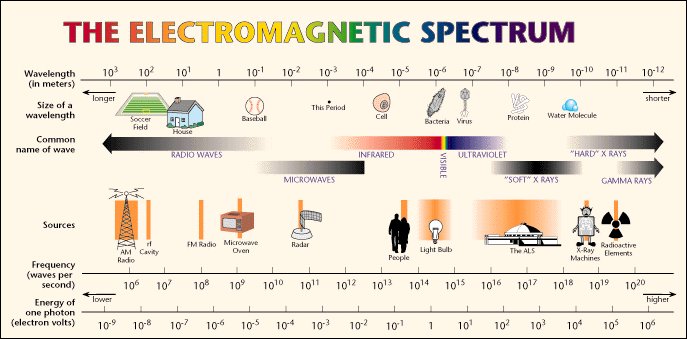
- 102Electromagnetic spectrumA continuous range of electric and magnetic radiation encompassing all wavelengths (or frequencies).
- 103FenstrationAny opening or arrangement of openings (normally filled with media for control) for the admission of daylight.
- 104Floor cavity ratio ,FCRA number computed by using the distance from the floor to the work plane (hf) as Heightcavity in the equations given in cavity ratio, CR.
- 105FoveaA small region at the center of the retina, subtending about two degrees, which contains cones but no rods and which forms the site of the most-distinct vision.
- 106Ganglion cellsSome retinal ganglion cells (melanopsin-containing) are photosensing and may have a role in entraining the circadian clock as well as other hormone-mediated effects. These cells are not believed to contribute to visual perception.
- 107GlareThe sensation produced by luminances within the visual field that are sufficiently greater than the luminance to which the eyes are adapted to cause annoyance, discomfort, or loss in visual performance or visibility.
- 108IlluminanceE=dΦ/dA
The areal density of the luminous flux incident at a point on a surface. - 109IncandescenceThe self-emission of radiant energy in the visible spectrum due to the thermal excitation of atoms or molecules
- 110Illuminance (lux or footcandle) meterAn instrument for measuring illuminance on a plane. Instruments that accurately respond to more than one spectral distribution are referred to as color corrected; i.e., the spectral response is balanced to V(λ) or V′(λ). Instruments that accurately respond to more than one satial distribution of incident flux are referred to as cosine corrected; i.e., the response to a source of unit luminous intensity that is illuminating the detector from a fixed distance and from different directions decreases as the cosine of the angle between the incident direction and the normal to the detector surface.The instrument consists of some form of photodetector with or without a filter driving a digital or analog readout through appropriate circuitry.
- 111Indirect lightingLighting involving luminaires that distribute 90% to 100% of the emitted light upward
- 112Intensity (candlepower) distribution curveA curve, often polar, that represents the variation in luminous intensity of a lamp or luminaire in a plane passing through the light center.
Note: A vertical candlepower distribution curve is obtained by taking measurements at various angles of elevation about a source in a vertical plane through the light center; unless the plane is specified, the vertical curve is assumed to represent an average such as would be obtained by rotating the lamp or luminaire about its vertical axis. A horizontal intensity distribution curve represents measurements made at various angles of azimuth in a horizontal plane through the light center. - 113Inverse square lawA law stating that the illuminance E at a point on a surface varies directly with the intensity I of a point source, and inversely as the square of the distance d between the source and the point. If the surface at the point is normal to the direction of the incident light, the law is expressed by:
E = I/d2