
Flashcards
Ch 21: Basic Numerical Procedures
Cards in this deck (8)
- 1Numerical procedures- For American plain vanilla options and some exotics, there is no analytical pricing formula
- Use numerical procedures to approximate the value
- E.g. trees, Monte Carlo simulation, finite differencing - 2Binomial tree pricing: American options1. Construct the Cox-Ross-Rubinstein (CRR) stock price tree
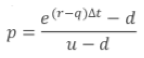
2. Compute risk-neutral probability, p
3. Compute option price at final nodes
4. Work backwards to obtain option prices at intermediate nodes then at initial node
5. Value at each intermediate node = max(continuation value, exercise value) - 3Binomial tree pricing: stock indices and currencies- For stock index, q = dividend yield on the stock portfolio underlying the index
- For currency, q = risk-free rate in foreign currency - 4Binomial tree pricing: options on assets that pay discrete dividends- Naïve approach: if we adjust downward prices for the nodes that occur after ex-div date, the tree won't recombine
- Instead, construct a tree with the initial price S* = S0 - PV(future dividends), and then back the dividends for the nodes occurring before ex-div date - 5Estimating delta and gamma- For European options, analytical formula for delta is N(d1)/-N(-d1)
- For American options, use the CRR tree to approximate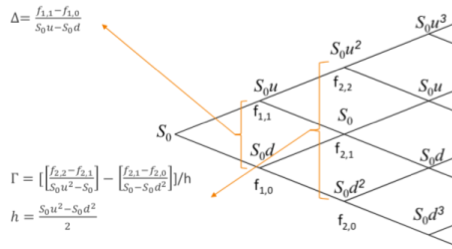
- 6Monte Carlo simulation: European vs Asian options- For European options, simulate a large number of ST using the GBM assumption and risk-neutral valuation
- For Asian options, simulate a large number of paths (not the terminal value) - 7Monte Carlo simulation: antithetic variable technique- Reduces the computational cost and standard error of the estimate
- Use epsilon and -epsilon to calculate f1and f2, then take the average and repeat for n samples - 8Monte Carlo simulation: advantages and disadvantages- Key advantage: use when payoff depends on path of S or complicated function of ST
- Key drawback: cannot easily handle early exercise situations (simulations move forward from 0 to T, so at each point in time, we cannot determine if early exercise is optimal as the range of paths after that point has not been investigated)
Information
- Description
- Business/Economics (BFC3340: Derivatives 2) Flashcards on Ch 21: Basic Numerical Procedures, created by Melina Mackey on 14/10/2019.
- Created by
- Melina Mackey · Oct 2019
- Updated
- Oct 15, 2019
- Views
- 0
- History
-
- Created by Melina Mackey · Oct 4, 2019
- Copied by Melina Mackey · Oct 4, 2019
- Copied by Melina Mackey · Oct 5, 2019
- Copied by Melina Mackey · Oct 6, 2019
- Copied by Melina Mackey · Oct 12, 2019
- Copied by Melina Mackey · Oct 14, 2019
- Rating