
Flashcards
Phys P1 (after efficiency) - F
Cards in this deck (79)
- 1What are non-renewable resources?Non-renewable energy resources are fossil fuels and nuclear fuel (e.g. uranium and plutonium). Fossil fuels are natural resources that form underground over millions of years. They are typically burnt to provide energy
- 2What are the 3 main fossil fuels?Coal
Oil
(Natural) Gas - 3What are the 7 renewable energy resources?The Sun (Solar)
Wind
Water Waves
Hydro-electricity
Bio-fuel
Tides
Geothermal - 4Characteristics of NON-renewable resourcesThese will all 'run out' one day.
They all do damage to the environment.
But they provide most of our energy. - 5Characteristics of renewable resourcesThere will never run out -- the energy can be 'renewed' as it is used.
Most of them do damage the environment, but in less nasty ways than non-renewables.
The trouble is they don't provide much energy and some of them are unreliable because they depend on the weather. - 6Non-renewable energy resources -Transport examplePetrol and diesel-powered vehicles use fuel created from oil.
Coal is used in some old-fashioned steam trains to boil water to produce steam - 7Renewable energy resources -Transport exampleVehicles that run on pure bio-fuels or a mix of bio-fuel and petrol or diesel (only the bio-fuel bit is renewable though)
- 8Non-renewable energy resources -Heating example ~ Natural gasNatural Gas is the most widely used fuel for heating homes in the UK. The gas is used to heat water, which is then pumped through radiators throughout the home
- 9Non-renewable energy resources -Heating example ~ CoalCoal is commonly burnt in fireplaces
- 10Non-renewable energy resources -Heating example ~ Electric heaters(sometimes called storage heaters) which use electricity generated from non-renewable energy resources.
- 11Renewable energy resources -Heating example ~ Geothermal heat pumpA geothermal heat pump uses geothermal energy resources to heat buildings
- 12Renewable energy resources -Heating example ~ Solar water heatersSolar water heaters work by using the sun to heat water which is then pumped into radiators in the building
- 13Renewable energy resources -Heating example ~ Bio-fuelBurning bio-fuel or using electricity generated from renewable resources can also be used for heating
- 14Wind power 1-21) Each turbine has a generator inside it - rotating blades turn the generator and produce electricity.
2) There's no pollution (except a bit when manufactured) - 15Wind power 3 - requirements3) Need about 1500 wind turbines to replace 1 coal-fired power station and 1500 cover a lot of ground - would have a bit effect on scenery/spoil view
- 16Wind power 4 - social problem4) Can be very noisy, which can be annoying for people living nearby
- 17Wind power 5 - demand5) Also, the problem of wind turbines stopping when the wind stops, or if the wind is too strong, and it's impossible to increase supply when there's extra demand (unlike power stations). On average, WTs produce electricity 70-85% of the time
- 18Wind power 6 - costs6) Initial costs are quite high, but there are no fuel costs and minimal running costs
- 19Wind power 7 - view7) There's no permanent damage to the landscape - if you remove the turbines, you remove the noise and the view returns to normal
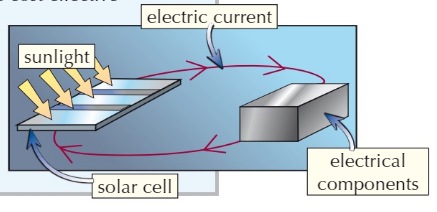
- 20Solar cells 1-21) Solar cells are often the best source of energy to charge batteries in calculators and watches which don't use much electricity
- 21Solar cell diagram
- 22Solar cells 2 - location2) Solar power is often used in remote places where there's not much choice (e.g. the Australian outback) and to power electric road signs and satellites
- 23Solar cells 3 - pollution3) There's no pollution
(although factories do use quite a lot of energy and produce some pollution when they manufacture the cells - 24Geothermal powerGeothermal power uses energy from underground thermal stores
- 25Geothermal power diagram
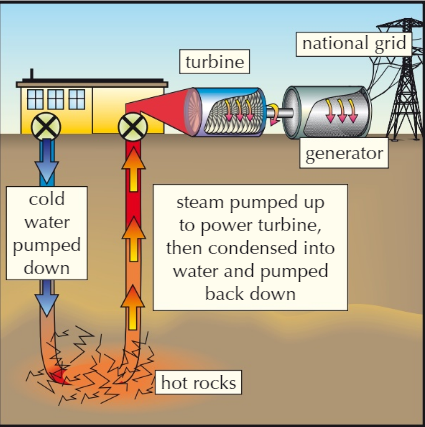
- 26Geothermal power 1 - location1) This is only possible in volcanic areas where hot rocks lie quite near to the surface. The source of much of the energy is the slow decay of various radioactive elements, including uranium, deep inside the earth
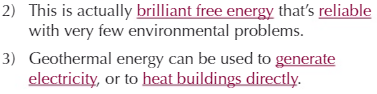
- 27Geothermal power 2-3 ~ reliability
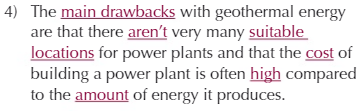
- 28Geothermal energy 4 - drawbacks
- 29Hydro-electric powerHydro-electric power transfers energy from the KE store of falling water
- 30HEP diagram
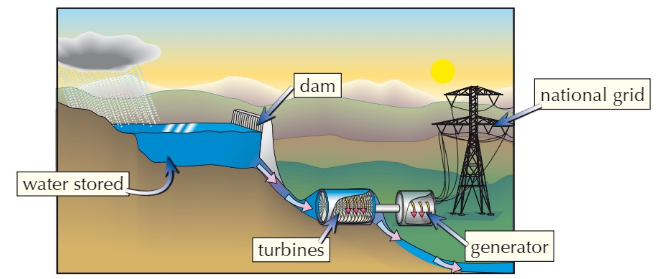
- 31HEP 1 - requirementsHEP usually requires the flooding of a valley by building a big dam.
Rainwater is caught and allowed out through turbines - 32HEP 2 - environmental impact

- 33HEP 3-4 ~ pro and con

- 34HEP 5 - costInitial costs are high, but there are no fuel costs and minimal running costs
- 35HEP 6 - scale/areaIt can be a useful way to generate electricity on a small scale in remote areas
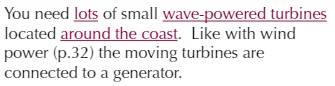
- 36Wave power 1 - requirements
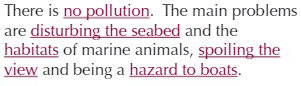
- 37Wave power 2 - pollution
- 38Wave power 3 - reliability

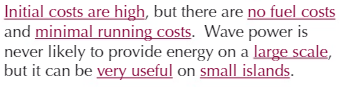
- 39Wave power 4 - costs
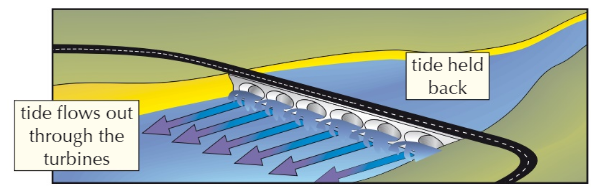
- 40What do tidal barrages use?Tidal barrages use the Sun and Moon's gravity
- 41Tidal barrages 1-2 ~ tides and building

- 42Tidal barrages 3 - productionTides are produced by the gravitational pull of the Sun and Moon
- 43Tidal barrages diagram
- 44Tidal barrages 4 - pollution

- 45Tidal barrages 5 - reliability

- 46Tidal barrages 6 - cost

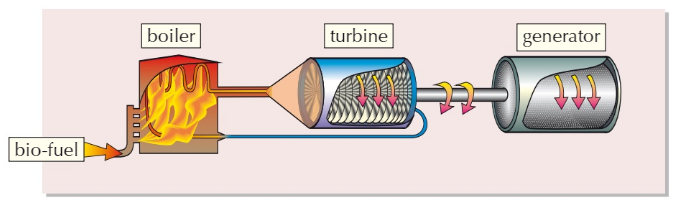
- 47What are biofuels made from?Either plant products or animal dung
- 48What form do bio-fuels take?Can be either:
-solid
-liquid
-gas
and can be burnt to produce electricity or run cars in same way as fossil fuels - 49Bio-fuels diagram
- 50Bio-fuels PROS 1 (emissions)1) they are supposedly carbon neutral, although there is some debate about this as it's only really true if you keep growing plants at the rate you're burning things.
- 51Bio-fuels PROS 2 (reliability)2) Fairly reliable, as crops take a relatively short time to grow and different crops can be grown all year round. However, they can't respond to immediate energy demands. To combat this, BFs are continuously processed and stored for when needed
- 52Bio-fuels CONS 1 (cost)1) The cost to refine bio-fuels so they are suitable for use is very high
- 53Bio-fuels CONS 2 (space/water)2) Some worry that growing crops specifically for biofuels will mean there isn't enough space or water to meet the demands for crops that are grown for food.
- 54Bio-fuels CONS 3 (deforestation)

- 55Non-renewables reliability 1 - demand

- 56Non-renewables reliability 2 - finite resources

- 57Non-renewables reliability 3 - cost

- 58Non-renewables environmental problems 1 - global warming

- 59Non-renewables environmental problems 2-3 ~ sulfur dioxide

- 60Non-renewables environmental problems 4 - landscape

- 61Non-renewables environmental problems 5 - oil spills

- 62Non-renewables environmental problems 6 - Nuclear waste disposal

- 63Non-renewables environmental problems 7 - Nuclear waste decommissioning

- 64Non-renewables environmental problems 8 - Nuclear power riskNuclear power always carries the risk of a major catastrophe like the Fukushima disaster in Japan
- 65Dependance on fossil fuels over 20th century

- 66Dependance on fossil fuels since the beginning of 21st century

- 67Where do we to produce most of our electricity?Fossils fuels
Mostly coal and gas, and from nuclear power - 68Reasons for burning fossils fuelsGenerating electricity
Oil (diesel and petrol) is used to fuel cars,
and gas is used to heat homes and cook food. - 69Aim to increase renewable energy use - target

- 70Reasons for increasing renewable energy use (1 - environment)We know burning FFs is very damaging to the environment. This makes people want to use renewable energy resources that affect the environment less
- 71Reasons for increasing renewable energy use (2 - finite)

- 72Reasons for increasing renewable energy use (3 - international/public pressure)

- 73Reasons for increasing renewable energy use (4 - cars)

- 74Use of renewables LIMITATIONS 1 - behaviour

- 75Use of renewables LIMITATIONS 2 - building costs

- 76Use of renewables LIMITATIONS 3 - location

- 77Use of renewables LIMITATIONS 4 - reliability

- 78Use of renewables LIMITATIONS 5 - research

- 79Use of renewables LIMITATIONS 6 - personal expense
