
21815063
Description

Flashcards by Marissa Alvarez, updated more than 1 year ago

|
Created by Marissa Alvarez
over 5 years ago
|
|
| Question | Answer |
| GOALS | ->Recognize the structures of the nitrogenous bases and nucleotides ->Know how orotate is synthesized from glutamate, C02 and aspartate ->Understand how orotate is used to produce OMP and UMP and how CTP is synthesized from UMP ->Understand allosteric regulatory mechanisms ->Know how ribonucleotides are reduced to form deoxyribonucleotides and how synthesis of nucleotides is balanced ->Understand how dTMP is synthesized from UMP ->Recognize how cancer drugs impact nucleotide biosynthesis |
| TUTORIAL SLIDES Pyrimidine synthesis de novo pathway ___ is the sugar substrate for de novo synthesis of pyrimidine nucleotides (like purine nucleotide synthesis) Unlike de novo purine nucleotide synthesis, the pyrimidine ring is synthesized ___ and is then attached to PRPP __ ___ ___ __ catalyzes the formation of carbamoyl phosphate from HC03-, ATP, and glutamine Carbamoyl phosphate and aspartate are covalently attached cyclized and modified to generate ____ Orotate is covalently linked to PRPP to make ___, which is modified to make ___ & ___ | PRPP first Carbamoyl phosphate synthetase Il orotate OMP UMP and CMP |
| Synthesis of deoxyribonucleotides Nucleotide ___, e.g. GDP, are the substrates to generate deoxynucleotide diphosphates, e.g. dGDP ___ ___ catalyzes the reduction of NDPs to generate dNDPs. The oxygen on the 2' carbon of the ribose is removed to convert it into ___ This results in production of DP, dGDP, dCDP and dUDP. dADP, dGDP and dCDP are phosphorylated to become dATP, dGTP and dCTP. dUDP is dephosphorylated to dUMP. What about dTTP? The dUMP ring is methylated (methyl comes from __) to generate dTMP, which is phosphorylated twice to form dTTP | diphosphates (NDPs) Ribonucleotide reductase deoxyribose THF |
| Pyrimidine vs purine nucleotide synthesis • Purines and pyrimidines can be made via de novo and salvage pathways ___ is used as a precursor in both de novo pathways In purine synthesis, the purine nitrogenous BASE is built from scratch WHILE attached to Cl of the sugar, i.e. PRPP is used in the __ step In pyrimidine synthesis, the pyrimidine nitrogenous base is built from scratch and THEN attached to Cl of the sugar, i.e. PRPP is used in the ___ step | PRPP first last |
| Pyrimidine nitrogenous bases The pyrimidine nitrogenous base that is built from scratch is called ___ Orotate reacts with PRPP to generate orotidine 5'- monophosphate (__) OMP is modified to produce uridine 5 '-monophosphate (___), which in turn is modified to produce the ___ pyrimidine nucleotides | orotate OMP UMP other |
| De novo synthesis of pyrimidines Pyrimidines have 2 nitrogens: I comes from the side chain of ___ and 1 comes from ____ Pyrimidines have 4 carbons: I comes from __ and the other 3 come from the ___ | glutamine aspartate CO2 aspartate (entire molecule) |
| De novo synthesis of pyrimidines The first step is the synthesis of ___ ___ • ___ ____ ____ ___ catalyzes the transfer of the side-chain nitrogen of glutamine to bicarbonate in a reaction requiring 2 ATPs This reaction occurs in the ____ Carbamoyl phosphate will be linked to ___ • Contrast with the synthesis of carbamoyl phosphate in the UREA cycle Carbamoyl phosphate synthetase __ catalyzes the reaction of ammonia with bicarbonate in a reaction requiring 2 ATPs Remember this reaction occurs in the ___ Carbamoyl phosphate is linked to ___ in the urea cycle | carbamoyl phosphate Carbamoyl phosphate synthetase Il cytoplasm aspartate I mitochondria ornithine |
| Synthesis of OMP Carbamoyl phosphate reacts with aspartate to form ___ ___ Reaction is catalyzed by ___ ____ (ATCase). This enzyme is very important as a key point of regulation of the pathway Carbamoyl aspartate (a linear molecule) is cyclized by ____ and then oxidized to produce ____ Orotate reacts with PRPP to produce orotidine 5 '-monophosphate (____) | carbamoyl aspartate aspartate transcarbamoylase dihydroorotase orotate OMP |
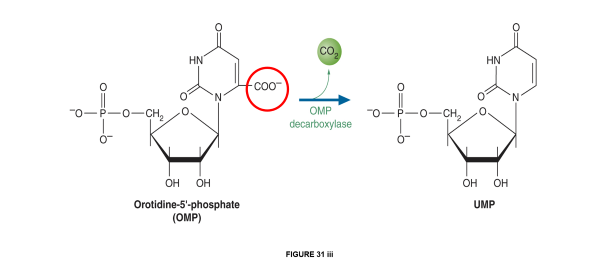
| Synthesis of OMP In eukaryotes, steps l, 2 and 3 are catalyzed by one enzyme that has ___ catalytic sites — increase the efficiency of synthesis The ___ ___ (__) activity is a key site of regulation OMP is decarboxylated to produce Uridine 5'-monophosphate (___) | three aspartate transcarbamoylase (ATCase) UMP |
| OMP is converted to UMP by ____ | decarboxylation |
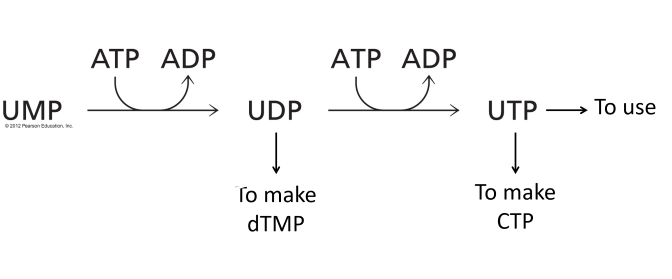
| UMP is ____ to form UTP | phosphorylated |
| Synthesis of CTP CTP is generated by transfer of amide nitrogen from glutamine to ___ Catalyzed by CTP synthetase (___ ___ reaction) *important point of regulation | UTP (UTP makes CTP) ATP dependent |
| Allosteric regulation ___ ___ (__) and ___ ___ are allosterically regulated CTP ____ the activity of both enzymes If level of UTP is also high, ___ is further inhibited ___ is an allosteric activator of ATCase (if levels are high want to increase pyrimidines) ___ is an allosteric activator of CTP synthetase (if GTP is high want to increase CTP) | Aspartate transcarbamoylase (ACTase) and CTP synthetase inhibits ATCase ATP GTP |
| Allosteric regulation of aspartate transcarbamoylase (ATC) CTP regulates activity (INHIBITS) by binding to an ___ site FAR from the active site of the enzyme | allosteric |
| Deoxyribonucleotide synthesis De novo pathways and most salvage pathways generate ribonucleotides (exception is salvage pathway for ___) Ribonucleotides are reduced to deoxyribonucleotides by ___ ____ Substrates are ___ (e.g. CDP) and products are ___ (e.g. dCDP) Electrons to reduce NDPs originate in ___ Regulation is complex | thymine ribonucleotide reductase NDPs dNDPs NADPH |
| Ribonucleotide reductase Reduction of nucleotide results in ___ of ribonucleotide reductase. Ribonucleotide reductase needs to be ___ in order to catalyze another reaction. | oxidation reduced |
| Regulation of ribonucleotide reductase Catalytic site ___ NDPs Activity site binds ___ or ___ — turns enzyme on or off Specificity site binds ATP/dATP or dTTP or dGTP - alters substrate ___ to make different dNDPs | reduces ATP (turns on) dATP (turns off) specificity |
| Regulation of ribonucleotide reductase If levels of dNTPs are high, don't need to make more. __ binds to shut OFF enzyme. If levels of dNTPs are low, need to make more. dATP is low, so ___ binds to turn enzyme ON. If levels of purines are high, need to make more pyrimidines. ___/__ binds to alter substrate specificity to make more __ and ____ If levels of pyrimidines are high, need to make more purines. ___ binds to alter substrate specificity to make more ___. If levels of dGDP is high, need to make more dADP. ___ binds to alter substrate specificity to make more dADP. | dATP ATP ATP/dATP dCDP & dUDP dTTP dGDP dGTP |
| Production of dNTPs dADP, dGDP and dCDP are phosphorylated to produce dATP, dGTP and dCTP for DNA synthesis It is very important the _ is NOT incorporated into DNA dUDP is dephosphorylated to form dUMP (if dUTP is accidently produced it is rapidly degraded to ___) • dUMP is methylated to form dTMP, which is phosphorylated to form ___ and ___ for DNA synthesis | U dUMP dTDP & dTTP |
| Generation of dTTP from dUMP ___ ___ catalyzes the transfer of the carbon from 5, 10-methylene THF to dUMP to produce dTMP When methyl group is transferred THF is oxidized to dihydrofolate and must be reduced back to THF by ___ to be used again (recycle THF) | Thymidylate synthase DHFR |
| 5 -Fluorouracil Structure is similar to uracil Can be converted into a nucleotide Inhibits ___ ____ This is an anti-cancer drug Why? Methotrexate: This is an inhibitor of ___. Therefore reduces level of THF. This is an anti-cancer Why? Gemcitabine: This is a pyrimidine ring analogue — can be converted to nucleotide diphosphate mimic — suicide inhibitor of ___ ___ — anti-cancer drug — why? | thymidylate synthase DHFR ribonucleotide reductase |
| Recap I Carbamoyl phosphate synthetase Il produces carbamoyl phosphate from ___, ___, & ___ Carbamoyl phosphate reacts with aspartate to produce a product that is cyclized and oxidized to produce ___ Oratate reacts with PRPP to produce ___, which is decarboxylated to generate ___ Amide group from glutamine is transferred to UTP to produce ___ CTP, UTP, ATP and GTP ____ regulate enzymes in the de novo pyrimidine synthesis pathway | glutamine, bicarbonate and ATP orotate OMP UMP CTP allosterically |
| Recap II NDPs are reduced by ___ ___ to produce dNDPs Ribonucleotide reductase binds different nucleotides to regulate activity and substrate specificity dUMP is methylated using 5,10 methylene THF as a carbon donor to produce ___ 5-fluorouracil, methotrexate, and gemcitabine are anti-cancer drugs that target ____ production | ribonucleotide reductase dTMP deoxynucleotide |

Want to create your own Flashcards for free with GoConqr? Learn more.