
Flashcards
BMS08-1006 -Histology of Soft Connective Tissue
Cards in this deck (21)
- 1What is soft connective tissue?Cells embedded in an extracellular matrix
- 2What are the 6 functions of soft connective tissue?1. Space filler
2. Mechanical support
3. Attachment/protection
4. Nutrient highway
5. Calcium/fat storage
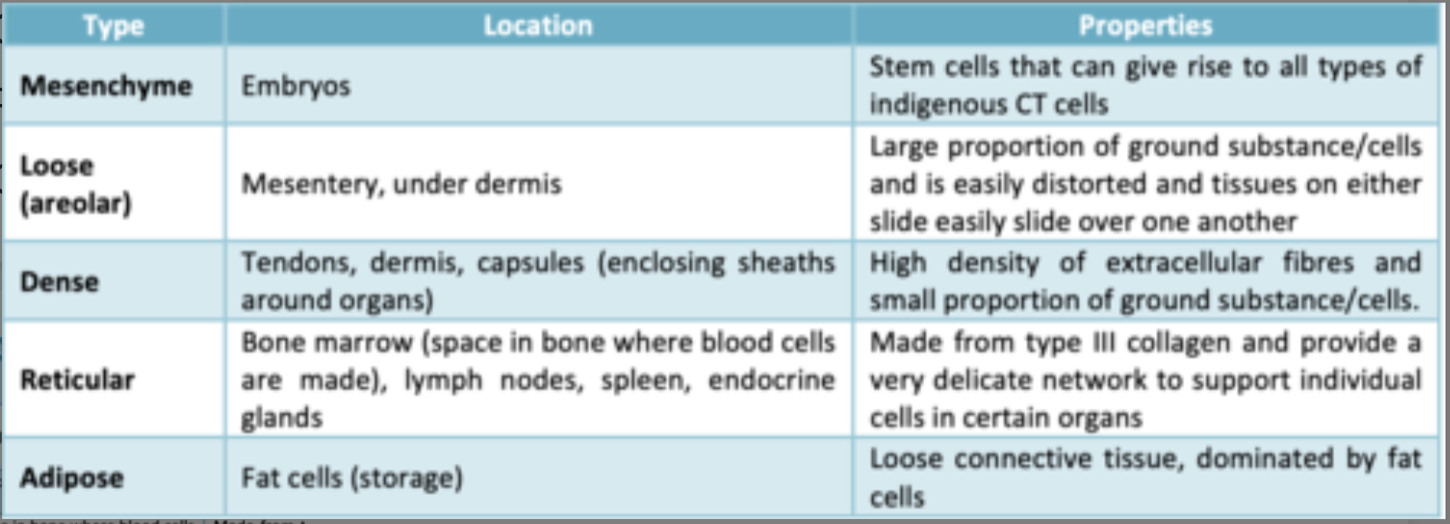
6. Immunological defense - 3What are the 4 types of soft connective tissue? What are their functions?1. Mesenchyme (embryonic)
2. Loose (under dermis)
3. Reticular (bone marrow/lymph
4. Adipose - 4Which 3 indigenous cells are present in the ECM?1. Fibroblasts that secrete ECM proteins
2. Adipocytes for fat storage/leptin release
3. Mast cells for immunological defense - 5What ECM proteins do fibroblasts secrete?1. Adhesive proteins
2. Collagen
3. Elastin - 6What immigrant cells are in the ECM of soft connective tissue?1. Lymphocytes
2. Basophils
3. Eosinophils
4. Dendrite cells
5. Neutrophils
6. Monocytes/macrophages - 7What is the ECM made up of?1. Collagen
2. Ground substance
3. Proteoglycans
4. Glycoaminoglycans (GAGs)
5. Polysaccharides
6. Elastic fibers
7. Adhesive glycoproteins - 8What type of collagen is the most dense, and found in fibrous connective tissue such as bones, tendons, and dentine?Type 1
- 9What type of collagen is the most flexible, and found in blood vessels/skin?Type 3
- 10What type of collagen is for flexibility and movement, and found in cartilage?Type 2
- 11Where is Type 4 (sheet) collagen found? What is unique about its structure?In the basement membrane
No fibril/triple helix, mesh network - 12What is the structure of collagen?Triple helix in fibrils
- 13What is the ground substance?Water stabilised by GAGs, proteoglycans, glycoproteins
- 14What are glycoaminoglycans (GAGs)?long sugars that are acidic to attract H20
- 15What do glycoaminoglycans do?Shock absorbant
Lubricant - 16What is the difference between GAGs and proteoglycans?Proteoglycans are GAGs covalently linked to protein
- 17What are elastic fibers made of? Where are they found?Made of elastin/fibrillin
Found in skin, lung, blood vessels - 18When are elastic fibers synthesised and what is their function?Synthesised at birth
Function is to extend, store energy when stretched - 19What are adhesive glycoproteins and what do they do?Intermediaries that bind cells via their cell surface integrin receptors
Helps form ECM - 20What are 3 examples of adhesive glycoproteins that cells bind to?1. Fibronectin
2. Tenascin (wound healing)
3. Laminin (binds epithelia to basement membrane) - 21Why do GAGs attract water?They are negatively charged sugars
Information
- Description
- Define what is meant by connective tissue. Classify the different types of connective tissue and give examples of their locations. State the functions of these tissues. List and identify the different cells found in soft connective tissue; relate their functions to their structures. Describe the different components of the extracellular matrix and state their functions.
- Created by
- Evian Chai
- Views
- 38
- Tags
- Rating