
22189067
Description

Flashcards by Marissa Alvarez, updated more than 1 year ago

|
Created by Marissa Alvarez
over 5 years ago
|
|
| Question | Answer |
| Lecture 39 learning goals Clear understanding of the following key points | • Why DNA replication is regarded as semiconservative. • DNA polymerases and the role of associated proteins that function in DNA unwinding, single-strand binding, priming, and clamping. • The semi-continuous nature of DNA synthesis (leading and lagging strand synthesis). • How DNA polymerase catalyzes DNA synthesis • Proofreading by DNA polymerase (3'-5' exonuclease activity). • Okazaki fragments, 5'-3' exonuclease activity, gap extension, and nick ligation |
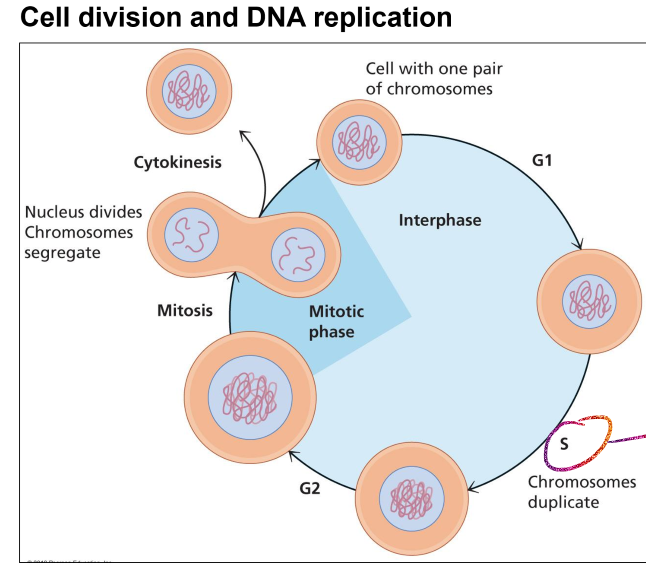
| Cell division and DNA Replication DNA replication occurs during the __ phase | S phase |
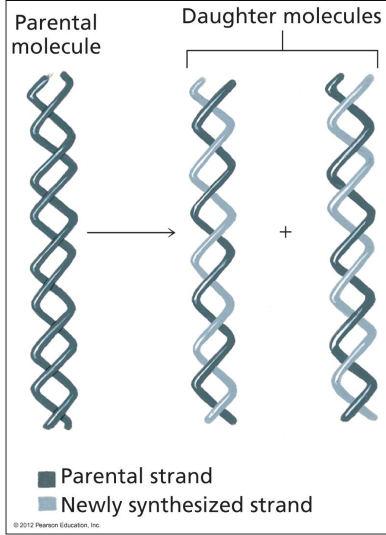
| DNA Replication is ____ Each strand of DNA acts as a ___ for the synthesis of a new strand. After replication, each daughter DNA molecule (duplex) contains one ___ and one ___ synthesized strand. This type of DNA synthesis is considered as ____. | semiconservative template parental newly semiconservative |
| DNA replication is ____ The E. coli chromosome is a circular double-stranded (4.6*10^6 DNA bp). The protein machine that carries out the replication is called ____. The replisome unwinds DNA at a unique site called ___, creates replication ___, and replicates DNA in BOTH directions. Each replication fork has one ___, and each parental strand serves as a ___ for the synthesis of a new strand. The replication speed by each replisome is estimated to be 1000 nucleotides/sec. Hence, the whole E. coli chromosome can be replicated in ~38 minutes. Origin (Ori) sequences are recognized by __ Termination occurs at the __ site which has sequences for the binding of a protein called termination utilization substance (__). | bidirectional replisome origin forks replisome template DnaA Ter Tus |
| DNA replication in eukaryotic chromosomes Eukaryotic chromosomes are linear, larger, and replication is initiated at ___ origins, but the movement is SLOWER. The slow speed is compensated by ___ initiation sites. | multiple multiple |
| DNA polymerases DNA polymerases catalyze DNA synthesis by the successive addition of nucleotides to the __-end. • In E. coli, there are THREE different DNA polymerases: DNA pol I — mainly in DNA ___ DNA pol Il — mainly in DNA ___ DNA pol Ill — major ___ enzyme DNA pol Ill contains 10 different ____ The holoenzyme is an asymmetric ___ There are two ___ complexes in the holoenzyme which are responsible for polymerization reactions. There are also two β-subunit complexes that form two ___ ___. But, there are single τ (Tau) and γ-complexes that function as a complex ___ and ___ ___, respectively. | 3'-end. repair repair replication subunits dimer core sliding clamps enhancer (Tau) clamp ladder (γ) |
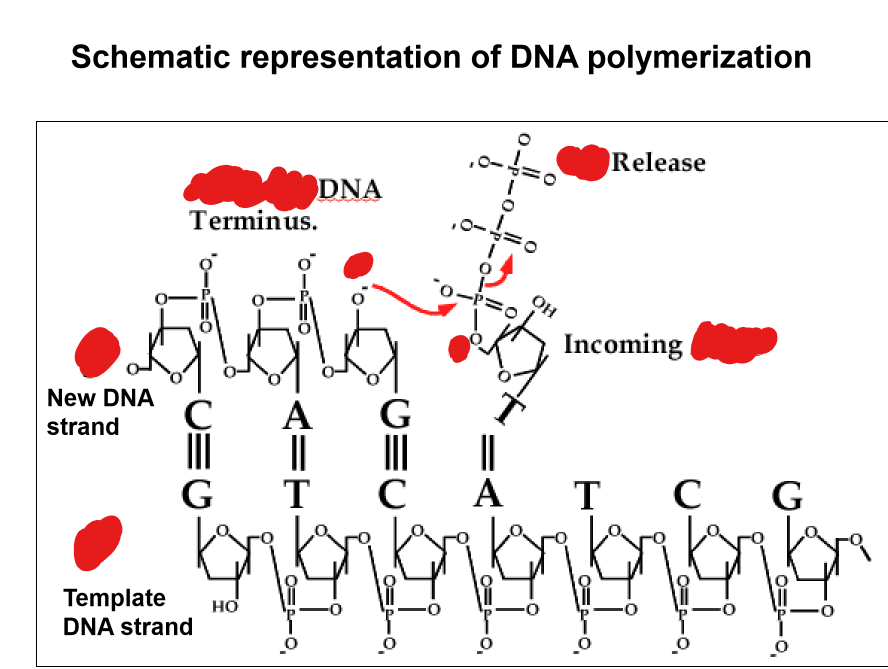
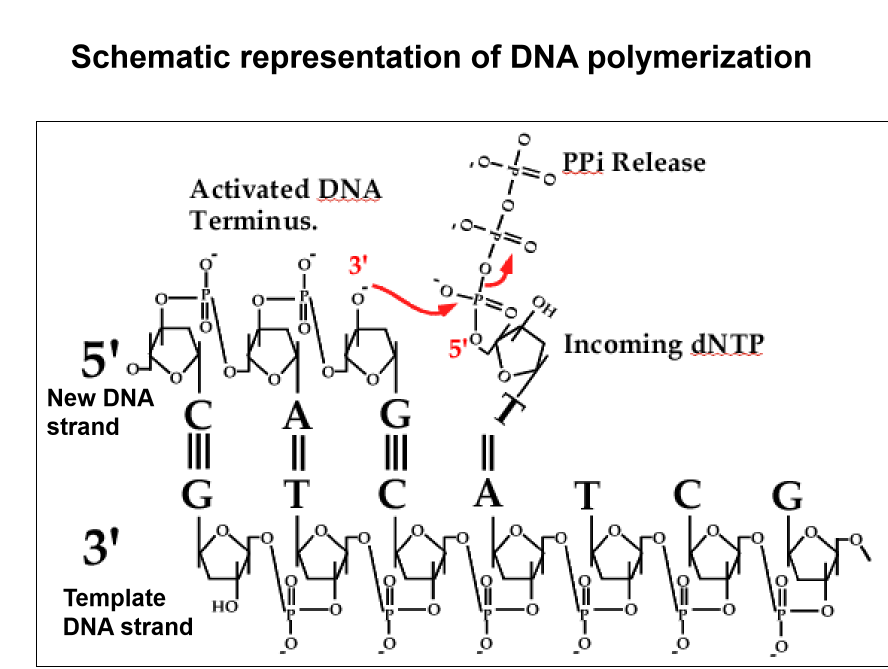
| Steps in DNA synthesis DNA is synthesized from dNTPs DNA synthesis proceeds in the _ direction. DNA pol Ill catalyzes the formation of a 3'-5' ___ bond. DNA polymerases cannot initiate chain synthesis de novo; they require a short RNA or DNA __ annealed to the template. First, the incoming dNTP base pairs with the complementary base in the template, and next the oxygen atom of the 3' hydroxyl group of the nascent chain makes a nucleophilic attack on the __-phosphorous atom of the incoming dNTP. This leads to the formation of a 3'-5' ___ bond. The cycle continues and DNA pol __ stays bound at the replication fork until completion. As the replisome slides by one residue, the __-end remains associated with the active site of the enzyme. DNA pol Ill also possesses a __-__ proofreading activity. The enzyme can recognize incorrect base pairing and distortion caused by a wrong nucleotide. It uses its ___ activity to remove the wrong nucleotide. | 5'->3' phosphodiester primer α phosphodiester Ill 3'-end 3'-5' exonuclease |
| Steps in DNA synthesis Continued... Replication errors can still be incorporated into genomic DNA particularly in ___ eukaryotes. The overall error rate is 10^-9, Hence in the human genome with 3.2*10^9 base pairs, a few errors can be incorporated each replication cycle. Other proteins important in DNA replication are DNA ___ (part of the replisome and unwind DNA), single-stranded binding proteins (SSBs), and ____ (relieve supercoiling induced by unwinding, NOT part of replisome). ___ binds to single-stranded DNA (mainly lagging strand) and prevents it from folding back and forming secondary structures. | higher helicases topoisomerases SSBs |
| Base pairing of incoming dNTP Activation of the O atom of the _-__. Nucleophilic attack on _-____ _-_ phosphodiester bond formation and chain elongation. DNA pol __ advances by one residue and the cycle continues. | 3'-OH α-Phosphate 3'-5' Ill |
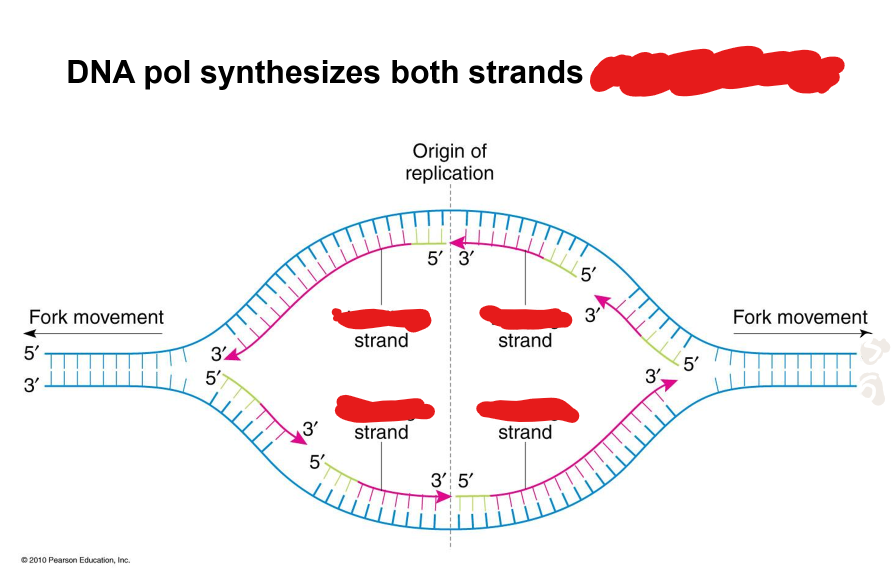
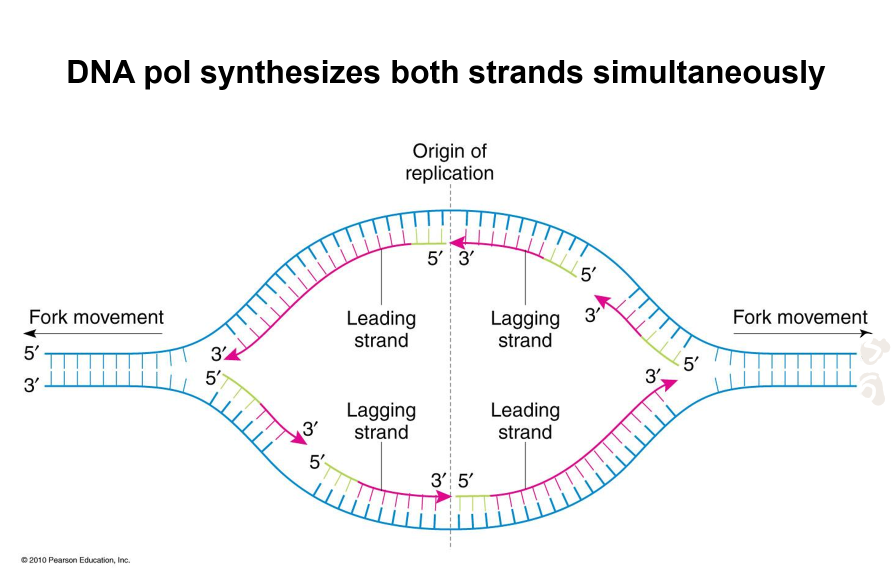
| DNA pol synthesizes both strands simultaneously Chain elongation by DNA polymerases is always in __-> __ direction. Due to the antiparallel structure of the duplex DNA molecule, the synthesis of new strands also proceeds in an ____ fashion. The new strand elongated in the same direction as the fork movement is called the ___ strand and the opposite is called the ____ strand. Since the pol Ill holoenzyme has two copies each of the core complex and the sliding clamp, it can synthesize ___ strands at the ___ time. While synthesis of the leading strand is ____, that of the lagging strand is ___. The overall synthesis is called semi-discontinuous. | 5'->3' antiparallel leading lagging both same continuous discontinuous |
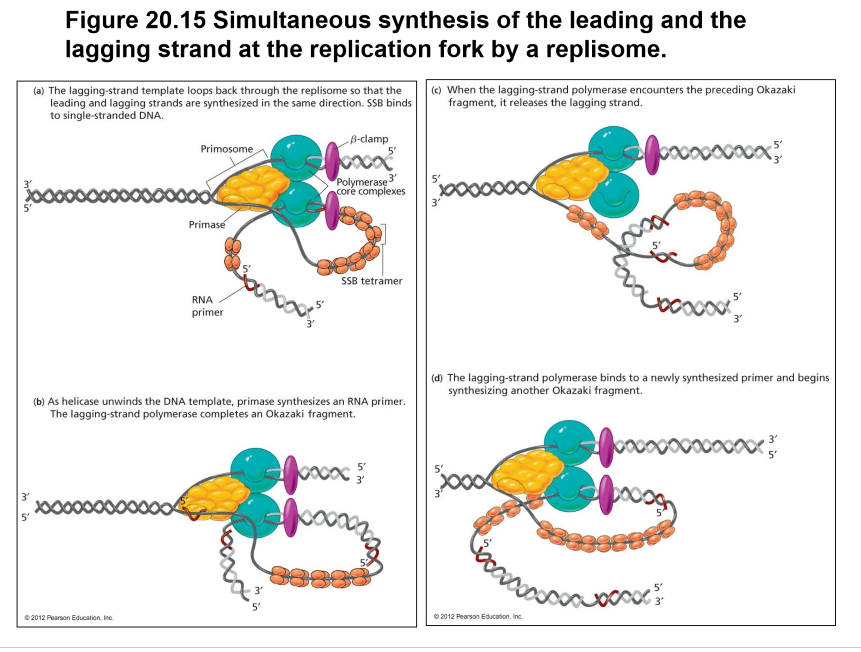
| DNA pol synthesizes both strands simultaneously Continued... Because fork movement (DNA unwinding) is opposite to the synthesis of the lagging strand, its synthesis requires frequent initiation as the single-stranded template becomes available. This is accomplished by making complementary short ___ ___ (by primases) at the replication fork, which is then extended by DNA pol Ill, leading to what is known as ___ ___ (DNA polymers with short RNA sequences). Okazaki fragments are joined by the actions of DNA pol __ and DNA ___. DNA pol __ has multiple activities, including 3'-5' proofreading, 5'-3' exonuclease to remove the RNA primers, and 5'-3' polymerase functions. DNA pol I without the 5'-3' exonuclease activity is called ____ ___ which is commonly used for sequencing and PCR reactions. Finally, the ___ joins the nick between the 3'-end and the next 5'-end | RNA primers Okazaki fragments I & ligase I Klenow fragment ligase |
| Figure 20.15 Simultaneous synthesis of the leading and the lagging strand at the replication fork by a replisome. | |
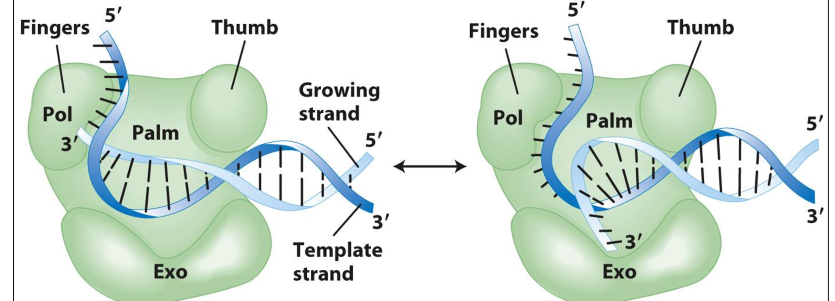
| Proofreading by DNA polymerase Ill • DNA polymerases have a 3D structure resembling a half-opened right hand. The "fingers" bind the single-stranded segment of the template strand, and the polymerase catalytic activity (PoI) lies in the junction between the fingers and palm. • Incorrect base addition at the 3' end causes ___ of the newly formed end of the duplex and polymerase pausing. • The growing strand 3' end is transferred to the _ -> _ ___ site (Exo) about 3 nm away, where the mispaired base and probably other bases are removed. • The 3' end flips back into the polymerase site and elongation resumes. | melting 3' -> 5' exonuclease |
| Mechanism of Okazaki Fragment Extension and Ligation Completion of Okazaki fragment synthesis leaves a ___ between the Okazaki fragment and the preceding RNA primer on the lagging strand. DNA pol __ extends the Okazaki fragment while its _->_ exonuclease activity removes the RNA primer. This process, called __ ___, results in movement of the nick along the lagging strand. DNA polymerase __ dissociates after extending the Okazaki fragment 10—12 nucleotides. DNA ___ binds to the nick DNA ligase catalyzes the formation of a ____ linkage, which seals the nick, creating a continuous lagging strand. The enzyme then dissociates from the DNA. | nick I 5'->3' nick translation I ligase phosphodiester |
| DNA replication in eukaryotes DNA replication is fundamentally the same in both prokaryotes and eukaryotes. There are a few exceptions: There are at least __ different DNA polymerases as opposed to three. ___ replication initiation sites and replication forks. ___ Okazaki fragments, but the mechanism of primer removal, gap extension, and ligation are very similar. Termination occurs when the polymerase reaches the end of the ___. Note that eukaryotic DNA is ___. Duplicated DNA becomes packaged into chromatin by binding to ___. | 5 Multiple Smaller template linear histones |
| Termination of DNA replication In E. coli that has ___ chromosome, initiation starts at __ (recognized by DnaA) and termination occurs at the __ site which has sequences for the binding of a protein called termination utilization substance (__). Tus prevents replication forks from passing through by ___ the replisome that includes DNA helicase. In eukaryotes, termination occurs when the polymerase reaches the end of the ___. Note that eukaryotic DNA is ___. | circular Ori Ter Tus inhibiting template linear |
Want to create your own Flashcards for free with GoConqr? Learn more.