
Flashcards
CompTIA Network+ Ch_4
Cards in this deck (48)
- 1What is the difference between an active and a passive hub?Hubs can be either active or passive. Hubs are considered active when they regenerate a signal before forwarding it to all the ports on the device.
- 2What is the major difference between a hub and a switch?Rather than forwarding data to all the connected ports, a switch forwards data only to the port on which the destination system is connected.
- 3What are the types of ports found on hubs and switches?Hubs and switches have two types of ports: Medium-Dependent Interface (MDI) and Medium-Dependent Interface Crossed (MDI-X).
- 4FirewallHardware or Software
Protects End-points (entry/exit points) of network.
Controls access.
Block network traffic.
Routers and WAPS sometimes have built-in firewalls - 5RouterSOHO - 1 to 10 users.
Routers normally create, add, or divide networks or network segments.
Network layer 3 - IP-based devices.
Route data from one network to another.
Reads the packet’s header to determine destination address.
Looks for address in routing table. - 6SwitchLike Hubs
Connectivity Points of Ethernet Network.
Twisted Pair cabling.
Forwards to port, using MAC address of device.
Full-Duplex. - 7Switch Methods*Cut-through
*Store-and-Forward
*Fragment-Free - 8Switch Methods Cut Throughthe packet is forwarded as soon as it is received.
No Error Checking - 9Switch Methods Store and Forwardthe entire packet is received and error-checked before forwarded.
Slower - 10Switch Methods Fragment-FreeCollision status determined, then forwarded.
- 11Hub CablingMedium Dependent Interface Crossed
(MDI-X)
Wires within connection are crossed.
Cross Over Cable.
(wires 1 an 3 crossed)
(wires 2 and 4 crossed)
Medium-Dependent Interface MDI port.
No need for signal to be crossed. - 12Hub LayerPhysical Layer 1
- 13Switch LayerData Link 2
or
Network Layer 3 - 14HUBPhysical Layer 1
Twisted Pair Cabling to connect devices.
Pathway for electric signals
Hubs can be joined to create larger networks.
Hubs direct data packets to all devices connected to it.
5-8 devices = workgroup hubs
<32 = high-density devices.
Active hubs regenerate signal and can buffer data. - 15BridgeBridge - Layer 1 and 2
Wireless Bridge - Data Link Layer 2
Sends data away from the network if it doesnt belong... to an alternative network. - 16Modemsmodulator/demodulator
converts digital signals into analog signals for phone lines.
Dial Up Internet - 17WAPWireless Access Point
Data Link Layer 2
Transeiver - Transmitter and Receiver
Create a WLAN
Some WAPs provide firewall and DHCP services.
A router is a switch, DHCP server, router and firewall. - 18Media ConverterWhen you have two dissimilar types of network media, a media converter is used to allow them to connect
AKA Couplers - 19Media Converter Examples*Single Mode Fiber to Ethernet
*Single Mode to Multimode Fiber
*Multimode fiber to Ethernet
*Fiber to Coaxial - 20Wireless Range ExtenderAKA Repeater or Booster
Amplifies wireless signals. - 21VoIP Endpointan endpoint is any final destination for a voice call. That final destination can be to a physical device (such as a p hysical telephone handset), a software application, or a server. Endpoints are used with the Session Initiation Protocol (SIP)
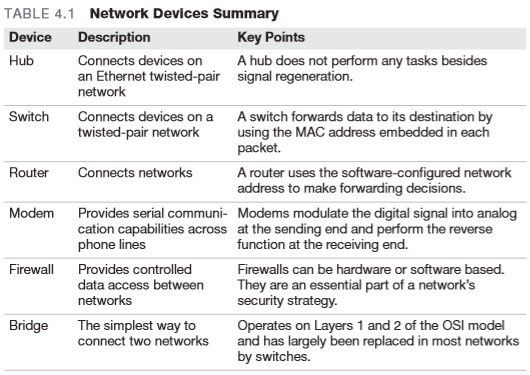
- 22Network Device Summary
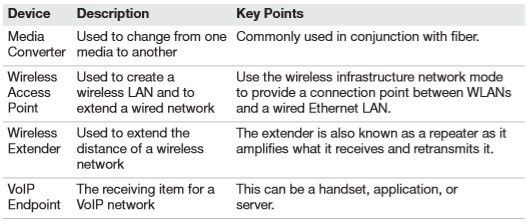
- 23Network Devices Continued
- 24Users are complaining that the network’s performance is unsatisfactory. It takes a long time to pull files from the server, and, under heavy loads, workstations can become disconnected from the server. The network is heavily used, and a new videoconferencing application is about to be installed. The network is a 1000BASE-T system created with Ethernet hubs. Which device are you most likely to install to alleviate the performance problems? ❍ A. Switch ❍ B. Router ❍ C. Media converter ❍ D. Firewall❍ A. Switch
- 25Which of the following devices forwards data packets to all connected ports? ❍ A. Router ❍ B. Switch ❍ C. Content filter ❍ D. Hub❍ D. Hub
- 26Which of the following devices passes data based on the MAC address? ❍ A. Hub ❍ B. Switch ❍ C. MSAU ❍ D. Router❍ B. Switch
- 27What can distribute incoming data to specific application servers and help distribute the load?A content switch can distribute incoming data to specific application servers and help distribute the load.
- 28True or false: A multilayer switch operates as both a router and a switch.True. A multilayer switch operates as both a router and a switch.
- 29Your company is looking to add a hardware device to the network that can increase redundancy and data availability as it increases performance by distributing the workload. What use case might this example technology apply to?A load balancer can be either a software or hardware component, and it increases redundancy and data availability as it increases performance by distributing the workload.
- 30Multilayer SwitchData Link Layer 2
Network Layer 3
Operates as both a router and a switch. - 31Content SwitchExamines the network data content and associated application forwards it related port.
Content Servers can help with Load Balancing
Can distribute incoming data to specific application servers and help distribute the load. - 32Wireless ControllerUsed with branch/remote office deployments for wireless authentication.
often used with VLAN pooling, in which multiple interfaces are treated as a single entity (usually for load balancing). - 33Load Balancer*workload is distributed among several
*increases network performance, reliability, and availability.
hardware device or software
Multilayer switches and DNS servers can serve as load balancers. - 34IDS/IPSIntrusion Detection System - Passive
Intrusion Prevention System - Active - 35IDS/IPS types*Behavior Based
*Signature Based
*Heuristic Based
*Network - NIDS or NIPs
*Host - HIDS or HIPS - 36Proxy ServerProxy servers typically are part of a firewall system.
a server that sits between a client computer and the Internet and looks at the web page requests the client sends.
Performs Caching of URLs.
Can disallow certain websites via ACLs - 37Reverse Proxy ServerResides near web servers and responds to requests.
Used for load balancing purposes
each proxy can cache information from servers. - 38VPN Concentrator*increases remote-access security
*add an additional level to VPN security
*sits between VPN Client and server.
*create the tunnel, authenticate users, encrypt the data, regulate the data transfer, and control traffic. - 39AAA/RADIUS ServerA protocol that enables a single server to become responsible for all remote-access authentication, authorization, and auditing (or accounting) services; this is referred to as AAA.
- 40UTM Appliances and NGFW/Layer 7 FirewallsUnified Threat Management
Next Generation Firewalls.
A firewall w/ additional functionality:
*Content Filtering *Signature Identification
*Virus Scanning Services *NAT
*URL Filtering *Bandwidth Mgt
UTMs can also be used as IDS/IPS, VPN,DLP, Load balancing, logging and monitoring - 41DLPData Loss Prevention
- 42VoIP PBX and GatewayWhen telephone technology is married with information technology, the result is called telephony.
having both data and VoIP on the same line, they are both vulnerable to attack.
VoIP Gateway or PBX gateway can convert legecy telephony connection and a VoIP connection using SIP (Session Initiation Protocol). This is referred to as a “digital gateway” because the voice media are converted in the process. - 43Content FilterBlock certain sites, such as Porn
The filter can be applied as software on client machines (known as client-side filters), on a proxy server on the network (a server-side filter), at the Internet service provider (ISP), or even within the search engine itself. - 44Which of the following can serve as load balancers? ❍ A. IDS and DNS servers ❍ B. Multilayer switches and IPS ❍ C. Multilayer switches and DNS servers ❍ D. VoIP PBXs and UTM appliances❍ C. Multilayer switches and DNS servers
- 45Which of the following is the best answer for a device that continually scans the network, looking for inappropriate activity? ❍ A. IPS ❍ B. NGFW ❍ C. VCPN ❍ D. AAA❍ A. IPS
- 46Which of the following is the best answer for any software that controls what a user is allowed to peruse and is most often associated with websites? ❍ A. IDS ❍ B. Proxy server ❍ C. RADIUS server ❍ D. Content filter❍ D. Content filter
- 47You are wanting to add a protocol to the network that enables a single server to become responsible for all remote-access authentication, authorization, and auditing (or accounting) services. Which use case is the best example of this? ❍ A. VPN ❍ B. RADIUS ❍ C. UTM ❍ D. VoIP❍ B. RADIUS
- 48—
Information
- Description
- CompTIA Network+ Flashcards on CompTIA Network+ Ch_4, created by Amber Saxon on 30/05/2020.
- Created by
- Amber Saxon
- Views
- 1
- Rating