
Flashcards
OCR Gateway Physics - P1
Cards in this deck (31)
- 1OCR Gateway Physics - P1_____________________________________________
- 2When a substance is heated...Its particles gain Kinetic Energy (KE)
- 3Temperature is a measure of...The average KE of particles in a substance. The hotter something is, the higher its temperature, and the higher the average KE of its particles.
- 4If there's a difference in temperature between two places...Then energy will flow between them.
- 5Specific Heat Capacity tells you...How much energy an object can store.
- 6When a substance is melting or boiling...The energy is being used for breaking intermolecular bonds rather than raising the temperature.
These are represented by flat spots on heating graphs. - 7Specific Latent heat is...The energy needed to change state without changing temperature.
E.g. The SLH of melting is the amount of energy needed to melt 1 kg of material without changing its temperature. - 8Conduction occurs mainly in solids because...The particles are tightly compacted together, meaning they can easily conduct energy. If they vibrate faster than others particles, they pass on their extra KE to neighbouring particles. This process continues throughout the solid and gradually the extra KE is spread throughout the solid, causing a rise in temperature.
- 9Conduction of heat is the process where...Vibrating particles pass on extra kinetic energy to neighbouring particles.
- 10Metals conduct heat really well because...Some of their electrons are free to move inside the metal. Heating makes the electrons move faster and collide with other free electrons, transferring energy.
- 11Most non-metals don't have free electrons so...They warm up more slowly, making them good insulators.
E.g. Saucepan handles - 12Convection only occurs in...Liquids and Gases
- 13Convection occurs when...the more energetic particles move from the hotter region to the cooler region - and take their heat energy with them.
- 14Convection can't happen in solids because...The particles can't move, they just vibrate on the spot.
- 15Radiation is different from conduction and convection in three ways:1. It doesn't need a medium to travel through, so it can occur in a vacuum.
2. It can only occur through transparent substances, like air glass and water.
3. The amount of radiation emitted or absorbed by an object depends to a large extent on its surface, colour and texture. - 16Grills heat food by...Infrared radiation. The heat is absorbed by the surface particles of the food, increasing their kinetic energy. The heat energy is then conducted or convected to more central parts.
- 17To cook food, microwave ovens use...Radiation. However, they use microwaves instead of infrared waves. Microwaves penetrate about 1 cm into the outer layer of the food where they're absorbed by water or fat molecules, increasing their KE. The energy is then conducted or convected to other parts.
- 18Things that emit energy are called...Sources
- 19Things that transfer and waster or lose energy are called...Sinks
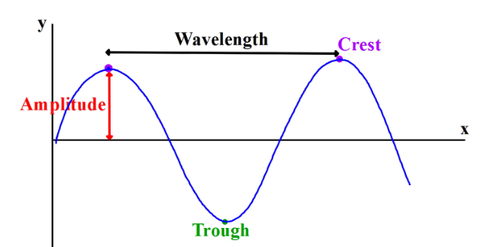
- 20Waves have three components:1. Amplitude (the displacement from the rest position to peak or trough).
2.Wavelength (the length of a full cycle of the wave. E.g. trough to trough).
3. Frequency (the number of complete cycles or oscillations passing a certain point per second). - 21Frequency is measured in...Hertz (Hz). 1 Hz is 1 wave per second.
- 22All waves can be... (3)1. Reflected
2. Refracted
3. Diffracted - 23Total Internal Reflection can only occur when...The light ray travels through a dense material such as glass, towards a less dense substance such as air. If the angle of incidence is big enough (bigger than the critical angle), the ray doesn't come out at all, but reflects back into the material.
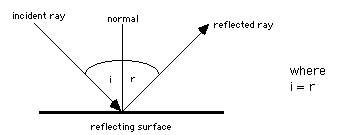
- 24Total Internal Reflection depends on...The Critical Angle
- 25Diffraction is...Waves spreading out
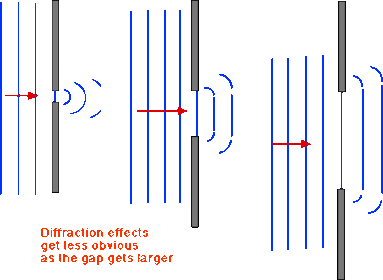
- 26Refraction is the principle that...Changing the speed of a wave can change its direction.
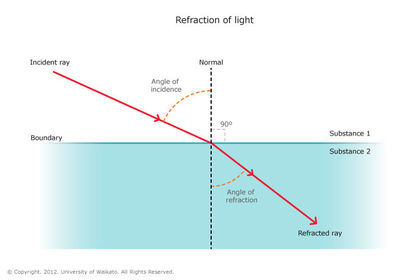
- 27There are seven types of EM waves, which way do you use to remember it?Raving - Radio Waves
Martians - Microwaves
Invade - Infra Red
Venus - Visible light
Using - Ultra Violet
X-ray
Guns - Gamma Rays - 28The properties of EM waves depend on... (2)Frequency & Wavelength
- 29Light signals can be sent through Fibre Optics by...Bouncing waves off the sides of a very narrow core, protected by outer cladding. The ray of light enters the fibre so that it hits the boundary between the core and the outer cladding at an angle greater than the critical angle for the material. This causes total internal reflection of the ray within the core.
- 30Advantages of Fibre Optics (3)1.Using light is a very quick way to communicate.
2. Multiplexing means that lots of different signals can be sent down a single optical fibre at the same time.
3. As a digital signal, there's little interference. - 31Lasers produce a...Narrow, intense beams of monochromatic light.
Information
- Description
- GCSE GCSE Flashcards on OCR Gateway Physics - P1, created by Rattan Bhorjee on 04/04/2015.
- Created by
- Rattan Bhorjee
- Views
- 366
- Tags
- Rating