
Flashcards
Movement Descriptions
Cards in this deck (56)
- 1Abductionlateral movement away from the midline of the body, along the lateral plane
(lateral dumbbell raises) - 2Adductionmovement medially towards the midline of the body, along the lateral plane
(lowering arms to side) - 3Flexionbending movement that results in (V) of angle in the joint by bringing bones together; usually in the sagittal plane
(elbow joint when hand is drawn to shoulder) - 4Extensionstraightening movement that results in (^) angle of the joint by bringing bones apart; usually in the sagittal plane
(elbow joint when hand moves away from shoulder) - 5Circumductioncircular movement of a limb that describes a cone or arc
(shoulder circle stretch) - 6Diagonal Abductionmovement by a limb through a diagonal plane away from the midline of the body
- 7Diagonal Adductionmovement by a limb through a diagonal plane towards and across the midline of the body
- 8External Rotationrotary movement around longitudinal axis of a bone away from the midline of the body
(occurs in transverse plane) - 9Internal Rotationrotary movement around longitudinal axis of a bone towards the midline of the body
(occurs in transverse plane) - 10Eversion (Ankle & Foot)turning sole of foot outward or laterally
(weight on inner edge) - 11Inversion (Ankle & Foot)turning sole of foot inward or medially
(weight on outer edge) - 12Dorsal Flexion (Ankle & Foot)flexion movement of ankle that results in top of the foot moving towards the shin
- 13Dorsal Extension (Ankle & Foot)extension movement of ankle that results in top of the foot moving away from the shin
- 14Pronationcombination of ankle dorsiflexion, subtalar eversion and forefoot abduction
- 15Supinationcombination of ankle plantar flexion, subtalar inversion and forefoot adduction
- 16Pronation (Radioulnar Joint)internally rotating radius where it lies diagonally across ulna, resulting in palm-down position of forearm
(from "down low" high five position, to "up high" high five position) - 17Supination (Radioulnar Joint)externally rotating radius where it lies parallel to ulna, resulting in palm up position
(from "up top" high five position, to "down low" high five position) - 18Depression (Shoulder Girdle)inferior movement of shoulder girdle
(return to normal position from shoulder shrug) - 19Elevation (Shoulder Girdle)superior movement of shoulder girdle
(shoulder shrug) - 20Protraction (Shoulder Girdle)forward movement of shoulder girdle away from the spine
(abduction of scapula)
(squeezing pecs) - 21Retraction (Shoulder Girdle)backward movement of shoulder girdle towards the spine
(adduction of scapula)
(unsqueezing pecs) - 22Rotation Downward (Shoulder Girdle)rotary movement of the scapula with inferior angle of scapula moving medially and downward
(return from front dumbbell raise) - 23Rotation Upward (Shoulder Girdle)rotary movement of the scapula with inferior angle moving laterally and upward
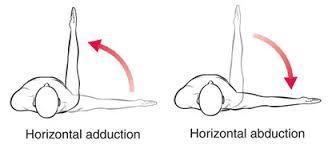
(front dumbbell raise) - 24Horizontal Abduction (Shoulder Girdle)movement of the humerus in horizontal plane away from the midline of the body
(aka: horizontal flexion or transverse abduction) - 25Horizontal Adduction (Shoulder Girdle)movement of humerus in horizontal plane towards the midline of the body
(aka: horizontal flexion or transverse adduction)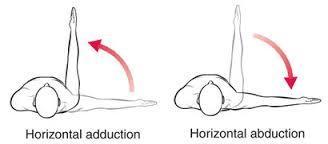
- 26Lateral Flexion (Side Bending) (Spine)movement of head and/or trunk laterally away from the midline of the body
(abduction of spine) - 27Reduction (Spine)return of spinal column to anatomical position from lateral flexion
(adduction of spine) - 28Palmar Flexion (Wrist & Hand)flexion movement of the wrist in the sagittal plane with dorsal side of wrist moving towards anterior side of forearm
(palm moves towards anterior side of forearm) - 29Dorsal Flexion (Dorsiflexion) (Wrist & Hand)extension movement of the wrist in the sagittal plane with dorsal or posterior side of wrist moving towards posterior side of the forearm
- 30Radial Flexion (Wrist & Hand)abduction movement at wrist of the thumb side of hand towards the forearm
- 31Ulnar Flexion (Wrist & Hand)adduction movement of wrist at the little finger side of the hand, towards the forearm
- 32Opposition of the Thumb (Wrist & Hand)diagonal movement of thumb across the palmar surface of the hand
- 33Reposition of the Thumb (Wrist & Hand)diagonal movement of thumb as it returns to the anatomical position from opposition of the thumb position
- 34Velocity a) definition b) equation c) unit of measurementa) the rate of change of displacement
b) Velocity = displacement/time
c) meters/sec (m/s) - 35Momentum a) definition b) equation c) unit of measurementa) quantity of motion by a moving body, product of mass and velocity
b) Momentum = mass x velocity
c) kilograms meters/second (kgm/s) - 36Acceleration a) definition b) equation c) unit of measurementa) the change in velocity
b) Acceleration = change in velocity/change in time
c) meters/second (m/s)^2 - 37Work a) definition b) equation c) unit of measurementa) a force acting upon an object to cause displacement
b) Work = force x displacement
(mass x acceleration) x displacement
(if not mentioned, acceleration is 9.8 m/s^2 a.k.a. gravity)
c) newtonmeters (nm) - 38Force a) definition b) equation c) unit of measurementa) any interaction causing an object with mass to change velocity
b) Force = mass x acceleration
c) Newtons (N) - 39Kinetic Energy a) definition b) equation c) unit of measurementa) the energy an object possesses as a result of it's motion; measure of an object's ability to do work
b) Kinetic Energy = 1/2(mass) x (velocity^2)
c) Joules (J) - 40Power a) definition b) equation c) unit of measurementa) the time it takes to move a load a certain distance
b) Absolute (Total) Power =
work/time
Relative Power =
absolute power/person's mass (kg)
c) Absolute Power >> Watts
Relative Power >> Watts/kg - 41Convert: Feet to MetersMeter = feet / 3.28
(3.28 feet in 1 meter) - 42Convert: Lbs to KilogramsKilogram = lbs / 2.20
(there are 2.20 lbs in 1 kilogram) - 43Frictionthe force that results from the resistance between the surfaces of two objects moving upon one another
- 44Coefficient of Frictionthe ratio between: forces needed to overcome the friction and the force holding the surfaces together
(force applied) over (force of object) - 45Levers Mechanical AdvantageMA = Resistance / Force
OR
MA = Length of Force Arm / Length of Resistance Arm - 46Torquethe turning effect of an eccentric force
(moment of force) - 47First Class Levers a) location of A/R/F b) produces balanced movement when.. c) produces powerful movement when... d) produces speed and range of motion when...a) Axis is located between the point of resistance & point of force application (RAF/FAR)
b) axis is equal distance from point "r" and point "f" (force arm and resistance arm are equal)
b) axis is close to point "r" (force arm is longer than resistance arm)
c) axis is close to point "f" (resistance arm is longer than force arm) - 48Force Arm a) definition b) relationship between length of force arm and torque c) relationship between length of force arm and leveragea) the distance between the point of force application and the axis
b) the longer the force arm, the more torque is produced
c) the longer the force arm, the greater the leverage - 49Second Class Levers a) definition/function b) location of R/A/F c) real world examplea) produces force movements, since large resistance can be moved by relatively small force
b) point "r" is located in between the axis and point "f" (ARF)
c) wheelbarrow - 50Third Class Levers a) definition/function b) location of R/A/F c) real world examplea) produces speed and range of motion movements (requires greater force to move smaller resistance)
b) point "f" is located between the axis and point "r"
c) example: rowing a boat via oar - 51Wheel & Axle Mechanical AdvantageMA = radius of wheel / radius of axle
- 52If a wheel has a 5 to 1 mechanical advantage over an axle, then...a) the wheel travels 5 times the distance as the axle (per revolution)
b) the wheel turns at a speed 5 times greater than the axle
c) both the wheel and axle make one full revolution at the same time - 53Pulleys a) function of single pulley b) function of compound pulleys c) mechanical advantagea) to change effective direction of the force application
b) to increase the mechanical advantage
c) each pulley has MA of 1
(ex: three pulley system has MA of 3) - 54Physical Skill Adaptations: Organic1) cardiovascular endurance
2) stamina
3) strength
4) flexibility - 55Physical Skill Adaptations: Neurological1) Coordination
2) Agility
3) Balance / Stability
4) Accuracy - 56Physical Skill Adaptations: Organic & Neurological1) Power
2) Speed