
Flashcards
Plastic Sample Questions
Cards in this deck (55)
- 1What is the major difference (property) between a thermoplastic and a thermoset?The way they respond to heat is different. Thermoplastics soften when heated and harden when cooled. (So they can be injected, or extruded). Thermosets form cross links - interconnections between polymer molecules. Heat degrades thermosets, and they cant be recycled
- 2Describe at least 4 key physical characteristics of an amorphous polymer and at least 4 key physical characteristics of a semi-crystalline polymer.Amorphous:
1. wide melting range
2. Low shrinkage after molding
3. Better impact
4. Can be transparent or water clear
5. moderate heat resistance
6. superior cosmetics
7. less waxy feel
8. prone to brittle failure
Crystalline:
1. defined melting point
2. high shrinkage and warpage
3. lower impact strength
4. high heat resistance but low heat deflection
5. usually opaque
6. good fatigue endurance
7. good lubricity
8. good chemical resistance
9. ability to flow in thin-walled sections - 3What's an example of a semi-crystalline commodity thermoplastic?Polyethylene (PE)
High Density Polyethylene (HDPE)
Low Density Polyehtylene (LDPE)
Polypropylene (PP) - 4List 3 examples each of an additive used in plastics.1. Colorants
2. UV Modifiers
3. Plasticizers (make things rubbery)
4. Impact modifiers
5. Flame retardants (electronics)
6. Anti-Statics
7. Foaming agents
8. Anti-bacterial
9. Fungicides
10. Scent capsules - 5List 2 examples of a structural reinforcement added to plastic materials before they are molded.1. glass fibers
2. Carbon fibers
3. metal fibers
4. aramid fibers
5. jute
6. polyester fibers - 6How is mold shrinkage expressed (how is it measured) and why should a designer consider mold shrinkage?ratio of expected reduction of plastic part dimension as part solidifies in the mold and cools vs original part. **Can be expressed in inches, cm, or %shrinkage
- 7What material is good for light pipes?PC
Polycarbonate - 8List 3 crystalline and 3 amorphous materials.Crystalline:
2. Nylon (PA)
3. Polyethylene (PE)
4. Polypropylene (PP)
5. (Co) Polyester (PET, PBT)
Amorphous:
1. ABS
2. Acrylic (PMMA)
3. Nylon
4. Polycarbonate (PC)
5. Polystyrene (PS)
6. Polyvinyl Chloride (PVC)
7. Cellulosics - 9What does the physical property "HDT" stand for and what does it mean to you as a designer?.Heat deflection temperature:
temp which a material deforms under specific load - starts loosing spec. properties - 10What material are coffee cup lids typically made from and why?Polystyrene - amorphous
-heat resistance and hardness
-easy to mold
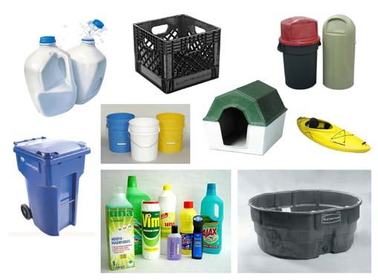
- can be recycled - 11Name the material (full name, no abbreviation) typically used for these products.HDPE
High density polyethylene - 12Name the material (full name, no abbreviation) typically used for these productsPolystyrene
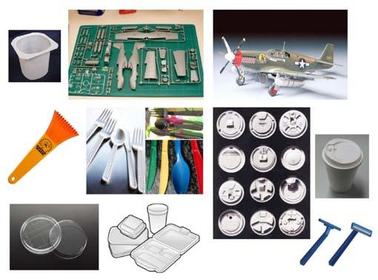
- 13Name the material (full name, no abbreviation) typically used for these products.polycarbonate
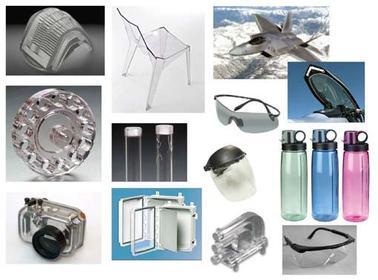
- 14List 5 key advantages and 3 disadvantages of thermoplastic injection molding (relative to other plastic molding processes).Advantages:
1. part complexity
2. in-line and side-core holes
3. fine detail
4. very small parts
5. molded-in threads
6. molded-in inserts
7. open hollow shapes
8. high volume production
9. control of wall thickness
10. great surface appearance
Disadvantages:
1. expensive equipment cost
2. expensive tooling
3. difficult undercuts
4. strength limited in weld lines
5. large parts not economically feasible
6. can't create closed hollow shapes - 15List the 4 distinct operations of the injection molding process. And for each operation, describe what's happening to plastic during that operation.1. melting the resin
--the extruder plasticizes the resin and accumulates it in the forward part of barrel. Heater bands maintain melt's temp as shot is built up
2. injection of the resin into closed mold
--valve opened, melt injected, air vented out thru holes for ejection pins and parting line, clamping system exerts opposing force to keep the mold closed
3. cooling the resin inside closed mold
--when cavity is filled, the part cools, extruder and clamping system push material into mold maintaining pressure until it cools (Freezes)
if accumulator is used, it can allow the extruder to recover for the next shot
4. opening mold and ejecting molded part
--when part has cooled enough, clamping system is released, injection valve is closed and the mold is opened.The moving platen moves backwards, away from extruder, with the molded part, ejector pins strike rear plate, ejecting the part and it either drops down or is removed by operator - 16Which of the 4 operations of injection molding takes the longest time?cooling
- 17What is the term "cycle time" refer to?the time it takes from when the mold closes to the time it opens
- 18Give at least 3 examples of activities/operations that the operator can perform within the cycle time?- spot checking molded parts for quality, color, accuracy
-basic trimming, clipping runners&gates
-drilling, cutting, routing
-placing parts in cooling fixtures
-applying labels / graphics
-adding screws / hardware
-product assembly
-wrapping / packaging for shipping
- coffee break - 19What are the two primary halves of the mold called that form the part?injection half of the mold (A plate)
ejector half of mold (B plate)
OR
cavity: generally the outside- more aesthetic (A)
core: generally the underside or back (B) - 20What is PMMA better known as?acrylic
- 21What created the marks on this part shown below?X: parting line from insert
Y: parting line from ejector pin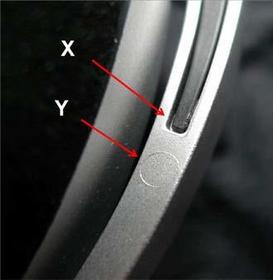
- 22List at least 4 factors that drive part design for injection molding.1. function of the part
2. assembly issues (how will it be put together?)
3. how much load will it experience?
4. materials
5. processing issues (how will it be molded?)
6. Keeping stress low
7. price & cycle time - 23Describe what the nominal wall is and list at least 3 reasons why it's the most important decision in plastic part design.Thickness of outside surface of the part, including the side walls
1.many other part detail rely on wall thickness
2.determines overall part strength
3.determines part weight
4.drives cycle time - 24On the illustration showing a part with a hole in the middle, there is a line shown. What does this line represent? What is it and why is it important?Weld line or knit line
- shows the direction of the flow of plastic
-the line appears where the melted plastic fronts met, but didn't join completely
-it can cause weakness in that location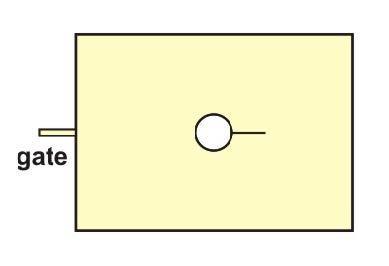
- 25Name the 10 of the 14 features identified in the illustration shown below.A. Parting Line
B. side action / undercut
C. A side (aesthetic)
D. Round
E. Fillet (or core out)
F. nominal wall thickness
G. Nominal wall with parallel draft
H. Undercut
I. Rib
J. snap or hook feature
K. shut off, bypass snap
L. Depth of draw
M. draft angle
N. Full round, safety edge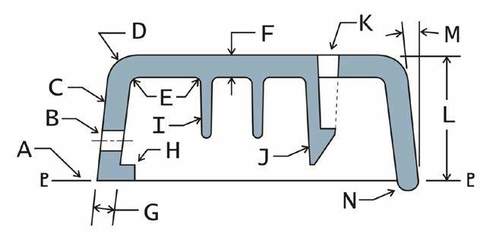
- 26What is the name for the defect shown in this injection molded part? What causes this defect?Sink mark
-caused by uneven wall thickness and cooling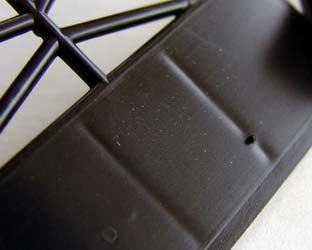
- 27Which is the best boss design shown below (A, B or C) and why?C. is better,
sink marks can occur on thick parts and this one doesn't have unequal thickness which prevents possible warpage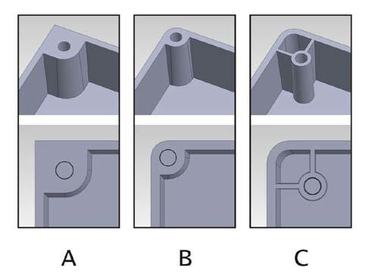
- 28What does the term "steel safe" mean? Why would you want to make a feature "steel safe?"Steel safe means you are
choosing to design your ribs thinner and shorter than you would normally.
Ribs and other features are designed to be smaller than you want in the end.
*In other words, its easier to cut into the mold and make things bigger if you need to *
** useful when creating critical fit between parts
**also money
subtractive processes are better than additive processes - cheaper this way - 29What are swimming pool plumbing components (the pipes, joints, valves, etc.) made of and why?PCV, polyvinyl chloride
It is chlorine resistant - 30In this illustration, there are two snaps A and B that are molded into a part. What can you tell me about the difference between snap A and snap B in terms of how they are molded?A. Snap hook, this needs a side action to mold
B. Shut off or bypass snap - it can be created using a normal mold without any side actions or undercuts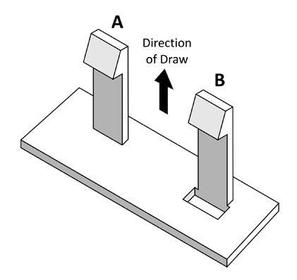
- 31Gas Assist Injection Molding and Low Pressure Structural Foam are two variants of High Pressure Injection Molding. What common key advantages over High Pressure Injection Molding do they both offer? List at least two, with one being the primary reason, the stating how they are different from each other.Both these processes can create large closed hollow parts while reducing stress and saving money.
They are different because gas assist can create truly hollow parts (injecting a bubble) and low pressure structural foam mixes air with plastic to create a foam inside. - 32What's the primary difference between the materials used for Low Pressure Structural Foam vs. Reaction Injection Molding (RIM)?Low Pressure Structural Foam: thermoplastics
Reaction Injection Molding (RIM): thermoset plastics - 33A mold using RTV (room temperature vulcanized silicone) for Reaction Injection Molding (RIM) molds allows you do something unique that you can't do with other mold materials. What is it?By using silicone as a mold, you are able to design a part with more complicated undercuts and side actions. The silicone is flexible so you are able to bend the mold to remove the part without damaging it.
- 34Adding a soft-touch elastomer grip to a rigid injection molded power drill housing is an example of what process?over molding
- 35Molding a metal screwdriver blade into the plastic screwdriver handle is an example of what process?insert molding
- 36If I want to mold a part that has an expensive virgin material with strict aesthetic requirements, what process can I use to fill the core of the nominal wall with less-expensive recycled material to reduce costs but maintain that quality look?co-injection process
-you shoot the expensive plastic on the outside and then shoot the inexpensive plastic in the inside of the mold - 37What are the 2 differences between plastic profile extrusion and pultrusion? (Hint: it has to do with the material.)Pultrusion uses thermoset plastic that has been impregnated with fiberglass. The plastic is then pulled through a die that has been heated.
In plastic profile extrusion, you can pretty much use any thermoplastic, which is then extruded through a die that has not been heated. - 38What does SMC and BMC stand for and what process are they used in?SMC: sheet molding compound
BMC: bulk (billet) molding compound
compression molding - 39What resin is used in fiberglass? It is a thermoplastic or a thermoset?Polyester
thermoset - 40What is the first coating applied to the mold if I want a smooth surface on the outside of a fiberglass part where I don't see the glass fibers?Gel coat
- 41What does RTM stand for? How does it work?Resin transfer molding
- A reinforcement is placed between two matching mold surfaces (male and female); the mold is then closed. The resin fills all voids in the mold
it is similar to fiberglass, except the thermoset resin is injected after the mold is closed. - 42Describe the rotomolding (rotational molding) process - there are 4 main steps.1. Put pellets of plastic / liquid plastic into the mold
2. Mold is heated and rotated
3. The mold is cooled and rotated
4. The part is removed from the mold - 43What's the primary difference between parts molded with Drape Forming (Male Mold Vacuum Forming) and Female Mold Vacuum Forming?Drape forming: the thickest part is at the top, where the plastic touches first
female mold vacuum forming: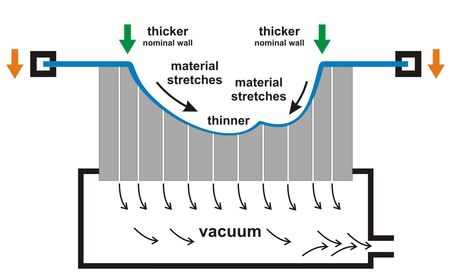
- 44What's an advantage and disadvantage of pressure forming over traditional vacuum forming?pressure forming is crisper and more professional, you get a more uniform wall
but it requires additional expertise and specific tooling- good for medical products (low production parts) - 45What's the difference between a parison and a preform in blow molding?parison:extruded plastic (like in the video) it is extruded within same cycle as part
preform blow molding: test tube with threads that is made before the part is extruded - 46What is Methylene Chloride used for when fabricating acrylic?solvent that can weld acrylic (and polycarbonate)
- 47Compare blow molding to other processes used to make large hollow parts. What are the other two primary candidates? Which process is best for molding parts with thick rugged outside corners? Why?Rotomolding, gas assist, twin sheet thermoforming
Rotomolding is best for thick rugged outside corners, because it can fill the corners completely which makes it stronger. - 48What plastic molding process is most similar to sheet metal bending? How does this process work?Plastic sheet bending
heats a wire or plate, you can use fixtures to make the process more precise - 49How is this plastic tool case made? (Hint: It is rugged and has double walls and a living hinge.)extrusion Blow molding HDPE (exception to the polypropylene living hinge)
gas assist cant do living hinge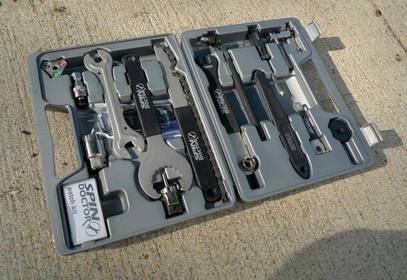
- 50(Part 1) Two different types of ladders ('A' and 'B') are shown in the images below. Describe how each is made. (Part 2) What are the advantages of one method over the other?A. extruded metal
B. Pultrusion plastic
B. is lighter and doesn't conduct electricity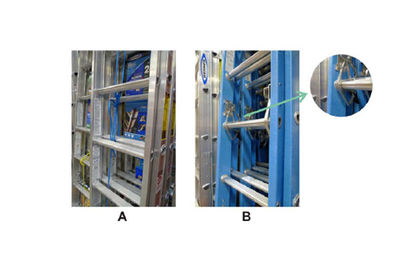
- 51This plastic storage shed is comprised of large, hollow panels. (Part 1) What primary material and process was used to make this shed? (Part 2) Why was this process used? What's a key drawback?HDPE, extruded blow molding
producing high quanitities
- 52These cylindrical plastic products are assembled using what process?spin welding, only for cylindrical objects
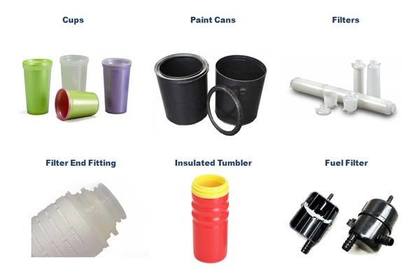
- 53What was used to hold in these metal contacts (see yellow arrows)?heat staking
aka ultrasonic staking
(alternative to welding when you are working with dissimilar materials which cannot be welded)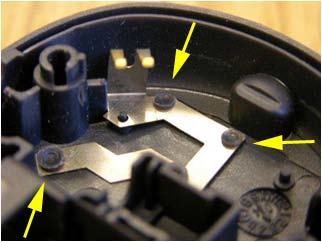
- 54What is this product? (I brought the upper half of it into class.) What material and process was used?rain barrel
rotomolded, bc large hollow enclosed part
hdpe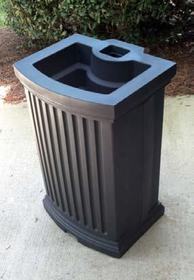
- 55What are the brass objects shown in this image? What are they used for? How are they installed into the plastic part?threaded inserts used to add threads to assemble with screws. Also for taking things apart, keeps threads intact rather than having threaded plastic
They are inserted using ultrasonic welding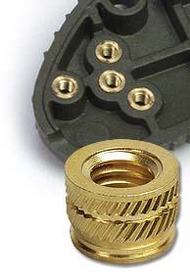
Information
- Description
- ID255 Plastic sample exam questions
- Created by
- wise.emilyj
- Views
- 142
- Tags
- Rating