
Flashcards
ML -RECAP
Cards in this deck (55)
- 1DEFINITION OF MACHINE LEARNINGthe use and development of machine systems that are able to learn and adapt without following explicit instructions, by using algorithms and statistical models to analyse and draw inferences from patterns in data.
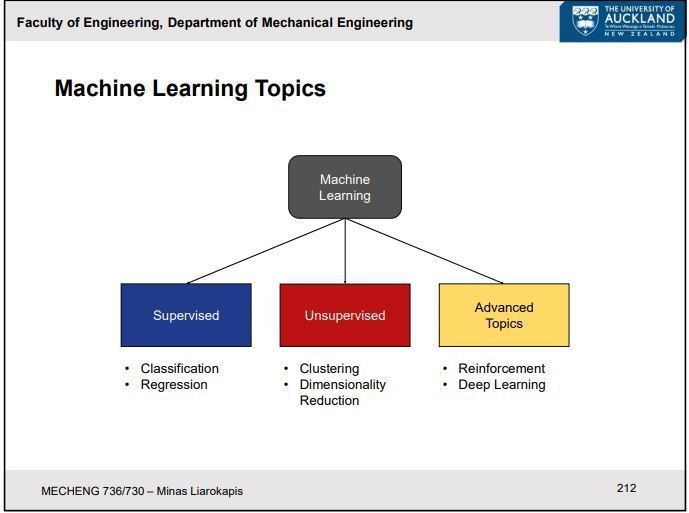
- 2Machine Learning Topics
- 3What is a manipulable grasp?Initial configuration - you need a pinch precesion grasp - can impart arbirtary velocities on the object without breaking contact. Must have freedom in dof for object to move.
Summary: So a grasp that facilitates the execution of manipulation tasks. - 4What is a Motor unit?A motor neuron and the 3 fibres it connects to.
- 5What HDM stands for in the context of manufacturing techniques and why it is useful?Explain that HDM focuses on multi-material parts. On how we can combine in molds rigid parts and silicon parts together.
Additive manufacturing techniques are used to print both permanent
components and sacrificial molds for deposited resins and inserted parts. - 6What is the difference between power and precision grasps?• Power grasps rely on form closure, precision or fingertip grasps rely on
force closure.
• A force-closure grasp completely restrains the object with the contact
forces.
• A form-closure grasp restrains the object geometrically (trapping it within
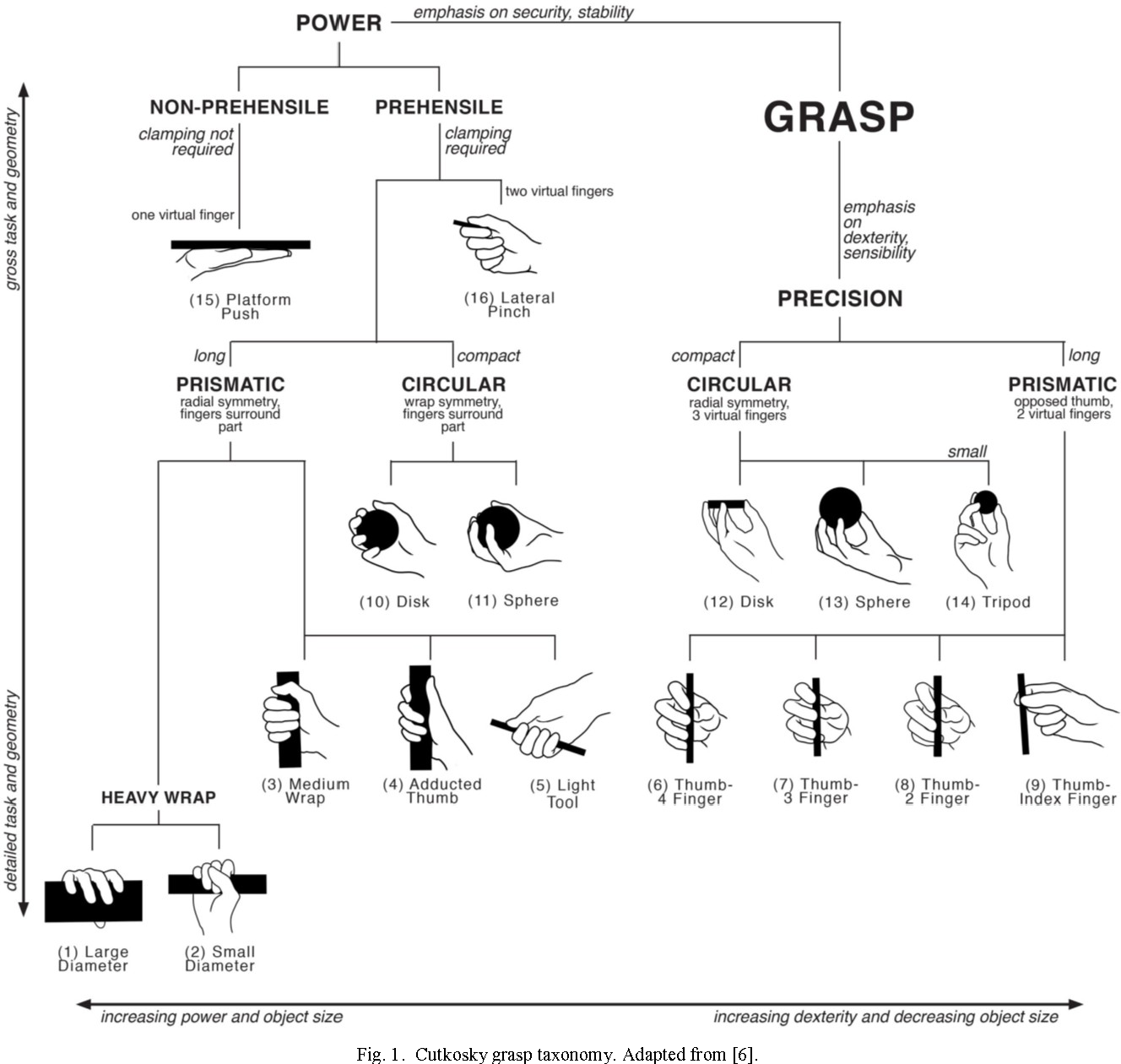
the hand structure). - 7Mention four types of power and precision grasps. -Examples. Types of grasps graphPrecesion - sphere, tripod, pinch, thumb and one,two three finger.
Power - lateral pinch, medium wrap, adducted thumb, light tool. Heavy wrap (large or small diameter). - 8Describe the following manipulation tasks: • Finger gaiting • Equilibrium point manipulation• • Equilibrium point manipulation
Equilibrium point manipulation can be executed starting with a two-fingered,
pinch, force closure grasp and relies on rolling contacts on the robotic
fingertips. Fingers grasp from one contact point to another. Draw example.
• Finger gaiting
Finger gaiting can be executed with at least four fingers/contact points starting with a pinch,
force closure grasp and employing grasping and regrasping strategies that
allow the fingers to gait on the object surface so as to reorient it. Finger
gaiting can also be executed with slipping contact. - 9What body parts have the most sensors?Fingers/hand, and head
- 10• What is proprioception?the sense of position of the limbs,
- 11kinesthesis, the sense of movement of
the limbs - 12• What are the different layers of the skin?The epidermis, the outermost layer of skin, provides a waterproof barrier and creates our skin tone.
The dermis, beneath the epidermis,
contains tough connective tissue, hair
follicles, and sweat glands.
The deeper subcutaneous tissue
(hypodermis) is made of fat and connective tissue. - 13Please define motor skill, fine motor skill and gross motor skill.“The ability to perform complex muscle-and-nerve acts that produce
movement; fine motor skills are small movements like writing and tying
shoes, gross motor skills are large movements like walking and kicking. - 14• What are the different phases of motor learning?Cognitive phase - When a learner is new to a specific task, the primary thought
process starts with, "What needs to be done?" Considerable cognitive activity is
required so that the learner can determine appropriate strategies to adequately reflect
the desired goal. Good strategies are retained and inefficient strategies are discarded.
The performance is greatly improved in a short amount of time.
Associative phase - The learner has determined the most-effective way to do the task
and starts to make subtle adjustments in performance. Improvements are more
gradual and movements become more consistent. This phase can last for a long time.
The skills in this phase are fluent, efficient, and aesthetically pleasing.
Autonomous phase - This phase may take several months to years to reach. The
phase is dubbed "autonomous" because the performer can now "automatically"
complete the task without having to pay any attention to performing it. Examples
include walking and talking or sight reading while doing simple arithmetic. - 15What are the different principles of motor skills?• Cephalocaudal – development from head to foot. The head develops earlier than the hand. Similarly, hand coordination develops before the coordination of the legs and feet.
• Proximodistal – movement of limbs that are closer to the body develop before the parts that are further away, such as a baby learns to control the upper arm before the hands or fingers. Fine movements of the fingers are the last to develop in the body.
• Gross to specific (fine) – a pattern in which larger muscle movements develop
before finer movements. For example, a child only being able to pick up large
objects, to then picking up an object that is small between the thumb and fingers. - 16ML defintionthe use and development of systems that are able to learn and adapt without following explicit instructions, by using algorithms and statistical models to analyse and draw inferences from patterns in data.
- 17What are the three main categories of Machine Learning that we discussed? What are two different types of supervised learning?
- 18What is a label?• A label is the thing we're predicting—the y variable in simple linear
regression.
• The label could be the future price of a stock, the person detected by a
mobile phone camera or the grasp that an amputee wants to execute with
a prosthetic hand. - 19What is a feature?• A feature is an input variable—the x variable in simple linear regression.
• A simple machine learning project might use a single feature, while a more
sophisticated machine learning project could use millions of features. - 20What is the difference between a classifier and a regressor?A regression model predicts continuous values. For example, regression
models make predictions that answer questions like the following:
• What will be the value of a house in California?
A classification model predicts discrete values. For example, classification
models make predictions that answer questions like the following:
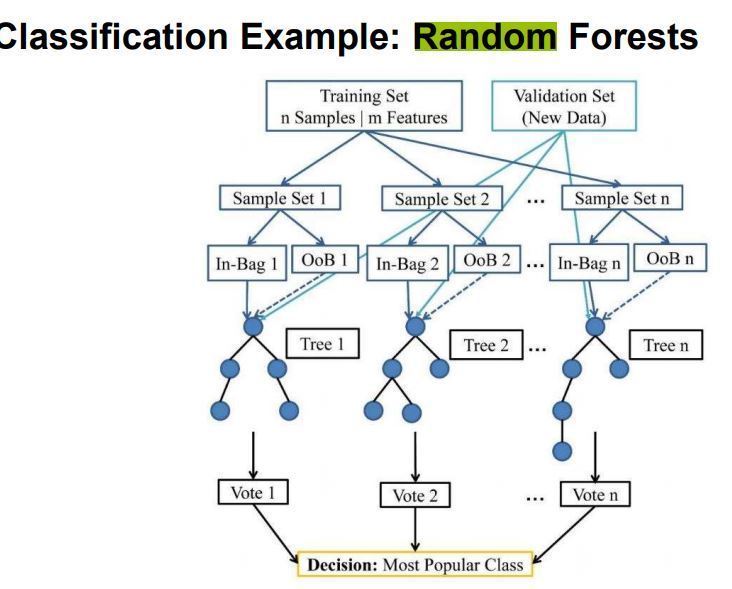
• Is a given email message spam or not spam? - 21• What is an ensemble classification method / ensemble classifier?• An ensemble of classifiers is a set of classifiers whose individual decisions
are combined in some way (weighted or unweighted voting) to classify new
examples.
• For example, the most common vote among the decisions of the individual
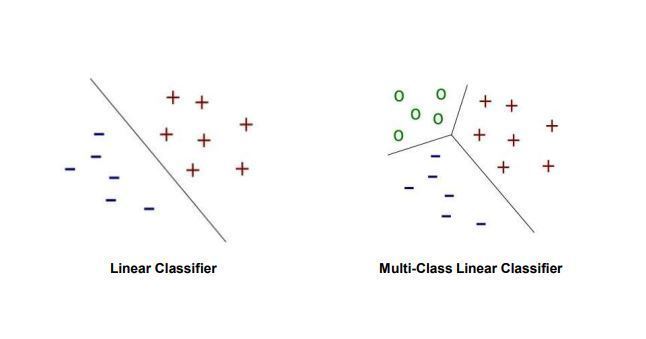
trees of a Fandom Forest classifier is provided as the output of the forest. - 22• Please draw an example of a linear classifier.
- 23Please draw an example of a Random Forests.
- 24• Please draw an example of a k-NN classifier.
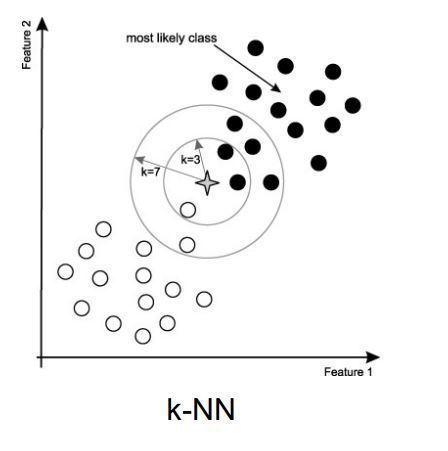
- 25What is a decision tree? How does it work?• A decision tree represents a function that takes as input a vector of feature values and returns a “decision” – a single output value.
• The input and the output values can be either discrete or continuous.
• A decision tree reaches a decision by performing a sequence of tests. Each internal node in the tree corresponds to a test of the value of one of the input feature variables.
• Each leaf node in the tree specifies a value to be returned by the function. - 26• What is an artificial neural network? How does it work?• An artificial neuron network (ANN) is a computational model based on
the structure and functions of biological neural networks. Information that
flows through the network affects the structure of the ANN because a
neural network changes - or learns, in a sense - based on that input and
output.
• ANNs are nonlinear statistical data modeling tools where the complex
relationships between inputs and outputs are modeled and data patterns
are found. - 27• Please draw the structure of an artificial neural network and name the different parts
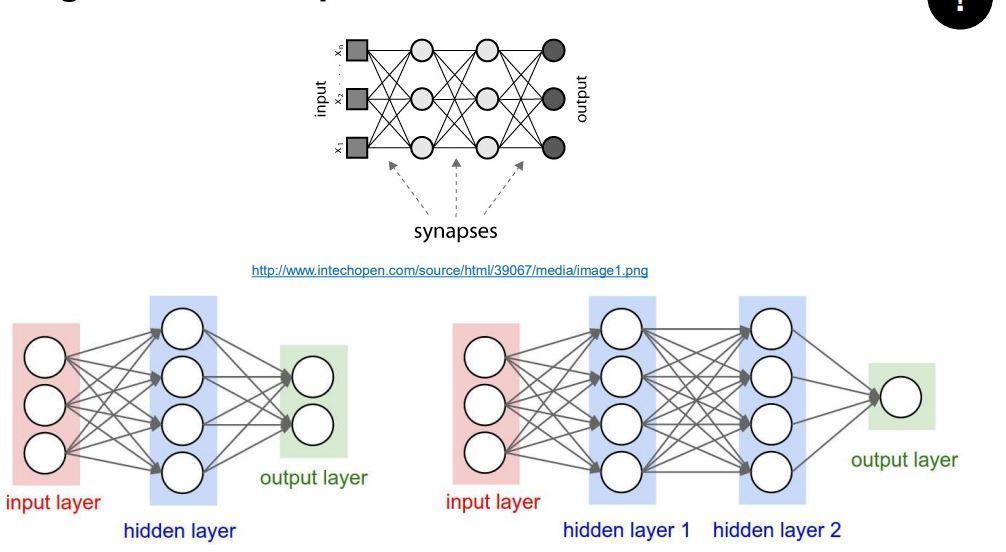
- 28• What is overfitting? • What is a preventative measure against overfitting?• A model that has learned the noise
instead of the signal is considered
“overfit” because it fits the training data
but has poor fit with new data. - 29Preventative measure against overfitting?K-fold Cross Validation
• Cross-validation is a powerful preventative measure against overfitting.
• The idea is clever: Use your initial training data to generate multiple mini
train-test splits. Use these splits to tune your model.
• In standard k-fold cross-validation, we partition the data into k subsets,
called folds. Then, we iteratively train the algorithm on k-1 folds while using
the remaining fold as the test set (called the “holdout fold”). - 30Draw K-fold cross validation
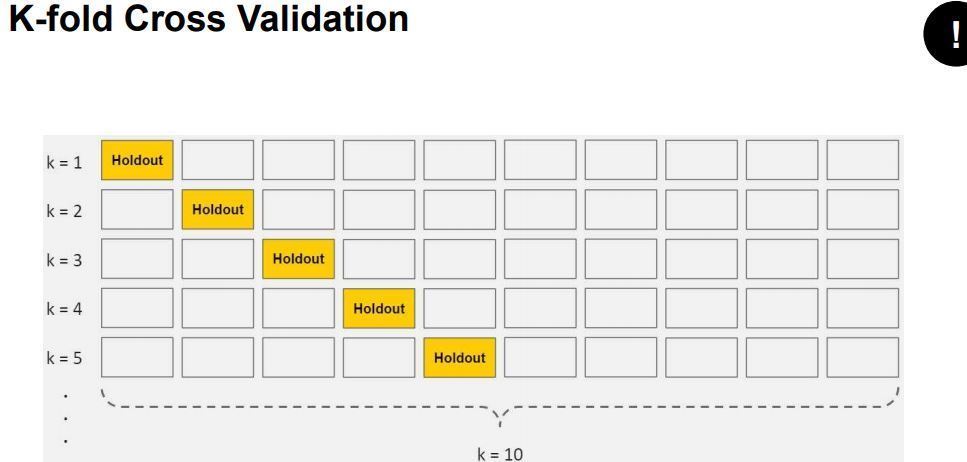
- 31• What is K-Means (clustering0? • How does it work?K-means
stores k centroids that it uses to define clusters. A point is considered to be
in a particular cluster if it is closer to that cluster's centroid than any other centroid.
• K-Means finds the best centroids by alternating between:
1) assigning data points to clusters based on the current centroids
2) choosing centroids (points which are the center of a cluster) based
on the current assignment of data points to clusters. - 32Please draw an example of K-Means clustering.
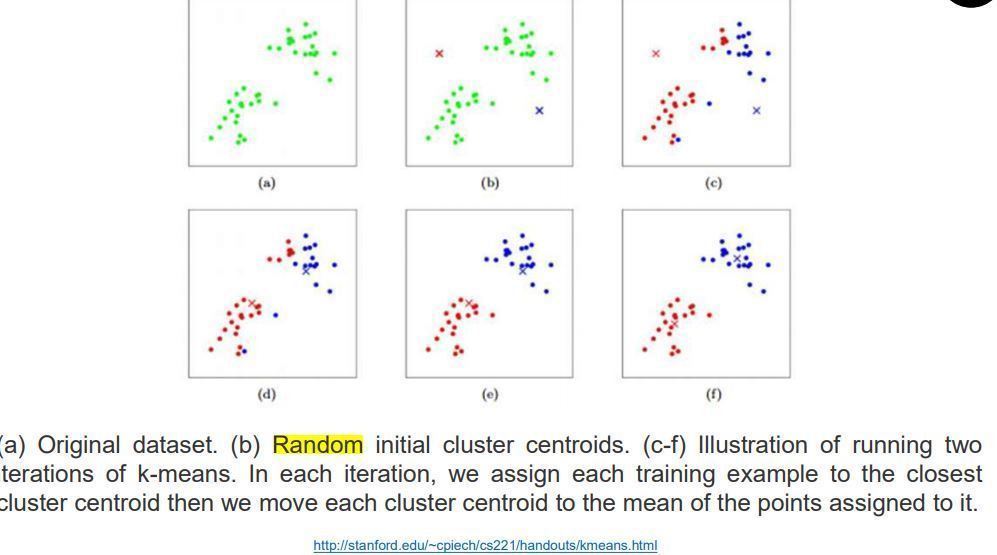
- 33Differences between the 4 mechanoreceptors.-Their location.
-Their speed of apaption to stimulation.
-Size of receptive fields.
-Types of mechnical stimulation they respond to. - 34Adaptive hands definitionAdaptive hands reconfigure to an equilibrium configuration.
The equilibrium configuration deprends on the characterstics of the fingers (such as joint stiffness, link length, force exerted, object weight and size). - 35Details, adv and disadv of sEMG, Pressure sensors and ultrasound.sEmg -> Excellent wearability but poor cost and stability.
Pressure -> Uses force-sensing to detect deformation of the skin caused by muscle movement.
-> All around good with excellent wearability and cost.
Ultrasound-> All around bad, especially as muscle movement changes unltrasound image. - 36Force Myography (FMGforce resisting sensors surrounding a limb to register the volumetric changes of the underlying musculotendinous complex during muscle activities
- 37Electromechnical delay and benefit?Electrical event preceds mechnical event by 50-150ms.
This delay can be useful in desinging real-tme muscle machine interfaces (e.g prosthesis) as signal processing and predictions can be computed within this delay for real-time responses (finger movement). - 38What is a motor neuron, what are the two types.Motor Neuron: A cell of the CNS which trasmits signals to muscle cells or glands to control their functional output.
Upper motor neurons extend from the cerebral cortex or brainstem to synapse with lower motor neruons.
Lower motor neurons carry signals from the upper motor neurons to the effectors (muscles). - 39What is feature extraction , and what are it's benefits?A feature is an input variable. FE: Selects a subset of input varaible information (susualy domain dependent) from the input data to use for as inputs to machine learning models during training and testing. OR: Reduces the data from a high dimensional space to a lower dimensionall space.(Example is PCA)
Adv: ->Simplifies models
-> Shorter training time (less computationally expensive)
'-> Reduces dimensionality of input data, likley improving accuracy. - 40Unsupervised learningThe process of inferring a function to describe the hidden structure of 'unlabelled data'
- 41ClusteringGrouping data points such that each point is more similar to other points in the group than to other groups.
- 42What are stiff/rigid and compliant actuators?Stiff/rigid -> Moves to a specefic position and will try and remian in that position regardless of any external forces.
Complaint actuator: Allows deviations from its equilibrium position, based on applied external forces. - 43Active vs Passive compliance?Active: Use a stiff actuator and a control system to be compliant.
Passive: Actuators that are either naturally compliant or contain an elastic element.
-> Passive actuators are because if a activley compliant actuator fails it loses compliance. - 44Difference between a power and precesion grasp?Power grasps rely on form closure whereas precision grasps rely on force closure.
- 45Ensemble method?-> A set of classifiers make decesions about the class/value of a data point and the indidivdual classifiers decesions are combined in some way (and can be weighted).
-> I.e the most common vote out of multiple random forest classifiers selected during classification. - 46How do decesion trees work?-> They reach a decesion by performing a series of tests . Each node corresponds to one of those tests which evaluate the input data.
-> Each leaf nodes in the tree specefies a value to be returned. - 47What is a manipulable grasp?Can impart arbitary velocities on an object without breaking contact.
Facilitates the exertion of dextorous manipulation tasks. - 48What are adaptive hands?Hands which can perform both caging/full grasps and precision/pinch grasps.
- 49Force vs form closure?Force closure-> Fingers resist motion of object though a set of contact forces.
-> Possible with fewer contacts- thus suitable for precesion grasps
Form closure - > Location of contact points ensures an objects immobility.
0> The stronger grasp; mainly used with power grasps. - 50"Robotics" DefinitionThe branch of techniques that deals with the design, construction , operation and application of robots.
- 51What is the reachable and dextorous workspace?Reachable -> The space which the manipulator can reach.
Dexterous -> The subset of the reacheable workspace which the manipulator can move with every degress of freedom (DOF) - 52Dexeterity definitionSkill in performing tasks, especially within the hands.
- 53Biomimetism vs bioinspiration?Biomimestism -> Attempts to reproduce or 'mimic' part of the biological system.
Bioinspiration -> Captures ideas from biological systems and uses the same idea to implement technology. - 54Extrinsic vs intrinsic dexterity?Intensive: The ability of the hand to manipulate an object with the fingers.
Extrinsic: The ability of a hand to manipulate an object whilst (explaninting?) the enviroment? - 55—
Information
- Description
- Flashcards on ML -RECAP, created by Amber Turner on 09/11/2020.
- Created by
- Amber Turner
- Views
- 0
- Rating