
2797683


| Question | Answer |
| Unit for acceleration? | |
| Speed = | Distance / Time |
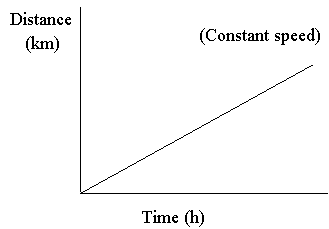
| How do you find speed from a distance-time graph? | Gradient of the line |
| Constant speed on distance-time graph | |
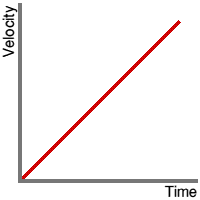
| Gradient of velocity-time graph = | ACCELERATION |
| Area of velocity time graph = | DISTANCE TRAVELLED |
| Constant acceleration on velocity-time graph | |
| Newton's 1st law | Every object will remain at rest or in uniform motion in a straight line unless acted upon by an external force. |
| Newton's 2nd law | The acceleration of an object is produced by a resultant force and is directly proportional to the magnitude of the resultant force, in the same direction as the net force, and inversely proportional to the mass of the object. F = ma |
| Newton's 3rd law | For every action, there is an equal and opposite reaction. |
| work done | force acting x distance moved in the DIRECTION OF THE FORCE |
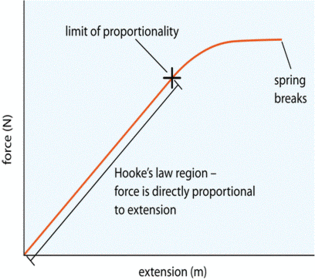
| Hooke's law | The extension of a material is proportional to the force applied to the object UP TO the ELASTIC limit of the material |
| Hooke's law formula | F = ke |
| Hooke's law graph | spring constant, k = gradient of STRAIGHT LINE |
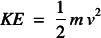
| Kinetic Energy formula | |
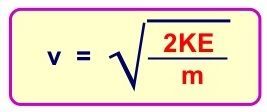
| Find velocity using Kinetic Energy | |
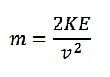
| Find mass from Kinetic Energy | Don't forget to SQUARE the VELOCITY |
| When objects fall...... | Kinetic Energy gained = GPE lost |
| GPE = | mass x gravitational field strength x height m x g x h On earth: g = 10 N / kg |
| Momentum is..... | the product of the mass and velocity of an object. how hard it is to make a moving object change velocity. |
| Momentum formula | p = mv |
| Momentum unit | kgm/s |
| Principle of conservation of momentum | momentum before collision/explosion = momentum after UNLESS objects are acted upon by an EXTERNAL force |

Want to create your own Flashcards for free with GoConqr? Learn more.